


 Aperçu en situation
 Partager
 Partager
 Détails
 Guide imprimable

 Télécharger
 Articles similaires
 Radiographie
 Voir le diaporama
 Statistiques
Back Garden
 Impressionism
 40.0 x 50.0 cm
Discover "Back Garden" by hilda wardlow woledge – an evocative impressionist oil painting of a rural cottage & garden. Explore its muted tones, textured brushwork & serene beauty. Perfect for art lovers!
Explore the evocative landscapes & still lifes of Hilda Wardlow-Wodledge. Known for her Yorkshire scenes & detailed observations, capturing light & texture in a unique style.
 Afficher la suite
L’œuvre d'art présentée sur cette page est protégée par le droit d'auteur, ce qui signifie que nous ne pouvons légalement créer ou vendre de reproduction identique. Cette protection est appliquée en vertu d'accords internationaux tels que la Convention de Berne et par les lois nationales, notamment celles énoncées par le Loi américaine sur le droit d'auteur - Titre 17.
Cette méthode est pleinement conforme aux réglementations sur le droit d'auteur car elle ne repose pas sur la copie ou la duplication de l'œuvre protégée. Il s'agit plutôt d'une réinterprétation créative — une nouvelle peinture qui s'inspire de l'original sans pour autant lui être identique.
Giclées et impressions d'art
Impressions giclées ou sur toile de qualité musée, avec une production rapide et des finitions au choix. ( Acheter la peinture faite à la main Passer au format image numérique)




































Format standard
personnalisé
CM
INCH
Choisissez parmi nos formats prédéfinis qui respectent les proportions originales de l’œuvre.
Loading sizes...

largeur
hauteur
Saisissez la largeur et la hauteur souhaitées pour qu'elles s'adaptent à votre cadre ou à votre mur. Une impression ne peut être que découpée, elle ne peut jamais être agrandie au-delà de l'image originale ; ainsi, un format de forme différente entraînera la perte d'une partie de l'image. Nous vous envoyons une maquette numérique pour approbation avant toute impression. L'image présentée sur cette page ne montre pas le recadrage réel — seule la maquette le permet.
Livraison dans le monde entier () en 2 semaines au lieu des 4/5 semaines habituelles. (22 octobre)

Livraison express gratuite dans le monde entier

Toile de lin de haute qualité

Assurance transport complète

Garantie de remboursement des droits de douane

Garantie de fidélité des couleurs

Garantie de retour de 100 jours (uniquement en cas de défaut)

Garantie de remboursement à 100%

Tarifs dégressifs sur quantité
 L'option verre n'est disponible que pour les dimensions inférieures à 110 cm.

Back Garden
Giclées et impressions d'art
Format de la reproduction
-


Prix total final
€ 61
Œuvres similaires


Biographie de l'artiste
Hilda Wardlow-Wodledge: A Yorkshire Visionary
Hilda Wardlow-Wodledge (1892–1985) remains a quietly significant figure in British art, particularly within the realm of landscape painting. Often overlooked amidst the more celebrated names of her era, her work possesses a unique charm and observational acuity that reveals a deep connection to the Yorkshire countryside – a region she consistently depicted with remarkable detail and a subtle, almost melancholic beauty. Born Hilda Wardlow in 1892 in Leeds, West Yorkshire, her artistic journey began modestly, influenced initially by the local art school and a growing appreciation for the Impressionist movement.
Early influences included the works of Constable and Turner, artists who demonstrated a masterful ability to capture light and atmosphere. However, Wardlow-Wodledge developed her own distinct style, characterized by meticulous observation and a restrained palette. She wasn’t interested in grand romantic vistas; instead, she focused on intimate scenes – quiet gardens, humble cottages nestled amongst rolling hills, and the subtle shifts of light across fields and streams. Her paintings are imbued with a sense of stillness and contemplation, inviting the viewer to share in her quiet appreciation for the natural world.
The Yorkshire Landscape: A Personal Revelation
Yorkshire became the central subject of Wardlow-Wodledge’s artistic life. She spent much of her adult life residing in and around the region, absorbing its rhythms and textures with an almost reverent eye. Her work is not simply a representation of the landscape; it's a deeply personal response to it – a series of intimate dialogues between herself and the land. She meticulously documented the changing seasons, capturing the golden hues of autumn, the misty greys of winter, and the vibrant greens of spring. The artist’s choice of subjects often reflected her own modest lifestyle, depicting scenes of rural life that resonated with her values.
A pivotal aspect of her work is her attention to detail. Wardlow-Wodledge wasn't content with broad strokes; she painstakingly rendered individual blades of grass, the weathered surfaces of stone walls, and the delicate patterns of wildflowers. This level of precision lends a remarkable sense of realism to her paintings, yet it never feels overly literal. Instead, it serves to heighten our awareness of the beauty and complexity of the natural world.
Technique and Style: A Quiet Intensity
Wardlow-Wodledge’s technique is characterized by a delicate balance between observation and interpretation. She employed a muted color palette – predominantly browns, greens, greys, and ochres – to create a sense of atmospheric depth and tranquility. Her brushwork is generally smooth and understated, avoiding dramatic gestures or bold contrasts. However, within this apparent restraint lies a remarkable intensity of feeling. She utilized layering techniques to build up texture and suggest form, creating surfaces that shimmer with reflected light.
Her later work began to incorporate elements of abstraction, particularly in her depictions of West Burton, Yorkshire. While retaining the fundamental characteristics of her landscape style – the meticulous observation, the muted palette, and the sense of quiet contemplation – these paintings moved towards a more expressive and dynamic approach. The layering of textures and the manipulation of color created a visual richness that was both captivating and unsettling.
Legacy and Recognition
Despite not achieving widespread fame during her lifetime, Hilda Wardlow-Wodledge’s work has gained increasing recognition in recent years. Her paintings are now held in several public collections, including the University of Hull Art Collection, and are exhibited regularly at galleries across the UK. Her unique vision – a quiet, intimate portrayal of the Yorkshire landscape – offers a valuable counterpoint to more overtly dramatic or romantic styles of painting.
Wardlow-Wodledge’s legacy lies not in grand pronouncements or revolutionary innovations, but in her unwavering dedication to observation and her ability to capture the subtle beauty of the everyday world. She reminds us that art can be found in the simplest of things – a patch of wildflowers, a weathered stone wall, or the quiet stillness of a Yorkshire afternoon.

En bref
- Artistic Movement Or Style: Impressionism, Landscape
- Artists Or Movements Influenced By This Artist: ['Contemporary British']
- Artists Who Influenced This Artist:
- Turner
- Cottage Painters
- Date Of Death: 1985
- Full Name: Hilda Wardlow-Wodledge
- Nationality: British
- Notable Artworks:
- Back Garden
- West Burton, Yorkshire
- Fruit and Flowers
- Place Of Birth: Yorkshire, UK
Articles connexes

The Timeless Charm of Oil on Board: Reimagining Texture and Light through the Impressionist Lens
Discover the profound intimacy of oil on panel. Explore how Impressionist masters used rigid supports to capture light, texture, and impasto depth through exquisite, handmade oil reproductions for discerning collectors.
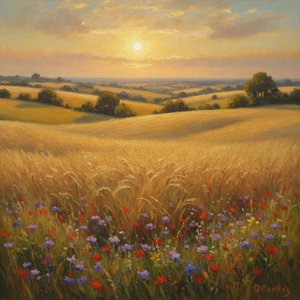
Golden Fields & Sun-Drenched Meadows: Capturing the Soul of Impressionist Landscapes
Immerse yourself in the luminous world of Impressionist landscapes. Discover how masters like Monet and Gauguin captured ephemeral light through plein air painting, and learn to bring the soul of sun-drenched meadows into your home with exquisite, hand-painted oil reproductions.

Beyond the Light: Capturing Raw Emotion and Subjective Vision in Post-Impressionist Landscapes
Explore the profound emotional depth of Post-Impressionist landscapes. Discover how masters like Van Gogh moved beyond light to capture raw human feeling through vibrant color and expressive texture in this expert art history retrospective.

The Beauty of Impermanence: Capturing Decay through Impressionist Eyes
Explore the profound beauty of impermanence through Impressionist and Post-Impressionist eyes. Discover how masters like Monet and Van Gogh captured fleeting light and the poetic essence of nature's transitions in our deep dive into art history and emotional landscapes.

Capturing the Soul: The Most Emotionally Moving Impressionist and Post-Impressionist Masterpieces
Discover the profound emotional depth of Impressionist and Post-Impressionist masterpieces. Explore how legends like Monet, Van Gogh, and Gauguin captured light and soul through evocative landscapes and vibrant brushwork for a timeless connection to art history.