


 Aperçu en situation
 Envoyer
 Partager
 Détails de l'œuvre
 Guide
Guide

 Télécharger l'image
 Articles similaires
 Radiographie
 Diaporama
 Statistiques
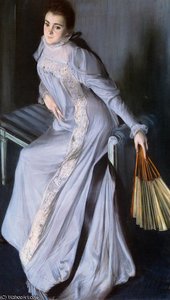
Julia Prinsep Stephen, née Jackson
 Acrylique sur toile
- Art mural
- French Portraiture Tradition
 90.0 x 73.0 cm
 Collection d’art gouvernementale
Portrait de Julia Prinsep Stephen par Jacques-Émile Blanche : une élégante femme au visage serein et à la beauté raffinée, capturée dans un tableau emblématique du mouvement britannique.
 Lire la suite
Jacques-Émile Blanche (1861-1942) : peintre français renommé pour ses portraits élégants de la haute société parisienne et londonienne, capturant la personnalité avec des coups de pinceau libres et influencé par Manet et Whistler. Découvrez son œuvre !
Giclées et impressions d'art
Impressions giclées ou sur toile de qualité musée, avec une production rapide et des finitions au choix. ( Commander la reproduction peinte à la main Passer au format numérique)




P118B €10

P118H €10

P118W €10

P438Z €10

P508JH €12

P508YH €12

P805H €10

P805Z €10

P919BZ €10

P919G €10

P919XJ €10

P959ZH €10

P968JZ €12

W106C €8

W218G €10

W218JH €8

W218Y €10

W307PJ €10

W316G €10

W316PJ €8

W316Y €10

W398PJ €8

W4111J €10

W500HY €15

W500JH €15

W692G €12

W849H €8

W940BG €15

W953PJ €8




Format standard
sur mesure
CM
INCH
Choisissez parmi nos formats prédéfinis qui respectent les proportions originales de l’œuvre.
Loading sizes...

largeur
hauteur
Saisissez la largeur et la hauteur souhaitées pour qu'elles s'adaptent à votre cadre ou à votre mur. Une impression peut être recadrée, mais jamais agrandie au-delà de l'image originale ; ainsi, un format de forme différente entraînera la perte d'une partie de l'image. Nous vous envoyons une maquette numérique pour approbation avant toute impression. L'image présentée sur cette page ne montre pas le recadrage réel — seule la maquette le permet.
Livraison dans le monde entier () en 2 semaines au lieu des 4/5 semaines habituelles. (27 octobre)

Livraison express gratuite dans le monde entier

Toile de lin de qualité supérieure

Assurance transport complète

Garantie de remboursement des droits de douane

Garantie de fidélité des couleurs

Politique de retour de 100 jours (uniquement en cas de défaut)

Garantie de remboursement à 100%

Offre de tarifs dégressifs
 L'option verre n'est disponible que pour les dimensions inférieures à 110 cm.

Julia Prinsep Stephen, née Jackson
Giclées et impressions d'art
Format de la reproduction
-


Prix total
€ 61
Julia Prinsep Stephen, née Jackson (1846–1895), Formerly Mrs Duckworth (mother of Virginia Woolf and Vanessa Bell)
Jacques-Émile Blanche’s portrait of Julia Prinsep Stephen, née Jackson, stands as a poignant emblem of Victorian refinement intertwined with the burgeoning anxieties of modernity. Painted around 1893, this canvas captures not merely a likeness but an essence—a woman radiating quiet dignity amidst a carefully orchestrated domestic tableau. The painting's subdued palette – dominated by earthy browns and creams – reflects the prevailing artistic sensibilities of its time, mirroring the restrained elegance championed by Blanche himself. He skillfully employs loose brushstrokes to convey texture and depth, prioritizing atmosphere over precise detail, a technique characteristic of Impressionism yet firmly rooted in academic tradition. The composition is deliberately balanced, featuring Stephen seated on a plush couch against a backdrop of patterned wallpaper—a symbol of bourgeois comfort and stability. Her gaze directs upwards, hinting at contemplation and perhaps a subtle awareness of the larger world beyond her immediate surroundings. The inclusion of a scarf draped around her neck adds an element of softness and femininity, contrasting with the formality of her posture. Notably, Blanche incorporates two additional figures: Stephen’s husband, Harold Duckworth, and their daughter Virginia Woolf—a deliberate gesture acknowledging the familial bonds that underpinned Victorian society. This intimate setting speaks volumes about the values of the era – family loyalty and social decorum. Beyond its aesthetic qualities, the portrait holds considerable symbolic weight. Julia Prinsep Stephen was a pivotal figure in literary history, mother to Virginia Woolf and Vanessa Bell, both pioneers of modernist experimentation. Blanche’s depiction captures her as a woman embodying traditional virtues—strength, grace, and maternal devotion—yet simultaneously hinting at an inner life rich with unspoken complexities. The presence of the cat adds an unexpected touch of domestic tranquility, reinforcing the painting's overarching mood of serene contemplation. It is a portrait that invites viewers to consider not just what Stephen looked like but also what she represented – a woman navigating the shifting currents of her time with unwavering composure and quiet dignity. Blanche’s masterful execution ensures this image continues to resonate with audiences today, offering a glimpse into a bygone era and its enduring fascination with human character.Questions et réponses
Que représente « Julia Prinsep Stephen, née Jackson » ?
Les thèmes présents dans «Julia Prinsep Stephen, née Jackson» de Jacques-Émile Blanche incluent victorian era, family portrait, elegant woman, interior scene, decorative art, french painting, symbolism. Ensemble, ils résument le sujet de l'œuvre.
Quelle est la teinte dominante de «Julia Prinsep Stephen, née Jackson» de Jacques-Émile Blanche ?
«Julia Prinsep Stephen, née Jackson» tend vers une nuance Spectre du vert au violet.
«Julia Prinsep Stephen, née Jackson» de Jacques-Émile Blanche est-il une peinture, un dessin ou une estampe ?
«Julia Prinsep Stephen, née Jackson» de Jacques-Émile Blanche est classé comme Art mural. Cette catégorie définit la nature de l'œuvre originale.
Œuvres similaires




Biographie de l'artiste
Early Life and Training
Jacques Émile Blanche (1861–1942) was born in Paris on January 1, 1861, within the affluent Parisian neighborhood of Passy, where his father, Émile Blanche—a noted pathologist—established a prestigious clinic. Surrounded by influential families and artists, Blanche’s upbringing fostered an appreciation for culture and creativity from a young age. His father encouraged his son's artistic inclinations, recognizing the importance of nurturing talent beyond the medical profession. He met many prominent writers and painters during his childhood, including Édouard Manet, who would profoundly shape his artistic vision. Blanche’s formative years were marked by exposure to intellectual discourse and artistic experimentation—experiences that instilled in him a lifelong dedication to observation and expressive representation.Career
Blanche pursued his artistic endeavors largely independently, honing his skills through self-discipline and tireless practice. Despite lacking formal training, he achieved considerable success as a portrait painter, developing a distinctive style influenced by both English Romanticism and Impressionist aesthetics. He established himself in London from 1870, becoming a member of the New English Art Club (NEAC), where he engaged with fellow artists and explored innovative techniques. Blanche’s artistic output spanned decades, characterized by meticulous attention to detail and a masterful command of tonal color—a hallmark of his oeuvre. His portraits captured not only physical likeness but also psychological nuance, conveying the inner lives of his subjects with sensitivity and insight. Notable among his accomplishments were collaborations with literary figures like Marcel Proust and Virginia Woolf, demonstrating his versatility as an artist and intellectual.Influences and Style
Blanche’s artistic style drew inspiration from several key sources—primarily Édouard Manet and James McNeill Whistler—whom he regarded as kindred spirits in their pursuit of truthfulness and expressive beauty. Like these artists, Blanche sought to capture the essence of his subjects through bold brushstrokes and a restrained palette, prioritizing emotional resonance over mere visual accuracy. His portraits embody a blend of observation and imagination, reflecting the influence of Impressionist principles while retaining elements of traditional portraiture conventions.Notable Works and Exhibitions
Blanche’s artistic legacy includes iconic paintings such as “The Kreutzer Sonata,” which exemplifies his ability to convey musical emotion through visual imagery; “Portrait of Henry James,” a masterpiece of psychological portraiture; and “London Views,” a series documenting the cityscape with remarkable clarity and atmospheric depth. His works were showcased in prestigious salons and exhibitions throughout his lifetime, securing his place among the leading artists of his era—a testament to his talent and unwavering commitment to artistic excellence.Historical Significance
Jacques Émile Blanche’s contribution to Impressionist art is undeniable—he stands as a symbol of Parisian elegance and intellectual sophistication during the Belle Époque. His portraits continue to resonate with audiences today, capturing the spirit of a bygone era and demonstrating the enduring power of visual storytelling.
Jacques-Émile Blanche
1861 - 1942 , France
L'essentiel de l'artiste
- Artistic Movement Or Style: Impressionism
- Artists Who Influenced This Artist:
- Edouard Manet
- James McNeill Whistler
- Date Of Birth: January 1, 1861
- Date Of Death: September 30, 1942
- Full Name: Jacques Émile Blanche
- Nationality: French
- Notable Artworks:
- The Kreutzer Sonata
- Portrait of Marcel Proust
- Place Of Birth: Paris, France
Articles connexes

Victorian Naturalism: The Art of Capturing Botanical Precision and Raw Wilderness
Explore the profound beauty of Victorian Naturalism. Discover how 19th-century masters captured botanical precision and raw landscapes through meticulous oil painting techniques and scientific observation.
Explorez des œuvres d'art classées par thèmes, styles et caractéristiques.


