


 Aperçu en situation
 Partager
 Partager
 Détails
 Guide imprimable

 Télécharger
 Articles similaires
 Radiographie
 Voir le diaporama
 Statistiques
Venice

Discover James Holland’s ‘Venice’ watercolor – a serene canal scene with Venetian architecture & a framed painting. Explore this romantic Impressionistic artwork.
A master of Romantic landscapes and Venice scenes. Discover the exquisite watercolours and oils of James Holland today.
 Afficher la suite
Acquérez une image numérique haute résolution et optimisée, d'une qualité bien supérieure à l'aperçu en ligne.
Chaque fichier est méticuleusement préparé par nos spécialistes internes à l'aide d'outils avancés et d'une retouche manuelle experte. Nous garantissons que chaque image possède une clarté exceptionnelle, une précision des couleurs irréprochable et un niveau de détail fin.
Le fichier final est livré par e-mail sous 72 heures, optimisé pour une utilisation immédiate dans des contextes professionnels, éditoriaux et d'impression. Il offre la même qualité de confiance que celle utilisée par les plus grands studios de création, éditeurs et galeries.
Image numérique
Téléchargez un fichier haute résolution pour votre usage personnel, l'impression et vos projets créatifs. ( Passer au format impression Acheter la peinture faite à la main)
Inclus avec chaque commande d'image numérique
Livraison numérique experte, garantie.
En choisissant TopImpressionists.com, vous n'obtenez pas seulement une simple image : vous recevez une œuvre numérique sublimée avec professionnalisme, conçue avec précision et accompagnée d'une garantie de satisfaction. Voici tout ce qui accompagne automatiquement votre commande :

Livraison rapide par e-mail
Votre fichier d'image numérique haute résolution vous sera envoyé par e-mail sous 72 heures après votre commande — prêt à un usage immédiat.

Fichier numérique optimisé par l'IA
Votre œuvre d'art bénéficie d'une optimisation professionnelle grâce à des outils d'IA avancés et une retouche manuelle, garantissant un niveau maximal de détail, de clarté et de fidélité chromatique.

Réexpédition gratuite à vie
Vous avez accidentellement supprimé ou perdu votre fichier ? Pas d'inquiétude — nous vous le renverrons gratuitement, quand vous le souhaitez.

Aucuns frais de douane — À jamais
Profitez de votre œuvre d'art instantanément sans frais de douane ni de livraison — les téléchargements numériques sont toujours exonérés de taxes.

Garantie de fidélité des couleurs
Nous garantissons que votre image numérique reproduit les couleurs de l'original aussi fidèlement que possible grâce à des outils professionnels et une gestion rigoureuse des couleurs.

Garantie de satisfaction de 100 jours
Si vous n'êtes pas satisfait de votre image numérique, nous la retoucherons ou vous rembourserons 100% sous 100 jours — sans poser de questions.

Garantie de remboursement à 100%
Pas satisfait ? Obtenez un remboursement intégral dans les 100 jours suivant la réception de votre fichier numérique — sans aucune question posée.

Remises sur les commandes groupées
Achetez 3 images, économisez 10% - Achetez 5, économisez 15% - Achetez 10+, économisez 20%. Idéal pour les projets créatifs, les galeries et les agences.
Œuvres similaires
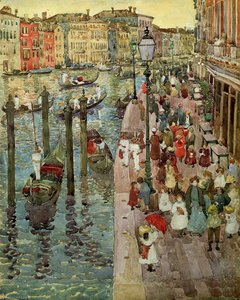


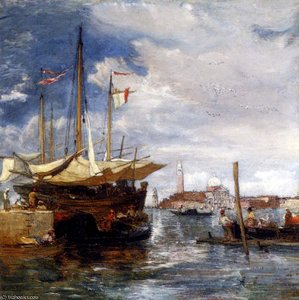


Biographie de l'artiste
The Potter's Precision
To understand the technical rigor of James Holland, one must look past the finished landscapes and toward the industrial grit of his beginnings in Burslem, Staffordshire. He did not emerge from a vacuum of pure theory; he was trained by the repetitive, exacting demands of the Davenport Pottery works. From age twelve, his hands were occupied with painting flowers onto porcelain and pottery. This early apprenticeship instilled a specific discipline regarding color and fine detail that remained present even when he transitioned to much larger canvases. He moved to London in 1819, carrying this decorative precision into a new arena of landscape and marine subjects.
His development was marked by a shift from the small-scale botanical accuracy required for ceramics to the broader atmospheric needs of topographical painting. While he continued to work as a pottery painter to sustain himself, his focus expanded toward architecture and natural history. By 1824, his first exhibition at the Royal Academy signaled that his skills were no longer confined to the surface of a teacup. He was a versatile practitioner, equally capable in oils and watercolours, a fact reflected in his prolific exhibition record across various prestigious societies.
Continental Sightings and Technical Shifts
Holland’s reputation was built on his ability to document the European landscape with structural integrity. His travels were not mere sightseeing; they were systematic studies of light and architecture. Between the 1830s and 1850s, he moved through France, Portugal, Switzerland, Austria, and the Netherlands. These excursions provided the raw material for his most recognized works. In France, specifically during visits to Rouen, he focused on architectural studies that demanded a sharp eye for form. His time in Portugal resulted in published works like The Tourist in Portugal, proving his utility as both an artist and a visual chronicler of the era.
His style underwent a visible transformation over the decades. The early watercolours, heavily influenced by the approach of Richard Parkes Bonington, possessed a certain delicate clarity. However, as time progressed, his technique became looser. He began to utilize bodycolour more extensively, moving away from purely transparent washes toward a more substantial, textured application. This shift allowed him to capture the heavier atmosphere of marine scenes and the complex light of Italian vistas with greater weight.
The Venetian Record
Venice remains the most significant anchor in his body of work. It was not a single visit but a recurring obsession that defined much of his later career. He returned to the city multiple times, notably in 1836, 1857, and throughout the mid-century, finding in its canals a subject that demanded both architectural precision and an understanding of light refraction. His depictions of the Grand Canal and Saint Mark's Basin demonstrate a mastery of the Venetian atmosphere, capturing the movement of gondolas and the play of sun on water without descending into mere sentimentality.
His professional standing was solidified through his involvement with major institutions:
- Royal Watercolour Society: He served as an associate in 1835 and achieved full membership by 1857 or 1858.
- Society of British Artists: He joined this group in 1843, remaining a member until 1848.
- Royal Academy: He exhibited thirty-two works here between 1824 and 1865.
- British Institution: His contributions reached ninety-one pieces at this venue.
Ultimately, Holland’s significance lies in his ability to bridge the gap between the meticulous decorative arts of the Potteries and the expansive, atmospheric demands of Victorian landscape painting. He was a colourist of high caliber, producing works that, while sometimes overlooked during his lifetime, gained substantial value as collectors sought the specific clarity he brought to continental views.

James Holland
1799 - 1870 , Écosse