

 Aperçu en situation
 Partager
 Partager
 Détails
 Guide imprimable

 Télécharger
 Articles similaires
 Radiographie
 Voir le diaporama
 Statistiques
David and Bathsheba
 Oil On Canvas
- WallArt
- Baroque Renaissance Fusion
 1562
1562- Renaissance
 162.0 x 197.0 cm
 Musée du Louvre
Experience the dramatic chiaroscuro of Jan Massys's 1562 David and Bathsheba, a Renaissance masterpiece capturing an intimate biblical moment you will want to own.
 Afficher la suite
Découvrez Jan Massys (1466-1530), peintre flamand majeur & fondateur de l'École d'Anvers ! Art religieux, scènes satiriques et influence durable.
Reproduction à l'huile faite à la main
Huile sur toile peinte à la main, avec cadre et dimensions personnalisés, réalisée sur commande par nos artistes. ( Passer au format impression Passer au format image numérique)




P118B €10

P118H €10

P118W €10

P438Z €10

P508JH €12

P508YH €12

P805H €10

P805Z €10

P919BZ €10

P919G €10

P919XJ €10

P959ZH €10

P968JZ €12

W106C €8

W218G €10

W218JH €8

W218Y €10

W307PJ €10

W316G €10

W316PJ €8

W316Y €10

W398PJ €8

W4111J €10

W500HY €15

W500JH €15

W692G €12

W849H €8

W940BG €15

W953PJ €8




Format standard
personnalisé
CM
INCH
Choisissez parmi nos formats prédéfinis qui respectent les proportions originales de l’œuvre.
Loading sizes...

largeur
hauteur
Vous pouvez saisir vos propres dimensions pour l'adapter à un cadre ou à un espace spécifique. Si la taille sélectionnée ne correspond pas aux proportions de l'image d'origine, nous recadrerons l'œuvre ou prolongerons la peinture avec des éléments peints à la main supplémentaires. Une maquette numérique vous sera envoyée pour approbation avant le début de la production.
Veuillez noter que l'aperçu à l'écran ne reflète pas le recadrage ou l'extension réels. Seule la maquette montrera fidèlement la composition finale.
Bien que des tailles personnalisées soient disponibles, nous vous recommandons de sélectionner une dimension dans la liste prédéfinie afin de préserver les proportions d'origine.
Exemples de personnalisation possibles : remplacer un visage par la photo du client ; ajouter un animal de compagnie (par exemple, remplacer un chat par un chien) ; inclure un message caché en arrière-plan ; modifier le paysage ou les éléments de l'arrière-plan.
Après la commande, l’équipe TopImpressionists.com contactera le client par e-mail pour recueillir ses instructions et lui fournira une maquette d’aperçu
Après la commande, l’équipe TopImpressionists.com contactera le client par e-mail pour recueillir ses instructions et lui fournira une maquette d’aperçu
Livraison dans le monde entier () en 3 à 4 semaines au lieu des 5 semaines habituelles. (14 octobre). Aucun compromis sur la qualité.

Livraison express gratuite dans le monde entier

Toile de lin de haute qualité

Assurance transport complète

Garantie de remboursement des droits de douane

Garantie de fidélité des couleurs

Garantie de retour de 100 jours (uniquement en cas de défaut)

Garantie de remboursement à 100%

Tarifs dégressifs sur quantité
 L'option verre n'est disponible que pour les dimensions inférieures à 110 cm.

David and Bathsheba
Technique de reproduction
Format de la reproduction
-


Prix total final
€ 233
A Moment Frozen in Time: The Allure of Jan Massys’s David and Bathsheba
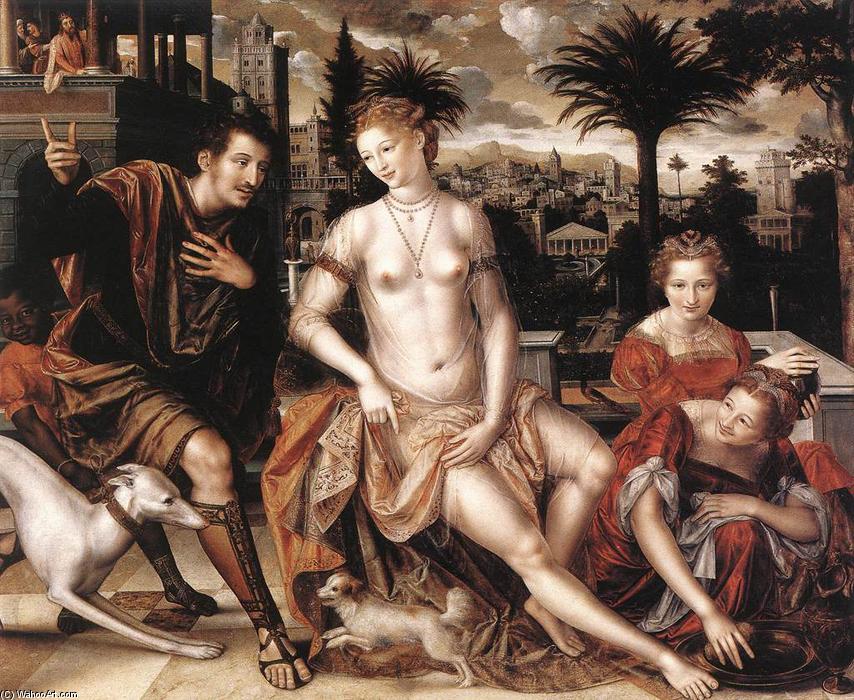
In the heart of Renaissance Antwerp, a period defined by both profound religious devotion and burgeoning worldly curiosity, Jan Massys captured a scene of unparalleled emotional and narrative tension. His 1562 masterpiece, David and Bathsheba, is far more than a mere biblical illustration; it is a window into the human psyche, capturing the exact moment where desire meets consequence. The painting recounts the clandestine encounter between King David and the Moabite woman, Bathsheba, a narrative of illicit passion that has captivated viewers for centuries. As we gaze upon this monumental canvas, we are drawn into an intimate tableau where every gesture and glance speaks of a secret shared between the figures and the observer.
The composition is masterfully orchestrated to guide the eye through a landscape of moral ambiguity. David, positioned with a commanding yet contemplative presence, gestures toward something unseen—perhaps a divine warning or a silent acknowledgment of the gravity of his transgression. Opposite him, Bathsheba lies in a state of palpable vulnerability, her upward gaze creating a powerful diagonal line of tension that connects the two protagonists. This intimacy is not solitary; Massys surrounds the central pair with supporting figures, including a servant attending to Bathsheba’s needs, which serves to remind us of the societal eyes and the inevitable repercussions that follow such private indiscretions. Even the small, quiet presence of a dog nestled near the edge of the scene adds a layer of symbolic depth, perhaps representing the lost innocence or the concept of fidelity amidst a moment of profound betrayal.
Mastery of Light and Texture in the Flemish Tradition
To behold this work is to witness the pinnacle of Renaissance oil technique. Massys utilized the medium of oil on canvas to achieve a level of realism that feels almost tactile. Through the meticulous application of paint, he renders the heavy, intricate folds of David’s robes with such precision that one can almost sense the weight of the fabric. This technical prowess extends to the delicate rendering of Bathsheba’s skin, where subtle glazing effects create a luminous, soft quality that contrasts beautifully with the more structured elements of the background.
Central to the painting's emotional impact is Massys’s use of chiaroscuro. By employing dramatic contrasts between deep shadows and brilliant highlights, the artist sculpts the figures out of the darkness, lending them a three-dimensional presence that commands the room. This manipulation of light does more than just define form; it heightens the atmospheric intensity, casting a somber, reflective mood over the entire scene. For the collector or the interior designer, such a piece offers a profound sense of drama and historical weight, making it an ideal centerpiece for spaces that value sophisticated storytelling and the timeless elegance of the Flemish masters.
Questions et réponses
En quelle année et dans quel mouvement "David and Bathsheba" a-t-elle été réalisée ?
«David and Bathsheba» a été réalisé en 1562, au sein du mouvement Baroque Renaissance Fusion.
Quel artiste et quel style se cachent derrière « David and Bathsheba » ?
Jan Massys a créé « David and Bathsheba » au sein du mouvement Baroque Renaissance Fusion.
«David and Bathsheba» de Jan Massys est-il une peinture, un dessin ou une estampe ?
«David and Bathsheba» de Jan Massys est classé comme WallArt. Cette catégorie décrit la nature de l'œuvre originale.
Quelle palette de couleurs est utilisée dans «David and Bathsheba» de Jan Massys ?
La palette de «David and Bathsheba» de Jan Massys est décrite comme étant Earthy. Il s'agit d'une description concise des couleurs de l'œuvre.
Que représente « David and Bathsheba » ?
Les sujets de « David and Bathsheba » sont biblical narrative, royal intrigue, sensuality, allegory, human emotion, renaissance painting, religious iconography.
Quelle saturation et quelle intensité «David and Bathsheba» de Jan Massys présente-t-il ?
La couleur de « David and Bathsheba » présente une saturation de Subtle Color et une intensité de Balanced.
L'œuvre «David and Bathsheba» de Jan Massys est-elle conservée dans le pays d'origine de l'artiste ?
Non - l'œuvre est conservée à l'étranger. Jan Massys est né(e) en Belgique, et l'original de « David and Bathsheba » est conservé dans un musée en France.
Quelle est la saturation des couleurs de «David and Bathsheba» de Jan Massys ?
«David and Bathsheba» de Jan Massys est présenté avec une saturation de Subtle Color.
Biographie de l'artiste
Jan Massys : Un Peintre Flamand de la Renaissance
- Nom: Jan Massys (également connu sous le nom de Jan Massijs)
- Origine: TopImpressionists
- Né: Anvers, Belgique (1466)
- Décédé: 1530
Jeunesse et Formation
- Jan Massys est né à Louvain, en Belgique, vers 1466. Ses parents étaient Joost Matsys et Catherine van Kincken. Des légendes suggèrent qu'il aurait d'abord été formé comme forgeron avant de se consacrer à la peinture. Cependant, les récits historiques indiquent que sa famille avait un revenu respectable, rendant la nécessité financière peu probable comme raison de son changement de carrière.
- Karel van Mander a affirmé que la forge avait été abandonnée en raison d'une maladie, pendant laquelle Massys décorait des gravures pour les célébrations du carnaval.
- Il a probablement reçu une formation initiale à Louvain avant de déménager à Anvers vers 1491, où il est devenu maître peintre au sein de la Guilde Saint-Luc.
- On pense largement que Joachim Patinir a étudié avec Massys et a contribué à certains de ses paysages.
- Son style reflète l'influence de Dirk Bouts, qui a apporté les qualités artistiques de Hans Memling et Rogier van der Weyden à Louvain.
Style Artistique et Œuvres Majeures
- Le travail de Massys se caractérise par une renaissance de l'art flamand sur les traces de Jan van Eyck et Rogier van der Weyden, combinant la fermeté du contour, le modelé clair et les détails minutieux avec la richesse lumineuse des pigments transparents.
- Ses peintures reflètent souvent une expression sincère, des rendus minutieusement détaillés et des effets subtils de lumière et d'ombre. Il accordait une grande attention aux bijoux, aux ornements des vêtements et à l'ornementation.
- Il est connu pour ses œuvres religieuses et ses scènes satiriques, démontrant une observation aiguë du sentiment humain et de la société.
- Œuvres Notables:
- La Duchesse Effroyable (1515) - Un portrait satirique célèbre commentant le vieillissement et les perceptions sociétales.
- Portrait d'un Vieil Homme (1513) – Un autre exemple de son commentaire satirique.
- L’Argentier et sa Femme (1514) – Une représentation révélant la cupidité et l'avarice au sein de la classe marchande.
- Retables religieux et panneaux de triptyques, notamment ceux construits pour l'église Saint-Pierre à Louvain.
- Vénus de Cythère (1561) - Une œuvre importante qui témoigne de son intérêt pour la beauté féminine et potentiellement influencée par l'art italien.
Influences et Importance Historique
- Influences: Dirk Bouts, Hans Memling, Rogier van der Weyden, Jan van Eyck.
- Massys est considéré comme un fondateur de l’École d'Anvers, contribuant de manière significative à son développement aux côtés d'artistes tels que son père, Quinten Massys, et son frère, Cornelis Massys.
- Ses œuvres satiriques ont été novatrices pour leur époque, offrant des commentaires sociaux à travers le portrait, ce qui était relativement rare dans l’art flamand antérieur.
- Il a contribué à raviver les qualités artistiques flamandes traditionnelles tout en intégrant des influences de l'Italie et d'autres régions des Pays-Bas.
- L'accent mis par Massys sur le caractère individuel et la représentation réaliste des émotions humaines a influencé les générations futures d’artistes.
Vie ultérieure et Héritage
- En 1544, Jan Massys et son frère Cornelis ont été bannis d'Anvers en raison de leurs croyances religieuses. Il a passé du temps en Italie et en France avant de retourner à Anvers.
- Il a été impliqué dans des litiges successoraux avec ses frères et sœurs plus tard dans sa vie.
- Malgré une période de circonstances réduites, il a reçu des commandes du conseil municipal avant sa mort en 1575.
- Son héritage réside dans sa contribution à l’École d'Anvers et son approche pionnière du portrait satirique au sein de l’art religieux et séculier. Il est rappelé pour ses compétences techniques, son souci du détail et ses observations perspicaces sur la nature humaine.

Jan Massys
1466 - 1530 , Belgique
En bref
- Artistes Influencés:
- Arian van Overbeke
- Willem Muelenbroec
- Joachim Patinir
- Artistes Influents:
- Dirk Bouts
- Hans Memling
- Rogier van der Weyden
- Jan van Eyck
- Date De Décès: 1530
- Date De Naissance: 1466
- Lieu De Naissance: Anvers, Belgique
- Mouvement Artistique: Renaissance flamande
- Nationalité: Belge
- Nom Complet: Jan Massys
- Oeuvres Notables:
- La Duchesse Effroyable
- Portrait d'homme âgé
- Le Changeur et sa femme
- Vénus de Cythère
Articles similaires

Drama and Light: Discover the Captivating Grandeur of Baroque Art
Immerse yourself in the dramatic splendor of Baroque art. Explore the profound impact of light, shadow, and the Counter-Reformation through an expert historical lens, celebrating the masters who defined an era of unparalleled grandeur and emotional intensity.
Explorez des œuvres d'art classées par thèmes, styles et caractéristiques.
