

Shown: · With its frame:
 Aperçu en situation
 Envoyer
 Partager
 Détails de l'œuvre
 Guide
Guide

 Télécharger l'image
 Articles similaires
 Radiographie
 Diaporama
 Q&A
Q&A Statistiques

€ 239
Reproduction à l'huile faite à la main
Huile sur toile peinte à la main, avec cadre et dimensions personnalisés, réalisée sur commande par nos artistes. ( Passer au format impression Passer au format numérique)
Size
·Format standard
sur mesure
CM
INCH
Choisissez parmi nos formats prédéfinis qui respectent les proportions originales de l’œuvre.
Loading sizes...

largeur
hauteur
Saisissez la largeur et la hauteur souhaitées, pour s'adapter à votre cadre ou à votre mur. Cette œuvre est peinte à la main ; ainsi, pour un format de forme différente, l'artiste peut peindre un peu plus autour du tableau ou réduire légèrement les bords — c'est vous qui choisissez. Nous vous envoyons une maquette numérique pour approbation avant que la peinture ne commence. L'image présentée sur cette page ne reflète pas le résultat réel — seule la maquette le fait.
 En savoir plus
Finish
·
White €1

Blurside €1

Extended €1

P118B €10

P118H €10

P118W €10

P438Z €10

P508JH €12

P508YH €12

P805H €10

P805Z €10

P919BZ €10

P919G €10

P919XJ €10

P959ZH €10

P968JZ €12

W106C €8

W218G €10

W218JH €8

W218Y €10

W307PJ €10

W316G €10

W316PJ €8

W316Y €10

W398PJ €8

W4111J €10

W500HY €15

W500JH €15

W692G €12

W849H €8

W940BG €15

W953PJ €8

H24-GOLD €30

H24-SILVER €30

H36-GOLD €45

H36-SILVER €45
Shipped in a protective tube, ready for your own framer.
Above 105 cm the frame is shipped as a kit for a professional framer — read the details.
Extras
optionalWhat do the extras include?
Examples of what can be changed: Replace face with customer photo; Add pet (e.g., replace cat with dog); Include hidden message in background; Change background landscape or elements.
After order, TopImpressionists.com team will email client for instructions and provide a mockup preview
After order, TopImpressionists.com team will email client for instructions and provide a mockup preview
Livraison dans le monde entier () en 3 à 4 semaines au lieu des 5 semaines habituelles. (2 novembre). Aucun compromis sur la qualité.
Vernis de protection
Cartel
Détails de la plaque en bronze gravée
This elegant plaque features the artist's name and the title of the artwork, finely engraved for a timeless presentation.
It is made from bronze with a refined, elegant finish. The text is precisely laser-engraved for a sharp and permanent result. Measuring 9x2 cm, the plaque is compact yet easy to read. It's built to be durable and scratch-resistant, offering a professional, museum-quality look. Mounting is simple thanks to the included adhesive backing.
Détails de la plaque en acrylique transparent
The plaque includes essential engraved details such as the artist's name, the title of the artwork, the date it was created, the type of media used-like oil on canvas or watercolor-a brief description of the piece, and a QR code that links to the complete artwork information.
It is crafted from clear acrylic, offering a sleek, modern appearance. The text is UV-engraved in black to ensure strong visual contrast. With a size of 10x15 cm, it ensures optimal readability. It comes equipped with two metal hooks for secure wall mounting. The plaque is designed to be weather-resistant, making it suitable for various environments, and it includes interactive features that work seamlessly with smartphone scanning.
Détails de la plaque en acrylique noir
This elegant plaque includes engraved information such as the artist's name, the title of the artwork, the date it was created, the type of media used (like oil on canvas or watercolor), a short description of the artwork, and a QR code for quick access to more information.
The plaque itself is made from refined black acrylic with a premium finish. The text is laser-engraved in white for high contrast and readability. Its size is 10x15 cm, designed to be easy to read. It comes with two metal hooks for professional mounting. The design is sleek and fits any interior style. It is also weather-resistant and durable, with built-in digital integration for mobile compatibility.
L'option verre n'est disponible que pour les dimensions inférieures à 110 cm.
 L'option verre n'est disponible que pour les dimensions inférieures à 110 cm.
- Livraison express gratuite dans le monde entier
- Toile de lin de qualité supérieure
- Assurance transport complète
- Garantie de remboursement des droits de douane
- Garantie de fidélité des couleurs
- Politique de retour de 100 jours (uniquement en cas de défaut)
- Garantie de remboursement à 100%
- Offre de tarifs dégressifs


Description de la pièce
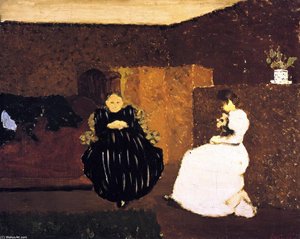
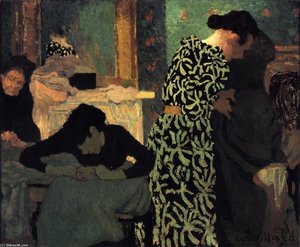
Jean-Édouard Vuillard’s “Interior” exemplifies the Nabi movement’s innovative use of color and form, depicting a serene domestic scene with muted tones and subtle textures. Created around 1900, this painting showcases Vuillard's mastery in capturing intimate moments within a home setting and is prominently displayed at the Detroit Institute of Arts.
Biographie de l'artiste
Jean-Édouard Vuillard (1868-1940) était un peintre français et membre des Nabis reconnu pour ses scènes intérieures intimistes, son style décoratif et son influence sur l'art moderne comme le cubisme. Découvrez son œuvre !
About the painting
Jean-Édouard Vuillard: Capturing Quietude in “Interior”
The painting "Interior," executed by Jean-Édouard Vuillard around 1900-1905, stands as a quintessential example of Nabis art—a movement that sought to revolutionize artistic expression through radical simplification and the exploration of color’s emotive power. More than just a depiction of domestic space, it embodies Vuillard's profound fascination with capturing fleeting moments of stillness and intimacy within the everyday world. Located at the Detroit Institute of Arts, this artwork invites viewers into a carefully constructed tableau that speaks volumes about artistic innovation and perceptual experience.A Synthesis of Impressionism and Japanese Influence
Vuillard’s approach to painting was deeply rooted in Impressionist principles—particularly the emphasis on capturing light and atmosphere—yet he decisively moved beyond its limitations. Influenced by the pioneering work of Paul Gauguin, Vuillard embraced a bold departure from academic conventions. However, his artistic vision gained significant impetus from Japanese prints (ukiyo-e), which had begun to circulate in Europe during this period. Like Serusier’s “The Talisman,” Vuillard utilized flattened planes of color—a technique borrowed directly from Japanese aesthetics—to create an illusion of depth and spatial ambiguity. This deliberate simplification wasn't merely stylistic; it represented a fundamental rethinking of how artists could represent reality, prioritizing feeling over precise observation.Composition and Color Palette: Orchestrating Emotion
The composition itself is deceptively simple. Two chairs dominate the scene, one occupied by a figure whose presence is subtly suggested rather than overtly portrayed—a characteristic Vuillard technique that encourages contemplation and invites viewers to fill in the gaps of perception. A window frames a glimpse of foliage outside, bathed in soft light, contributing to the overall sense of tranquility. Yet, it’s the color palette that truly distinguishes “Interior.” Vuillard employed hues of pink, peach, and pale yellow—colors chosen not for their literal representation but for their ability to evoke emotion. These shades coalesce into a harmonious blend that conveys warmth, comfort, and perhaps even melancholy—a testament to Vuillard's masterful control over chromatic orchestration.Symbolism Within Everyday Reality
Beyond its formal qualities, “Interior” resonates with symbolic significance. The empty chair serves as a poignant reminder of absence and solitude, while the window represents connection to nature—a recurring motif in Vuillard’s oeuvre. The bird perched on the windowsill symbolizes freedom and aspiration, subtly elevating the scene beyond mere visual description. These elements intertwine to create a narrative that transcends the surface appearance of the room, prompting viewers to consider themes of contemplation, memory, and the beauty inherent in ordinary life.Legacy and Influence
Vuillard’s innovative approach to color and form profoundly impacted subsequent artistic movements—most notably Cubism and Fauvism—establishing him as a pivotal figure in the transition from Impressionism to abstraction. His unwavering commitment to capturing subjective experience continues to inspire artists today, demonstrating the enduring power of art to convey emotion and illuminate the complexities of human perception. “Interior” remains an unforgettable masterpiece, embodying Vuillard’s artistic genius and securing his place among the most celebrated painters of the Belle Époque.Questions et réponses
Quel est le niveau de contraste de «Interior» de Jean-Édouard Vuillard ?
Le niveau de contraste de «Interior» de Jean-Édouard Vuillard est Serene.
Quelle est la teinte dominante de « Interior » ?
«Interior» tend vers une nuance Ochre to Sepia.
Puis-je utiliser la réalité augmentée pour visualiser «Interior» de Jean-Édouard Vuillard dans ma pièce ?
La page Aperçu en RA de «Interior» de Jean-Édouard Vuillard utilise la réalité augmentée pour visualiser l'œuvre dans votre propre espace, à partir d'un appareil compatible.
Quick facts and art quiz
About Jean-Édouard Vuillard
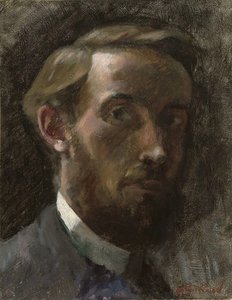
Jean-Édouard Vuillard
1868 - 1940, France
Biographie de l'artiste
**early life and artistic beginnings**
Jean-Édouard Vuillard, né à Cuiseaux en Bourgogne le 11 novembre 1868, fut l’enfant d'un couple atypique : son père, un ancien officier de marine retraité, et sa mère, une couturière. Cette famille modeste, après le décès du père en 1877, s'installa à Paris, ouvrant la voie à une vie artistique riche en découvertes. Dès son plus jeune âge, Jean-Édouard manifesta un intérêt certain pour l’art, fréquentant notamment le lycée Fontaine, où il développa sa sensibilité aux œuvres de Michel-Ange et aux sculptures classiques. C'est là qu'il rencontra des figures clés qui allaient influencer son parcours, dont Maurice Denis et Pierre Véber, futurs compagnons d'art. En 1885, après avoir abandonné ses ambitions militaires initiales, il se lança dans la voie de l’artiste, rejoignant le studio du peintre Diogène Maillart, un lieu de rencontres et d'expérimentations crucial pour sa formation.**les nabis : une révolution artistique**
L'année 1889 marqua un tournant décisif dans la vie de Vuillard : il se joignit à Maurice Denis, Paul Sérusier, et d’autres artistes audacieux pour fonder le groupe *Les Nabis*. Ce collectif, dont le nom évoque le prophète, s'inspirait des peintres allemands du XVIIe siècle, notamment Rembrandt et Vermeer, mais surtout de l'art japonais, avec ses compositions équilibrées, ses couleurs vives et son utilisation ingénieuse de la perspective. Les Nabis cherchaient à transcender la simple reproduction de la réalité, en explorant les possibilités expressives de la couleur et de la forme. Vuillard, initialement hésitant face à cette approche symbolique, finit par s'abandonner à l’expérimentation, intégrant progressivement les principes du groupe dans son œuvre. Cette période fut marquée par une recherche constante de nouvelles techniques et d'une esthétique personnelle, influencée par les théâtres symbolistes qui fleurissaient à Paris.**l'intimité des lieux et la figure féminine**
L’œuvre de Vuillard est profondément ancrée dans l’observation attentive du quotidien, en particulier des intérieurs domestiques. Il peignait avec une sensibilité particulière les appartements bourgeois, les salons, les chambres, transformant ces espaces ordinaires en microcosmes chargés d'émotions et de mélancolie. La présence féminine occupe une place centrale dans ses tableaux : sa mère, sa grand-mère, et plus tard, Lucy Hessel, sa compagne et mécène, sont souvent représentées dans des scènes intimes, capturant leur essence avec une subtilité remarquable. Ces portraits ne se limitent pas à la simple représentation physique ; ils cherchent à saisir l'âme de ces femmes, leurs gestes, leurs expressions, leurs émotions. Il est important de noter que Vuillard a toujours été un artiste solitaire, préférant le travail en studio à la vie sociale, ce qui contribue à l’atmosphère particulière et introspective de son œuvre.**l'évolution stylistique et l'héritage**
Après 1900, lorsque *Les Nabis* se dispersent, Vuillard connaît une évolution stylistique notable. Il abandonne progressivement les expérimentations formelles audacieuses du groupe pour adopter un style plus réaliste, mettant au premier plan la précision des détails et la richesse des couleurs. Cette période est marquée par des portraits de personnalités influentes de l'industrie et des arts français, réalisés dans des contextes familiers et reconnaissables. Vuillard continue à explorer les thèmes de l’intimité et du quotidien, mais avec une approche plus mature et maîtrisée. Son œuvre, riche en nuances et en subtilités, a exercé une influence considérable sur les générations d'artistes qui lui ont succédé, notamment dans le développement du cubisme et de l'abstraction. Jean-Édouard Vuillard est aujourd’hui reconnu comme l'un des artistes français les plus importants du XXe siècle, dont les tableaux continuent de fasciner par leur beauté singulière et leur profondeur émotionnelle.**conclusion**
L'œuvre de Jean-Édouard Vuillard représente une véritable révolution dans le monde de l'art. Son approche novatrice de la couleur, de la forme et de la représentation a ouvert de nouvelles perspectives pour les artistes du XXe siècle. Il est un artiste qui a su capturer l’essence de la vie quotidienne, en particulier l’intimité des lieux et la beauté des figures féminines. Vuillard reste une figure incontournable de l'art moderne, dont l'héritage continue d'inspirer les artistes du monde entier.Quick facts about Jean-Édouard Vuillard
- Artistic Movement Or Style: Nabis
- Artists Or Movements Influenced By This Artist:
- Cubism
- Fauvism
- Artists Who Influenced This Artist: ['Paul Gauguin']
- Date Of Birth: November 11, 1868
- Date Of Death: June 21, 1940
- Full Name: Jean Édouard Vuillard
- Nationality: French
- Notable Artworks:
- Woman Sweeping
- Sunlit Interior
- Place Of Birth: Cuiseaux, France


Explorez des œuvres d'art classées par thèmes, styles et caractéristiques.









Jean-Édouard Vuillard
Interior
() ·
With its frame: · Hand-painted in oil on linen
Total