Aperçu en situation
 Partager
 Partager
 Détails
 Guide
Guide

 Télécharger
 Articles similaires
 Radiographie
 Voir le diaporama
 Statistiques
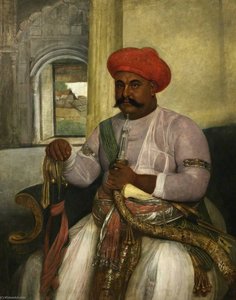
David Garrick
 Oil On Canvas
- WallArt
- Baroque Rococo Fusion
 1763
1763- Early Modern
 75.0 x 63.0 cm
 Musée Ashmolean d’Art et d’Archéologie
Admire Johann Zoffany's iconic portrait of David Garrick alongside Eva Maria Veigel, capturing the theatrical spirit of Georgian England at The Ashmolean Museum.
 Afficher la suite
Découvrez les chefs-d'œuvre du XVIIIe siècle de Johann Zoffany ! Reconnu pour ses 'pièces conversationnelles', combinant la précision allemande et l'allure italienne. Explorez les portraits, les peintures d'histoire et bien plus encore – disponibles sur TopImpressionists.
Reproduction à l'huile faite à la main
Huile sur toile peinte à la main, avec cadre et dimensions personnalisés, réalisée sur commande par nos artistes. ( Passer au format impression Passer au format image numérique)




P118B $10

P118H $10

P118W $10

P438Z $10

P508JH $12

P508YH $12

P805H $10

P805Z $10

P919BZ $10

P919G $10

P919XJ $10

P959ZH $10

P968JZ $12

W106C $8

W218G $10

W218JH $8

W218Y $10

W307PJ $10

W316G $10

W316PJ $8

W316Y $10

W398PJ $8

W4111J $10

W500HY $15

W500JH $15

W692G $12

W849H $8

W940BG $15

W953PJ $8




Format standard
personnalisé
CM
INCH
Choisissez parmi nos formats prédéfinis qui respectent les proportions originales de l’œuvre.
Loading sizes...

largeur
hauteur
Vous pouvez saisir vos propres dimensions pour l'adapter à un cadre ou à un espace spécifique. Si la taille sélectionnée ne correspond pas aux proportions de l'image d'origine, nous recadrerons l'œuvre ou prolongerons la peinture avec des éléments peints à la main supplémentaires. Une maquette numérique vous sera envoyée pour approbation avant le début de la production.
Veuillez noter que l'aperçu à l'écran ne reflète pas le recadrage ou l'extension réels. Seule la maquette montrera fidèlement la composition finale.
Bien que des tailles personnalisées soient disponibles, nous vous recommandons de sélectionner une dimension dans la liste prédéfinie afin de préserver les proportions d'origine.
Exemples de personnalisation possibles : remplacer un visage par la photo du client ; ajouter un animal de compagnie (par exemple, remplacer un chat par un chien) ; inclure un message caché en arrière-plan ; modifier le paysage ou les éléments de l'arrière-plan.
Après la commande, l’équipe TopImpressionists.com contactera le client par e-mail pour recueillir ses instructions et lui fournira une maquette d’aperçu
Après la commande, l’équipe TopImpressionists.com contactera le client par e-mail pour recueillir ses instructions et lui fournira une maquette d’aperçu
Livraison dans le monde entier () en 3 à 4 semaines au lieu des 5 semaines habituelles. (23 septembre). Aucun compromis sur la qualité.

Livraison express gratuite dans le monde entier

Toile de lin de haute qualité

Assurance transport complète

Garantie de remboursement des droits de douane

Garantie de fidélité des couleurs

Garantie de retour de 100 jours (uniquement en cas de défaut)

Garantie de remboursement à 100%

Tarifs dégressifs sur quantité
 L'option verre n'est disponible que pour les dimensions inférieures à 110 cm.

David Garrick
Technique de reproduction
Format de la reproduction
-


Prix total final
$ 269
A Theatrical Soul Captured in Oil
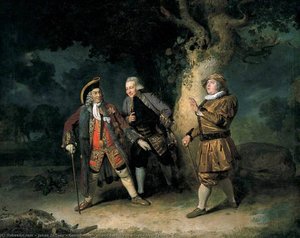
In the quiet halls of The Ashmolean Museum of Art and Archaeology, there exists a portrait that does more than merely record a likeness; it breathes with the very essence of the eighteenth-century stage. Johann Zoffany’s 1763 masterpiece, David Garrick, is an evocative window into the heart of Enlightenment England. At first glance, we encounter the commanding presence of Garrick, the most celebrated actor of his era, rendered with a profound sense of dignity and intellectual depth. Zoffny does not present us with a mere performer in costume, but with a man whose very existence was intertwined with the dramatic arts. The composition is intimate yet grand, focusing on Garrick from the chest up against a somber, dark background that pushes his luminous features toward the viewer, demanding an immediate and visceral connection.
The technique employed by Zoffany is nothing short of masterful, showcasing the meticulous precision characteristic of the finest oil-on-canvas works of the period. Through subtle tonal gradations and a sophisticated command of light, the artist breathes life into the textures of the subject's attire—the crisp white collar contrasting sharply against the deep black of his formal coat. This interplay of light and shadow, or chiaroscuro, serves to sculpt Garrick’s face, highlighting a contemplative gaze that seems to look beyond the frame, perhaps lost in thought regarding a recent performance or a future script. For the discerning collector or interior designer, this painting offers a profound sense of classical elegance, making it an ideal centerpiece for spaces that value historical gravity and sophisticated drama.
The Dual Faces of Drama
Beyond the physical representation of a legendary actor, Zoffany weaves a complex tapestry of symbolism into the very fabric of the portrait. Floating near Garrick’s face are two iconic theatrical masks: the smiling visage of Comedy and the furrowed, mournful brow of Tragedy. These are not mere decorative elements; they are the dual pillars of the human experience that Garrick mastered on stage. The presence of these masks transforms the portrait from a standard biographical study into a profound meditation on the nature of performance and emotion. It suggests that behind the dignified gentleman lies the capacity for both joyous exuberance and profound sorrow, mirroring the duality of the human condition itself.
This symbolic layer adds an intellectual richness that elevates the artwork, making it much more than a decorative piece. It invites the viewer to contemplate the boundaries between reality and artifice, between the man and the persona. For those looking to adorn a home or gallery with a reproduction of this caliber, the painting provides a continuous source of conversation and inspiration. It embodies a period where art, intellect, and social status converged in a beautiful, theatrical display. To possess such a work is to hold a fragment of history—a moment frozen in 1763, where the spirit of the theatre remains eternally vibrant and hauntingly beautiful.
Biographie de l'artiste
Johann Zoffany : Vie et Héritage
Jeunesse et Formation
Johann Zoffany, né Johannes Josephus Zaufallij en 1733 à Fribourg-en-Méningue, en Allemagne, était un peintre qui a acquis une renommée principalement en Angleterre et en Italie. Les détails de son enfance sont rares, mais il est connu qu'il a reçu une formation artistique dès son plus jeune âge. Il a d’abord été apprenti chez un sculpteur, peut-être Melchior Paulus à Ellwangen, avant d'étudier avec Martin Speer à Regensburg. Cette période fondatrice a jeté les bases de sa carrière future.
Voyage en Italie et en Angleterre
En 1750, Zoffany voyagea à Rome, où il entra dans l'atelier d'Agostino Masucci et y affina ses compétences au sein de la tradition artistique italienne. Il s’installa ensuite en Angleterre en 1760, se débrouillant pour le moment en créant des conceptions décoratives pour les horloges fabriquées par Stephen Rimbault. Cette période marque un tournant car il commença à établir des liens et à gagner une reconnaissance dans la scène artistique de Londres.
Patronage Royal et Développement Artistique
Zoffany attira rapidement l'attention du roi George III et de la reine Charlotte, devenant un portraitiste favori de la famille royale. Sa capacité à capturer des moments informels – tels que La Reine Charlotte et ses deux plus jeunes enfants (1765) – le distinguait des peintres de cour plus formels. Il était également populaire auprès de la famille impériale autrichienne et a été nommé baron de l'Empire du Saint-Empire romain germanique en 1776 par l'impératrice Marie Thérèse.
Le Maître des « Pièces de Conversation »
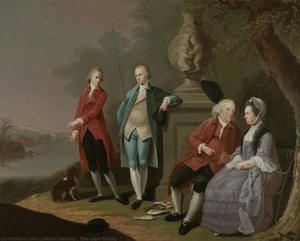
Zoffany est devenu célèbre pour ses « pièces de conversation », ou *conversazione* – portraits de groupe informels représentant des rassemblements sociaux. Il excellait à capturer les personnalités et les interactions au sein de ces scènes, mettant souvent en vedette des figures importantes de la société, du théâtre et de la littérature. Ses œuvres telles que La Famille Cope (1775) illustrent ce style, offrant un aperçu de la vie de ses mécènes.
Réalisations Majeures et Œuvres Notables
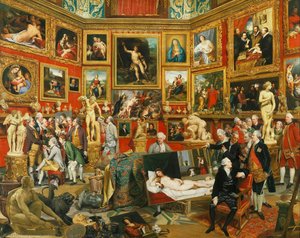
- Tribuna de l'Uffizi (1772-1778) : Peut-être son œuvre la plus célèbre, une représentation méticuleuse de la Galerie Uffizi à Florence.
- Dr William Hunter enseignant l'anatomie à l'Académie Royale (1779) : Une représentation fascinante de l'éducation médicale et de l'enquête scientifique.
- George III (1771) : Un portrait royal mettant en valeur le pouvoir et l'élégance du roi.
- Le match à la perruque du colonel Mordaunt (1784-1786) : Une représentation vibrante de la vie coloniale en Inde, capturant un événement culturel unique.
Années en Inde et Vie ultérieure
De 1783 à 1789, Zoffany résidait en Inde, où il a peint des portraits de figures importantes telles que Warren Hastings et Asaf-ud-Daula. Ses expériences là-bas ont influencé son style artistique et ses sujets. Une histoire remarquable de cette période concerne un naufrage près des îles Andaman, où les survivants ont recouru à des mesures extrêmes pour leur survie.
Influences et Héritage
L'œuvre de Zoffany reflète des influences tant de la précision allemande que de l'art italien. Il a été influencé par des artistes tels qu’Agostino Masucci et s'est inspiré de la tradition baroque. Son style, en revanche, a influencé ses contemporains et les artistes ultérieurs intéressés par le portrait et le commentaire social. Il a relié les traditions artistiques et a laissé un impact durable sur l'art du XVIIIe siècle.
Signification Historique
Les peintures de Johann Zoffany fournissent des informations précieuses sur les coutumes sociales, la vie intellectuelle et les valeurs culturelles de son temps. Ses « pièces de conversation » offrent des portraits intimes d'individus importants et de leur monde, tandis que ses représentations de l'Inde contribuent à notre compréhension de l'histoire coloniale. Il reste une figure importante dans l'histoire de l'art, célébré pour sa compétence technique, ses observations perspicaces et sa vision artistique unique.

johann zoffany
1733 - 1810 , Allemagne
En bref
- Artistic Movement Or Style: Néo-classicisme
- Artists Who Influenced This Artist:
- Agostino Masucci
- Martin Speer
- Date Of Birth: 1733
- Full Name: Johann Joseph Zoffany
- Nationality: Allemand
- Notable Artworks:
- La Tribuna de Florència
- Le Docteur William Hunter enseignant l'anatomie à l'Académie Royale
- George III
- Le match à la perruque du colonel Mordaunt
- Place Of Birth: Frankfurt am Main
Articles similaires

Jacques-Louis David: Neoclassical Ideals & Revolutionary Witness
Explore the life & art of Jacques-Louis David, leading Neoclassical painter of the French Revolution. Discover iconic works like 'The Death of Marat' and his lasting impact on art history. Expert analysis & high-quality reproductions at TopImpressionists.

Thomas Rowlandson: Satire, Society & the Art of Caricature in Georgian England
Explore the witty world of Thomas Rowlandson, master Georgian caricaturist! Discover his satirical prints & insightful social commentary on 18th-century England. Learn about his life, techniques, and enduring influence.

Johann Zoffany: Capturing Georgian Society with Brushstrokes of Cosmopolitan Flair
Explore the captivating world of Johann Zoffany, master portraitist of Georgian society. Discover his unique 'conversation pieces,' imperial commissions & lasting legacy. A guide for discerning collectors.

David Cox the Elder: Landscape, Light & the Romantic Vision of Rural England
Explore the captivating landscapes of David Cox the Elder, a pivotal figure in British Romanticism. Discover his masterful watercolour techniques, enduring legacy & find timeless art for your home at TopImpressionists.

Gerard David: Bridging Late Medieval Tradition with Early Renaissance Humanism
Explore the captivating world of Gerard David, a pivotal figure bridging late medieval artistry with the Early Renaissance. Discover his innovative techniques, religious masterpieces, and enduring legacy – a must-read for discerning art collectors.
Explorez des œuvres d'art classées par thèmes, styles et caractéristiques.