Aperçu en situation
 Partager
 Partager
 Détails
 Guide imprimable

 Télécharger
 Articles similaires
 Radiographie
 Voir le diaporama
 Statistiques
McSorley


Découvrez l'emblématique McSorley’s Bar de John Sloan (1912). Une œuvre intemporelle sur la vie urbaine, disponible en édition limitée.
 Afficher la suite
John French Sloan (1871-1951): Un peintre américain majeur de l'École Ashcan et du réalisme américain. Ses œuvres captivent la vie quotidienne à New York au début du XXe siècle.
Giclées et impressions d'art
Impressions giclées ou sur toile de qualité musée, avec une production rapide et des finitions au choix. ( Acheter la peinture faite à la main Passer au format image numérique)




P118B €10

P118H €10

P118W €10

P438Z €10

P508JH €12

P508YH €12

P805H €10

P805Z €10

P919BZ €10

P919G €10

P919XJ €10

P959ZH €10

P968JZ €12

W106C €8

W218G €10

W218JH €8

W218Y €10

W307PJ €10

W316G €10

W316PJ €8

W316Y €10

W398PJ €8

W4111J €10

W500HY €15

W500JH €15

W692G €12

W849H €8

W940BG €15

W953PJ €8




Format standard
personnalisé
CM
INCH
Choisissez parmi nos formats prédéfinis qui respectent les proportions originales de l’œuvre.
Loading sizes...

largeur
hauteur
Saisissez la largeur et la hauteur souhaitées pour qu'elles s'adaptent à votre cadre ou à votre mur. Une impression ne peut être que découpée, elle ne peut jamais être agrandie au-delà de l'image originale ; ainsi, un format de forme différente entraînera la perte d'une partie de l'image. Nous vous envoyons une maquette numérique pour approbation avant toute impression. L'image présentée sur cette page ne montre pas le recadrage réel — seule la maquette le permet.
Livraison dans le monde entier () en 2 semaines au lieu des 4/5 semaines habituelles. (24 octobre)

Livraison express gratuite dans le monde entier

Toile de lin de haute qualité

Assurance transport complète

Garantie de remboursement des droits de douane

Garantie de fidélité des couleurs

Garantie de retour de 100 jours (uniquement en cas de défaut)

Garantie de remboursement à 100%

Tarifs dégressifs sur quantité
 L'option verre n'est disponible que pour les dimensions inférieures à 110 cm.

McSorley
Giclées et impressions d'art
Format de la reproduction
-


Prix total final
€ 61
Un aperçu de la rudesse et du glamour de Chelsea
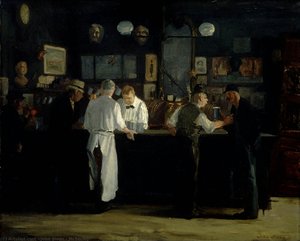
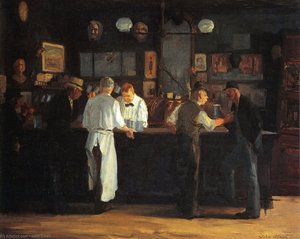
L'œuvre « McSorley’s Bar » de John French Sloan, peinte en 1912, n'est pas une simple représentation d'une taverne new-yorkaise ; c'est un instantané méticuleusement observé d'une époque — l'aube du mouvement de l'Ashcan School et l'éveil de la conscience sociale de l'Amérique du début du XXe siècle. Le tableau capture un moment précis au sein du McSorley’s Old Ale House, une institution de Chelsea qui demeure remarquablement inchangée aujourd'hui, offrant un lien tangible avec le passé. Sloan ne cherchait pas à romantiser la vie urbaine ; il la présentait plutôt avec une honnêteté sans faille, révélant les drames silencieux et les interactions quotidiennes qui se déroulent au sein de cet établissement populaire.

(Source de l'image : Wikimedia Commons)
L'Ashcan School et une vision réaliste
Le travail de Sloan est inextricablement lié à l'Ashcan School, un groupe d'artistes américains qui ont rejeté les portraits idéalisés privilégiés par les traditions artistiques académiques. Au lieu de cela, ils se sont concentrés sur la représentation des réalités de la vie urbaine : la pauvreté, le travail et les expériences souvent négligées des gens ordinaires. L'attention méticuleuse de Sloan aux détails — les surfaces usées des tables, la lueur vacillante du gaz, les expressions sur les visages des clients — est la marque de fabrique de ce mouvement. Il ne visait pas de grands récits ; il cherchait à capturer l'essence d'un lieu et d'un temps spécifiques par une observation attentive et un rendu magistral.
La composition du tableau est délibérément sobre, mais puissamment évocatrice. Sloan emploie une palette de couleurs feutrées — principalement des bruns, des gris et des ocres — pour créer un sentiment de réalisme et d'atmosphère. La lumière est dramatique, projetant des ombres allongées qui accentuent la profondeur et la texture de la scène. On remarque comment il utilise des coups de pinceau lâches pour transmettre le mouvement et l'énergie, capturant les conversations animées et les interactions informelles entre les hommes au comptoir.
Le symbolisme dans les détails
Au-delà de sa représentation immédiate d'une scène de bar, « McSorley’s Bar » est riche en détails symboliques. Les nombreuses horloges sur le mur ne sont pas simplement décoratives ; elles représentent le passage implacable du temps et les pressions de la vie urbaine. Le mobilier usé et le décor simple témoignent de l'existence précaire de nombreux clients. Même l'agencement des bouteilles et des verres suggère un sentiment de familiarité et de routine. L'inclusion de deux livres à l'arrière-plan laisse entrevoir un désir de quêtes intellectuelles au milieu du tumulte quotidien, suggérant que ce bar était bien plus qu'un simple lieu de boisson ; c'était aussi un point de ralliement pour ceux en quête de répit et de conversation.
Un portrait intemporel de Chelsea
« McSorley’s Bar » demeure remarquablement pertinent aujourd'hui. C'est un rappel poignant de l'esprit durable de New York, de ses quartiers vibrants et des personnes qui l'ont façonné. Le tableau offre un aperçu d'une époque révolue, nous invitant à réfléchir à la complexité de la vie urbaine et à l'importance de préserver notre patrimoine culturel. Les reproductions de cette œuvre emblématique continuent de résonance auprès des collectionneurs comme des décorateurs d'intérieur, apportant une touche d'histoire authentique de New York et de génie artistique à n'importe quel espace.
Questions et réponses
De quoi est composé "McSorley" et dans quel style est-il réalisé ?
Dans « McSorley », la technique du Huile sur toile rencontre le mouvement École de l'Ashcan.
L'œuvre « McSorley » est-elle plutôt claire ou plutôt sombre dans l'ensemble ?
« McSorley » présente une luminosité globale de ombres profondes, avec une luminance de Sombre.
Qui a créé "McSorley" ?
L'artiste à l'origine de « McSorley » est John French Sloan. L'œuvre est répertoriée sous le nom de John French Sloan.
Biographie de l'artiste
Early Life and Artistic Awakening
John French Sloan, born August 2, 1871, in Lock Haven, Pennsylvania, emerged from humble beginnings that profoundly shaped his artistic vision. His childhood was marked by a familial need for support; his father’s struggles with mental health necessitated young John taking on responsibilities beyond his years. This early exposure to the realities of working-class life—a world often overlooked by the established art circles—would become a defining characteristic of his oeuvre. He moved with his family to Philadelphia, where he honed his skills initially not through formal academic training, but as an assistant cashier at Porter and Coates, a bookstore brimming with prints and illustrations. This environment proved formative; it allowed him to study masters like Dürer and Rembrandt, fostering a deep appreciation for draftsmanship and etching techniques. It was here, amidst the commerce of printed images, that Sloan began creating his own art, quietly developing a style rooted in observation and meticulous detail. His early work wasn’t born from privilege or leisure, but from necessity and a keen eye for the world around him—a foundation upon which he would build a remarkable career.The Ashcan School and Urban Realism
Sloan's trajectory shifted dramatically with his encounter with Robert Henri, a charismatic painter who championed artistic independence and a commitment to portraying everyday life. This connection led Sloan to the heart of what became known as the Ashcan School—a group of artists dedicated to depicting the gritty realities of turn-of-the-century New York City. Alongside William Glackens, George Luks, Everett Shinn, and others, Sloan rejected the idealized landscapes and portraits favored by many of their contemporaries, instead turning their attention to the bustling streets, crowded tenements, and vibrant social life of the city’s poorer neighborhoods. His work became a visual chronicle of this often-ignored world—capturing scenes from McSorley's Bar to women drying their hair on rooftops. Sloan wasn’t merely documenting; he was imbuing these scenes with a sense of empathy and dignity, elevating the lives of ordinary people onto the canvas. He possessed an uncanny ability to capture the *essence* of neighborhood life, the subtle gestures and fleeting moments that revealed the character of a place and its inhabitants. This commitment to realism wasn’t simply aesthetic; it was also informed by his socialist leanings, though he always maintained a distinction between his art and his political beliefs.Style and Influences
Sloan's artistic style is characterized by a distinctive blend of influences. While rooted in realism, his work wasn’t devoid of stylistic nuance. He employed dark, rich hues—often emphasizing the contrast between light and shadow—to create a sense of drama and atmosphere. His compositions were carefully constructed, often utilizing strong diagonals to draw the viewer's eye into the scene. The influence of etching is evident in his precise linework and attention to detail, even in his paintings. Beyond Henri, Sloan drew inspiration from European masters like Edgar Degas and Honoré Daumier, admiring their ability to capture movement and social commentary. However, he forged a uniquely American voice, one that resonated with the energy and dynamism of New York City. His work wasn’t about grand narratives or historical events; it was about the small moments, the everyday experiences that constituted the fabric of urban life. He found beauty in the mundane, transforming ordinary scenes into compelling works of art. Wake of the Ferry exemplifies his ability to imbue a seemingly simple scene with emotional depth and symbolic resonance.Legacy and Lasting Impact
John French Sloan’s legacy extends far beyond his contributions to the Ashcan School. He was a prolific artist who worked in various mediums—painting, etching, lithography, drawing—and consistently explored themes of urban life, social justice, and human connection. His commitment to portraying the realities of working-class America paved the way for future generations of artists who sought to challenge conventional artistic norms and engage with social issues. He was a dedicated teacher, sharing his knowledge and passion with countless students throughout his career. Even as artistic tastes evolved, Sloan remained true to his vision, continuing to paint scenes that reflected his deep connection to New York City and its people. His work continues to resonate today, offering a poignant glimpse into a bygone era and reminding us of the enduring power of art to illuminate the human condition. His paintings are not merely historical documents; they are timeless portraits of life, love, and loss. Sloan’s influence can be seen in the works of subsequent realist painters and continues to inspire artists who seek to find beauty and meaning in the everyday world.
John French Sloan
1871 - 1951 , États-Unis
En bref
- Artistic Movement Or Style: Ashcan School, Realism
- Artists Who Influenced This Artist: ['Robert Henri']
- Date Of Birth: August 2, 1871
- Full Name: John French Sloan
- Nationality: American
- Notable Artworks:
- Wake of the Ferry
- McSorley’s Bar
- Place Of Birth: Lock Haven, USA
Articles connexes

Capturing the Light: A Journey Through the Soul of American Impressionism and the Hudson River School
Explore the luminous beauty of American Impressionism and the Hudson River School. Discover a curated journey through light, landscape, and history, celebrating the enduring legacy of masters through exquisite, hand-painted oil reproductions for the discerning art lover.
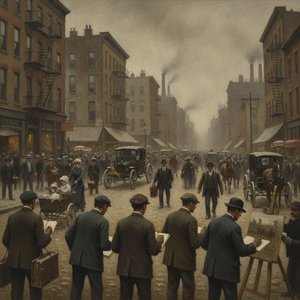
The Ashcan School: Capturing the Raw, Unfiltered Soul of Urban Life through American Realism
Discover the raw beauty of the Ashcan School. Explore how masters like Bellows and Henri captured the gritty, vibrant soul of early 20th-century New York through profound American Realism and evocative urban landscapes.

The Unvarnished Truth: A Cultural Journey Through the Soul of American Realism
Explore the profound beauty of American Realism. From the Ashcan School's urban grit to intimate portraits, discover how artists captured the authentic soul of a nation through unvarnished truth and masterful observation.
Explorez des œuvres d'art classées par thèmes, styles et caractéristiques.