


 Aperçu en situation
 Partager
 Partager
 Détails
 Guide imprimable

 Télécharger
 Articles similaires
 Radiographie
 Voir le diaporama
 Statistiques
Self Portrait


Experience the realism of Eastman Johnson's 'Self Portrait' (1860). A captivating oil painting showcasing an American artist’s nuanced portrayal of himself, reflecting a bygone era.
 Afficher la suite
Découvrez Jonathan Eastman Johnson (1824-1906), le "Rembrandt américain" ! Explorez ses scènes de genre, portraits de Lincoln et plus encore, capturant la vie américaine quotidienne avec l'influence des maîtres hollandais.
Reproduction à l'huile faite à la main
Huile sur toile peinte à la main, avec cadre et dimensions personnalisés, réalisée sur commande par nos artistes. ( Passer au format impression Passer au format image numérique)




P118B €10

P118H €10

P118W €10

P438Z €10

P508JH €12

P508YH €12

P805H €10

P805Z €10

P919BZ €10

P919G €10

P919XJ €10

P959ZH €10

P968JZ €12

W106C €8

W218G €10

W218JH €8

W218Y €10

W307PJ €10

W316G €10

W316PJ €8

W316Y €10

W398PJ €8

W4111J €10

W500HY €15

W500JH €15

W692G €12

W849H €8

W940BG €15

W953PJ €8




Format standard
personnalisé
CM
INCH
Choisissez parmi nos formats prédéfinis qui respectent les proportions originales de l’œuvre.
Loading sizes...

largeur
hauteur
Saisissez la largeur et la hauteur souhaitées, pour s'adapter à votre cadre ou à votre mur. Cette œuvre est peinte à la main ; ainsi, pour un format de forme différente, l'artiste peut peindre un peu plus autour du tableau ou réduire légèrement les bords — c'est vous qui choisissez. Nous vous envoyons une maquette numérique pour approbation avant que la peinture ne commence. L'image présentée sur cette page ne reflète pas le résultat réel — seule la maquette le fait.
Exemples de personnalisation possibles : remplacer un visage par la photo du client ; ajouter un animal de compagnie (par exemple, remplacer un chat par un chien) ; inclure un message caché en arrière-plan ; modifier le paysage ou les éléments de l'arrière-plan.
Après la commande, l’équipe TopImpressionists.com contactera le client par e-mail pour recueillir ses instructions et lui fournira une maquette d’aperçu
Après la commande, l’équipe TopImpressionists.com contactera le client par e-mail pour recueillir ses instructions et lui fournira une maquette d’aperçu
Livraison dans le monde entier () en 3 à 4 semaines au lieu des 5 semaines habituelles. (23 octobre). Aucun compromis sur la qualité.

Livraison express gratuite dans le monde entier

Toile de lin de haute qualité

Assurance transport complète

Garantie de remboursement des droits de douane

Garantie de fidélité des couleurs

Garantie de retour de 100 jours (uniquement en cas de défaut)

Garantie de remboursement à 100%

Tarifs dégressifs sur quantité
 L'option verre n'est disponible que pour les dimensions inférieures à 110 cm.

Self Portrait
Technique de reproduction
Format de la reproduction
-


Prix total final
€ 236
A Window into American Realism: Eastman Johnson’s “Self Portrait” (1860)
Eastman Johnson's "Self Portrait" of 1860 is more than just a likeness; it’s a meticulously crafted window into the soul of an era and the quiet dignity of a man. Painted during a pivotal period of American artistic development, this oil-on-canvas work embodies the burgeoning realism that would define Johnson's career and, in many ways, shape the course of 19th-century portraiture. The painting immediately draws the viewer in with its direct gaze – Johnson’s eyes meet ours across time, conveying a sense of thoughtful introspection and understated strength.
The composition is deceptively simple yet profoundly effective. Dressed in a dark, well-tailored coat and holding a red cloth—a subtle detail that hints at theatricality or perhaps a deliberate gesture of presentation – Johnson presents himself against a muted wall adorned with a vase and a clock. These elements aren’t merely decorative; they ground the portrait within a domestic setting, suggesting a life lived within the rhythms of everyday existence. The background's subdued palette further emphasizes the subject, allowing his features and demeanor to take center stage.
The Painter’s Palette: Technique and Style
Johnson’s masterful technique is rooted in the academic traditions he studied in Europe, particularly in Düsseldorf, Germany, where he honed his skills alongside other American artists seeking a rigorous artistic education. However, unlike many of his European contemporaries, Johnson didn't simply replicate established styles; he adapted them to reflect the unique character of American life. His brushwork is precise and controlled, yet imbued with a remarkable sensitivity to light and shadow. Note the subtle gradations in tone that define the contours of his face, creating a sense of volume and depth.
The painting’s realism extends beyond mere representation. Johnson captures not just Johnson's physical appearance but also something of his personality – a quiet confidence tempered by a hint of melancholy. The careful attention to detail—the texture of the coat, the slight furrow in his brow—reveals a deep understanding of human anatomy and expression. It’s a testament to Johnson’s ability to translate observation into compelling visual narrative.
A Man of His Time: Historical Context
To fully appreciate “Self Portrait,” it's essential to understand the social and artistic landscape of 1860 America. The nation was grappling with the aftermath of the Civil War, navigating a period of Reconstruction and profound societal change. Johnson’s work reflects this atmosphere of introspection and quiet resilience. He wasn’t interested in grand historical narratives or idealized representations; instead, he focused on capturing the realities of ordinary American life – a theme that would become increasingly prominent in his later genre paintings.
Johnson's connection to Washington D.C. is particularly significant. He lived and worked there for much of his career, documenting the lives of politicians, businessmen, and everyday citizens. His portraits offer invaluable insights into the social fabric of a rapidly evolving nation. The inclusion of elements like the vase and clock—common features of domestic interiors—further anchors the portrait within this specific context.
Symbolism and Emotional Resonance
While seemingly straightforward, “Self Portrait” is rich in subtle symbolism. The red cloth held in Johnson’s hand could represent passion, creativity, or perhaps a theatrical element – reflecting his involvement in stage design and set dressing. The direct gaze of the subject invites contemplation, prompting us to consider not only Johnson's identity but also our own relationship with self-representation and portraiture itself.
Ultimately, “Self Portrait” is a powerful testament to the enduring appeal of realism as an artistic approach. It’s a painting that speaks to the complexities of human experience – capturing both the outward appearance and the inner life of a man who sought to document his time with honesty, nuance, and a profound appreciation for the beauty of everyday existence.
Questions et réponses
Puis-je commander une reproduction à l'huile de « Self Portrait » ?
Les reproductions peintes à la main de «Self Portrait» de Jonathan Eastman Johnson sont vendues sur ce site web : une reproduction à l'huile peinte à la main sur toile de lin, via sa page Reproduction peinte à la main.
«Self Portrait» est-il l'une des œuvres les plus populaires de Jonathan Eastman Johnson ?
Le niveau de popularité enregistré pour «Self Portrait» de Jonathan Eastman Johnson est Recognized.
Quel âge avait Jonathan Eastman Johnson lors de la création de « Self Portrait » ?
Jonathan Eastman Johnson a réalisé « Self Portrait » à l'âge de 36. L'artiste est né en 1824 et l'œuvre date de 1860.
Biographie de l'artiste
Jonathan Eastman Johnson : Une Vie au Service de l'Art Américain
- Né: 29 juillet 1824, Lovell, Maine
- Décédé: 5 avril 1906, New York City
- Nationalité: Américaine
Jeunesse et Débuts Artistiques
- Johnson est né dans une famille ayant de fortes attaches avec les affaires et les organisations fraternelles. Son père, Philip Carrigan Johnson, y jouait un rôle actif.
- Il a grandi à Fryeburg et Augusta, Maine, acquérant une exposition précoce à la vie communautaire qui allait plus tard informer ses sujets artistiques.
- Sa formation artistique formelle a commencé en 1840 lorsqu'il fut apprenti auprès d'un lithographe de Boston, marquant le début de sa carrière d'artiste.
- Il déménagea à Washington D.C. à la fin des années 1840 avec sa famille en raison du poste de son père au Département de la Marine. Cette période l'exposa à divers sujets et expériences qui influencèrent son travail ultérieur.
Style Artistique, Influences et Développement
- Peinture d’Genre: Johnson est surtout connu pour ses peintures de genre – des scènes représentant la vie quotidienne. Ces œuvres offraient une perspective unique sur la société américaine, capturant les histoires de personnes ordinaires.
- Portraiture: Outre la peinture de genre, il était également un portraitiste habile, créant des ressemblances à la fois d'individus communs et de figures importantes comme Abraham Lincoln, Nathaniel Hawthorne, Ralph Waldo Emerson et Henry Wadsworth Longfellow.
- Influence des Maîtres Hollandais: Un tournant important dans son développement artistique survint dans les années 1850 lorsqu’il étudia l’œuvre des maîtres hollandais du XVIIe siècle à La Haye. Cette influence se manifeste dans la composition, l'éclairage et le réalisme de ses peintures ultérieures, lui valant le surnom de « Le Rembrandt américain ».
- Réalisme: Son travail s'inscrit dans le courant plus large du mouvement réaliste, soulignant les représentations précises de la vie quotidienne plutôt que des représentations idéalisées ou romancées.
Œuvres Majeures et Réalisations
- Vie des Nègres au Sud (1859): Considérée comme l'une des peintures les plus importantes du XIXe siècle en Amérique, cette œuvre dépeint des Afro-Américains profitant de leur temps libre. Elle a suscité un débat considérable sur les relations raciales et les conditions sociales dans le sud antebellum.
- Série de Guerre Civile: Johnson documenta l'impact de la guerre civile sur la vie civile à travers une série de peintures poignantes représentant des familles anxieuses et des scènes loin du champ de bataille. Ride For Liberty (1862) en est un exemple notable, dépeignant une famille asservie s’échappant vers la liberté.
- Scènes de Nouvelle-Angleterre: Ses représentations de la vie rurale de la Nouvelle-Angleterre, y compris la récolte du sucre d'érable et des canneberges, célébraient les valeurs et le savoir-faire traditionnels américains.
- Commandes de Portraits: Johnson gagna en reconnaissance pour ses portraits de figures importantes, notamment les présidents américains Chester Arthur, Grover Cleveland et Benjamin Harrison, ainsi que des hommes d'affaires influents comme Jay Gould et John D. Rockefeller.
- Co-fondateur du Metropolitan Museum of Art: L’engagement de Johnson envers l’art allait au-delà de sa propre pratique ; il fut un co-fondateur du Metropolitan Museum of Art à New York, son nom étant inscrit à son entrée, signifiant ainsi sa contribution significative au monde artistique américain.
Signification Historique et Héritage
- Pionnier de la Peinture d’Genre: Johnson a joué un rôle crucial dans l'établissement de la peinture de genre comme une forme d'expression artistique respectée en Amérique.
- Commentaire Social: Ses œuvres offraient souvent des commentaires sociaux subtils, incitant à la réflexion sur des questions telles que les relations raciales, les distinctions de classe et l'impact de la guerre.
- Influence sur le Réalisme Américain: La dévotion de Johnson à représenter la vie quotidienne avec honnêteté et détail a contribué à façonner le développement de la peinture réaliste américaine.
- Reconnaissance Durable: Aujourd'hui, Jonathan Eastman Johnson est reconnu comme une figure importante de l’histoire de l’art américain, célébré pour sa compétence technique, ses observations perspicaces et ses contributions durables au patrimoine artistique de la nation.

Jonathan Eastman Johnson
1824 - 1906 , Royaume-Uni
En bref
- Artistic Movement Or Style: Genre et Réalisme
- Artists Who Influenced This Artist: ['Maîtres néerlandais du XVIIe siècle']
- Date Of Birth: 29 juillet 1824
- Date Of Death: 5 avril 1906
- Full Name: Jonathan Eastman Johnson
- Nationality: Américain
- Notable Artworks:
- Negro Life at the South
- Ride For Liberty
- Scènes de Nouvelle-Angleterre
- Place Of Birth: Lovell, Royaume-Uni
Articles connexes
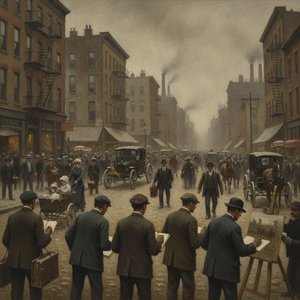
The Ashcan School: Capturing the Raw, Unfiltered Soul of Urban Life through American Realism
Discover the raw beauty of the Ashcan School. Explore how masters like Bellows and Henri captured the gritty, vibrant soul of early 20th-century New York through profound American Realism and evocative urban landscapes.

The Unvarnished Truth: A Cultural Journey Through the Soul of American Realism
Explore the profound beauty of American Realism. From the Ashcan School's urban grit to intimate portraits, discover how artists captured the authentic soul of a nation through unvarnished truth and masterful observation.

The Raw Truth: A Definitive Guide to the Power and Legacy of Social Realism Art
Explore the profound impact of Social Realism. Discover how masters like Courbet rejected idealism to capture the raw, socio-political truths of the working class through powerful, unvarnished art history and enduring visual critique.
Explorez des œuvres d'art classées par thèmes, styles et caractéristiques.


