

 Aperçu en situation
 Envoyer
 Partager
 Détails de l'œuvre
 Guide
Guide

 Télécharger l'image
 Articles similaires
 Radiographie
 Diaporama
 Statistiques
Crucifixion
 Huile sur toile
- Art mural
- Renaissance Dutch
 1545
1545- Renaissance
 101.0 x 58.0 cm
 Musée de l'Ermitage
Experience the dramatic realism of Van Heemskerck's 1545 Crucifixion triptych, blending Dutch detail with Italian grandeur; discover this masterpiece today.
 Lire la suite
Maerten van Heemskerck (1498-1574) était un peintre néerlandais de la Renaissance connu pour ses portraits innovants, ses scènes religieuses et son influence italienne. Découvrez ses chefs-d'œuvre emblématiques comme « Samson Shattering the Pillars » et plongez au cœur de l’histoire artistique flamande !
Reproduction à l'huile faite à la main
Huile sur toile peinte à la main, avec cadre et dimensions personnalisés, réalisée sur commande par nos artistes. ( Passer au format impression Passer au format numérique)




P118B €10

P118H €10

P118W €10

P438Z €10

P508JH €12

P508YH €12

P805H €10

P805Z €10

P919BZ €10

P919G €10

P919XJ €10

P959ZH €10

P968JZ €12

W106C €8

W218G €10

W218JH €8

W218Y €10

W307PJ €10

W316G €10

W316PJ €8

W316Y €10

W398PJ €8

W4111J €10

W500HY €15

W500JH €15

W692G €12

W849H €8

W940BG €15

W953PJ €8




Format standard
sur mesure
CM
INCH
Choisissez parmi nos formats prédéfinis qui respectent les proportions originales de l’œuvre.
Loading sizes...

largeur
hauteur
Saisissez la largeur et la hauteur souhaitées, pour s'adapter à votre cadre ou à votre mur. Cette œuvre est peinte à la main ; ainsi, pour un format de forme différente, l'artiste peut peindre un peu plus autour du tableau ou réduire légèrement les bords — c'est vous qui choisissez. Nous vous envoyons une maquette numérique pour approbation avant que la peinture ne commence. L'image présentée sur cette page ne reflète pas le résultat réel — seule la maquette le fait.
Exemples de personnalisation possibles : remplacer un visage par la photo du client ; ajouter un animal de compagnie (par exemple, remplacer un chat par un chien) ; inclure un message caché en arrière-plan ; modifier le paysage ou les éléments de l'arrière-plan.
Après la commande, l’équipe TopImpressionists.com contactera le client par e-mail pour recueillir ses instructions et lui fournira une maquette d’aperçu
Après la commande, l’équipe TopImpressionists.com contactera le client par e-mail pour recueillir ses instructions et lui fournira une maquette d’aperçu
Livraison dans le monde entier () en 3 à 4 semaines au lieu des 5 semaines habituelles. (26 octobre). Aucun compromis sur la qualité.

Livraison express gratuite dans le monde entier

Toile de lin de qualité supérieure

Assurance transport complète

Garantie de remboursement des droits de douane

Garantie de fidélité des couleurs

Politique de retour de 100 jours (uniquement en cas de défaut)

Garantie de remboursement à 100%

Offre de tarifs dégressifs
 L'option verre n'est disponible que pour les dimensions inférieures à 110 cm.

Crucifixion
Technique de reproduction
Format de la reproduction
-


Prix total
€ 236
A Window Into Faith: Maerten van Heemskerck’s Crucifixion Triptych
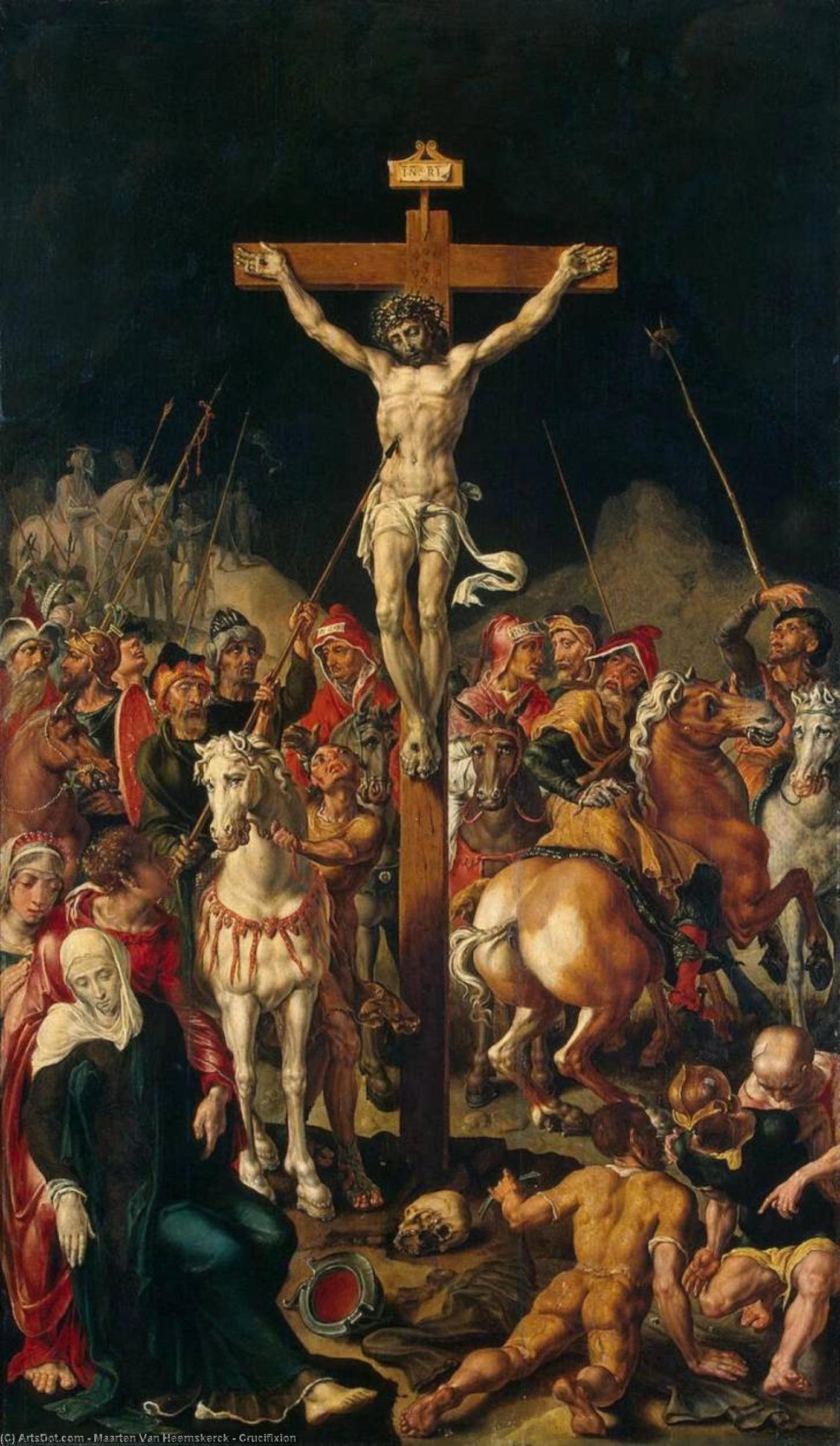
The Crucifixion by Maerten van Heemskerck, completed in 1545, stands as a monumental achievement of the Dutch Renaissance and a testament to the enduring power of religious iconography. More than just a depiction of Christ's suffering – though undeniably poignant – this triptych transcends mere representation, immersing viewers in a meticulously crafted tableau that speaks volumes about humanist ideals and artistic innovation. Painted during a period marked by fervent piety and intellectual curiosity, it embodies the spirit of its time while simultaneously securing its place as one of the most influential artworks of the era.Style and Technique: Bridging Italian Renaissance Grandeur with Dutch Realism
Van Heemskerck skillfully blended elements of Italian Renaissance grandeur with the burgeoning realism characteristic of Dutch art. Influenced by artists like Michelangelo and Raphael, he adopted a pyramidal composition – a technique favored in monumental religious paintings – to convey stability and solemnity. However, unlike many Italian counterparts that prioritized idealized beauty, Van Heemskerck’s approach embraced meticulous detail and naturalistic observation. The artist painstakingly rendered textures—the rough linen of Christ's robe, the weathered stone of the cross—creating a palpable sense of physicality that distinguishes it from more stylized depictions. This careful attention to realism was further enhanced by his masterful use of chiaroscuro – dramatic contrasts between light and shadow – which sculptured form and imbued the scene with emotional depth.Historical Context: Rome Under Charles V and the Reformation’s Influence
The Crucifixion's creation coincided with a pivotal moment in European history: the reign of Charles V, Holy Roman Emperor, and the escalating tensions surrounding the Protestant Reformation. The Habsburg monarch championed Catholicism fiercely, commissioning artworks like this to reaffirm papal authority and bolster religious faith. Yet, Van Heemskerck’s work wasn’t solely driven by political considerations; it reflected a broader humanist preoccupation with human suffering and mortality – themes explored extensively in classical literature and philosophy. The triptych served as part of a larger project to decorate the Porta San Sebastiano in Rome, commemorating Charles V's victory over Protestant forces—a visual declaration of imperial piety amidst religious upheaval.Symbolism: Layers of Meaning Beyond Visual Representation
The Crucifixion’s symbolism is rich and multifaceted. The central panel depicts Jesus Christ crucified on the cross, a universally recognized emblem of sacrifice and redemption. His outstretched arms symbolize humility and acceptance of divine judgment, while his gaze directs upward towards God—a gesture signifying hope and spiritual aspiration. Surrounding him are figures representing Mary Magdalene, Nicodemus, Joseph of Arimathea, and others who witnessed Christ’s death – each embodying compassion and devotion. The inclusion of a horse on the right panel reinforces the imagery of royalty and divine majesty, mirroring the emperor's patronage. Furthermore, the cup positioned at the bottom left corner symbolizes the Eucharist—the sacrament commemorating Jesus’s sacrifice—underscoring the theological significance of the artwork.Emotional Impact: A Profound Reflection on Suffering and Faith
Ultimately, Maerten van Heemskerck’s Crucifixion transcends mere visual spectacle; it evokes a profound emotional response in viewers. The subdued palette – dominated by earthy tones – contributes to an atmosphere of solemn contemplation. Yet, the artist's masterful manipulation of light and shadow intensifies the drama of the scene, conveying the agony of Christ’s torment and eliciting empathy for his suffering. It compels us to confront questions about faith, mortality, and divine compassion—themes that continue to resonate across centuries. The Crucifixion remains a powerful reminder of humanity's capacity for sorrow and its unwavering belief in redemption – an enduring masterpiece that secures its place as one of the most poignant expressions of Renaissance spirituality.Questions et réponses
Dans quelle pièce recommanderiez-vous d'exposer «Crucifixion» de Maerten Van Heemskerck ?
Une reproduction de « Crucifixion » s'intègre parfaitement dans une Salon.
Puis-je commander une reproduction à l'huile de « Crucifixion » ?
Vous pouvez commander une reproduction peinte à la main de «Crucifixion» de Maerten Van Heemskerck directement sur sa page Reproduction peinte à la main : une reproduction à l'huile peinte à la main sur toile de lin, réalisée sur commande.
L'œuvre « Crucifixion » dispose-t-elle d'un aperçu en réalité augmentée ?
Visualisez «Crucifixion» de Maerten Van Heemskerck sur votre propre mur grâce à la page Aperçu en RA de l'œuvre, en utilisant la réalité augmentée sur un appareil compatible.
Biographie de l'artiste
Early Life and Training
Maerten Jacobsz van Heemskerck, a titan of Dutch Renaissance art, emerged from humble beginnings in the village of Heemskerk, North Holland, circa 1498. His artistic journey commenced under the tutelage of Cornelius Willemsz in Haarlem, establishing a foundational understanding of painting techniques and stylistic considerations. This formative period was further enriched by brief studies with Jan Lucasz in Delft, exposing him to the burgeoning artistic fervor of the Low Countries. However, his true mentor proved to be Jan van Scorel, whose Italianate style profoundly shaped Heemskerck’s aesthetic sensibilities—a style characterized by dramatic chiaroscuro and meticulous detail.Career Highlights
Maerten van Heemskerck's oeuvre distinguishes itself through a masterful fusion of Dutch realism with the grandeur of Italian Mannerism. His magnum opus, “The Donor and Saint Mary Magdalene,” stands as an unparalleled exemplar of Dutch family portraiture, pioneering a genre that would define its era. This monumental canvas embodies his meticulous observation of human anatomy and psychological nuance—a hallmark of his artistic approach. Notably, Heemskerck collaborated extensively with prominent artists such as Antonio da Sangallo the Younger, Battista Franco, and Francesco de’ Rossi (il Salviati) on the ambitious redecoration project of the Porta San Sebastiano in Rome – a testament to his rapid adaptability and skill as a scene painter during his formative years abroad. Furthermore, Heemskerck's drawings—particularly those depicting classical sculptures and architectural marvels—offer invaluable insight into his engagement with Italian artistic heritage. These sketches, now housed in two meticulously preserved albums at the Kupferstichkabinett Berlin, reveal an unwavering dedication to capturing the essence of Roman art and its influence on European aesthetics.Notable Works and Legacy
Heemskerck’s artistic output spanned a remarkable range of subjects—religious iconography alongside secular portraits—demonstrating his versatility as a painter. Among his most celebrated compositions are “Lamentation on the Dead Christ,” a poignant depiction of sorrowful grief imbued with emotional depth, and “Pieter Jan Foppeszoon and His Family,” which showcases an exceptional level of realism in portraying familial bonds. Yet, perhaps his enduring fame rests upon “Samson Shattering the Pillars of the Temple,” a dramatic tableau capturing the biblical narrative with breathtaking dynamism and expressive force—a masterpiece that cemented his reputation as one of the foremost artists of his time. Maerten van Heemskerck’s legacy extends far beyond his individual artworks; he fundamentally reshaped Dutch artistic conventions, establishing precedents for future generations of painters and solidifying his place among the luminaries of Northern Renaissance art history. His influence can be discerned in subsequent stylistic developments and continues to inspire artists today.Historical Significance
Maerten van Heemskerck’s contribution to the visual arts transcends mere technical proficiency; he embodies the spirit of humanist inquiry and artistic innovation that characterized the High Renaissance—a period marked by a renewed interest in classical ideals and a fervent pursuit of beauty and truth. His pioneering family portraits revolutionized genre painting, elevating it to new heights of psychological complexity and artistic sophistication. Moreover, his involvement in monumental projects like the Porta San Sebastiano underscored his role as a key participant in shaping cultural discourse and commemorating significant historical events—a testament to his artistic prowess and intellectual engagement. Maerten van Heemskerck’s enduring influence serves as an inspiration for artists striving to achieve excellence and convey profound human emotions through visual mediums.
Maerten Van Heemskerck
1498 - 1574 , Pays-Bas
L'essentiel de l'artiste
- Artistic Movement Or Style: Mannerisme
- Artists Who Influenced This Artist:
- Jan van Scorel
- Antonio Da Sangallo
- Date Of Birth: 1 juin 1498
- Date Of Death: 1 octobre 1574
- Full Name: Maerten Jacobsz van Heemskerck
- Nationality: Pays-Bas
- Notable Artworks:
- La Lamentation sur le Christ
- Saint Pierre et Saint Jean
- Samson frappant les piliers du temple
- Place Of Birth: Heemskerk, Pays-Bas
Articles connexes

Golden Light & Dutch Skies: The Timeless Magic of Dutch Golden Age Landscapes
Discover the breathtaking beauty of Dutch Golden Age landscapes. Explore the mastery of light, chiaroscuro, and 17th-century realism through an expert art history lens, celebrating the enduring legacy of the Dutch Masters for discerning collectors and art lovers.

Mastering Light & Shadow: A Journey Through the Dutch Golden Age's Luminous Legacy
Embark on a cultural journey through the Dutch Golden Age. Explore the masterful interplay of light and shadow in 17th-century masterpieces, from Rembrandt to Vermeer, and discover how this era of profound realism continues to inspire fine art collectors today.
Explorez des œuvres d'art classées par thèmes, styles et caractéristiques.


