
Shown: · With its frame:
 Aperçu en situation
 Envoyer
 Partager
 Détails de l'œuvre
 Guide
Guide

 Télécharger l'image
 Articles similaires
 Radiographie
 Diaporama
 Q&A
Q&A Statistiques
- 43.0 x 57.0 cm


€ 239
Reproduction à l'huile faite à la main
Huile sur toile peinte à la main, avec cadre et dimensions personnalisés, réalisée sur commande par nos artistes. ( Passer au format impression Passer au format numérique)
Cette œuvre est protégée par le droit d'auteur
L’œuvre d'art présentée sur cette page est protégée par le droit d'auteur, ce qui signifie que nous ne pouvons légalement créer ou vendre de reproduction identique. Cette protection est appliquée en vertu d'accords internationaux tels que la Convention de Berne et par les lois nationales, notamment celles énoncées par le Loi américaine sur le droit d'auteur - Titre 17.
En tant qu'alternative respectueuse et légale, nous proposons des œuvres d'art personnalisées, peintes à la main et inspirées de l'original. Nos artistes talentueux et professionnels étudient avec soin le style, l'ambiance et l'essence artistique de l'œuvre originale pour créer une pièce nouvelle et unique qui évoque la même émotion — tout en restant une création originale en soi.
Cette méthode est pleinement conforme aux réglementations sur le droit d'auteur car elle ne repose pas sur la copie ou la duplication de l'œuvre protégée. Il s'agit plutôt d'une réinterprétation créative — une nouvelle peinture qui s'inspire de l'original sans pour autant lui être identique.
 En savoir plus
Size
·Format standard
sur mesure
CM
INCH
Choisissez parmi nos formats prédéfinis qui respectent les proportions originales de l’œuvre.
Loading sizes...

largeur
hauteur
Saisissez la largeur et la hauteur souhaitées, pour s'adapter à votre cadre ou à votre mur. Cette œuvre est peinte à la main ; ainsi, pour un format de forme différente, l'artiste peut peindre un peu plus autour du tableau ou réduire légèrement les bords — c'est vous qui choisissez. Nous vous envoyons une maquette numérique pour approbation avant que la peinture ne commence. L'image présentée sur cette page ne reflète pas le résultat réel — seule la maquette le fait.
Finish
·
White €1

Blurside €1

Extended €1

P118B €10

P118H €10

P118W €10

P438Z €10

P508JH €12

P508YH €12

P805H €10

P805Z €10

P919BZ €10

P919G €10

P919XJ €10

P959ZH €10

P968JZ €12

W106C €8

W218G €10

W218JH €8

W218Y €10

W307PJ €10

W316G €10

W316PJ €8

W316Y €10

W398PJ €8

W4111J €10

W500HY €15

W500JH €15

W692G €12

W849H €8

W940BG €15

W953PJ €8

H24-GOLD €30

H24-SILVER €30

H36-GOLD €45

H36-SILVER €45
Shipped in a protective tube, ready for your own framer.
Above 105 cm the frame is shipped as a kit for a professional framer — read the details.
Extras
optionalWhat do the extras include?
Examples of what can be changed: Replace face with customer photo; Add pet (e.g., replace cat with dog); Include hidden message in background; Change background landscape or elements.
After order, TopImpressionists.com team will email client for instructions and provide a mockup preview
After order, TopImpressionists.com team will email client for instructions and provide a mockup preview
Livraison dans le monde entier () en 3 à 4 semaines au lieu des 5 semaines habituelles. (1 novembre). Aucun compromis sur la qualité.
Vernis de protection
Cartel
Détails de la plaque en bronze gravée
This elegant plaque features the artist's name and the title of the artwork, finely engraved for a timeless presentation.
It is made from bronze with a refined, elegant finish. The text is precisely laser-engraved for a sharp and permanent result. Measuring 9x2 cm, the plaque is compact yet easy to read. It's built to be durable and scratch-resistant, offering a professional, museum-quality look. Mounting is simple thanks to the included adhesive backing.
Détails de la plaque en acrylique transparent
The plaque includes essential engraved details such as the artist's name, the title of the artwork, the date it was created, the type of media used-like oil on canvas or watercolor-a brief description of the piece, and a QR code that links to the complete artwork information.
It is crafted from clear acrylic, offering a sleek, modern appearance. The text is UV-engraved in black to ensure strong visual contrast. With a size of 10x15 cm, it ensures optimal readability. It comes equipped with two metal hooks for secure wall mounting. The plaque is designed to be weather-resistant, making it suitable for various environments, and it includes interactive features that work seamlessly with smartphone scanning.
Détails de la plaque en acrylique noir
This elegant plaque includes engraved information such as the artist's name, the title of the artwork, the date it was created, the type of media used (like oil on canvas or watercolor), a short description of the artwork, and a QR code for quick access to more information.
The plaque itself is made from refined black acrylic with a premium finish. The text is laser-engraved in white for high contrast and readability. Its size is 10x15 cm, designed to be easy to read. It comes with two metal hooks for professional mounting. The design is sleek and fits any interior style. It is also weather-resistant and durable, with built-in digital integration for mobile compatibility.
L'option verre n'est disponible que pour les dimensions inférieures à 110 cm.
 L'option verre n'est disponible que pour les dimensions inférieures à 110 cm.
- Livraison express gratuite dans le monde entier
- Toile de lin de qualité supérieure
- Assurance transport complète
- Garantie de remboursement des droits de douane
- Garantie de fidélité des couleurs
- Politique de retour de 100 jours (uniquement en cas de défaut)
- Garantie de remboursement à 100%
- Offre de tarifs dégressifs


Description de la pièce
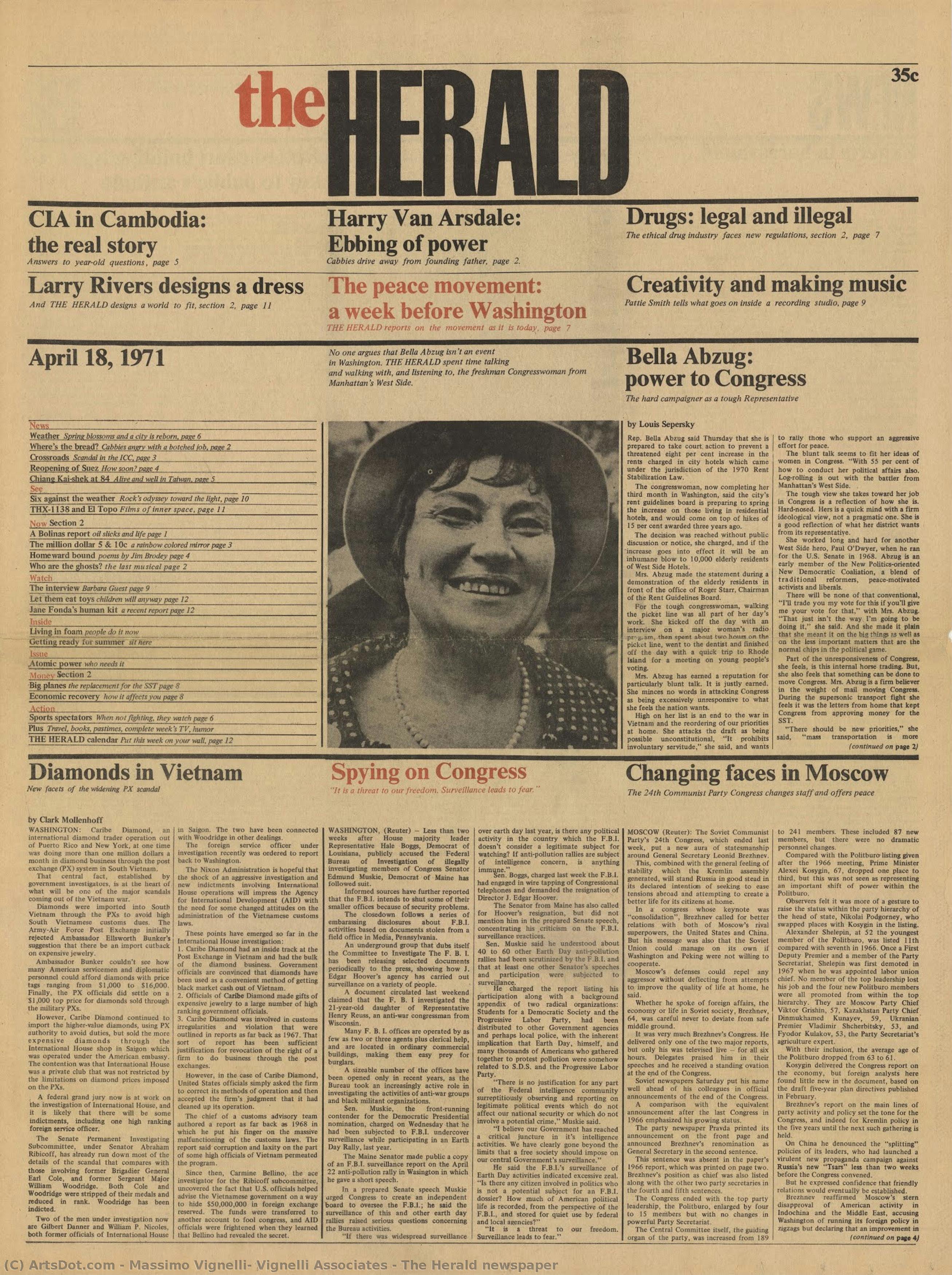
Experience the modernist grid design of The Herald newspaper by Massimo Vignelli (1971), showcasing vintage graphic communication art; discover this iconic piece today.
Biographie de l'artiste
Meta Description: Massimo Vignelli (1931-2014): Icône italienne du design minimaliste, célèbre pour la carte du métro de NYC et les identités visuelles marquantes. Découvrez son héritage ! ==== END RESPONSE ====
About the painting
The Grid of Modern Communication: Vignelli's The Herald
To encounter this piece is to step directly into the vibrant, structured chaos of mid-century New York journalism. This reproduction of The Herald newspaper from April 1971, conceived by Massimo Vignelli and his associates, is far more than mere ephemera; it is a meticulously designed artifact of visual communication history. It captures a moment when design principles—simplicity, functionality, and rigorous structure—were being aggressively applied to the seemingly unruly medium of print journalism. The very act of presenting this newspaper front page transforms what might be considered disposable media into a profound study in modernist graphic discipline.
A Masterclass in Structured Design
Vignelli’s genius, always rooted in an almost architectural understanding of space, is on full display here. The description notes the structure: a rigid grid of six columns and sixteen modules per column. This underlying skeleton dictates every element—the placement of headlines like "Diamonds in Vietnam," the accompanying portrait of the smiling woman, and the smaller articles detailing everything from spying congress to changing leaves in Moscow. Vignelli’s commitment to using a single typeface, Times Roman, across various weights and sizes, speaks volumes about his belief in universal legibility. It is a powerful testament to the idea that restraint—the disciplined use of negative space and consistent typography—can generate an overwhelming sense of order and sophistication.
Historical Resonance and Materiality
The year 1971 places this work within a fascinating cultural nexus, post-war modernism grappling with the burgeoning media landscape. While the paper itself ultimately folded due to distribution issues, its surviving design remains potent. For the collector or designer, understanding this context is key. This piece speaks to an era obsessed with efficiency and clarity in information transfer. When considering a reproduction for your space, you are not just acquiring art; you are curating a dialogue about how we consume knowledge—a conversation between the fleeting headline and the enduring power of good design.
Symbolism of the Grid
The grid itself functions as the primary symbolic element. In an age where digital information often feels overwhelming, this physical manifestation of order offers a visual anchor. It symbolizes control, but not oppressive control; rather, it suggests that even complex narratives—the confluence of international events and local interest—can be organized into digestible, beautiful patterns. The interplay between the large, arresting photograph and the tightly packed textual modules creates a dynamic tension, mirroring the very energy of a bustling city like New York in that era.
Bringing Modernist Precision Home
For interior design or gallery display, this piece offers an unparalleled opportunity to inject intellectual rigor into a space. It pairs beautifully with minimalist furniture, mid-century modern accents, or any setting that appreciates the clean lines of 20th-century industrial aesthetics. Owning this reproduction is an homage to Massimo Vignelli’s lifelong dedication to elevating the mundane—the daily newspaper—into something enduringly beautiful and intellectually stimulating.
Questions et réponses
À quel mouvement artistique appartient « The Herald newspaper » ?
Le mouvement associé à «The Herald newspaper» de Massimo Vignelli, Vignelli Associates est Modernism. Cette classification situe l'œuvre parmi des artistes et des œuvres d'art apparentés.
Quel est l'usage recommandé pour une impression de « The Herald newspaper » ?
Cette impression de « The Herald newspaper » est idéale pour Statement.
Quelle est la forme de «The Herald newspaper» de Massimo Vignelli, Vignelli Associates et quelles sont ses dimensions ?
L'œuvre « The Herald newspaper » est au format Portrait et l'original mesure 43 x 57 cm. Ces deux informations sont utiles lors de la planification d'une reproduction.
Quick facts and art quiz
About Massimo Vignelli, Vignelli Associates

Massimo Vignelli, Vignelli Associates
1931 - 2014, Italie
Biographie de l'artiste
Début de vie et carrière
Massimo Vignelli, un designer italien renommé, est né le 10 janvier 1931 à Milan. Il a étudié l'architecture au Politecnico di Milano puis à l'Università IUAV de Venise. À l'âge de 16 ans, il rejoint le cabinet des frères Castiglioni, qui concevait dans une grande variété de domaines.
Œuvres et contributions notables
Le style de Massimo Vignelli mettait l'accent sur la simplicité, en utilisant des formes géométriques basiques et une gamme limitée de polices de caractères. Parmi ses œuvres les plus notables figurent :
- Heller Rainbow Dinnerware, un projet de conception d'un service de vaisselle empilable, qui mettait en valeur son approche minimaliste.
- Tredicesima Triennale di Milano, une affiche dont la conception reflétait son utilisation de couleurs vives et de formes géométriques.
- Knoll Design (couverture), une couverture démontrant sa capacité à créer des visuels saisissants pour des marques renommées.
Collaborations et associations
Massimo Vignelli a cofondé Vignelli Associates avec son épouse, Lella Vignelli, en 1971. Ce partenariat a conduit à la création de nombreuses conceptions emblématiques, notamment la signalétique du métro de New York.
Héritage et impact
L'influence de Massimo Vignelli sur le design italien est indéniable. Son travail a été présenté dans divers musées, dont le Vignelli Center for Design Studies à Rochester, aux États-Unis. Ses créations continuent d'inspirer les nouvelles générations de designers et d'artistes.
Œuvres sélectionnées disponibles sur TopImpressionists.com
- Heller Rainbow Dinnerware (vue de face)
- Tredicesima Triennale di Milano (rouge sur rose)
- Knoll Design (couverture)
Références
Quick facts about Massimo Vignelli, Vignelli Associates
- Date De Décès: 27 mai 2014
- Date De Naissance: 10 janvier 1931
- Lieu De Naissance: Milan, Italie
- Mouvement Artistique: Modernisme, Minimalisme
- Nationalité: Italienne
- Nom Complet: Massimo Vignelli
- Œuvres Notables:
- Heller Rainbow Dinnerware
- Triennale di Milano
- Knoll Design (couverture)
Explorez des œuvres d'art classées par thèmes, styles et caractéristiques.

![Vaisselle arc-en-ciel Heller
[vue de face]](/media/artworks/images-thumb/cd/9c/cd9c3f1015cd05d21f20d796279c84cb.jpg)
![Heller Le Groupe Arc-en-ciel
[vue de face]](/media/artworks/images-thumb/63/ff/63ff27e205bc52fa330b5129aaab17df.jpg)

![Fort Worth Art Museum Le film italien : Néoréalisme et au-delà affiche et calendrier d'événements
[vue de face]](/media/artworks/images-thumb/9a/f3/9af3622e1fac840c383fbfca8217073b.jpg)

![Knoll International
[vue de face]](/media/artworks/images-thumb/3f/ee/3feeb868249b96ea2d449739ed478876.jpg)
![Milano
[vue de couverture, pliée]](/media/artworks/images-thumb/d9/d4/d9d4b14c78e469c5d339069b4321c34b.jpg)


![Tredicesima Triennale di Milano
[rouge sur rose]](/media/artworks/images-thumb/d5/7c/d57c0494b16c39484ce82132534f6312.jpg)


![La Maison Blanche
[vue de face]](/media/artworks/images-thumb/a8/c8/a8c8083505c92320e67caa42c197cd7d.jpg)


Massimo Vignelli, Vignelli Associates
The Herald newspaper
() ·
With its frame: · Hand-painted in oil on linen
Total