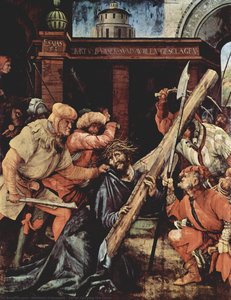
Aperçu en situation
 Envoyer
 Partager
 Détails de l'œuvre
 Guide
Guide

 Télécharger l'image
 Articles similaires
 Radiographie
 Diaporama
 Q&A
Q&A Statistiques
St Anthony (detail)


Witness the profound spiritual intensity of Matthias Grünewald's 'St Anthony Tempted,' a masterpiece capturing Saint Anthony’s struggle against demonic forces. Explore its rich symbolism and artistic brilliance.
 Lire la suite
Explorez l'art dramatique de Matthias Grünewald de la Renaissance allemande ! Connu pour le Retable d'Issenheim et ses peintures religieuses chargées d'émotion. Découvrez son style unique chez TopImpressionists.
Giclées et impressions d'art
Impressions giclées ou sur toile de qualité musée, avec une production rapide et des finitions au choix. ( Commander la reproduction peinte à la main Passer au format numérique)




P118B €10

P118H €10

P118W €10

P438Z €10

P508JH €12

P508YH €12

P805H €10

P805Z €10

P919BZ €10

P919G €10

P919XJ €10

P959ZH €10

P968JZ €12

W106C €8

W218G €10

W218JH €8

W218Y €10

W307PJ €10

W316G €10

W316PJ €8

W316Y €10

W398PJ €8

W4111J €10

W500HY €15

W500JH €15

W692G €12

W849H €8

W940BG €15

W953PJ €8




Format standard
sur mesure
CM
INCH
Choisissez parmi nos formats prédéfinis qui respectent les proportions originales de l’œuvre.
Loading sizes...

largeur
hauteur
Saisissez la largeur et la hauteur souhaitées pour qu'elles s'adaptent à votre cadre ou à votre mur. Une impression peut être recadrée, mais jamais agrandie au-delà de l'image originale ; ainsi, un format de forme différente entraînera la perte d'une partie de l'image. Nous vous envoyons une maquette numérique pour approbation avant toute impression. L'image présentée sur cette page ne montre pas le recadrage réel — seule la maquette le permet.
Livraison dans le monde entier () en 2 semaines au lieu des 4/5 semaines habituelles. (1 novembre)

Livraison express gratuite dans le monde entier

Toile de lin de qualité supérieure

Assurance transport complète

Garantie de remboursement des droits de douane

Garantie de fidélité des couleurs

Politique de retour de 100 jours (uniquement en cas de défaut)

Garantie de remboursement à 100%

Offre de tarifs dégressifs
 L'option verre n'est disponible que pour les dimensions inférieures à 110 cm.

St Anthony (detail)
Giclées et impressions d'art
Format de la reproduction
-


Prix total
€ 61
The Weight of the Desert: A Study in Medieval Devotion
Matthias Grünewald’s “St Anthony (detail)” is not merely a portrait; it's an immersion into the psychological and spiritual landscape of 16th-century Germany. Painted around 1515, this intimate depiction captures a moment of profound contemplation within the saint’s solitary desert existence – a world rendered with startling realism amidst the conventions of late medieval art. The painting immediately draws the eye to Anthony's face: etched with lines of worry and deep thought, his gaze is directed slightly off-center, suggesting an internal struggle, a battle waged not against external foes but against the seductive whispers of temptation. The muted palette – dominated by earthy browns, ochres, and subtle blues – reinforces this sense of introspection, creating a space that feels both grounded and profoundly melancholic.
- Technique: Grünewald’s mastery lies in his meticulous attention to detail. The texture of Anthony's beard is rendered with an almost sculptural quality, each strand meticulously painted; the folds of his crimson cloak are subtly defined, conveying a sense of weight and movement. The use of *sfumato*, a technique borrowed from Renaissance masters, softens the edges and creates a hazy atmosphere, contributing to the painting’s dreamlike quality.
- Composition: The composition is deliberately restrained, focusing entirely on Anthony and his immediate surroundings. This intensifies the sense of isolation and draws the viewer into the saint's inner world. The dark background serves to further isolate the figure, emphasizing his vulnerability and spiritual struggle.
Echoes of the Isenheim Altarpiece
“St Anthony (detail)” is inextricably linked to Grünewald’s monumental Isenheim Altarpiece, a work that profoundly shaped the artist's style and vision. While the altarpiece itself is a complex tapestry of religious imagery, this panel offers a concentrated distillation of its core themes: temptation, solitude, and the enduring power of faith. The stylistic similarities are striking – the same dramatic use of light and shadow, the same intense emotionality, and the same willingness to depict human suffering with unflinching honesty. It’s believed that Grünewald was working on this detail while simultaneously contributing to the larger altarpiece project, demonstrating a remarkable capacity for simultaneous creation.
Research Note: The Isenheim Altarpiece offers an unparalleled opportunity to witness Grünewald’s artistic genius in full context, revealing the depth and complexity of his vision.Symbolism: The Desert's Silent Language
Beyond its immediate depiction of St. Anthony, the painting is laden with symbolic meaning. The barren landscape surrounding the saint represents the harsh realities of desert life – a place of deprivation, solitude, and constant temptation. The small cell within the ruined tower symbolizes Anthony’s retreat into himself, his dedication to prayer and contemplation. The presence of the demonic figures, rendered in shadowy detail, underscores the ongoing struggle against evil that defines the saint's journey. Notably, the inclusion of a small crucifix within the cell suggests the ultimate source of strength and salvation – a reminder of Christ’s sacrifice and the promise of redemption.
- The Red Hat: The distinctive red hat worn by Anthony is not merely decorative; it's a symbol of his dedication to the Franciscan Order, signifying humility and service.
- The Deer: The deer in the foreground represents worldly desires and temptations, subtly hinting at the challenges Anthony faces in maintaining his spiritual purity.
A Window into the Soul
“St Anthony (detail)” transcends its status as a mere religious painting; it’s a profound meditation on human nature – on our capacity for both great suffering and enduring faith. Grünewald's ability to capture the weight of the desert, the intensity of inner turmoil, and the quiet dignity of a man wrestling with his demons is truly remarkable. This intimate portrait invites viewers to contemplate their own struggles, their own temptations, and their own search for meaning in a world often characterized by uncertainty and despair. It remains a powerful testament to the enduring legacy of one of Germany’s greatest Renaissance artists.
Questions et réponses
Quelle est la couleur dominante de «St Anthony (detail)» de Matthias Grünewald ?
La couleur dominante de «St Anthony (detail)» de Matthias Grünewald est le Noir (#161311).
«St Anthony (detail)» de Matthias Grünewald utilise-t-il des contrastes marqués ou des harmonies douces ?
Dans « St Anthony (detail) », un Niveau de contraste contraste s'allie à une Forte unité chromatique harmonie.
«St Anthony (detail)» de Matthias Grünewald est-il une peinture, un dessin ou une estampe ?
«St Anthony (detail)» de Matthias Grünewald est classé comme Décoration murale. Cette catégorie définit la nature de l'œuvre originale.
Biographie de l'artiste
Matthias Grünewald : Vie et Héritage
Jeunesse et Débuts Artistiques
Matthias Grünewald, né Mathis Gothart Neithardt vers 1470-1475 à Würzburg, en Allemagne, est une figure centrale du Renouveau allemand. Bien qu'il ait vécu dans une période de plus en plus influencée par les idéaux du Renouveau italien, Grünewald est resté profondément ancré dans les traditions artistiques tardives de l’Europe centrale médiévale. Les détails sur sa jeunesse sont rares, mais il est connu qu'il a reçu une formation artistique, probablement au sein d'ateliers locaux.
Développement Artistique et Influences
Le développement artistique de Grünewald a été façonné par les traditions nordiques prévalentes de réalisme, d’intensité émotionnelle et d’observation détaillée. Son œuvre témoigne des influences d'artistes tels qu'Albrecht Dürer et Martin Schongauer, mais il a tracé un chemin unique caractérisé par une expression dramatique et des couleurs vives. Il n'a pas été directement impliqué dans les cercles humanistes prévalents en Italie ; à la place, son art servait principalement à des fins religieuses, reflétant les angoisses spirituelles de son temps.
Œuvres Majeures et Style Artistique
- L'Autel d’Issenheim (1512-1516) : Ce chef-d'œuvre, exposé au Musée d'Unterlinden à Colmar, est considéré comme l'apogée de Grünewald. Il dépeint des scènes de la vie du Christ avec un réalisme saisissant, en particulier en se concentrant sur la souffrance et le salut.
- La Crucifixation (c. 1502-1503) : Une œuvre précoce démontrant son style en développement, mettant en valeur une émotion intense et un détail anatomique.
- Vierge de l'Annonciation (1512-14) : Étude pour l’Autel d’Issenheim, révélant son processus de planification méticuleux.
- Moïse (1511) : Dessin mettant en évidence le talent de Grünewald pour capturer des figures expressives et des poses dramatiques.
Le style de Grünewald se distingue par:
- Composition Dramatique : Il a utilisé des arrangements dynamiques pour intensifier l'impact émotionnel.
- Palette de Couleurs Vives : Son utilisation de couleurs intenses, souvent contrastées, a créé une expérience visuelle puissante.
- Représentation Réaliste de la Souffrance : Grünewald n’a pas hésité à représenter la douleur physique et émotionnelle associée aux récits religieux.
- Figures Expressives : Ses figures sont imprégnées d'émotions fortes et de profondeur psychologique.
Signification Historique et Héritage
L’œuvre de Grünewald témoigne du pouvoir durable des traditions artistiques médiévales en Allemagne au cours du Renouveau. Il a comblé le fossé entre le style gothique tardif et l'émergence du Renouveau, créant une langue visuelle unique qui a résonné auprès de ses contemporains. Son influence peut être observée chez les artistes allemands ultérieurs qui ont continué à explorer des thèmes de ferveur religieuse et d’intensité émotionnelle. Bien qu'il ait été largement oublié après sa mort en 1528, Grünewald a connu un regain d'intérêt au XIXe siècle, et aujourd'hui il est reconnu comme l'un des peintres les plus importants du Renouveau allemand. Son art continue de captiver les spectateurs par son émotion brute, son génie technique et sa profondeur spirituelle profonde.
Exploration Complémentaire
Découvrez-en davantage sur la vie et l'œuvre de Matthias Grünewald à : TopImpressionists

Matthias Grünewald
1480 - 1528 , Allemagne
L'essentiel de l'artiste
- Artistic Movement Or Style: Renaissance allemande
- Artists Or Movements Influenced By This Artist:
- Renaissance italienne
- Art gothique tardif
- Artists Who Influenced This Artist:
- Albrecht Dürer
- Martin Schongauer
- Date Of Birth: c. 1475/1480
- Date Of Death: 1528
- Full Name: Matthias Grünewald
- Nationality: Allemand
- Notable Artworks:
- Retable d'Issenheim
- La Crucifixion
- Vierge de l'Annonciation
- Moïse
- Place Of Birth: Würzburg, Allemagne
Articles connexes

Divine Light & Golden Splendor: A Journey Through the Sacred Grandeur of High Medieval Art
Embark on a soulful journey through High Medieval art. Explore the divine light of Gothic cathedrals, Byzantine splendor, and sacred masterpieces that shaped Western history with our expert-led cultural reflections.

Whispers of the Soul: Discovering the Sacred Beauty and Intricate Devotion of Early Medieval Art
Embark on a soulful journey through Early Medieval art. Explore the sacred beauty of illuminated manuscripts, Byzantine gold leaf, and the profound spiritual symbolism that shaped history. Discover the timeless devotion captured in every intricate detail.

The Magic of International Gothic: Elegance, Gold, and Courtly Splendor in Medieval Art
Discover the breathtaking elegance of International Gothic art. Explore a world of gilded manuscripts, courtly splendor, and the delicate transition from medieval symbolism to Renaissance naturalism through an expert art-historical lens.
Explorez des œuvres d'art classées par thèmes, styles et caractéristiques.