Aperçu en situation
 Partager
 Partager
 Détails
 Guide imprimable

 Télécharger
 Articles similaires
 Radiographie
 Voir le diaporama
 Statistiques
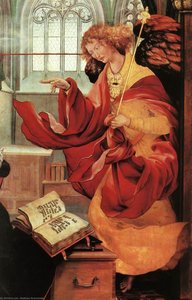
The Annunciation
 Huile sur panneau
- Northern Renaissance
 1515
1515 269.0 x 141.0 cm
 Musée d’Unterlinden
Witness the profound Annunciation by Matthias Grünewald! This Renaissance masterpiece, housed in Colmar's Musée d’Unterlinden, showcases stunning detail & symbolism. Explore its rich history and artistic legacy.
 Afficher la suite
Explorez l'art dramatique de Matthias Grünewald de la Renaissance allemande ! Connu pour le Retable d'Issenheim et ses peintures religieuses chargées d'émotion. Découvrez son style unique chez TopImpressionists.
Giclées et impressions d'art
Impressions giclées ou sur toile de qualité musée, avec une production rapide et des finitions au choix. ( Acheter la peinture faite à la main Passer au format image numérique)




P118B €10

P118H €10

P118W €10

P438Z €10

P508JH €12

P508YH €12

P805H €10

P805Z €10

P919BZ €10

P919G €10

P919XJ €10

P959ZH €10

P968JZ €12

W106C €8

W218G €10

W218JH €8

W218Y €10

W307PJ €10

W316G €10

W316PJ €8

W316Y €10

W398PJ €8

W4111J €10

W500HY €15

W500JH €15

W692G €12

W849H €8

W940BG €15

W953PJ €8




Format standard
personnalisé
CM
INCH
Choisissez parmi nos formats prédéfinis qui respectent les proportions originales de l’œuvre.
Loading sizes...

largeur
hauteur
Saisissez la largeur et la hauteur souhaitées pour qu'elles s'adaptent à votre cadre ou à votre mur. Une impression ne peut être que découpée, elle ne peut jamais être agrandie au-delà de l'image originale ; ainsi, un format de forme différente entraînera la perte d'une partie de l'image. Nous vous envoyons une maquette numérique pour approbation avant toute impression. L'image présentée sur cette page ne montre pas le recadrage réel — seule la maquette le permet.
Livraison dans le monde entier () en 2 semaines au lieu des 4/5 semaines habituelles. (24 octobre)

Livraison express gratuite dans le monde entier

Toile de lin de haute qualité

Assurance transport complète

Garantie de remboursement des droits de douane

Garantie de fidélité des couleurs

Garantie de retour de 100 jours (uniquement en cas de défaut)

Garantie de remboursement à 100%

Tarifs dégressifs sur quantité
 L'option verre n'est disponible que pour les dimensions inférieures à 110 cm.

The Annunciation
Giclées et impressions d'art
Format de la reproduction
-


Prix total final
€ 61
The Annunciation: A Renaissance Echo of Divine Grace
Matthias Grünewald’s “The Annunciation,” painted in 1515, isn't merely a depiction of a biblical moment; it’s a profound meditation on faith, humility, and the unfolding mystery of God’s plan. Housed within the Musée d’Unterlinden in Colmar, France, this masterpiece transcends its historical context to resonate powerfully with viewers centuries later. Grünewald, a pivotal figure bridging the late medieval and early Renaissance periods, deliberately eschewed the prevailing Italian humanist style, instead drawing upon the rich traditions of Northern European art—a lineage characterized by intense emotionality, meticulous detail, and an unwavering focus on religious narrative.
The scene itself is deceptively simple: the Archangel Gabriel stands to Mary’s right, his flowing robes a vibrant crimson that speaks both of divine authority and passionate urgency. He extends his hand, presenting a lily—a potent symbol of purity and virginity, inextricably linked with Mary's role as the Mother of God. Mary, kneeling gracefully on the left, is rendered in shades of serene blue, reflecting her humility and acceptance of this extraordinary destiny. The architectural setting, reminiscent of a Gothic cathedral’s archway, provides a sense of sacred space—a stage for this pivotal encounter.
A Symphony of Color and Light
Grünewald's mastery lies not just in his composition but also in his innovative use of color and light. The palette is deliberately restrained, dominated by the complementary hues of red and blue – a deliberate choice that amplifies their symbolic weight. The strong, directional light source, originating from the upper left corner, dramatically illuminates Mary’s face, emphasizing her vulnerability and receptiveness to the divine message. This carefully orchestrated lighting creates a palpable sense of depth and drama, drawing the viewer's eye directly to the central figures.
Furthermore, Grünewald employs a technique known as *sfumato*, subtly blurring edges and creating atmospheric effects—a hallmark of Renaissance painting that he skillfully adapted to his own style. This adds an ethereal quality to the scene, suggesting the otherworldly nature of the event unfolding before us. The meticulous detail evident in the drapery, the intricate patterns on the clothing, and the subtle modeling of the figures speaks to Grünewald’s exceptional technical skill and unwavering commitment to realism.
Symbolism Woven into Every Detail
Beyond the immediate narrative, “The Annunciation” is rich with symbolic meaning. The dove hovering above Mary represents the Holy Spirit—the divine breath that will bring forth Christ. The architectural setting itself alludes to the sacredness of the event and the importance of God’s presence in human life. Even the positioning of Gabriel and Mary within the archway can be interpreted symbolically, representing harmony and balance – a visual embodiment of the theological concept of *coincidence of opposites*.
The lily held by Gabriel is not merely a floral emblem; it's a potent reminder of Mary’s virginity and her role as the vessel through which Christ will be born. The careful rendering of each element—from the angel’s wings to Mary’s expression—contributes to a complex tapestry of meaning that invites contemplation and interpretation.
A Timeless Masterpiece: Reproductions Available
“The Annunciation” remains a profoundly moving work of art, captivating viewers with its beauty, drama, and spiritual depth. High-quality reproductions are now available through TopImpressionists, allowing art enthusiasts to bring this iconic masterpiece into their homes or offices. These meticulously crafted oil paintings faithfully capture the essence of Grünewald’s original—a testament to his artistic genius and a timeless reminder of the miracle at the heart of Christian faith. For those seeking to delve deeper into the world of Matthias Grünewald, we encourage you to explore the resources linked below, including detailed images, artist biographies, and related works.
- The Annunciation (detail): /en/art/matthias-grunewald-the-annunciation-detail-8XZGPE-en/
- The Annunciation: /en/art/matthias-grunewald-the-annunciation-8XZGPD-en/
- Matthias Grünewald: /en/artists/matthias-grunewald-en/
- Explore the collection at: https://TopImpressionists.com
- Learn more about the Musée d’Unterlinden: https://en.wikipedia.org/wiki/Mus%C3%A9e_d%27Unterlinden
Questions et réponses
Où devrait être accrochée une reproduction de «The Annunciation» de Matthias Grünewald ?
Le format (Élancé) et l'espace recommandé (Salon) sont les deux caractéristiques de disposition enregistrées pour «The Annunciation» de Matthias Grünewald.
Quelle taille est suggérée pour "The Annunciation" dans un(e) Salon ?
L'association recommandée pour «The Annunciation» de Matthias Grünewald : une impression de Grand format dans un(e) Salon.
«The Annunciation» de Matthias Grünewald est-elle une œuvre lumineuse ou sombre ?
Dans l'ensemble, « The Annunciation » présente une luminosité de équilibrée. La luminosité perçue décrit si l'œuvre paraît claire ou sombre.
Biographie de l'artiste
Matthias Grünewald : Vie et Héritage
Jeunesse et Débuts Artistiques
Matthias Grünewald, né Mathis Gothart Neithardt vers 1470-1475 à Würzburg, en Allemagne, est une figure centrale du Renouveau allemand. Bien qu'il ait vécu dans une période de plus en plus influencée par les idéaux du Renouveau italien, Grünewald est resté profondément ancré dans les traditions artistiques tardives de l’Europe centrale médiévale. Les détails sur sa jeunesse sont rares, mais il est connu qu'il a reçu une formation artistique, probablement au sein d'ateliers locaux.
Développement Artistique et Influences
Le développement artistique de Grünewald a été façonné par les traditions nordiques prévalentes de réalisme, d’intensité émotionnelle et d’observation détaillée. Son œuvre témoigne des influences d'artistes tels qu'Albrecht Dürer et Martin Schongauer, mais il a tracé un chemin unique caractérisé par une expression dramatique et des couleurs vives. Il n'a pas été directement impliqué dans les cercles humanistes prévalents en Italie ; à la place, son art servait principalement à des fins religieuses, reflétant les angoisses spirituelles de son temps.
Œuvres Majeures et Style Artistique
- L'Autel d’Issenheim (1512-1516) : Ce chef-d'œuvre, exposé au Musée d'Unterlinden à Colmar, est considéré comme l'apogée de Grünewald. Il dépeint des scènes de la vie du Christ avec un réalisme saisissant, en particulier en se concentrant sur la souffrance et le salut.
- La Crucifixation (c. 1502-1503) : Une œuvre précoce démontrant son style en développement, mettant en valeur une émotion intense et un détail anatomique.
- Vierge de l'Annonciation (1512-14) : Étude pour l’Autel d’Issenheim, révélant son processus de planification méticuleux.
- Moïse (1511) : Dessin mettant en évidence le talent de Grünewald pour capturer des figures expressives et des poses dramatiques.
Le style de Grünewald se distingue par:
- Composition Dramatique : Il a utilisé des arrangements dynamiques pour intensifier l'impact émotionnel.
- Palette de Couleurs Vives : Son utilisation de couleurs intenses, souvent contrastées, a créé une expérience visuelle puissante.
- Représentation Réaliste de la Souffrance : Grünewald n’a pas hésité à représenter la douleur physique et émotionnelle associée aux récits religieux.
- Figures Expressives : Ses figures sont imprégnées d'émotions fortes et de profondeur psychologique.
Signification Historique et Héritage
L’œuvre de Grünewald témoigne du pouvoir durable des traditions artistiques médiévales en Allemagne au cours du Renouveau. Il a comblé le fossé entre le style gothique tardif et l'émergence du Renouveau, créant une langue visuelle unique qui a résonné auprès de ses contemporains. Son influence peut être observée chez les artistes allemands ultérieurs qui ont continué à explorer des thèmes de ferveur religieuse et d’intensité émotionnelle. Bien qu'il ait été largement oublié après sa mort en 1528, Grünewald a connu un regain d'intérêt au XIXe siècle, et aujourd'hui il est reconnu comme l'un des peintres les plus importants du Renouveau allemand. Son art continue de captiver les spectateurs par son émotion brute, son génie technique et sa profondeur spirituelle profonde.
Exploration Complémentaire
Découvrez-en davantage sur la vie et l'œuvre de Matthias Grünewald à : TopImpressionists

Matthias Grünewald
1480 - 1528 , Allemagne
En bref
- Artistic Movement Or Style: Renaissance allemande
- Artists Or Movements Influenced By This Artist:
- Renaissance italienne
- Art gothique tardif
- Artists Who Influenced This Artist:
- Albrecht Dürer
- Martin Schongauer
- Date Of Birth: c. 1475/1480
- Date Of Death: 1528
- Full Name: Matthias Grünewald
- Nationality: Allemand
- Notable Artworks:
- Retable d'Issenheim
- La Crucifixion
- Vierge de l'Annonciation
- Moïse
- Place Of Birth: Würzburg, Allemagne
Articles connexes

Jacob Henricus Maris: A Master of Dutch Atmospheric Realism & the Intimate Landscape
Explore the captivating world of Jacob Henricus Maris, a leading figure of the Dutch Hague School. Discover his atmospheric landscapes, signature brushstrokes & lasting influence on 19th-century art. Learn more at TopImpressionists.

Fra Angelico : Les 25 Chefs-d'œuvre Incontournables pour une Décoration Spirituelle
Plongez dans l'univers spirituel de Fra Angelico avec les 25 œuvres incontournables du maître italien. Découvrez l'histoire, la technique et la beauté intemporelle de ses fresques Renaissance. Reproductions d'art exceptionnelles sur TopImpressionists.com.

Divine Messengers: A Curated Guide to the Iconography of Angel Gabriel in Art History
Explore the profound beauty of Angel Gabriel in art history. From Renaissance masterpieces to Baroque splendor, our expert guide delves into the sacred iconography and timeless techniques of these divine messengers for the discerning art enthusiast.

Dante Gabriel Rossetti : Les 25 Œuvres Maîtresses du Préraphaélisme à Redécouvrir
Plongez dans l'univers fascinant de Dante Gabriel Rossetti ! Découvrez les 25 œuvres majeures du préraphaélisme : symbolisme, poésie et beauté victorienne. Reproductions d'art exceptionnelles sur TopImpressionists.com.

Matthias Grünewald : Dévotion, Distorsion et Tourments Spirituels dans l'Art de la Renaissance
Explorez l'œuvre poignante de Matthias Grünewald, figure majeure de la Renaissance allemande. Analyse approfondie de son iconographie expressive et du célèbre Retable d'Isenheim. Découvrez un art empreint de dévotion et de tourments spirituels.
Explorez des œuvres d'art classées par thèmes, styles et caractéristiques.