

Shown: · With its frame:
 Aperçu en situation
 Envoyer
 Partager
 Détails de l'œuvre
 Guide
Guide

 Télécharger l'image
 Articles similaires
 Radiographie
 Diaporama
 Q&A
Q&A Statistiques
- 98.0 x 83.0 cm


€ 239
Reproduction à l'huile faite à la main
Huile sur toile peinte à la main, avec cadre et dimensions personnalisés, réalisée sur commande par nos artistes. ( Passer au format impression Passer au format numérique)
Size
·Format standard
sur mesure
CM
INCH
Choisissez parmi nos formats prédéfinis qui respectent les proportions originales de l’œuvre.
Loading sizes...

largeur
hauteur
Saisissez la largeur et la hauteur souhaitées, pour s'adapter à votre cadre ou à votre mur. Cette œuvre est peinte à la main ; ainsi, pour un format de forme différente, l'artiste peut peindre un peu plus autour du tableau ou réduire légèrement les bords — c'est vous qui choisissez. Nous vous envoyons une maquette numérique pour approbation avant que la peinture ne commence. L'image présentée sur cette page ne reflète pas le résultat réel — seule la maquette le fait.
 En savoir plus
Finish
·
White €1

Blurside €1

Extended €1

P118B €10

P118H €10

P118W €10

P438Z €10

P508JH €12

P508YH €12

P805H €10

P805Z €10

P919BZ €10

P919G €10

P919XJ €10

P959ZH €10

P968JZ €12

W106C €8

W218G €10

W218JH €8

W218Y €10

W307PJ €10

W316G €10

W316PJ €8

W316Y €10

W398PJ €8

W4111J €10

W500HY €15

W500JH €15

W692G €12

W849H €8

W940BG €15

W953PJ €8

H24-GOLD €30

H24-SILVER €30

H36-GOLD €45

H36-SILVER €45
Shipped in a protective tube, ready for your own framer.
Above 105 cm the frame is shipped as a kit for a professional framer — read the details.
Extras
optionalWhat do the extras include?
Examples of what can be changed: Replace face with customer photo; Add pet (e.g., replace cat with dog); Include hidden message in background; Change background landscape or elements.
After order, TopImpressionists.com team will email client for instructions and provide a mockup preview
After order, TopImpressionists.com team will email client for instructions and provide a mockup preview
Livraison dans le monde entier () en 3 à 4 semaines au lieu des 5 semaines habituelles. (31 octobre). Aucun compromis sur la qualité.
Vernis de protection
Cartel
Détails de la plaque en bronze gravée
This elegant plaque features the artist's name and the title of the artwork, finely engraved for a timeless presentation.
It is made from bronze with a refined, elegant finish. The text is precisely laser-engraved for a sharp and permanent result. Measuring 9x2 cm, the plaque is compact yet easy to read. It's built to be durable and scratch-resistant, offering a professional, museum-quality look. Mounting is simple thanks to the included adhesive backing.
Détails de la plaque en acrylique transparent
The plaque includes essential engraved details such as the artist's name, the title of the artwork, the date it was created, the type of media used-like oil on canvas or watercolor-a brief description of the piece, and a QR code that links to the complete artwork information.
It is crafted from clear acrylic, offering a sleek, modern appearance. The text is UV-engraved in black to ensure strong visual contrast. With a size of 10x15 cm, it ensures optimal readability. It comes equipped with two metal hooks for secure wall mounting. The plaque is designed to be weather-resistant, making it suitable for various environments, and it includes interactive features that work seamlessly with smartphone scanning.
Détails de la plaque en acrylique noir
This elegant plaque includes engraved information such as the artist's name, the title of the artwork, the date it was created, the type of media used (like oil on canvas or watercolor), a short description of the artwork, and a QR code for quick access to more information.
The plaque itself is made from refined black acrylic with a premium finish. The text is laser-engraved in white for high contrast and readability. Its size is 10x15 cm, designed to be easy to read. It comes with two metal hooks for professional mounting. The design is sleek and fits any interior style. It is also weather-resistant and durable, with built-in digital integration for mobile compatibility.
L'option verre n'est disponible que pour les dimensions inférieures à 110 cm.
 L'option verre n'est disponible que pour les dimensions inférieures à 110 cm.
- Livraison express gratuite dans le monde entier
- Toile de lin de qualité supérieure
- Assurance transport complète
- Garantie de remboursement des droits de douane
- Garantie de fidélité des couleurs
- Politique de retour de 100 jours (uniquement en cas de défaut)
- Garantie de remboursement à 100%
- Offre de tarifs dégressifs


Description de la pièce
Moritz Daniel Oppenheim’s groundbreaking self-portrait captures the spirit of German Jewish art during Romanticism; holding his palette with pride beside a nude statue, this iconic depiction embodies a pivotal moment in Jewish artistic history. Explore and acquire this masterpiece.
Biographie de l'artiste
Découvrez Thomas & William Daniell ! Artistes britanniques pionniers de 'Oriental Scenery' et des paysages détaillés. Reproductions peintes à la main disponibles !
About the painting
A Visionary Gaze: The Soul of Moritz Daniel Oppenheim’s Self-Portrait
In the quiet intensity of his 1814 Self-Portrait, we encounter more than just the likeness of a young man; we witness the dawn of a profound artistic identity. Moritz Daniel Oppenheim, a figure who would later become a pioneer of Jewish artistic representation in Germany, presents himself here with a striking blend of youthful ambition and classical poise. Holding his palette with a sense of quiet pride, the artist positions himself against the backdrop of a neoclassical statue, a deliberate choice that speaks to his aspirations for professional legitimacy within the rigorous academic traditions of his era. The composition is masterfully layered, featuring secondary figures that breathe life into the scene—one assisting in the portraiture process and another observing from the periphery—creating a narrative depth that hints at the social interconnectedness and the watchful eyes of a society in transition.
The technique employed in this masterpiece is a breathtaking marriage of German Romanticism and Classical restraint. Oppenheim demonstrates an extraordinary command over chiaroscuro, using dramatic contrasts between light and shadow to sculpt the forms of his own face and the cold, smooth surface of the marble statue. His brushwork is meticulous, capturing the subtle textures of fabric and the nuanced tonal shifts that give the skin a lifelike warmth. This technical precision does not merely serve to replicate reality; it serves to elevate the subject. The interplay of light suggests an inner illumination, reflecting the intellectual awakening of an artist finding his voice amidst the shifting cultural tides of nineteenth-century Europe.
Symbolism and the Weight of Heritage
Beyond the surface of the paint lies a rich tapestry of symbolism that resonates with anyone moved by the struggle for identity. The palette held in Oppenheim’s hand is not merely a tool of his trade, but a potent emblem of creative agency and the power of the intellect to document and shape culture. It represents his dedication to capturing the nuances of Jewish life during a period of immense transformation. In stark contrast, the neoclassical statue standing beside him embodies permanence, tradition, and the weight of the classical canon. This juxtaposition creates a beautiful tension between the enduring past and the dynamic, unfolding present—a central theme in Oppenheim’s life as he navigated the complexities of being a Jewish artist in a German society that was both restrictive and evolving.
For the discerning collector or interior designer, this work offers an unparalleled emotional depth. It is a piece that invites contemplation on themes of resilience, ambition, and the courage required to claim one's place in history. Whether placed in a curated gallery setting or as a focal point in a sophisticated study, this reproduction brings with it the spirit of a man who refused to let his heritage be silenced by prejudice. It is an invitation to celebrate the triumph of the human spirit and the enduring power of art to bridge the gap between tradition and modernity.
Questions et réponses
Quel est le niveau de contraste dans «Self-Portrait» de Moritz Daniel Oppenheim ?
Le niveau de contraste de «Self-Portrait» de Moritz Daniel Oppenheim est Gentle.
Comment puis-je visionner «Self-Portrait» de Moritz Daniel Oppenheim sous forme de diaporama ?
Vous pouvez visionner «Self-Portrait» de Moritz Daniel Oppenheim sous forme de diaporama sur la page Diaporama de l'œuvre.
Quelles sont les dimensions de l'œuvre originale « Self-Portrait » ?
«Self-Portrait» mesure 98 x 83 cm dans sa forme originale. Les dimensions originales constituent une référence utile lors du choix de la taille d'une reproduction.
Quick facts and art quiz
About Moritz Daniel Oppenheim

Moritz Daniel Oppenheim
1800 - 1882, Allemagne
Biographie de l'artiste
Un Visionnaire de l'Identité Juive
Moritz Daniel Oppenheim (1800-1882) s'impose comme une figure singulière dans les annales de l'histoire de l'art allemand, agissant comme un pionnier profond de la représentation artistique juive. Né à Hanau, en Allemagne, sa vie et son œuvre étaient profondément ancrées dans un engagement à documenter et à célébrer les nuances de la vie et de la culture juives durant le XIXe siècle transformateur. Il fut souvent salué comme le premier peintre juif à avoir obtenu une reconnaissance généralisée au sein du paysage artistique dominant, dépassant le simple détail biographique pour créer une œuvre qui incarne un registre visuel essentiel d'une communauté naviguant entre les complexités de la modernisation et la volonté farouche de préserver ses traditions sacrées.
Le voyage artistique d'Oppenheim débuta par une formation fondamentale sous la direction de Conrad Westermayr dans sa ville natale, où il absorba pour la première fois les principes de la peinture romantique allemande. Cependant, sa véritable ascension professionnelle fut catalysée par son entrée à l'Académie des Beaux-Arts de Munich à l'âge de dix-sept ans. C'est au sein de ces halls prestigieux qu'il perfectionna sa maîtrise technique aux côtés de contemporains tels que Wilhelm Leibl et Johann Baptist Eberhard Krauss. Cherchant à élargir ses horizons, Oppenheim entreprit une période transformatrice d'études à l'étranger, voyageant à Paris pour étudier auprès de Jean-Baptiste Regnault, puis vers Rome. En Italie, guidé par des luminaires comme Bertel Thorwaldsen et le peintre nazaréen Johann Friedrich Overbeck, son style évolua vers un mélange sophistiqué d'observation méticuleuse et d'influence classique. Cette période romaine fut particulièrement charnière, car elle insuffla à son travail un sens de la gravité historique qui allait plus tard nourrir ses représentations des rituels juifs et de la vie quotidienne.
L'Art de l'Intimité et de la Tradition
Le cœur de la contribution d'Oppenheim à l'art réside dans sa capacité à transformer la sphère domestique en une scène pour un récit culturel profond. Ses peintures se concentrent souvent sur des scènes intimes de la vie familiale juive, capturant la dignité tranquille du rituel et la chaleur des liens communautaires. Sous son pinceau, le banal devient monumental. Dans des œuvres telles que La Fin du Shabbat (Sabbath-Ausgang), il emploie un réalisme magistral et un symbolisme subtil pour dépeindre la transition poignante du repos sacré du Shabbat vers le monde temporel, invitant le spectateur à être le témoin de la sainteté du rituel familial.
Sa capacité à tisser le contexte historique avec l'émotion personnelle est peut-être plus évidente dans ses peintures de genre qui documentent des étapes culturelles spécifiques. Par exemple :
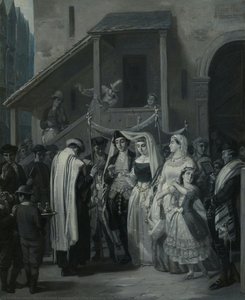
- Le Mariage (Die Trauung) : Une représentation d'un détail époustouflant d'un mariage juif en 1866 au sein du ghetto de Francfort, où Oppenheim capture la splendeur des tenues traditionnelles et la solennité de la houppa, offrant un aperçu rare et préservé d'un mode de vie en voie de disparition.
- Le Retour du Volontaire : Dans cette superbe huile sur toile de 1834, il explore l'intersection de l'héritage juif et de la plus large histoire européenne, dépeignant un soldat revenant des Guerres de Libération vers une famille vivant toujours selon des coutumes ancestrales, illustrant avec efficacité la tension entre les mutations politiques de l'ère napoléonienne et une identité religieuse immuable.
Héritage et Importance Historique
Au-delà de sa compétence technique, l'œuvre d'Oppenheim est inextricablement liée au mouvement de la Wissenschaft des Judentums — un effort érudit pour établir l'histoire et la culture juives comme un domaine académique respecté. Ses peintures fonctionnaient comme une recherche visuelle, fournissant une représentation digne et authentique d'une communauté souvent marginalisée dans le canon artistique européen plus large. En portraiturant des sujets juifs avec le même niveau de détail, de dignité et de grandeur romantique habituellement réservés aux thèmes aristocratiques ou mythologiques, il a défié les préjugés existants et affirmé l'importance de l'identité juive au sein du tissu culturel allemand.
En fin de compte, l'héritage de Moritz Daniel Oppenheim est celui de la résilience et de la visibilité. Il ne s'est pas contenté de peindre des scènes ; il a construit un langage visuel pour une époque de transition. Sa capacité à capturer l'équilibre délicat entre le vieux monde et le nouveau garantit que son travail demeure un point de repère vital pour comprendre l'expérience juive du XIXe siècle, faisant de lui une figure indispensable de l'histoire du romantisme allemand et du récit mondial de l'art juif.
Quick facts about Moritz Daniel Oppenheim
- Artistic Movement Or Style: Romantisme
- Artists Who Influenced This Artist:
- Jean-Baptiste Regnault
- Bertel Thorwaldsen
- Barthold Georg Niebuhr
- Johann Friedrich Overbeck
- Date Of Birth: 7 janvier 1800
- Date Of Death: 26 février 1882
- Full Name: Moritz Daniel Oppenheim
- Nationality: Allemand
- Notable Artworks: ['Retour du volontaire aux guerres de libération à sa famille vivant encore selon les vieilles coutumes']
- Place Of Birth: Hanau, Allemagne
Explorez des œuvres d'art classées par thèmes, styles et caractéristiques.


Moritz Daniel Oppenheim
Self-Portrait
() ·
With its frame: · Hand-painted in oil on linen
Total