


 Aperçu en situation
 Envoyer
 Partager
 Détails de l'œuvre
 Guide
Guide

 Télécharger l'image
 Articles similaires
 Radiographie
 Diaporama
 Statistiques
Krishna (Spring in Kulu)


Experience the serene spirituality of Krishna by Nicholas Roerich, featuring bold colors and flattened planes characteristic of Symbolism; discover this masterpiece today.
 Lire la suite
Explorez l'art captivant de Nicolas Roerich (1874-1947) : Symbolisme, paysages himalayens et peintures mystiques. Designs pour les Ballets Russes et défenseur de la préservation culturelle.
Reproduction à l'huile faite à la main
Huile sur toile peinte à la main, avec cadre et dimensions personnalisés, réalisée sur commande par nos artistes. ( Passer au format impression Passer au format numérique)




P118B €10

P118H €10

P118W €10

P438Z €10

P508JH €12

P508YH €12

P805H €10

P805Z €10

P919BZ €10

P919G €10

P919XJ €10

P959ZH €10

P968JZ €12

W106C €8

W218G €10

W218JH €8

W218Y €10

W307PJ €10

W316G €10

W316PJ €8

W316Y €10

W398PJ €8

W4111J €10

W500HY €15

W500JH €15

W692G €12

W849H €8

W940BG €15

W953PJ €8




Format standard
sur mesure
CM
INCH
Choisissez parmi nos formats prédéfinis qui respectent les proportions originales de l’œuvre.
Loading sizes...

largeur
hauteur
Saisissez la largeur et la hauteur souhaitées, pour s'adapter à votre cadre ou à votre mur. Cette œuvre est peinte à la main ; ainsi, pour un format de forme différente, l'artiste peut peindre un peu plus autour du tableau ou réduire légèrement les bords — c'est vous qui choisissez. Nous vous envoyons une maquette numérique pour approbation avant que la peinture ne commence. L'image présentée sur cette page ne reflète pas le résultat réel — seule la maquette le fait.
Exemples de personnalisation possibles : remplacer un visage par la photo du client ; ajouter un animal de compagnie (par exemple, remplacer un chat par un chien) ; inclure un message caché en arrière-plan ; modifier le paysage ou les éléments de l'arrière-plan.
Après la commande, l’équipe TopImpressionists.com contactera le client par e-mail pour recueillir ses instructions et lui fournira une maquette d’aperçu
Après la commande, l’équipe TopImpressionists.com contactera le client par e-mail pour recueillir ses instructions et lui fournira une maquette d’aperçu
Livraison dans le monde entier () en 3 à 4 semaines au lieu des 5 semaines habituelles. (28 octobre). Aucun compromis sur la qualité.

Livraison express gratuite dans le monde entier

Toile de lin de qualité supérieure

Assurance transport complète

Garantie de remboursement des droits de douane

Garantie de fidélité des couleurs

Politique de retour de 100 jours (uniquement en cas de défaut)

Garantie de remboursement à 100%

Offre de tarifs dégressifs
 L'option verre n'est disponible que pour les dimensions inférieures à 110 cm.

Krishna (Spring in Kulu)
Technique de reproduction
Format de la reproduction
-


Prix total
€ 237
A Vision of Serenity: Exploring Roerich's Krishna
To gaze upon this depiction of Krishna (Spring in Kulu) is to step across the threshold into a realm where spirituality meets breathtaking natural grandeur. Nicholas Roerich, the polymath whose life spanned art, archaeology, and profound philosophical inquiry, captured here not just a scene, but an entire state of being—one of tranquil contemplation amidst the vibrant awakening of spring. The composition immediately draws the eye to the central figure, Krishna, seated in deep meditation beneath the delicate canopy of blossoming trees. This is more than a portrait; it is an invocation of peace, rendered with the unmistakable, visionary hand of an artist deeply attuned to the universal spirit.
The Language of Form and Color
Roerich’s technique here speaks volumes about his unique artistic vocabulary. One observes a masterful employment of bold outlines that define every peak, every leaf, and every fold of drapery, lending the entire scene a stylized, almost sacred geometry. The color palette is nothing short of breathtaking: the intense, vibrant blues of the sky and distant mountains provide a cool, majestic counterpoint to the warm, earthy tones anchoring the foreground. These contrasting planes of color—the deep azure against the soft pinks and whites of the blossoms—are not merely decorative; they are structural elements that build depth through layering rather than strict perspective. The overall effect is one of luminous clarity, as if bathed in an eternal, diffused sunlight.
Symbolism Woven into the Landscape
The symbolism within this work is rich and multilayered, inviting endless contemplation. The blossoming trees are a quintessential celebration of renewal, marking the triumphant return of life after winter's slumber. Krishna himself embodies the ultimate stillness amidst the flux of existence; his meditative posture suggests an inner wisdom that transcends the magnificent backdrop of snow-capped peaks. These mountains, towering and eternal, serve as a powerful metaphor for the enduring nature of spirit against the fleeting cycles of earthly life. The entire tableau whispers of enlightenment—the quiet realization found at the intersection of profound nature and divine presence.
A Touch of Primitivism and Universal Artistry
Stylistically, this piece resonates with elements of Symbolism and a beautiful, almost primal directness that characterizes Roerich’s finest work. The flattened perspective and simplified forms eschew academic realism in favor of emotional truth. This deliberate choice elevates the artwork from mere depiction to pure evocation. For the collector or designer seeking an object imbued with deep meaning, this reproduction offers not just aesthetic beauty for a wall, but a focal point for meditation within any space. It is art that speaks directly to the soul, promising a moment of profound quietude whenever it is viewed.
Questions et réponses
À quelle étape de la carrière de Nicolas Roerich « Krishna (Spring in Kulu) » s'inscrit-elle ?
« Krishna (Spring in Kulu) » est représentatif de la période Mature Period de Nicolas Roerich.
Existe-t-il un guide pour «Krishna (Spring in Kulu)» de Nicolas Roerich ?
Le guide de « Krishna (Spring in Kulu) » est la page Fiche pédagogique de l'œuvre — une fiche informative imprimable présentant l'œuvre accompagnée de sa légende, de sa mention de crédit et de son tableau d'identification (artiste, dates, technique, dimensions originales, collection).
L'œuvre « Krishna (Spring in Kulu) » de Nicolas Roerich est-elle dans le domaine public, et pourquoi ?
«Krishna (Spring in Kulu)» de Nicolas Roerich est dans le dans le domaine public - ses droits d'auteur sont tombés dans le domaine public. La durée du droit d'auteur court à partir du décès de l'artiste, survenu en 1947.
Biographie de l'artiste
Nicholas Roerich : Vie, Art et Héritage
Jeunesse et Éducation
- Nicolas Constantinovich Roerich est né le 9 octobre 1874 à Saint-Pétersbourg, en Russie.
- Son père, notaire public allemand de la Baltique, et sa mère, une femme russe, ont cultivé chez lui un goût précoce pour les arts.
- Roerich a poursuivi le droit et l'art simultanément, s'inscrivant à l'Université de Saint-Pétersbourg et à l'Académie des Beaux-Arts impériale en 1893.
- Il a reçu le titre d'"Artiste" en 1897 et un diplôme de droit l'année suivante.
Poursuites Artistiques et Influences
- Le développement artistique de Roerich a été significativement influencé par le Symbolisme russe, un mouvement mettant l'accent sur la spiritualité et la profondeur émotionnelle.
- Il s'est impliqué dans la société "World of Art" de Sergueï Diaghilev, devenant son président de 1910 à 1916.
- Ses premières œuvres ont mis en évidence une fascination pour l'archéologie et la conception de décors de scène, menant à des collaborations sur des productions pour les Ballets Russes.
- Il a également été influencé par l'apocryphe et les écrits sectaires médiévaux comme le Livre de Colombe.
Collaboration avec les Ballets Russes
- Les conceptions de Roerich pour les Ballets Russes ont été très saluées, en particulier son travail sur l'Opéra Prince Igor d'Alexandre Borodine (1909) et l’Opéra Le Rite de Printemps d'Igor Stravinsky (1913).
- Ses décors de scène ont combiné des recherches historiques avec un art imaginatif, créant des productions visuellement époustouflantes.
- Cette collaboration l'a établi comme une figure de proue en matière de conception théâtrale au début du XXe siècle.
Développement Artistique et Thèmes
- Les peintures de Roerich ont évolué pour incorporer des thèmes de plus en plus mystiques et spirituels, reflétant son intérêt croissant pour la Théosophie et les religions orientales.
- Sa série Études architecturales (1904–1905) a démontré sa prouesse architecturale et son engagement à préserver le patrimoine culturel.
- Des motifs récurrents dans son œuvre comprennent des paysages majestueux, des villes anciennes et des figures religieuses telles que Saint Panteleimon et Kuan Yin.
- Il a souvent représenté l'Himalaya, une région qui avait un profond sens spirituel pour lui.
Réalisations Majeures et Reconnaissance
- Roerich était un défenseur dévoué de la protection de l'art et de l'architecture pendant les temps de guerre.
- Ses efforts ont conduit à la création du Pacte Roerich (1935), un traité international pour la préservation des objets culturels, lui valant de nombreuses nominations au prix Nobel de la paix.
- Il a voyagé largement en Asie centrale, menant des recherches archéologiques et documentant les cultures anciennes.
- Son œuvre est présentée dans des collections muséales prestigieuses du monde entier, notamment la Galerie d'art d'Astrachane.
Signification Historique et Héritage
- L'impact de Nicolas Roerich sur l'art et la culture russes est immeasurable.
- Il a comblé le fossé entre l'expression artistique et l'exploration spirituelle, influençant des générations d'artistes et de penseurs.
- Son engagement à préserver le patrimoine culturel reste pertinent aujourd'hui, soulignant l'importance de protéger notre héritage commun.
- L'héritage de Roerich s'étend au-delà de ses peintures ; il est souvenu comme un artiste visionnaire, érudit et humanitaire.

Nicolas Roerich
1874 - 1947 , Russie
L'essentiel de l'artiste
- Artistes Influents: ['Symbolisme russe']
- Date De Décès: 13 décembre 1947
- Date De Naissance: 9 octobre 1874
- Lieu De Naissance: Saint-Pétersbourg, Russie
- Mouvement Artistique: Symbolisme russe
- Nationalité: Russe
- Nom Complet: Nicolas Roerich
- Œuvres Notables:
- Lac des Nagas
- Mont de cinq trésors
- Chemin vers Kailas 4
- Tempe-jal-tzen-baykin
- Guerrier
- Pont de Gloire
Articles connexes

Nicholas Roerich: Mysticism, Mountains & the Search for Ageless Wisdom in Art
Explore the captivating art of Nicholas Roerich – a visionary painter whose Himalayan landscapes blend spiritual mysticism with cultural preservation. Discover his legacy & symbolism.

Les 10 Chefs-d'œuvre Dominés par le Bleu Ardoise : Art, Histoire & Décor
Plongez dans l'univers fascinant des 10 plus beaux tableaux dominés par le bleu ardoise. Découvrez l'histoire, les artistes et les techniques de ces chefs-d'œuvre impressionnistes et contemporains. Inspirez votre décoration intérieure avec !

Les 10 Chefs-d'œuvre du Paysage Romantique : Artistes et Décor d'Intérieur
Plongez dans l'émotion du Romantisme avec les 10 plus beaux paysages de Friedrich, Turner & Delacroix. Découvrez leur histoire et trouvez l'inspiration déco idéale sur TopImpressionists.com !

Évocations de lieux : Un voyage historique à travers l'art du paysage
Explorez l'histoire fascinante de la peinture de paysage à travers les chefs-d'œuvre du Romantisme. Découvrez Friedrich, Turner et Aivazovski et laissez-vous inspirer par la beauté sauvage et le sublime. Reproduction d'art de qualité chez TopImpressionists.
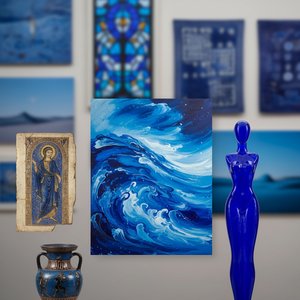
The Allure of Azure: Exploring the Symbolic & Aesthetic Depths of Blue in Art History
Explore the rich history of blue in art! Discover its symbolism, from ancient pigments to modern masterpieces by Kandinsky & Seurat. Uncover the psychological impact and cultural meanings behind this captivating hue.
Explorez des œuvres d'art classées par thèmes, styles et caractéristiques.


