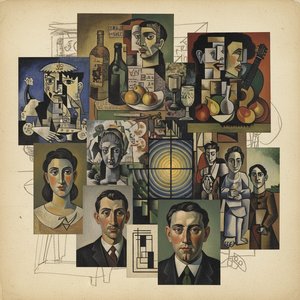
Description de l'œuvre
Pablo Picasso: A Revolutionary Artist
Pablo Ruiz y Picasso (1881–1973) stands as one of the most influential figures in 20th-century art, reshaping artistic conventions and captivating audiences worldwide with his groundbreaking innovations. Born in Málaga, Spain, Picasso’s early life was marked by a prodigious talent for drawing and painting—a gift nurtured by his father, José Ruiz y Blasco, who instilled in him a foundational understanding of artistic principles. Moving to Barcelona and later Madrid, he pursued formal training while simultaneously forging an independent path, challenging academic dogma with rebellious spirit.
The Blue Period (1901–1906)
Picasso’s artistic journey commenced with the emotionally charged Blue Period, commencing around 1901. Influenced by personal tragedies—the untimely death of his mother and the subsequent loss of his younger sister—he adopted a palette dominated by somber blues and greens to express profound sorrow and introspection. This stylistic choice mirrored the pervasive atmosphere of poverty and despair prevalent in Parisian society at the time, reflecting Picasso’s empathy for marginalized individuals. Notable works from this period include “The Old Guitarist” and “La Vie,” demonstrating his masterful command of tonal modulation and conveying palpable emotional depth.
The Rose Period (1904–1906)
Following the melancholic hues of the Blue Period, Picasso transitioned into the Rose Period, characterized by warmer tones—primarily pinks, reds, and oranges—reflecting a newfound optimism and engagement with human relationships. This stylistic shift coincided with his burgeoning romance with Fernande Olivier, injecting vibrancy and tenderness into his artistic vision. Paintings from this era showcase idealized figures bathed in soft light, portraying themes of love, familial bonds, and social harmony. “Family of Saltimbanques” exemplifies the Rose Period’s aesthetic sensibilities—a harmonious blend of realism and expressive color.
Cubism (1907–1914)
Picasso irrevocably altered the course of art history with the advent of Cubism, pioneered collaboratively with Georges Braque around 1907. Rejecting traditional perspective and representation, Cubism fragmented objects into geometric planes—challenging viewers’ perceptions of reality and ushering in a revolutionary aesthetic. Picasso's initial explorations of Analytical Cubism focused on dissecting subjects into interlocking cubes—reducing them to their fundamental forms while simultaneously presenting multiple viewpoints simultaneously. Later, Synthetic Cubism incorporated collage elements—introducing textures and colors from external sources—expanding the artistic vocabulary and blurring boundaries between painting and sculpture. “Les Demoiselles d’Avignon” remains a cornerstone of Cubist innovation—a daring departure from conventional portraiture that profoundly impacted subsequent artistic movements.
Guernica (1937)
Perhaps Picasso's most enduring masterpiece, Guernica (1937), stands as an indictment of the horrors inflicted upon civilians during the Spanish Civil War. Executed in response to Nazi bombing raids on Basque town Guernica—a poignant symbol of suffering and resilience—the painting employs a monochromatic palette—primarily black, white, and gray—to convey the anguish and devastation experienced by victims of conflict. Picasso’s masterful use of symbolism—featuring anguished figures representing humanity, grief, and despair—creates a visceral emotional response in viewers—serving as an unforgettable testament to artistic courage and moral responsibility. The monumental canvas embodies Picasso's unwavering commitment to social justice—solidifying his legacy as one of the greatest artists of all time.
##Conclusion: A Lasting Legacy
Pablo Picasso’s prolific output spanned decades—spanning diverse styles and mediums—leaving an indelible mark on art history. From the introspective depths of the Blue Period to the vibrant dynamism of Cubism, Picasso consistently pushed artistic boundaries—inspiring generations of artists and captivating audiences worldwide with his visionary creativity. His unwavering dedication to experimentation—coupled with his profound empathy for human experience—ensures that Picasso’s legacy continues to resonate powerfully—affirming his position as an unparalleled innovator and a monumental figure in the annals of art.



 Commander la reproduction
 Partager
 Partager
 Détails de l'œuvre

 Télécharger
 Articles similaires
 Radiographie
 Diaporama


 Afficher la suite






































 L'option verre n'est disponible que pour les dimensions inférieures à 110 cm.