

Shown: · With its frame:
 Aperçu en situation
 Envoyer
 Partager
 Détails de l'œuvre
 Guide
Guide

 Télécharger l'image
 Articles similaires
 Radiographie
 Diaporama
 Q&A
Q&A Statistiques

€ 239
Reproduction à l'huile faite à la main
Huile sur toile peinte à la main, avec cadre et dimensions personnalisés, réalisée sur commande par nos artistes. ( Passer au format impression Passer au format numérique)
Size
·Format standard
sur mesure
CM
INCH
Choisissez parmi nos formats prédéfinis qui respectent les proportions originales de l’œuvre.
Loading sizes...

largeur
hauteur
Saisissez la largeur et la hauteur souhaitées, pour s'adapter à votre cadre ou à votre mur. Cette œuvre est peinte à la main ; ainsi, pour un format de forme différente, l'artiste peut peindre un peu plus autour du tableau ou réduire légèrement les bords — c'est vous qui choisissez. Nous vous envoyons une maquette numérique pour approbation avant que la peinture ne commence. L'image présentée sur cette page ne reflète pas le résultat réel — seule la maquette le fait.
 En savoir plus
Finish
·
White €1

Blurside €1

Extended €1

P118B €10

P118H €10

P118W €10

P438Z €10

P508JH €12

P508YH €12

P805H €10

P805Z €10

P919BZ €10

P919G €10

P919XJ €10

P959ZH €10

P968JZ €12

W106C €8

W218G €10

W218JH €8

W218Y €10

W307PJ €10

W316G €10

W316PJ €8

W316Y €10

W398PJ €8

W4111J €10

W500HY €15

W500JH €15

W692G €12

W849H €8

W940BG €15

W953PJ €8

H24-GOLD €30

H24-SILVER €30

H36-GOLD €45

H36-SILVER €45
Shipped in a protective tube, ready for your own framer.
Above 105 cm the frame is shipped as a kit for a professional framer — read the details.
Extras
optionalWhat do the extras include?
Examples of what can be changed: Replace face with customer photo; Add pet (e.g., replace cat with dog); Include hidden message in background; Change background landscape or elements.
After order, TopImpressionists.com team will email client for instructions and provide a mockup preview
After order, TopImpressionists.com team will email client for instructions and provide a mockup preview
Livraison dans le monde entier () en 3 à 4 semaines au lieu des 5 semaines habituelles. (2 novembre). Aucun compromis sur la qualité.
Vernis de protection
Cartel
Détails de la plaque en bronze gravée
This elegant plaque features the artist's name and the title of the artwork, finely engraved for a timeless presentation.
It is made from bronze with a refined, elegant finish. The text is precisely laser-engraved for a sharp and permanent result. Measuring 9x2 cm, the plaque is compact yet easy to read. It's built to be durable and scratch-resistant, offering a professional, museum-quality look. Mounting is simple thanks to the included adhesive backing.
Détails de la plaque en acrylique transparent
The plaque includes essential engraved details such as the artist's name, the title of the artwork, the date it was created, the type of media used-like oil on canvas or watercolor-a brief description of the piece, and a QR code that links to the complete artwork information.
It is crafted from clear acrylic, offering a sleek, modern appearance. The text is UV-engraved in black to ensure strong visual contrast. With a size of 10x15 cm, it ensures optimal readability. It comes equipped with two metal hooks for secure wall mounting. The plaque is designed to be weather-resistant, making it suitable for various environments, and it includes interactive features that work seamlessly with smartphone scanning.
Détails de la plaque en acrylique noir
This elegant plaque includes engraved information such as the artist's name, the title of the artwork, the date it was created, the type of media used (like oil on canvas or watercolor), a short description of the artwork, and a QR code for quick access to more information.
The plaque itself is made from refined black acrylic with a premium finish. The text is laser-engraved in white for high contrast and readability. Its size is 10x15 cm, designed to be easy to read. It comes with two metal hooks for professional mounting. The design is sleek and fits any interior style. It is also weather-resistant and durable, with built-in digital integration for mobile compatibility.
L'option verre n'est disponible que pour les dimensions inférieures à 110 cm.
 L'option verre n'est disponible que pour les dimensions inférieures à 110 cm.
- Livraison express gratuite dans le monde entier
- Toile de lin de qualité supérieure
- Assurance transport complète
- Garantie de remboursement des droits de douane
- Garantie de fidélité des couleurs
- Politique de retour de 100 jours (uniquement en cas de défaut)
- Garantie de remboursement à 100%
- Offre de tarifs dégressifs


Description de la pièce
Biographie de l'artiste
Découvrez l'art révolutionnaire de Jackson Pollock (1912-1956), pionnier de l’Expressionnisme Abstrait et de la peinture à gouttes ! Explorez ses œuvres emblématiques, son intensité émotionnelle et son héritage durable.
About the painting
L'essence de l'expression abstraite
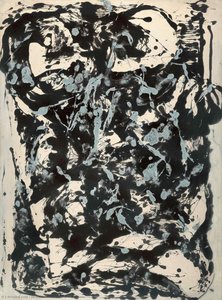
Reflection of the Big Dipper, créée en 1947 par Jackson Pollock, est une œuvre séminale qui incarne l'essence même de l'expressionnisme abstrait et de la peinture gestuelle, ou Action painting. Cette pièce, mesurant 111 x 91,5 cm, est conservée au Stedelijk Museum à Amsterdam, aux Pays-Bas. Pollock fut une figure de proue du mouvement expressionniste abstrait, apparu à New York après la Seconde Guerre mondiale. S'inspirant du surréalisme, ce courant se divisait principalement entre les peintres de l'action et les peintres de champs colorés. En tant que maître de l'action painting, Pollock a révolutionné sa technique en délaissant le travail traditionnel au pinceau pour adopter la méthode innovante du dripping, ou peinture égouttée.Technique et composition
Reflection of the Big Dipper illustre parfaitement le style unique de Pollock, caractérisé par des couches de peinture où l'émail égoutté apporte la touche finale. La composition est dominée par des traînées de peinture noire qui tissent une toile dynamique à travers la toile. Sous ce réseau complexe, des couleurs vibrantes telles que le jaune, le rouge et le violet ajoutent de la profondeur et de la complexité à l'œuvre. Des éclaboussures de diverses teintes suggèrent une énergie frénétique, reflétant le processus de peinture spontané de l'artiste.Exposition et réception
Le tableau fut exposé à la Betty Parsons Gallery en 1948, aux côtés de seize autres œuvres de Pollock. L'exposition reçut des critiques élogieuses, marquant un jalon significatif dans la carrière de l'artiste. Cette période de son travail représente une phase de transition cruciale entre la manipulation traditionnelle de la peinture et sa technique révolutionnaire du dripping.Signification artistique et héritage
Reflection of the Big Dipper est un exemple quintessentiel de l'expressionnisme abstrait, mettant au défi le spectateur de s'engager avec l'œuvre sur les plans émotionnel et intellectuel. Le réseau dense de peinture projetée crée un sentiment de spontanéité et une puissance expressive emblématique du style de Pollock. La technique innovante de l'artiste et la nature abstraite de son travail ont influencé des générations de créateurs. Ses contributions au mouvement expressionniste abstrait sont reconnues mondialement, faisant de lui l'un des artistes les plus célébrés de sa génération. ConclusionReflection of the Big Dipper de Jackson Pollock est un chef-d'œuvre qui encapsule l'essence de l'expressionnisme abstrait et de la peinture gestuelle. Sa composition unique, sa technique et son importance historique en font une pièce captivante dans le monde de l'art.
- Jackson Pollock : Reflection of the Big Dipper
- Expressionnisme Abstrait
- Jackson Pollock sur Wikipédia
Questions et réponses
Quelle émotion «Reflet de la Grande Ourse» de Jackson Pollock dégage-t-il ?
«Reflet de la Grande Ourse» est empreint d'un sentiment Énergique. La tonalité émotionnelle décrit l'impression qui se dégage de l'œuvre.
À quel courant artistique «Reflet de la Grande Ourse» de Jackson Pollock appartient-il ?
«Reflet de la Grande Ourse» de Jackson Pollock appartient au mouvement Expressionnisme abstrait. Ce mouvement apporte le contexte stylistique de l'œuvre.
Dans quelle pièce recommanderiez-vous d'exposer «Reflet de la Grande Ourse» de Jackson Pollock ?
Une reproduction de « Reflet de la Grande Ourse » s'intègre parfaitement dans une Salon.
Quick facts and art quiz
About Jackson Pollock

Jackson Pollock
1912 - 1956, États-Unis
Biographie de l'artiste
Early Life and the Seeds of Innovation
Paul Jackson Pollock, born in Cody, Wyoming, in 1912, was a restless spirit from the outset. His early life was marked by frequent relocation as his father pursued work as a land surveyor across the vast landscapes of the American West. This itinerant existence instilled in young Pollock a deep connection to the natural world and an exposure to diverse cultures, particularly through encounters with Native American art during those surveying trips – impressions that would subtly permeate his artistic vision later in life.
Pollock’s formal artistic training began at the Manual Arts High School in Los Angeles, followed by studies at the Art Students League of New York under the tutelage of Thomas Hart Benton. Benton, a prominent figure in the Regionalist movement, emphasized rhythmic composition and narrative themes rooted in American life. While Pollock initially absorbed these lessons, his inherent inclination leaned toward more abstract explorations. He was also profoundly impacted by Mexican muralists like José Clemente Orozco, whose powerful depictions of social struggle resonated deeply with him. These early influences laid a foundation, but it was the burgeoning world of Surrealism that truly unlocked Pollock’s artistic potential.
The Birth of Action Painting and a Revolutionary Technique
The 1930s saw Pollock experimenting with various techniques, seeking alternatives to traditional brushwork. He began pouring paint, exploring its fluidity and unpredictable nature. However, it was around 1947 that his artistic trajectory underwent a radical transformation. Abandoning the easel altogether, Pollock laid canvases directly on the floor, initiating what would become known as his “drip painting” technique.
This wasn’t merely about applying paint; it was about embodying the act of creation itself. Pollock's canvases became arenas for physical expression, capturing the immediacy of his gestures and emotions. The resulting paintings are characterized by their “all-over” composition – a lack of central focus that invites the viewer to explore the entire surface as a unified field of energy. Intricate networks of lines and colors intertwine, creating a visual complexity that is both captivating and challenging. He employed unconventional tools—sticks, knives, even syringes—to manipulate the paint in unpredictable ways, further emphasizing the spontaneous nature of his process.
This innovative approach positioned Pollock as a central figure in the burgeoning Abstract Expressionist movement, which emerged in post-World War II New York City. Abstract Expressionism prioritized spontaneous gesture, large scale, and non-representational imagery, reflecting a broader cultural shift away from traditional artistic conventions. His marriage to fellow artist Lee Krasner was also pivotal; she provided unwavering emotional support and actively encouraged his artistic development, recognizing the groundbreaking nature of his work.
Iconic Works and Lasting Legacy
Pollock’s most celebrated works—such as Number 1, 1950 (Lavender Mist), One: Number 31, 1950, Blue Poles: Number 11, 1952, and Convergence—are testaments to his revolutionary technique. These paintings are not simply images; they are records of a performance, imbued with the artist’s physical presence and emotional intensity. The dynamic energy that emanates from these canvases is palpable, drawing viewers into a world of pure abstraction.
His style transcends mere aesthetics; it's an exploration of process over product. Pollock sought to capture the immediacy of his actions and emotions on canvas, rejecting traditional notions of composition and representation. He delved into Jungian psychology, exploring archetypes and the subconscious in his art, seeking to tap into universal symbols and primal energies.
Pollock’s impact on the history of art is immeasurable. He fundamentally altered the way artists approached painting, breaking free from easel-based methods and embracing a more performative approach. His work helped solidify New York City's position as a global center for modern art, shifting the focus away from European dominance. His influence can be seen in the work of countless artists who followed, including those associated with Color Field painting and later forms of abstract expressionism.
Though initially met with mixed reviews—some critics dismissed his work as chaotic or lacking skill—Pollock’s reputation grew steadily after his untimely death in 1956 at age 44. Today, he is universally recognized as one of the most important and influential artists of the 20th century, a visionary who dared to challenge conventions and redefine the boundaries of artistic expression.
Quick facts about Jackson Pollock
- Artistic Movement Or Style: Abstract Expressionism
- Artists Who Influenced This Artist:
- José Clemente Orozco
- Thomas Hart Benton
- Date Of Birth: January 28, 1912
- Date Of Death: August 11, 1956
- Full Name: Paul Jackson Pollock
- Nationality: American
- Notable Artworks:
- Number 1, 1950 (Lavender Mist)
- One: Number 31, 1950
- Blue Poles: Number 11, 1952
- Convergence
- Place Of Birth: Cody, USA
Explorez des œuvres d'art classées par thèmes, styles et caractéristiques.



Jackson Pollock
Reflet de la Grande Ourse
() ·
With its frame: · Hand-painted in oil on linen
Total