


 Aperçu en situation
 Envoyer
 Partager
 Détails de l'œuvre
 Guide
Guide

 Télécharger l'image
 Articles similaires
 Radiographie
 Diaporama
 Q&A
Q&A Statistiques
The Grammar


Paul Sérusier's 'The Grammar' (1892) is an iconic Cloisonnism painting, pioneering abstract art & inspiring the Nabis movement. Explore its symbolism and artistic innovation.
 Lire la suite
Découvrez Paul Sérusier (1864-1927), peintre post-impressionniste français & pionnier de l'art abstrait. Explorez son style cloisonniste, son influence sur les Nabis et ses œuvres clés comme 'Le Talisman'.
Giclées et impressions d'art
Impressions giclées ou sur toile de qualité musée, avec une production rapide et des finitions au choix. ( Commander la reproduction peinte à la main Passer au format numérique)




P118B €10

P118H €10

P118W €10

P438Z €10

P508JH €12

P508YH €12

P805H €10

P805Z €10

P919BZ €10

P919G €10

P919XJ €10

P959ZH €10

P968JZ €12

W106C €8

W218G €10

W218JH €8

W218Y €10

W307PJ €10

W316G €10

W316PJ €8

W316Y €10

W398PJ €8

W4111J €10

W500HY €15

W500JH €15

W692G €12

W849H €8

W940BG €15

W953PJ €8




Format standard
sur mesure
CM
INCH
Choisissez parmi nos formats prédéfinis qui respectent les proportions originales de l’œuvre.
Loading sizes...

largeur
hauteur
Saisissez la largeur et la hauteur souhaitées pour qu'elles s'adaptent à votre cadre ou à votre mur. Une impression peut être recadrée, mais jamais agrandie au-delà de l'image originale ; ainsi, un format de forme différente entraînera la perte d'une partie de l'image. Nous vous envoyons une maquette numérique pour approbation avant toute impression. L'image présentée sur cette page ne montre pas le recadrage réel — seule la maquette le permet.
Livraison dans le monde entier () en 2 semaines au lieu des 4/5 semaines habituelles. (30 octobre)

Livraison express gratuite dans le monde entier

Toile de lin de qualité supérieure

Assurance transport complète

Garantie de remboursement des droits de douane

Garantie de fidélité des couleurs

Politique de retour de 100 jours (uniquement en cas de défaut)

Garantie de remboursement à 100%

Offre de tarifs dégressifs
 L'option verre n'est disponible que pour les dimensions inférieures à 110 cm.

The Grammar
Giclées et impressions d'art
Format de la reproduction
-


Prix total
€ 61
The Grammar: A Pioneering Exploration of Abstraction
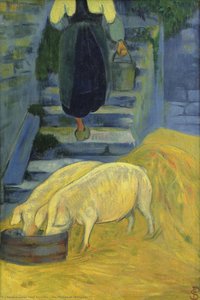
Paul Sérusier’s “Grammar,” painted in 1892, stands as a pivotal work not just within the artist's oeuvre but also as a foundational piece in the development of modern art. More than simply a portrait, it’s an intensely personal and experimental exploration of color, form, and the very nature of representation – a bold step towards abstraction that profoundly influenced generations of artists to come. The painting depicts a woman seated on the ground, absorbed in reading a book, a scene rendered with remarkable intimacy and a deliberate departure from traditional academic styles.
Sérusier’s artistic journey was deeply intertwined with the burgeoning Nabis movement, a group of Symbolist painters who sought to move beyond mere imitation of nature towards expressing inner emotions and spiritual truths. He initially studied at the Académie Julian, but it was his summer sojourn in Pont-Aven, Brittany, that proved transformative. There, under the tutelage of Paul Gauguin – a figure whose influence extended far beyond technique – Sérusier encountered the revolutionary approach of Cloisonnism, championed by Gauguin himself. This style, characterized by sharply defined outlines and areas of flat color applied in small, separate strokes, aimed to mimic the appearance of stained glass, creating a sense of luminous clarity and symbolic resonance.
Cloisonnism and the Language of Color
“Grammar” exemplifies this Cloisonnism technique with striking precision. The woman’s figure is not rendered through subtle gradations of tone but rather defined by bold, distinct outlines – a deliberate simplification that prioritizes color and form over meticulous detail. Sérusier employs a vibrant palette, dominated by deep blues, greens, and ochres, creating an atmosphere both serene and slightly melancholic. The colors aren’t blended; instead, they are applied in small, separate strokes, building up layers of hue and texture. This technique, combined with the flattened perspective, creates a sense of immediacy and directness, as if the painting is capturing a fleeting moment of contemplation.
Crucially, Sérusier’s use of color isn't merely descriptive; it carries symbolic weight. The blues evoke a sense of introspection and mystery, while the greens suggest connection to nature – a key theme in Symbolist art. The muted ochres contribute to the painting’s overall feeling of quietude and contemplation. The deliberate choice of colors, rather than realistic representation, is central to the work's expressive power.
A Study in Form and Abstraction
Beyond its technical mastery, “Grammar” represents a significant shift towards abstraction. While not entirely devoid of recognizable forms – the woman’s figure, the book, the surrounding objects – the painting prioritizes the exploration of color and form over strict representation. The simplified shapes, flattened perspective, and emphasis on pure color anticipate later developments in abstract art, foreshadowing the work of artists like Kandinsky and Mondrian. It's a deliberate move away from photographic realism towards a more subjective and expressive approach to visual language.
The painting’s title, “Grammar,” is particularly intriguing. It suggests that Sérusier was not simply depicting a scene but rather exploring the fundamental building blocks of artistic expression – the elements of color, line, and form – in a way that transcends traditional representation. The book itself becomes a symbol of knowledge and contemplation, inviting the viewer to engage with the painting on a deeper level.
Legacy and Inspiration
“Grammar” remains a vital work in the history of modern art, demonstrating Sérusier’s pioneering spirit and his profound influence on subsequent generations. It's a testament to the power of abstraction to convey emotion, ideas, and spiritual truths. Reproductions of this evocative painting continue to inspire artists and collectors alike, offering a glimpse into the heart of artistic innovation and the enduring quest for new forms of visual expression.
Questions et réponses
Puis-je utiliser la réalité augmentée pour visualiser «The Grammar» de Paul Sérusier dans ma pièce ?
Visualisez «The Grammar» de Paul Sérusier sur votre propre mur grâce à la page Aperçu en RA de l'œuvre, en utilisant la réalité augmentée sur un appareil compatible.
Comment le style de « The Grammar » s'inscrit-il dans l'époque de son créateur ?
«The Grammar» de Paul Sérusier s'inscrit dans le mouvement Cloisonnism / Nabis, au sein de l'époque XIXe siècle de son créateur.
Quelle intensité et quelle saturation «The Grammar» de Paul Sérusier présente-t-il ?
La couleur de « The Grammar » présente une saturation de Muted et une intensité de Monochromatic.




Biographie de l'artiste
Premières années et formation
Louis-Paul-Henri Sérusier, plus connu sous le nom de Paul Sérusier, est né à Paris le 9 novembre 1864. Il a étudié à l'Académie Julian dans les années 1880 où il devint moniteur. Cette période marque le début de son parcours artistique qui le mènera à être un pionnier de l’art abstrait et à inspirer le mouvement d'avant-garde des Nabis, du synthétisme et du cloisonnisme.Carrière Artistique
Au cours de l'été 1888, Sérusier se rendit à Pont-Aven où il rejoignit un petit groupe d’artistes autour de Paul Gauguin. Sous la supervision étroite de Gauguin, Sérusier peignit "Le Talisman", un exercice extrême en cloisonnisme qui approchait l'abstraction pure. Cette œuvre mettait en valeur son style innovant et sa volonté d'expérimenter de nouvelles techniques. En tant que peintre post-impressionniste, Sérusier faisait partie du groupe Les Nabis, aux côtés de Pierre Bonnard, Édouard Vuillard et Maurice Denis. Bien qu’il ne soit pas aussi largement reconnu que certains de ses pairs, ses contributions au développement de l'art abstrait sont indéniables.Œuvres Notables et Héritage
Parmi les œuvres notables de Sérusier, on peut citer :- L'Averse (1893), Musée d’Orsay, Paris
- Portrait de Paul Ranson (1890), Musée d’Orsay, Paris
- Mélancolie (1890)
- Les Mangeurs de Serpents (1894), Muzeum Narodowe, Varsovie
Mouvement Artistique et Influence
Le travail de Sérusier a été influencé par le cloisonnisme, un style caractérisé par des formes audacieuses et plates séparées par des contours sombres. Ce mouvement, qui est apparu à la fin du XIXe siècle, a joué un rôle important dans le développement de l'art moderne.- Explorez davantage le cloisonnisme : le mouvement artistique du cloisonnisme
- Découvrez l'œuvre de Sérusier : Paul Sérusier | TopImpressionists.com
- Apprenez à connaître le mouvement des Nabis : le mouvement des Nabis
- Paul Sérusier était un peintre français qui a ouvert la voie à l'art abstrait et inspiré le mouvement des Nabis.
- Il a étudié à l'Académie Julian puis a enseigné à l'Académie Ranson.
- Le travail de Sérusier a été influencé par le cloisonnisme, un style caractérisé par des formes audacieuses et plates.

Paul Sérusier
1864 - 1927 , France
L'essentiel de l'artiste
- Artistes Influents:
- Paul Gauguin
- Émile Bernard
- Date De Décès: 7 octobre 1927
- Date De Naissance: 9 novembre 1864
- Influences Artistiques:
- Cloisonnisme
- Synthetisme
- Lieu De Naissance: Paris, France
- Mouvement Artistique: Post-impressionnisme, Nabi
- Nationalité: Française
- Nom Complet: Paul Sérusier
- Œuvres Notables:
- L'Averse (1893)
- Portrait de Paul Ranson (1890)
- Le Talisman (1888)
Articles connexes

The Soul of Color: A Journey into the Emotional Resonance of Lyrical Abstraction
Embark on a cultural journey through Lyrical Abstraction. Explore how masters like Kandinsky used color and motion to translate emotion into visual poetry. Discover the profound beauty of abstract expressionism and learn to curate emotional resonance in your own art collection.
Explorez des œuvres d'art classées par thèmes, styles et caractéristiques.


