

Shown: · With its frame:
 Aperçu en situation
 Envoyer
 Partager
 Détails de l'œuvre
 Guide
Guide

 Télécharger l'image
 Articles similaires
 Radiographie
 Diaporama
 Q&A
Q&A Statistiques

€ 239
Reproduction à l'huile faite à la main
Huile sur toile peinte à la main, avec cadre et dimensions personnalisés, réalisée sur commande par nos artistes. ( Passer au format impression Passer au format numérique)
Size
·Format standard
sur mesure
CM
INCH
Choisissez parmi nos formats prédéfinis qui respectent les proportions originales de l’œuvre.
Loading sizes...

largeur
hauteur
Saisissez la largeur et la hauteur souhaitées, pour s'adapter à votre cadre ou à votre mur. Cette œuvre est peinte à la main ; ainsi, pour un format de forme différente, l'artiste peut peindre un peu plus autour du tableau ou réduire légèrement les bords — c'est vous qui choisissez. Nous vous envoyons une maquette numérique pour approbation avant que la peinture ne commence. L'image présentée sur cette page ne reflète pas le résultat réel — seule la maquette le fait.
 En savoir plus
Finish
·
White €1

Blurside €1

Extended €1

P118B €10

P118H €10

P118W €10

P438Z €10

P508JH €12

P508YH €12

P805H €10

P805Z €10

P919BZ €10

P919G €10

P919XJ €10

P959ZH €10

P968JZ €12

W106C €8

W218G €10

W218JH €8

W218Y €10

W307PJ €10

W316G €10

W316PJ €8

W316Y €10

W398PJ €8

W4111J €10

W500HY €15

W500JH €15

W692G €12

W849H €8

W940BG €15

W953PJ €8

H24-GOLD €30

H24-SILVER €30

H36-GOLD €45

H36-SILVER €45
Shipped in a protective tube, ready for your own framer.
Above 105 cm the frame is shipped as a kit for a professional framer — read the details.
Extras
optionalWhat do the extras include?
Examples of what can be changed: Replace face with customer photo; Add pet (e.g., replace cat with dog); Include hidden message in background; Change background landscape or elements.
After order, TopImpressionists.com team will email client for instructions and provide a mockup preview
After order, TopImpressionists.com team will email client for instructions and provide a mockup preview
Livraison dans le monde entier () en 3 à 4 semaines au lieu des 5 semaines habituelles. (1 novembre). Aucun compromis sur la qualité.
Vernis de protection
Cartel
Détails de la plaque en bronze gravée
This elegant plaque features the artist's name and the title of the artwork, finely engraved for a timeless presentation.
It is made from bronze with a refined, elegant finish. The text is precisely laser-engraved for a sharp and permanent result. Measuring 9x2 cm, the plaque is compact yet easy to read. It's built to be durable and scratch-resistant, offering a professional, museum-quality look. Mounting is simple thanks to the included adhesive backing.
Détails de la plaque en acrylique transparent
The plaque includes essential engraved details such as the artist's name, the title of the artwork, the date it was created, the type of media used-like oil on canvas or watercolor-a brief description of the piece, and a QR code that links to the complete artwork information.
It is crafted from clear acrylic, offering a sleek, modern appearance. The text is UV-engraved in black to ensure strong visual contrast. With a size of 10x15 cm, it ensures optimal readability. It comes equipped with two metal hooks for secure wall mounting. The plaque is designed to be weather-resistant, making it suitable for various environments, and it includes interactive features that work seamlessly with smartphone scanning.
Détails de la plaque en acrylique noir
This elegant plaque includes engraved information such as the artist's name, the title of the artwork, the date it was created, the type of media used (like oil on canvas or watercolor), a short description of the artwork, and a QR code for quick access to more information.
The plaque itself is made from refined black acrylic with a premium finish. The text is laser-engraved in white for high contrast and readability. Its size is 10x15 cm, designed to be easy to read. It comes with two metal hooks for professional mounting. The design is sleek and fits any interior style. It is also weather-resistant and durable, with built-in digital integration for mobile compatibility.
L'option verre n'est disponible que pour les dimensions inférieures à 110 cm.
 L'option verre n'est disponible que pour les dimensions inférieures à 110 cm.
- Livraison express gratuite dans le monde entier
- Toile de lin de qualité supérieure
- Assurance transport complète
- Garantie de remboursement des droits de douane
- Garantie de fidélité des couleurs
- Politique de retour de 100 jours (uniquement en cas de défaut)
- Garantie de remboursement à 100%
- Offre de tarifs dégressifs


Description de la pièce
Experience the vibrant tranquility of Paul Signac's 1906 Pointillist masterpiece The Bay featuring colorful sailboats on a serene seascape and inviting you to bring this Neo-Impressionist gem into your collection.
Biographie de l'artiste
Découvrez Paul Signac (1863-1935), maître du néo-impressionnisme et du pointillisme ! Ses paysages côtiers lumineux et son influence sur l'art moderne chez TopImpressionists.
About the painting
A Symphony of Light and Color
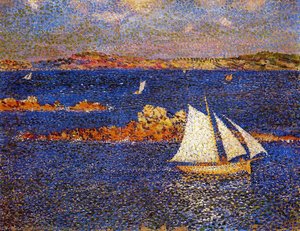
In the tranquil embrace of Paul Signac’s 1906 masterpiece, "The Bay," the viewer is invited into a world where light does not merely illuminate a scene but becomes the very fabric of its existence. This breathtaking work captures a serene coastal moment, where two sailboats with vibrant red and white sails drift lazily upon a shimmering expanse of water. The composition is anchored by a rugged, rocky shoreline in the foreground, where textured trees reach toward a sky filled with soft, drifting clouds. Beyond the gentle movement of the boats, a distant cliff rises with a sense of quiet grandeur, providing a structural weight that balances the ethereal lightness of the sea and sky. It is a scene that transcends mere landscape painting, offering instead a meditative window into the harmony of the natural world.
The true soul of this painting lies in its meticulous execution through the Pointillist technique, a method perfected by Signac to achieve a scientific yet deeply emotional resonance. Rather than blending pigments on a palette, Signac applied tiny, distinct dots of pure, unadulterated color directly onto the canvas. From a distance, these rhythmic pulsations of pigment dance and merge within the viewer's eye, creating an optical fusion that mimics the flickering quality of sunlight on water. This technique lends "The Bay" a unique, vibrating texture; the colors do not sit static upon the surface but seem to breathe and shimmer, capturing the fleeting essence of a summer afternoon with unparalleled vitality.
The Legacy of Neo-Impressionism
To understand the profound impact of "The Bay," one must look to the historical currents that shaped Paul Signac’s vision. As a pioneer of Neo-Impressionism, Signac sought to move beyond the spontaneous, often fleeting impressions of his predecessors toward a more structured and systematic approach to art. Influenced heavily by the scientific theories of color and light prevalent in late 19th-century France, he transformed the canvas into a laboratory of perception. In this work, we see the culmination of years of experimentation—a transition from the soft edges of Impressionism to a disciplined, mosaic-like precision that celebrates the mathematical beauty of light.
For the discerning collector or interior designer, "The Bay" offers much more than aesthetic beauty; it provides a focal point of sophisticated tranquility. The striking contrast between the deep, saturated tones of the rocky coast and the brilliant pops of crimson in the sails creates a dynamic visual energy that can anchor a room with elegance. Whether placed in a contemporary gallery setting or a classic study, this reproduction serves as a testament to the enduring power of Pointillism. It is an invitation to slow down, to observe the minute details, and to rediscover the profound peace found in the rhythmic dance of color and light.
Questions et réponses
Puis-je utiliser la réalité augmentée pour visualiser «The bay» de Paul Signac dans ma pièce ?
« The bay » dispose d'un aperçu en réalité augmentée : la page Aperçu en RA de l'œuvre vous permet de la visualiser dans votre propre espace sur un appareil compatible.
«The bay» de Paul Signac est-il une composition en portrait, en paysage ou carrée ?
«The bay» de Paul Signac est une composition en Landscape. Il convient de vérifier les proportions avant de choisir un format d'impression.
À quelle étape de la carrière de Paul Signac appartient « The bay » (1906) ?
Datée de 1906, l'œuvre « The bay » s'inscrit dans la période Mature Period du développement de Paul Signac.
Quick facts and art quiz
About Paul Signac

Paul Signac
1863 - 1935, France
Biographie de l'artiste
La Vision Harmonieuse de Paul Signac
Paul Victor Jules Signac, né à Paris en 1863, s'est imposé comme une figure charnière de l'évolution de l'art moderne, indissociablement lié à la naissance et au développement du Néo-Impressionnisme. Initialement attiré par l'architecture, une rencontre de jeunesse avec l'exposition de Claude Monet a allumé en lui une passion durable pour la peinture, le lançant sur une voie qui allait redéfinir la théorie des couleurs et l'expression artistique. Signac n'était pas seulement un peintre ; il était un explorateur dévoué de la lumière, de la couleur et de la science même qui sous-tend la perception visuelle. Ses premières œuvres, bien que manifestant des tendances impressionnistes, ont rapidement évolué sous l'influence profonde de Georges Seurat, forgeant un partenariat qui a donné naissance au Pointillisme – une technique caractérisée par l'application méticuleuse de minuscules points distincts de couleur pure, destinés à se mélanger optiquement dans l'œil du spectateur. Il ne s'agissait pas simplement d'esthétique ; c'était une tentative de systématiser la peinture, en l'ancrant dans des principes scientifiques et en défiant les normes artistiques conventionnelles.Un Dialogue avec Seurat et la Naissance du Néo-Impressionnisme
La rencontre entre Signac et Seurat en 1884 s'est révélée transformative pour les deux artistes. Ils partageaient une fascination pour les écrits d'Eugène Delacroix sur la théorie des couleurs, particulièrement son exploration des contrastes complémentaires et de l'impact émotionnel de la teinte. Ensemble, ils se sont lancés dans une investigation rigoureuse de ces principes, les traduisant en une technique picturale révolutionnaire. Signac a embrassé de tout cœur la vision de Seurat, abandonnant les touches fugaces de l'Impressionnisme pour l'application précise et calculée de points de couleur. Boulevard de Clichy (1886) constitue un premier témoignage de cette nouvelle approche, illustrant le style méticuleux de Signac et son engagement à capturer la vitalité de la vie urbaine à travers un prisme scientifique. Cependant, leur collaboration n'était pas seulement technique ; elle était intellectuelle, nourrie par le désir partagé d'élever la peinture au rang d'une science rigoureuse. Signac est devenu un fervent défenseur des idées de Seurat, promouvant sans relâche le Néo-Impressionnisme et défendant ses principes face aux critiques. La mort tragique et prématurée de Seurat en 1891 a laissé à Signac le rôle de principal champion de leur vision artistique commune, un rôle qu'il a assumé avec un dévouement inébranlable.Rêveries Côtières et Indépendance Artistique
Après la disparition de Seurat, le voyage artistique de Signac a pris une nouvelle dimension, profondément influencée par son amour profond pour la voile et l'attrait de la côte méditerranéenne. Il découvrit Saint-Tropez en 1892, y établissant une demeure qui devint un refuge pour les artistes et une source d'inspiration infinie. Les eaux scintillantes, les ports baignés de soleil et les villes côtières pittoresques offrirent un cadre idéal pour explorer l'interaction entre la lumière et la couleur. La Bouée Rouge, Saint-Tropez (1895) illustre parfaitement cette période, démontrant sa maîtrise du Pointillisme dans la capture des teintes vibrantes et de l'énergie dynamique de la mer. Sa technique a évolué, devenant plus fluide et expressive tout en conservant ses fondements scientifiques. Il commença à expérimenter avec des touches plus larges et une palette plus étendue, s'éloignant de l'adhésion stricte à la méthode de pointillé précis de Seurat. Les voyages de Signac s'étendirent au-delà de la France, englobant l'Italie, la Hollande et même Constantinople, chaque périple enrichissant son vocabulaire artistique et élargissant sa perspective.Un Mécène de l'Avant-Garde et un Héritage Durable
Au-delà de ses propres aspirations artistiques, Signac joua un rôle crucial dans la promotion du développement de l'art moderne grâce à son leadership au sein de la Société des Artistes Indépendants. En tant que président de 1908 jusqu'à sa mort en 1935, il fut le défenseur de la liberté artistique et offrit une plateforme aux talents émergents, notamment Henri Matisse, André Derain et d'autres pionniers du Fauvisme et du Cubisme. Il fut parmi les premiers à reconnaître et à soutenir leurs travaux novateurs, exposant des œuvres controversées qui défiaient les normes esthétiques conventionnelles. L'engagement de Signac envers l'inclusivité et sa volonté d'embrasser l'innovation ont aidé à façonner la trajectoire de l'art du XXe siècle. Ses écrits théoriques, notamment D'Eugène Delacroix au Néo-Impressionnisme (1899), ont davantage consolidé sa position de figure intellectuelle majeure dans le monde de l'art. L'héritage de Paul Signac s'étend bien au-delà de ses peintures captivantes ; il fut un artiste visionnaire, un théoricien dévoué et un mécène généreux qui influença profondément le cours de l'art moderne, laissant une marque indélébile sur les générations d'artistes à venir.Dates Clés et Réalisations
- 1863 : Naissance à Paris, France.
- 1884 : Cofondateur de la Société des Artistes Indépendants avec Georges Seurat.
- 1886 : Peint *Boulevard de Clichy*, un exemple clé du début du Pointillisme.
- 1895 : Création de *La Bouée Rouge, Saint-Tropez*, illustrant sa maîtrise des scènes côtières.
- 1899 : Publication de *D'Eugène Delacroix au Néo-Impressionnisme*, une œuvre séminale sur la théorie des couleurs.
- 1908 – 1935 : Président de la Société des Artistes Indépendants, défenseur des artistes d'avant-garde.
- 1935 : Décès à Paris à l'âge de 72 ans, laissant derrière lui un riche héritage artistique.
Quick facts about Paul Signac
- Artistic Movement Or Style: Neo-Impressionism, Pointillism
- Artists Or Movements Influenced By This Artist:
- Henri Matisse
- Fauvism
- Artists Who Influenced This Artist:
- Claude Monet
- Georges Seurat
- Date Of Birth: 1863
- Date Of Death: 1935
- Full Name: Paul Victor Jules Signac
- Nationality: French
- Notable Artworks:
- Boulevard de Clichy
- The Red Buoy
- La Valleuse
- Place Of Birth: Paris
Œuvres similaires





Explorez des œuvres d'art classées par thèmes, styles et caractéristiques.


Paul Signac
The bay
() ·
With its frame: · Hand-painted in oil on linen
Total