

 Aperçu en situation
 Envoyer
 Partager
 Détails de l'œuvre
 Guide
Guide

 Télécharger l'image
 Articles similaires
 Radiographie
 Diaporama
 Q&A
Q&A Statistiques
Chepstow Castle


Philip Wilson Steer's "Chepstow Castle" captures the majestic British landscape with atmospheric watercolors. Explore this iconic work of Impressionist art, showcasing the castle and River Wye.
 Lire la suite
Découvrez Philip Wilson Steer (1860-1942), figure clé de l'impressionnisme britannique ! Paysages lumineux, influences de Manet & Whistler, visibles à la Tate et à l'Uffizi.
Giclées et impressions d'art
Impressions giclées ou sur toile de qualité musée, avec une production rapide et des finitions au choix. ( Commander la reproduction peinte à la main Passer au format numérique)




P118B €10

P118H €10

P118W €10

P438Z €10

P508JH €12

P508YH €12

P805H €10

P805Z €10

P919BZ €10

P919G €10

P919XJ €10

P959ZH €10

P968JZ €12

W106C €8

W218G €10

W218JH €8

W218Y €10

W307PJ €10

W316G €10

W316PJ €8

W316Y €10

W398PJ €8

W4111J €10

W500HY €15

W500JH €15

W692G €12

W849H €8

W940BG €15

W953PJ €8




Format standard
sur mesure
CM
INCH
Choisissez parmi nos formats prédéfinis qui respectent les proportions originales de l’œuvre.
Loading sizes...

largeur
hauteur
Saisissez la largeur et la hauteur souhaitées pour qu'elles s'adaptent à votre cadre ou à votre mur. Une impression peut être recadrée, mais jamais agrandie au-delà de l'image originale ; ainsi, un format de forme différente entraînera la perte d'une partie de l'image. Nous vous envoyons une maquette numérique pour approbation avant toute impression. L'image présentée sur cette page ne montre pas le recadrage réel — seule la maquette le permet.
Livraison dans le monde entier () en 2 semaines au lieu des 4/5 semaines habituelles. (31 octobre)

Livraison express gratuite dans le monde entier

Toile de lin de qualité supérieure

Assurance transport complète

Garantie de remboursement des droits de douane

Garantie de fidélité des couleurs

Politique de retour de 100 jours (uniquement en cas de défaut)

Garantie de remboursement à 100%

Offre de tarifs dégressifs
 L'option verre n'est disponible que pour les dimensions inférieures à 110 cm.

Chepstow Castle
Giclées et impressions d'art
Format de la reproduction
-


Prix total
€ 61
The Canvas as a Window: Philip Wilson Steer’s Chepstow Castle
Philip Wilson Steer's "Chepstow Castle" isn’t merely a depiction of a medieval fortress; it’s an immersion into the very essence of the Welsh landscape and the evocative power of memory. Painted in 1905, this watercolour captures more than just the physical structure of Chepstow Castle perched dramatically upon its limestone cliffs overlooking the River Wye. Instead, Steer offers us a shimmering, almost dreamlike vision—a testament to his profound understanding of light, atmosphere, and the enduring connection between man and nature. The castle itself, rendered with delicate washes of grey and ochre, seems to dissolve into the misty backdrop, becoming less a solid monument and more a spectral presence within the scene.
Steer’s artistic journey was one of constant evolution. Initially influenced by French Impressionism – particularly Manet and Whistler – he later sought inspiration in the works of John Constable and J.M.W. Turner, embracing a style that prioritized capturing fleeting moments and atmospheric effects over precise detail. This shift is powerfully evident here; the painting isn’t concerned with photographic accuracy but rather with conveying a specific mood—a sense of quiet contemplation and timelessness. The artist's deliberate blurring of edges and his masterful use of color create an ethereal quality, inviting the viewer to step into the scene and experience it as if they were standing beside the river themselves.
The Influence of Turner and Constable: A Return to English Roots
Steer’s decision to revisit the styles of Constable and Turner was a deliberate one, representing a conscious move away from the Parisian art world and back towards his British heritage. Constable's focus on the rural landscape—particularly the interplay of light and shadow in fields and waterways—provided Steer with a model for capturing the subtle nuances of the Welsh countryside. Similarly, Turner’s exploration of atmospheric perspective and his ability to evoke mood through color informed Steer’s approach to depicting the misty Wye Valley. The painting's silvery palette, reminiscent of Turner’s seascapes, suggests a sense of mystery and melancholy, while the composition echoes Constable’s emphasis on capturing the beauty of ordinary subjects.
Notably, Steer’s work during this period was heavily influenced by his travels in search of the picturesque. He sought out sites that were popular with eighteenth-century travelers—locations where the natural world could be experienced as a sublime and awe-inspiring spectacle. This pursuit is vividly reflected in "Chepstow Castle," which captures not just the castle itself but also the surrounding landscape, creating a harmonious whole. The inclusion of the River Wye, rendered with delicate washes of blue and grey, adds to the painting’s sense of tranquility and timelessness.
Symbolism and Emotional Resonance
Beyond its purely visual qualities, "Chepstow Castle" is rich in symbolic meaning. The castle itself represents not only a physical structure but also a symbol of power, history, and resilience—a reminder of the enduring legacy of Norman England in Wales. The misty atmosphere surrounding the castle evokes a sense of nostalgia and longing, suggesting that the past is never truly gone but continues to resonate within the present. The figures on the boats add a human element to the scene, hinting at the ongoing connection between people and place.
Steer’s masterful use of light—particularly its ability to transform the landscape—creates an emotional resonance that transcends mere representation. The painting evokes a sense of quiet contemplation and invites the viewer to reflect on their own relationship with history, memory, and the natural world. It's a piece that speaks not just to the eye but also to the heart, offering a glimpse into the artist’s profound understanding of beauty and its power to inspire.
Questions et réponses
Quelle est l'atmosphère générale de «Chepstow Castle» de Philip Wilson Steer ?
«Chepstow Castle» dégage une atmosphère Calm.
Quelle ambiance "Chepstow Castle" apporterait-elle à une pièce ?
«Chepstow Castle» de Philip Wilson Steer dégage une atmosphère Calm et s'intègre parfaitement dans une Living Room. Cette ambiance reflète l'émotion que l'œuvre apporte à l'espace qui l'entoure.
Quel sujet et quelle atmosphère «Chepstow Castle» de Philip Wilson Steer associe-t-elle ?
«Chepstow Castle» met en scène castle, river, landscape, wales, boats, 1905, steer, et l'atmosphère qui s'en dégage est Calm.
Œuvres similaires


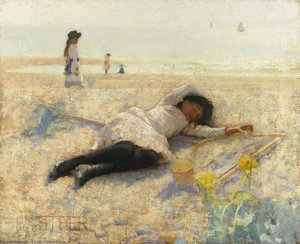


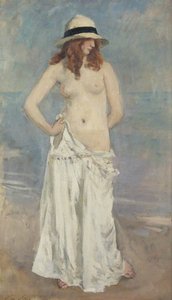

Biographie de l'artiste
Jeunesse et Formation Artistique
Philip Wilson Steer, né à Birkenhead en 1860, baigna dès son plus jeune âge dans un environnement artistique stimulant. Son père, portraitiste et professeur d’art, fut le premier à éveiller sa sensibilité esthétique, une influence déterminante qui allait façonner son destin. Un déménagement familial vers Whitchurch, près de Monmouth, lorsqu'il avait trois ans, l'imprégna des paysages verdoyants de la campagne britannique, un motif qui réapparaîtra fréquemment dans son œuvre ultérieure. Son éducation formelle débuta à Hereford Cathedral School, où il acquit une base solide avant de se consacrer pleinement à ses ambitions artistiques. Il poursuivit sa formation à la Gloucester School of Art puis aux South Kensington Drawing Schools, affinant ainsi ses compétences techniques et explorant différentes approches picturales. Cependant, c’est son séjour à Paris entre 1880 et 1884 qui marqua un tournant décisif dans son parcours artistique. À l'Académie Julian, puis sous la tutelle d'Alexandre Cabanel à l'École des Beaux-Arts, il découvrit un univers foisonnant de nouvelles idées et techniques, ouvrant ses horizons sur les courants artistiques émergents.L’Influence Impressionniste et l’Émergence d’un Style Personnel
Paris fut pour Steer une véritable révélation. Il fut profondément touché par l'œuvre d'Édouard Manet et de James McNeill Whistler, admirant leur audace à capturer la lumière, les couleurs et l'atmosphère avec une liberté nouvelle. Cette rencontre avec l’impressionnisme français eut un impact profond sur son art, mais Steer ne se contenta pas d’imiter ce mouvement. Il sut habilement fusionner ces influences françaises avec sa sensibilité anglaise innée, créant ainsi un style unique et reconnaissable. Ses tableaux se caractérisent par une capacité remarquable à saisir des instants fugaces – le scintillement du soleil sur l'eau, la brume matinale enveloppant la côte. Il employait des touches de pinceau lâches et vibrantes non pas pour reproduire fidèlement la réalité, mais pour évoquer des émotions et créer une impression d’immédiateté. Les scènes de plage et les paysages marins devinrent des thèmes récurrents dans son œuvre, souvent baignés d'une lumière argentée et translucide qui témoigne de sa maîtrise du rendu atmosphérique. Des œuvres comme La Music Room, réalisée au début de sa carrière, révèlent déjà ses talents prometteurs en matière de composition et de traitement de la lumière, tandis que des tableaux tels que Girls Running: Walberswick Pier captivent par leur énergie et leur vitalité.Un Acteur Clé du Renouveau Artistique Britannique
Philip Wilson Steer ne se limita pas à peindre ; il s'investit activement dans la vie artistique de son pays. Il joua un rôle essentiel dans la fondation du New English Art Club, une organisation qui visait à promouvoir l’art moderne en Grande-Bretagne, une initiative audacieuse à une époque où les goûts traditionnels étaient encore dominants. Grâce à cette plateforme et à ses participations régulières aux expositions de la Royal Academy, notamment à l'exposition impressionniste londonienne de 1889, il contribua à faire connaître les nouvelles tendances artistiques et à remettre en question les conventions établies. Son séjour à la colonie d’artistes d’Etaples en 1887 fut également une expérience enrichissante qui affina sa vision artistique. Cette communauté dynamique de peintres lui offrit un environnement stimulant pour l'expérimentation et la collaboration, renforçant ainsi sa capacité à capturer la lumière et l'atmosphère avec une finesse croissante. Steer s’inspira d’une multitude de maîtres – John Constable, J.M.W. Turner, voire même François Boucher – mais il sut toujours filtrer ces influences à travers sa propre sensibilité artistique.Héritage et Reconnaissance Posthume
Philip Wilson Steer continua de peindre avec passion jusqu'en 1940, date à laquelle des problèmes de santé l’obligèrent à interrompre son activité. Il s’éteignit en 1942, à l’âge de 81 ans, laissant derrière lui une œuvre riche et variée qui témoigne de son talent exceptionnel. Sa contribution fut largement reconnue de son vivant, notamment par l'attribution de l'Ordre du Mérite. Aujourd'hui, ses tableaux sont conservés dans des collections prestigieuses à travers le monde, dont la Tate Gallery et même les Galeries Uffizi – une preuve éclatante de sa renommée internationale. Au-delà de ses œuvres elles-mêmes, Steer a laissé un héritage durable grâce à son long mandat d'enseignant à la Slade School of Art. Pendant de nombreuses années, il influença profondément des générations de jeunes artistes, leur transmettant non seulement des compétences techniques, mais aussi une appréciation profonde de l’observation et de l’intégrité artistique. Sa contribution au développement et à l’acceptation de l’impressionnisme en Grande-Bretagne est indéniable, consolidant ainsi sa place parmi les figures majeures de l'histoire de l'art britannique – un peintre qui a su avec brio concilier tradition et modernité, laissant une empreinte indélébile sur le paysage artistique du pays. Des œuvres emblématiques telles que Convalescent, par la richesse de ses textures et son regard évocateur, ou encore The Teme at Ludlow, qui sublime la beauté sereine des paysages anglais, continuent d'émerveiller les spectateurs aujourd’hui, témoignant de l’intemporalité de sa vision artistique.
Philip Wilson Steer
1860 - 1942 , Royaume-Uni
L'essentiel de l'artiste
- Artistes Influents:
- Manet
- Whistler
- Constable
- Turner
- Date De Décès: 18 mars 1942
- Date De Naissance: 28 décembre 1860
- Influence Sur: Impressionnisme britannique
- Lieu De Naissance: Birkenhead, Royaume-Uni
- Mouvement Artistique: Impressionnisme
- Nationalité: Britannique
- Nom Complet: Philip Wilson Steer
- Œuvres Notables:
- The Music Room
- Girls Running
- Convalescent
- The Teme at Ludlow
Articles connexes

Capturing the Light: A Journey Through the Ethereal Magic of Impressionism and Post-Impressionism
Embark on a cultural journey through the luminous world of Impressionism. Discover the profound beauty of Monet, Van Gogh, and Cézanne through expert art history insights and explore how to bring these timeless masterpieces into your home with museum-quality hand-painted reproductions.
Explorez des œuvres d'art classées par thèmes, styles et caractéristiques.


