

Shown: · With its frame:
 Aperçu en situation
 Envoyer
 Partager
 Détails de l'œuvre
 Guide
Guide

 Télécharger l'image
 Articles similaires
 Radiographie
 Diaporama
 Q&A
Q&A Statistiques
 Acrylic On Canvas
- WallArt
- German Romanticism
 1809
1809- 19th Century
 225.0 x 189.0 cm
 Hamburger Kunsthalle
€ 239
Reproduction à l'huile faite à la main
Huile sur toile peinte à la main, avec cadre et dimensions personnalisés, réalisée sur commande par nos artistes. ( Passer au format impression Passer au format numérique)
Size
·Format standard
sur mesure
CM
INCH
Choisissez parmi nos formats prédéfinis qui respectent les proportions originales de l’œuvre.
Loading sizes...

largeur
hauteur
Saisissez la largeur et la hauteur souhaitées, pour s'adapter à votre cadre ou à votre mur. Cette œuvre est peinte à la main ; ainsi, pour un format de forme différente, l'artiste peut peindre un peu plus autour du tableau ou réduire légèrement les bords — c'est vous qui choisissez. Nous vous envoyons une maquette numérique pour approbation avant que la peinture ne commence. L'image présentée sur cette page ne reflète pas le résultat réel — seule la maquette le fait.
 En savoir plus
Finish
·
White €1

Blurside €1

Extended €1

P118B €10

P118H €10

P118W €10

P438Z €10

P508JH €12

P508YH €12

P805H €10

P805Z €10

P919BZ €10

P919G €10

P919XJ €10

P959ZH €10

P968JZ €12

W106C €8

W218G €10

W218JH €8

W218Y €10

W307PJ €10

W316G €10

W316PJ €8

W316Y €10

W398PJ €8

W4111J €10

W500HY €15

W500JH €15

W692G €12

W849H €8

W940BG €15

W953PJ €8

H24-GOLD €30

H24-SILVER €30

H36-GOLD €45

H36-SILVER €45
Shipped in a protective tube, ready for your own framer.
Above 105 cm the frame is shipped as a kit for a professional framer — read the details.
Extras
optionalWhat do the extras include?
Examples of what can be changed: Replace face with customer photo; Add pet (e.g., replace cat with dog); Include hidden message in background; Change background landscape or elements.
After order, TopImpressionists.com team will email client for instructions and provide a mockup preview
After order, TopImpressionists.com team will email client for instructions and provide a mockup preview
Livraison dans le monde entier () en 3 à 4 semaines au lieu des 5 semaines habituelles. (31 octobre). Aucun compromis sur la qualité.
Vernis de protection
Cartel
Détails de la plaque en bronze gravée
This elegant plaque features the artist's name and the title of the artwork, finely engraved for a timeless presentation.
It is made from bronze with a refined, elegant finish. The text is precisely laser-engraved for a sharp and permanent result. Measuring 9x2 cm, the plaque is compact yet easy to read. It's built to be durable and scratch-resistant, offering a professional, museum-quality look. Mounting is simple thanks to the included adhesive backing.
Détails de la plaque en acrylique transparent
The plaque includes essential engraved details such as the artist's name, the title of the artwork, the date it was created, the type of media used-like oil on canvas or watercolor-a brief description of the piece, and a QR code that links to the complete artwork information.
It is crafted from clear acrylic, offering a sleek, modern appearance. The text is UV-engraved in black to ensure strong visual contrast. With a size of 10x15 cm, it ensures optimal readability. It comes equipped with two metal hooks for secure wall mounting. The plaque is designed to be weather-resistant, making it suitable for various environments, and it includes interactive features that work seamlessly with smartphone scanning.
Détails de la plaque en acrylique noir
This elegant plaque includes engraved information such as the artist's name, the title of the artwork, the date it was created, the type of media used (like oil on canvas or watercolor), a short description of the artwork, and a QR code for quick access to more information.
The plaque itself is made from refined black acrylic with a premium finish. The text is laser-engraved in white for high contrast and readability. Its size is 10x15 cm, designed to be easy to read. It comes with two metal hooks for professional mounting. The design is sleek and fits any interior style. It is also weather-resistant and durable, with built-in digital integration for mobile compatibility.
L'option verre n'est disponible que pour les dimensions inférieures à 110 cm.
 L'option verre n'est disponible que pour les dimensions inférieures à 110 cm.
- Livraison express gratuite dans le monde entier
- Toile de lin de qualité supérieure
- Assurance transport complète
- Garantie de remboursement des droits de douane
- Garantie de fidélité des couleurs
- Politique de retour de 100 jours (uniquement en cas de défaut)
- Garantie de remboursement à 100%
- Offre de tarifs dégressifs


Description de la pièce
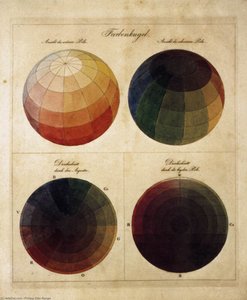
Experience 'Colour Spheres' by Philipp Otto Runge – a mesmerizing 1809 engraving depicting vibrant color spheres arranged in a harmonious circular design. A captivating piece of Romantic art.
Biographie de l'artiste
Philipp Otto Runge (1777-1810) : peintre romantique allemand célèbre pour ses paysages symboliques, portraits et sa théorie novatrice des couleurs ('Sphère chromatique'). Découvrez son art mystique et son influence durable.
About the painting
A Symphony of Color: Philipp Otto Runge’s “Colour Spheres”
Philipp Otto Runge's "Colour Spheres," painted in 1809, isn’t merely a depiction of spheres; it’s an intensely personal and profoundly symbolic exploration of color theory, spirituality, and the very essence of perception. Created during a pivotal moment in German Romanticism – a period grappling with tradition versus innovation, reason versus emotion – Runge sought to move beyond the constraints of academic painting and forge a new visual language rooted in his own deeply felt inner world. The work, now housed within the Kunsthalle in Hamburg, Germany, is a testament to this ambition, radiating an almost palpable sense of contemplative energy.
The composition itself is deceptively simple: four distinct spheres dominate the canvas, each imbued with a unique chromatic harmony. These aren’t static objects; they appear to pulse with light and movement, their surfaces shimmering with subtle gradations of color. Runge masterfully employs a technique reminiscent of both pastel drawing and early Impressionism – delicate layering of translucent washes creates an ethereal quality, while careful attention to value and hue establishes a remarkable sense of depth and luminosity. The spheres aren’t rendered with photographic realism; instead, they are idealized forms, suggesting a connection to the divine or the abstract realms of consciousness. The choice of materials—engraving media—contributes to this luminous effect, allowing for a richness of tone rarely achieved with oil paint alone.
The Roots of Color Theory and Spiritual Symbolism
Runge’s fascination with color stemmed from his deep engagement with the philosophy of Jakob Böhme, a 17th-century German mystic who believed that colors possessed inherent spiritual significance. Böhme posited that each hue corresponded to a specific stage of human development or a particular aspect of the divine. Runge sought to translate these esoteric ideas into visual form, believing that color could be used to unlock deeper levels of understanding and experience. His work reflects this intellectual pursuit, moving beyond mere representation to become a vehicle for conveying complex philosophical concepts.
The arrangement of the spheres themselves is laden with symbolic meaning. The central sphere, predominantly red, often represents passion, energy, and earthly existence – the realm of the senses. The green sphere embodies growth, harmony, and connection to nature. Blue signifies intellect, contemplation, and the spiritual realm. Yellow, positioned furthest from the viewer, evokes joy, enlightenment, and divine grace. The circular arrangement suggests a cyclical process—a journey through different states of consciousness or stages of life. It’s important to note that Runge's color theory was radically different from prevailing scientific understanding at the time; he prioritized subjective experience over objective measurement.
A Dialogue with Goethe and the Romantic Spirit
Runge’s work resonated deeply with his contemporary, Johann Wolfgang von Goethe, who shared a profound interest in color theory. The two artists engaged in extensive correspondence, exchanging ideas about the nature of perception and the expressive potential of color. Indeed, Runge's exploration of color was heavily influenced by Goethe’s theories on optics and aesthetics. This intellectual exchange highlights the vibrant artistic and philosophical ferment of the early 19th century – a period marked by a renewed interest in spirituality, emotion, and the power of individual experience.
Furthermore, “Colour Spheres” embodies the core tenets of German Romanticism: an emphasis on intuition, imagination, and the sublime. It rejects the rationalism of the Enlightenment in favor of a more subjective and emotionally charged approach to art. The painting’s evocative atmosphere—its sense of mystery, wonder, and spiritual yearning—captures the essence of this artistic movement perfectly. It invites the viewer not simply to *see* the colors but to *feel* them, to connect with their own inner world.
Collecting a Timeless Masterpiece
Reproductions of “Colour Spheres” offer a remarkable opportunity to bring Runge’s visionary aesthetic into any interior space. The delicate layering and luminous quality of the original are faithfully reproduced in high-quality prints, allowing the painting's subtle nuances to shine through. Whether displayed as a statement piece or incorporated into a more restrained color scheme, this artwork will undoubtedly serve as a focal point, sparking conversation and inspiring contemplation. Consider commissioning a hand-painted reproduction – a truly unique and authentic representation of this seminal work of German Romantic art.
Questions et réponses
Quel est l'usage recommandé pour une impression de « Colour Spheres » ?
Cette impression de « Colour Spheres » est idéale pour Statement.
Quel est le niveau de contraste dans «Colour Spheres» de Philipp Otto Runge ?
Le contraste clair-obscur de « Colour Spheres » est évalué à Statement. Le contraste décrit l'intensité de la différence entre les zones claires et les zones sombres.
L'œuvre « Colour Spheres » dispose-t-elle d'un aperçu en réalité augmentée ?
La page Aperçu en RA de «Colour Spheres» de Philipp Otto Runge utilise la réalité augmentée pour visualiser l'œuvre dans votre propre espace, à partir d'un appareil compatible.
Quick facts and art quiz
About Philipp Otto Runge

Philipp Otto Runge
1777 - 1810, Allemagne
Biographie de l'artiste
Une Vie Illuminée par la Vision Intérieure
Philipp Otto Runge, un nom qui résonne avec l'esprit naissant du Romantisme allemand, fut un artiste dont la vie tragiquement courte démentit la profondeur et l'originalité de sa vision. Né en 1777 à Wolgast, alors partie de la Poméranie suédoise, dans une famille ancrée dans la construction navale et liée à la noblesse prussienne, les premières années de Runge furent marquées par la maladie, favorisant une nature contemplative qui influencerait profondément ses recherches artistiques. Cette période de fragilité physique nourrit également un talent précoce pour les *silhouettes découpées*, une pratique qu'il poursuivra tout au long de sa vie – témoignage de sa capacité innée à distiller la forme et l’émotion avec une précision remarquable. Sa formation formelle commença plus tard que la plupart, initialement par un apprentissage commercial à Hambourg dans l'entreprise de son frère Daniel. Cependant, l'attrait de l'expression artistique s'avéra trop fort, le conduisant à Copenhague en 1799 pour étudier la peinture sous la direction de Jens Juel. Cela marqua le véritable début du parcours de Runge vers celui d’un des artistes allemands les plus innovants et spirituellement motivés.L'Aube du Symbolisme Romantique
Le développement artistique de Runge fut profondément influencé par son déménagement à Dresde en 1801, où il rencontra des figures clés comme Caspar David Friedrich et Ludwig Tieck. C’est également là qu’il fit la connaissance de Pauline Bassenge, qu'il épousa en 1804. Cette période fut témoin d'une fascination croissante pour les écrits mystiques de Jakob Böhme, dont les explorations philosophiques des harmonies cachées de l'univers résonnèrent profondément avec les inclinations spirituelles de Runge. Un moment décisif survint en 1803 lorsqu’il rencontra inopinément Johann Wolfgang von Goethe à Weimar, nouant une amitié fondée sur des intérêts communs pour la théorie des couleurs et l'expression artistique. Cette rencontre se révéla transformatrice, encourageant Runge à approfondir le langage symbolique de l'art et à explorer l'interconnexion de toutes choses. Ses premières œuvres reflétèrent cette sensibilité romantique émergente, s’éloignant de la retenue néoclassique vers des paysages et des portraits chargés d'émotion et imprégnés de sens personnel. *Les Enfants Hülsenbeck* (1805), par exemple, n'est pas simplement un portrait mais une représentation poignante de l'intimité familiale et de l'innocence enfantine, rendue avec une qualité presque éthérée.La Couleur comme Langage Cosmique
L’héritage le plus durable de Runge réside dans son travail révolutionnaire sur la théorie des couleurs. Il croyait que la couleur n'était pas simplement un phénomène visuel mais une force fondamentale façonnant notre perception de la réalité et reflétant l'ordre divin. Cette conviction conduisit au développement de sa *Farben-Kugel* (Sphère des Couleurs), publiée en 1810, peu avant sa mort prématurée de la tuberculose à l’âge de trente-trois ans. La Sphère des Couleurs n'était pas simplement un traité scientifique ; c'était une tentative de cartographier tout le spectre des couleurs sur une forme tridimensionnelle, avec le blanc et le noir représentant les pôles opposés et les couleurs primaires – bleu, jaune et rouge – symbolisant la Trinité chrétienne. Le bleu représentait Dieu et la nuit, le rouge symbolisait le matin, le soir et Jésus, tandis que le jaune incarnait le Saint-Esprit. Les expériences méticuleuses de mélange des couleurs en disque de Runge étaient une tentative de fournir un soutien empirique à son cadre théorique, démontrant comment les couleurs pouvaient être harmonieusement mélangées pour créer une vaste gamme de nuances. Cette exploration n'était pas isolée ; elle était intimement liée à sa pratique artistique, influençant l'utilisation symbolique de la couleur dans ses peintures et ses dessins.La Symphonie Inachevée des ‘Temps de la Journée’
Runge envisageait un *Gesamtkunstwerk* – une œuvre d'art totale – qui fusionnerait peinture, poésie, musique et architecture en une expérience sensorielle unifiée. Cette ambition trouva son expression la plus ambitieuse dans sa série *Tageszeiten* (Temps de la Journée), commencée en 1803. Le projet comprenait quatre peintures monumentales représentant le matin, midi, le soir et la nuit, chacune conçue pour être exposée dans un bâtiment spécialement construit accompagnée de musique et de poésie. Seules deux versions du « Matin » furent achevées, mais les dessins pour l'ensemble du cycle révèlent la profonde compréhension du symbolisme de Runge et son désir de capturer l'essence spirituelle du temps lui-même. Ces œuvres marquèrent une rupture avec la peinture paysagère traditionnelle, imprégnant la nature d’une signification religieuse et émotionnelle. Il cherchait non pas seulement à représenter le monde extérieur mais à transmettre son harmonie intérieure et sa présence divine. Le concept était révolutionnaire pour l'époque, anticipant les développements ultérieurs de l'art abstrait et des installations multimédias.Une Influence Durable
Bien que sa carrière ait été écourtée par la maladie, l’impact de Philipp Otto Runge sur le Romantisme allemand et le développement de l'art moderne est indéniable. Son exploration de la théorie des couleurs a influencé des générations d'artistes, notamment ceux associés au mouvement Bauhaus. Son insistance sur le symbolisme et l'expression émotionnelle ouvrit la voie aux peintres expressionnistes ultérieurs. Runge, avec son mélange unique d’enquête scientifique, de conviction spirituelle et d’innovation artistique, continue de captiver et d’inspirer. Il demeure une figure essentielle de l'histoire de l'art – un artiste visionnaire qui osa explorer les profondeurs cachées de la perception humaine et les mystères de l'univers à travers le langage de la couleur, de la forme et du symbolisme. Ses œuvres ne sont pas simplement des peintures ; ce sont des fenêtres ouvertes sur un monde illuminé par une vision intérieure, nous invitant à contempler l’interconnexion profonde de toutes choses.Quick facts about Philipp Otto Runge
- Artistes Qui L'Ont Influencé:
- Jakob Böhme
- Goethe
- Artistes/Mouvements Influencés: ['Caspar David Friedrich']
- Date De Décès: 2 décembre 1810
- Date De Naissance: 23 juillet 1777
- Lieu De Naissance: Wolgast, Allemagne
- Mouvement Artistique: Romantisme allemand
- Nationalité: Allemand
- Nom Complet: Philipp Otto Runge
- Oeuvres Notables:
- Les Enfants Hülsenbeck
- Le Grand Matin
- Sphère des couleurs
Explorez des œuvres d'art classées par thèmes, styles et caractéristiques.



Philipp Otto Runge
Colour Spheres
() ·
With its frame: · Hand-painted in oil on linen
Total