

 Aperçu en situation
 Envoyer
 Partager
 Détails de l'œuvre
 Guide
Guide

 Télécharger l'image
 Articles similaires
 Radiographie
 Diaporama
 Statistiques
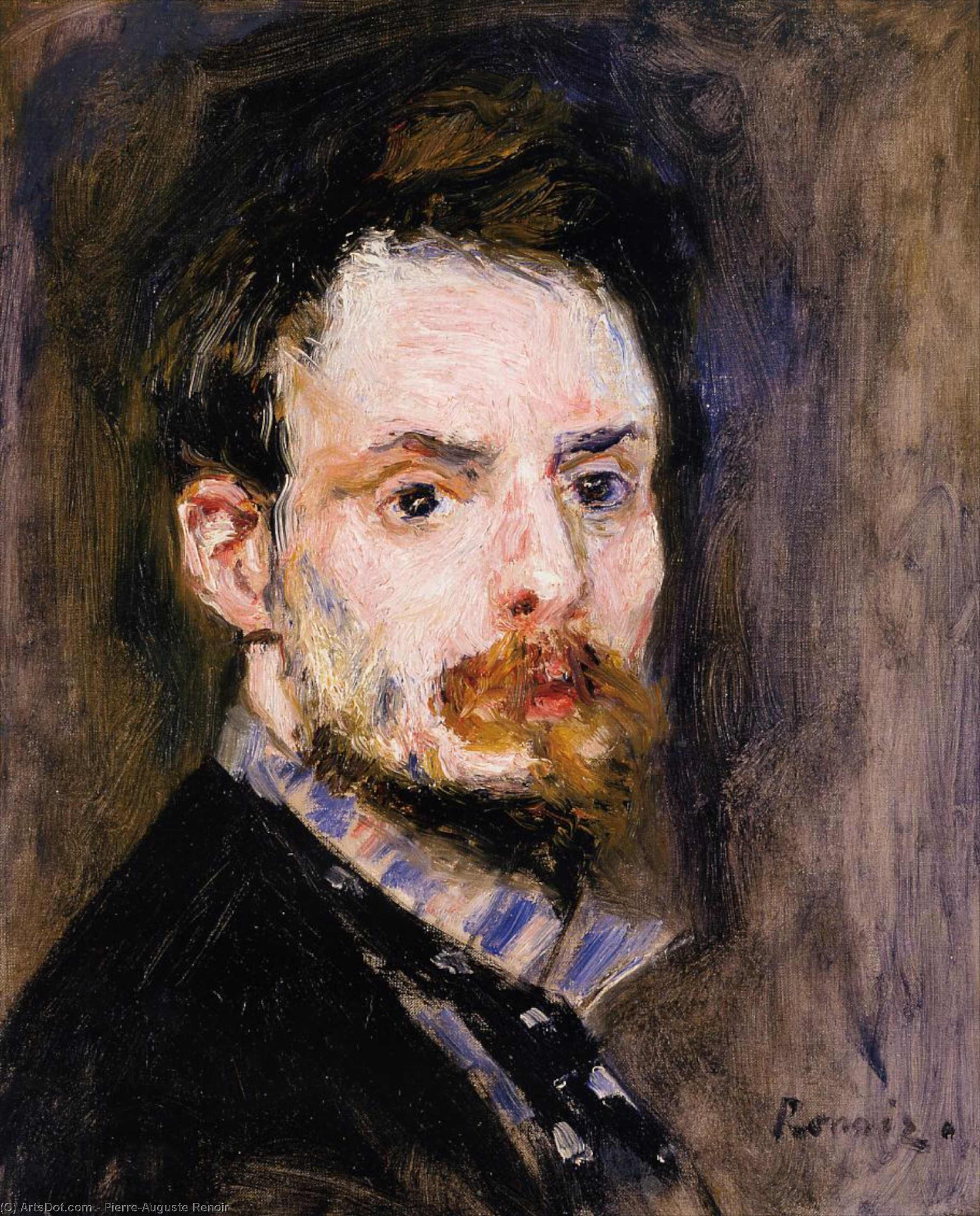
Autoportrait
 Huile sur toile
- Art mural
- Mouvement impressionniste
 1875
1875- XIXe siècle
 Sterling et Francine Clark Art Institute
Découvrez l'iconique *Autoportrait* de Renoir (1875) ! Ce chef-d'œuvre impressionniste révèle l'âme de l'artiste par ses couleurs lumineuses et sa profondeur psychologique. Explorez son symbolisme au Clark Art Institute.
 Lire la suite
Explorez le monde vibrant de Pierre-Auguste Renoir (1841-1919), un peintre impressionniste majeur, célébré pour ses portraits lumineux, scènes de vie parisienne et la beauté féminine. Découvrez son héritage et les contributions artistiques de sa famille.
Reproduction à l'huile faite à la main
Huile sur toile peinte à la main, avec cadre et dimensions personnalisés, réalisée sur commande par nos artistes. ( Passer au format impression Passer au format numérique)




P118B €10

P118H €10

P118W €10

P438Z €10

P508JH €12

P508YH €12

P805H €10

P805Z €10

P919BZ €10

P919G €10

P919XJ €10

P959ZH €10

P968JZ €12

W106C €8

W218G €10

W218JH €8

W218Y €10

W307PJ €10

W316G €10

W316PJ €8

W316Y €10

W398PJ €8

W4111J €10

W500HY €15

W500JH €15

W692G €12

W849H €8

W940BG €15

W953PJ €8




Format standard
sur mesure
CM
INCH
Choisissez parmi nos formats prédéfinis qui respectent les proportions originales de l’œuvre.
Loading sizes...

largeur
hauteur
Saisissez la largeur et la hauteur souhaitées, pour s'adapter à votre cadre ou à votre mur. Cette œuvre est peinte à la main ; ainsi, pour un format de forme différente, l'artiste peut peindre un peu plus autour du tableau ou réduire légèrement les bords — c'est vous qui choisissez. Nous vous envoyons une maquette numérique pour approbation avant que la peinture ne commence. L'image présentée sur cette page ne reflète pas le résultat réel — seule la maquette le fait.
Exemples de personnalisation possibles : remplacer un visage par la photo du client ; ajouter un animal de compagnie (par exemple, remplacer un chat par un chien) ; inclure un message caché en arrière-plan ; modifier le paysage ou les éléments de l'arrière-plan.
Après la commande, l’équipe TopImpressionists.com contactera le client par e-mail pour recueillir ses instructions et lui fournira une maquette d’aperçu
Après la commande, l’équipe TopImpressionists.com contactera le client par e-mail pour recueillir ses instructions et lui fournira une maquette d’aperçu
Livraison dans le monde entier () en 3 à 4 semaines au lieu des 5 semaines habituelles. (28 octobre). Aucun compromis sur la qualité.

Livraison express gratuite dans le monde entier

Toile de lin de qualité supérieure

Assurance transport complète

Garantie de remboursement des droits de douane

Garantie de fidélité des couleurs

Politique de retour de 100 jours (uniquement en cas de défaut)

Garantie de remboursement à 100%

Offre de tarifs dégressifs
 L'option verre n'est disponible que pour les dimensions inférieures à 110 cm.

Autoportrait
Technique de reproduction
Format de la reproduction
-


Prix total
€ 237
A Window Into Renoir’s Soul: Examining Pierre-Auguste Renoir's Self Portrait
Pierre-Auguste Renoir’s *Self Portrait*, completed in 1875, transcends mere depiction; it embodies the very essence of Impressionism and offers a profound glimpse into the artist’s psyche during a pivotal moment in his career. Currently residing at The Sterling and Francine Clark Art Institute in Williamstown, Massachusetts, this oil on canvas masterpiece continues to captivate audiences with its luminous palette and subtle psychological nuances. Its enduring appeal stems not only from Renoir's masterful technique but also from the painting’s reflection of the artistic fervor and intellectual currents shaping late 19th-century France.The Impressionist Technique: Capturing Fleeting Light
Renoir’s approach to portraying himself—and indeed, much of his oeuvre—is quintessential Impressionism. He eschewed meticulous detail in favor of capturing the ephemeral qualities of light and color as perceived by the eye. Notice the delicate brushstrokes – feathery, almost translucent – that coalesce into amorphous shapes rather than sharply defined contours. These strokes aren’t intended to reproduce reality exactly but to convey its vibrancy and dynamism. The artist skillfully utilizes broken color—applying pigment in small patches alongside areas of bare canvas—allowing light to illuminate the surface and creating a shimmering effect reminiscent of dappled sunlight filtering through foliage. This technique, championed by Monet and others, prioritized sensory experience over academic precision.A Portrait Steeped in Symbolism: Identity and Artistic Vision
Beyond its technical brilliance, *Self Portrait* is laden with symbolic significance. Renoir’s gaze directly confronts the viewer, establishing a connection that speaks to the artist's confidence and self-awareness—a characteristic often interpreted as representing his unwavering belief in his artistic vision. The inclusion of his beard and mustache isn’t merely descriptive; it symbolizes maturity and experience – qualities Renoir sought to convey through his art. Furthermore, the serene blue sky serves as a backdrop that evokes tranquility and contemplation, mirroring the artist's inner state as he wrestled with the challenges and triumphs of establishing himself as a leading figure in Impressionism. The painting is more than just an image; it’s a statement about Renoir’s identity as both a man and an artist.Historical Context: The Height of Impressionist Innovation
Painted during a period of immense artistic experimentation, *Self Portrait* exemplifies the broader movement that was transforming European art. Impressionism arose in defiance of academic conventions—which prioritized idealized representations and meticulous realism—and instead embraced spontaneity and subjective perception. Renoir’s peers were actively exploring new ways to express emotion and atmosphere, influenced by scientific discoveries concerning color theory and optics. The painting's creation coincided with a surge of artistic confidence within the Parisian avant-garde, fueled by exhibitions like Impression, Sunrise (1872) which established Monet as the movement’s vanguard. Renoir’s self portrait stands as a testament to this spirit of innovation and represents a crucial step in establishing Impressionism as one of the most influential art movements of the century.Emotional Resonance: A Moment of Reflection
Ultimately, *Self Portrait* resonates with viewers on an emotional level. The painting's soft hues and luminous brushstrokes evoke feelings of serenity and introspection—inviting contemplation about identity, creativity, and the pursuit of beauty. It’s a portrait not merely of Renoir’s physical appearance but also of his inner world—a realm where light, color, and emotion converge to create an unforgettable image that continues to inspire admiration and scholarly study today. Its enduring legacy underscores Renoir's profound contribution to modern art history.Questions et réponses
Où puis-je voir l'original de «Autoportrait» de Pierre-Auguste Renoir ?
L'original de «Autoportrait» de Pierre-Auguste Renoir est conservé au Sterling et Francine Clark Art Institute, Williamsburg, États-Unis d'Amérique. Une reproduction permet d'exposer l'œuvre chez soi.
Quelle est la technique utilisée pour « Autoportrait » ?
«Autoportrait» de Pierre-Auguste Renoir est réalisé en Huile sur toile. Les reproductions visent à restituer l'aspect de cette technique.
Quand et avec quels matériaux Autoportrait a-t-il été réalisé ?
«Autoportrait» de Pierre-Auguste Renoir est une œuvre réalisée en Huile sur toile, datant de 1875.
Œuvres similaires




Biographie de l'artiste
jeunesse et carrière
pierre-auguste renoir, un artiste français essentiel, est né le 25 février 1841 à Limoges, en France. Il a joué un rôle crucial dans la formation du mouvement impressionniste, réputé pour sa lumière vibrante et ses couleurs saturées. L'œuvre de Renoir célébrait la beauté, en particulier la sensualité féminine, le plaçant dans une lignée d'artistes allant de Rubens à Watteau.héritage artistique
L'héritage de Renoir s'est étendu au-delà de ses toiles, en tant que patriarche d'une famille où l'art prospérait sous diverses formes. Ses enfants, pierre renoir (1885–1952), le cinéaste jean renoir (1894–1979) et l'artiste céramiste claude renoir (1901–1969), ont chacun apporté des contributions significatives dans leurs domaines respectifs. Son petit-fils, le cinéaste claude renoir (1913–1993), a davantage fait progresser l'héritage artistique de la famille.œuvres notables et musées
* la danse à Bougival, une peinture notable de Renoir, illustre sa maîtrise de la capture de l'essence de l'art impressionniste. * Le musée des collettes, situé à Cagnes-sur-Mer, en France, est une destination incontournable pour les amateurs d'art. Ce musée, autrefois la maison de pierre-auguste renoir, témoigne de sa vie et de son œuvre, abritant quinze de ses peintures. * Le musée maurice denis, une autre perle cachée en France, présente une impressionnante collection de peintures post-impressionnistes françaises du XIXe et début du XXe siècle.explorez l'art de Renoir avec TopImpressionists
- découvrez le charme du musée des collettes (France) et de son art impressionniste sur TopImpressionists : [https://TopImpressionists.com/@@/a@d3aupf](https://TopImpressionists.com/@@/a@d3aupf)
- explorez les merveilles du musée maurice denis (France) avec TopImpressionists : /fr/art/show/art-d3aue3-fr/
- visualisez les peintures de Renoir, y compris la danse à Bougival, sur TopImpressionists : [https://TopImpressionists.com/@/pierre-auguste renoir](https://TopImpressionists.com/@/pierre-auguste%20renoir)

Pierre-Auguste Renoir
1841 - 1919 , France
L'essentiel de l'artiste
- Artistes Influents:
- Rubens
- Watteau
- Camille Pissarro
- Édouard Manet
- Date De Décès: 3 décembre 1919
- Date De Naissance: 25 février 1841
- Influences Artistiques:
- Impressionnisme
- Post-impressionnisme
- Lieu De Naissance: Limoges, France
- Mouvement Artistique: Impressionnisme
- Nationalité: Française
- Nom Complet: Pierre-Auguste Renoir
- Oeuvres Notables:
- La Danse à Bougival
- Le Déjeuner des canotiers
- Bal au moulin de la Galette
- Après le bain
Articles connexes

Capturing Light and Joy: A Definitive Guide to the Luminous Masterpieces of Pierre-Auguste Renoir
Discover the luminous world of Pierre-Auguste Renoir. Explore an expert guide to his mastery of light, color, and joy through the lens of Impressionist history, perfect for fine art enthusiasts and collectors seeking timeless elegance.

Les 10 Chefs-d'œuvre Impressionnistes qui ont Révolutionné l'Art : Décoration & Histoire
Plongez au cœur de l'Impressionnisme avec les 10 œuvres majeures de Monet, Renoir & Degas. Découvrez l'histoire et la lumière unique de ces chefs-d'œuvre. Reproductions d'art exceptionnelles sur TopImpressionists.com.

Les 10 Chefs-d'œuvre Impressionnistes qui ont Révolutionné la Peinture | TopImpressionists
Plongez au cœur de l'Impressionnisme avec les 10 chefs-d'œuvre incontournables de Monet, Renoir et Degas. Découvrez l'histoire, la technique & l'émotion derrière ces tableaux célèbres. Reproductions d'art de qualité musée sur TopImpressionists.com !

Renoir : 25 Chefs-d'œuvre Incontournables – L’Art de la Lumière
Plongez au cœur de l'univers vibrant de Pierre-Auguste Renoir ! Découvrez 25 chefs-d’œuvre emblématiques, explorant la lumière, les couleurs et la joie de vivre. Reproductions d'art de qualité musée sur TopImpressionists.com.

The Luminous World of Pierre-Auguste Renoir: An Exploration of Impressionism's Sensuous Embrace
Explore the captivating world of Pierre-Auguste Renoir! Discover his life, iconic Impressionist masterpieces & enduring legacy with our expert guide. High-quality reproductions available.
Explorez des œuvres d'art classées par thèmes, styles et caractéristiques.


