


 Partager
 Partager
 Détails
 Guide imprimable

 Télécharger
 Articles similaires
 Voir le diaporama
 Statistiques
Dogia


Step back in time with this stunning studio shot of a vintage Salvatore Ferragamo shoe! Admire the intricate floral embroidery and classic design of this iconic 1949 masterpiece.
 Afficher la suite
"meta_description": "Salvatore Ferragamo : designer italien iconique, connu pour ses chaussures élégantes et innovantes, influençant le glamour hollywoodien et l'art de la mode depuis les années 1930."
Reproduction à l'huile faite à la main
Huile sur toile peinte à la main, avec cadre et dimensions personnalisés, réalisée sur commande par nos artistes. ( Passer au format impression Passer au format image numérique)




































Format standard
personnalisé
CM
INCH
Choisissez parmi nos formats prédéfinis qui respectent les proportions originales de l’œuvre.
Loading sizes...

largeur
hauteur
Vous pouvez saisir vos propres dimensions pour l'adapter à un cadre ou à un espace spécifique. Si la taille sélectionnée ne correspond pas aux proportions de l'image d'origine, nous recadrerons l'œuvre ou prolongerons la peinture avec des éléments peints à la main supplémentaires. Une maquette numérique vous sera envoyée pour approbation avant le début de la production.
Veuillez noter que l'aperçu à l'écran ne reflète pas le recadrage ou l'extension réels. Seule la maquette montrera fidèlement la composition finale.
Bien que des tailles personnalisées soient disponibles, nous vous recommandons de sélectionner une dimension dans la liste prédéfinie afin de préserver les proportions d'origine.
Exemples de personnalisation possibles : remplacer un visage par la photo du client ; ajouter un animal de compagnie (par exemple, remplacer un chat par un chien) ; inclure un message caché en arrière-plan ; modifier le paysage ou les éléments de l'arrière-plan.
Après la commande, l’équipe TopImpressionists.com contactera le client par e-mail pour recueillir ses instructions et lui fournira une maquette d’aperçu
Après la commande, l’équipe TopImpressionists.com contactera le client par e-mail pour recueillir ses instructions et lui fournira une maquette d’aperçu
Livraison dans le monde entier () en 3 à 4 semaines au lieu des 5 semaines habituelles. (26 septembre). Aucun compromis sur la qualité.

Livraison express gratuite dans le monde entier

Toile de lin de haute qualité

Assurance transport complète

Garantie de remboursement des droits de douane

Garantie de fidélité des couleurs

Garantie de retour de 100 jours (uniquement en cas de défaut)

Garantie de remboursement à 100%

Tarifs dégressifs sur quantité
 L'option verre n'est disponible que pour les dimensions inférieures à 110 cm.

Dogia
Technique de reproduction
Format de la reproduction
-


Prix total final
$ 269
The Embodiment of Mid-Century Glamour
To gaze upon this exquisite depiction of Salvatore Ferragamo's 1949 "Dogia" is to step directly into the vibrant, sophisticated heart of post-war Italian design. This piece transcends mere footwear; it is a wearable sculpture, a testament to the intersection where meticulous craftsmanship meets ephemeral beauty. The shoe itself, rendered in lustrous black satin, immediately commands attention, its material sheen suggesting an almost liquid elegance. It speaks of an era when fashion was not merely dressing, but a profound statement of identity and aspiration. The composition, captured with the precision of high-end product photography, isolates this single object against a stark white void, forcing the viewer into an intimate dialogue with its form.
A Tapestry of Thread and Time
What elevates this piece beyond simple documentation is the breathtaking artistry woven across its surface. The floral embroidery—a riot of carefully placed pinks, creamy whites, sunny yellows, soft blues, and verdant greens—transforms the structured satin base into a delicate garden blooming upon the foot. This technique requires an almost unbelievable level of dexterity; each petal, every leaf, is individually stitched, creating a rich, tactile contrast against the smooth, dark background. The interplay between the cool sheen of the satin and the raised, textured quality of the embroidery floss is what gives the piece its visual depth. It suggests hours of patient labor, the focused devotion of an artisan whose skill was matched only by his vision.
The Legacy of Ferragamo's Vision
Understanding the context of Salvatore Ferragamo enriches our appreciation immeasurably. Born into a tradition of skilled making, Ferragamo’s career was one of relentless innovation, forever pushing the boundaries of what shoes could be. This 1949 design is a perfect artifact of that genius—a marriage of structural integrity with decorative exuberance. The shoe embodies the glamour associated with Hollywood's golden age, yet it retains an underlying sense of artisanal honesty. For the collector or designer, this piece offers a tangible connection to a pivotal moment in fashion history, representing Italian mastery before the modern deluge of mass production.
Symbolism and Enduring Allure
Emotionally, the "Dogia" whispers tales of springtime renewal and confident femininity. The flowers are universal symbols of beauty and transience, while the shoe itself speaks to empowerment—the ability to move through the world with grace and undeniable style. Owning or reproducing such a piece is not just acquiring an object; it is curating a mood. It infuses any space, be it a gallery wall or a sophisticated dressing room vignette, with an aura of romantic nostalgia and timeless sophistication. It invites contemplation on the enduring power of beauty crafted by human hands.
Biographie de l'artiste
Un héritage forgé dans le cuir : La vie et la vision de Salvatore Ferragamo
Salvatore Ferragamo, un nom synonyme d'élégance, d'innovation et de l'âge d'or du glamour hollywoodien, est né dans l'humilité en 1898 à Bonito, en Italie. Loin du monde scintillant qu'il allait finir par définir, la jeunesse de Salvatore était imprégnée de simplicité rurale ; pourtant, c'est ici que son extraordinaire voyage a commencé. Onzième d'une fratrie de quatorze enfants, il manifesta une fascination innée pour la cordonnerie, passant des heures interminables à observer le artisan local — un métier initialement découragé par son père qui le considérait comme une profession de faible rang social. Cependant, la passion du jeune Salvatore s'avéra inébranlable ; à seulement neuf ans, il confectionna sa première paire de chaussures pour la première communion de sa sœur, témoignage de son talent naissant et de sa détermination. Cet acte ne fut pas simplement la création d'une chaussure ; ce fut le forgeage d'un destin. Il marqua la naissance d'une vision artistique qui allait remodeler le paysage de la mode.De Boston à Hollywood : Une ascension transatlantique
Poussé par l'ambition, Ferragamo émigra en Amérique en 1915, rejoignant ses frères à Boston avant de graviter vers l'industrie cinématographique florissante de la Californie. Ce mouvement s'avéra décisif. Il établit d'abord un atelier de réparation, mais reconnut rapidement un besoin non satisfait : des chaussures d'une exécution exquise, adaptées aux exigences du grand écran. Les stars d'Hollywood — Lillian Gish, Mary Pickford et bientôt tant d'autres — devinrent sa clientèle fidèle. Ferragamo ne se contentait pas de fabriquer des chaussures ; il façonnait des illusions, sublimant les personnages à l'écran qui captivaient une nation entière. Il comprit le pouvoir de la narration visuelle et la manière dont la chaussure pouvait contribuer au récit d'un personnage. Cette compréhension le poussa à étudier l'anatomie à l'Université de Californie du Sud, convaincu que le véritable confort et l'élégance découlaient d'une compréhension profonde de la structure du pied. Son utilisation innovante de semelles en acier pour le soutien de la voûte plantaire révolutionna la construction de la chaussure, privilégiant à la fois l'esthétique et le bien-être — une marque de fabrique de sa philosophie de design.Le retour aux sources : Renaissance florentine et épanouissement artistique
En 1927, Ferragamo retourna dans sa patrie, s'installant à Florence, une ville imprégnée de traditions artistiques et artisanales. Il y établit un atelier qui devint rapidement un laboratoire d'innovation. Malgré les difficultés financières durant la Grande Dépression, menant à une faillite en 1933, il persévéra, porté par une foi inébranlable en sa vision. En réétablissant son entreprise en 1938 au sein de l'historique Palazzo Spini Feroni, Ferragamo entama une période de créativité prolifique. Il expérimenta sans crainte des matériaux non conventionnels — le liège, la peau de poisson, et même le métal — repoussant les limites du possible dans la cordonnerie. Cette volonté de défier les conventions devint sa signature. Ses créations n'étaient pas de simples objets fonctionnels ; elles étaient des œuvres d'art sculpturales, reflétant une profonde appréciation de l'histoire et un esprit audacieux de modernité. L'emblématique semelle compensée, née de la pénurie de matériaux pendant la guerre, témoigne de sa débrouillardise et de son ingéniosité, lui valant le prestigieux prix Neiman Marcus en 1947.Une empreinte durable : Héritage et influence
L'impact de Salvatore Ferragamo s'étend bien au-delà du domaine de la chaussure. Il fonda Salvatore Ferragamo S.p.A., un empire du luxe qui continue de prospérer aujourd'hui, exploitant des centaines de boutiques à travers le monde. Bien que célébré pour ses créations destinées aux icônes d'Hollywood comme Marilyn Monroe — il créa son célèbre talon aiguille — et Audrey Hepburn, son influence résonne dans la mode contemporaine. Son engagement envers le confort anatomique, les matériaux innovants et les formes sculpturales a ouvert la voie à des générations de designers. Le Musée Ferragamo à Florence sert de tribut vivant à son héritage, exposant non seulement ses modèles de chaussures révolutionnaires, mais aussi ses intérêts artistiques plus larges, incluant des collections telles que La Collezione Bonello (Malte) et la Collection Palumbo-Fossati (Venise). Son travail transcende la simple mode ; c'est une célébration de l'art, de l'innovation et du pouvoir durable de l'artisanat italien. Bien qu'il se soit éteint en 1960, l'esprit de Salvatore Ferragamo continue d'inspirer, nous rappelant que le vrai style ne réside pas seulement dans ce que nous portons, mais dans l'histoire qu'il raconte.Œuvres et collections notables
- Pollicino : Une sculpture de chaussure Pop Art vibrante, mettant en avant des couleurs audacieuses et un design ludique.
- Sandale (1952) : Un exemple emblématique d'artisanat luxueux et de design géométrique, incarnant l'élégance de l'époque.
- Prototipo di sandalo (1938) : Une magnifique chaussure antique démontrant une broderie complexe et un savoir-faire artisanal.
- <La Collezione Bonello (Malte) : Une collection soigneusement sélectionnée présentant des œuvres de maîtres tels que Le Caravage et Alberto Morrocco, reflétant l'appréciation de Ferragamo pour les beaux-arts.
- <La Collection Palumbo-Fossati (Venise, Italie) : Un assemblage renommé de peintures européennes s'étendant sur plusieurs siècles, soulignant les intérêts culturels plus vastes de Ferragamo.

Salvatore Ferragamo
1898 - 1960 , Italie
En bref
- Artistic Movement Or Style: Baroque
- Artists Or Movements Influenced By This Artist: ['Christian Dior']
- Artists Who Influenced This Artist: ['Luca Giordano']
- Date Of Birth: 5 juin 1898
- Date Of Death: 7 août 1960
- Full Name: Salvatore Ferragamo
- Nationality: Italien
- Notable Artworks:
- Pollicino
- Sandal (1952)
- Prototipo di sandalo (1938)
- Place Of Birth: Bonito, Italie
Articles similaires

Gianfranco Ferré: Deconstructing Haute Couture – A Legacy of Architectural Form
Explore the revolutionary world of Gianfranco Ferré, 'the architect of fashion.' Discover his architectural approach to haute couture, iconic Dior designs, and lasting influence on luxury style. A deep dive for collectors & enthusiasts.

The Lens of Luxury: A Visual Journey Through the Evolution and Artistry of Fashion Photography
Embark on a visual journey through the evolution of fashion photography. Discover how masters like Gianfranco Ferré blended geometry, surrealism, and texture to redefine high-fashion art for collectors and connoisseurs of luxury imagery.

Échos du Temps : Nostalgie, Technique et Signification Culturelle dans la Peinture Vintage
Explorez la nostalgie en peinture vintage : des analyses d'experts sur Hopper, Katz et Wesselmann aux conseils pour collectionner l'art moderne. Découvrez comment ces œuvres captivent et inspirent.
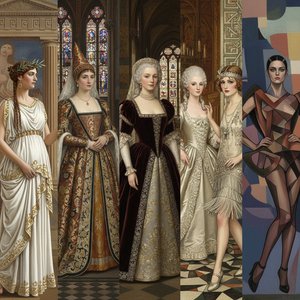
Style Through the Ages: Iconic Artworks That Defined the Evolution of Fashion Design
Explore the breathtaking intersection of fine art and high fashion. Discover how iconic masterpieces from Art Deco to Impressionism have shaped the world of luxury couture and timeless design in this curated visual journey.

Draped Narratives: Fashion as Symbol & Subject in Historical Art
Explore the fascinating history of fashion as a symbol of power & status in art! Discover masterpieces from Gainsborough to Tissot and learn how clothing shaped societal narratives. Find museum-quality reproductions at TopImpressionists.
Explorez des œuvres d'art classées par thèmes, styles et caractéristiques.


