

Shown: · With its frame:
 Aperçu en situation
 Envoyer
 Partager
 Détails de l'œuvre
 Guide
Guide

 Télécharger l'image
 Articles similaires
 Radiographie
 Diaporama
 Q&A
Q&A Statistiques

€ 239
Reproduction à l'huile faite à la main
Huile sur toile peinte à la main, avec cadre et dimensions personnalisés, réalisée sur commande par nos artistes. ( Passer au format impression Passer au format numérique)
Size
·Format standard
sur mesure
CM
INCH
Choisissez parmi nos formats prédéfinis qui respectent les proportions originales de l’œuvre.
Loading sizes...

largeur
hauteur
Saisissez la largeur et la hauteur souhaitées, pour s'adapter à votre cadre ou à votre mur. Cette œuvre est peinte à la main ; ainsi, pour un format de forme différente, l'artiste peut peindre un peu plus autour du tableau ou réduire légèrement les bords — c'est vous qui choisissez. Nous vous envoyons une maquette numérique pour approbation avant que la peinture ne commence. L'image présentée sur cette page ne reflète pas le résultat réel — seule la maquette le fait.
 En savoir plus
Finish
·
White €1

Blurside €1

Extended €1

P118B €10

P118H €10

P118W €10

P438Z €10

P508JH €12

P508YH €12

P805H €10

P805Z €10

P919BZ €10

P919G €10

P919XJ €10

P959ZH €10

P968JZ €12

W106C €8

W218G €10

W218JH €8

W218Y €10

W307PJ €10

W316G €10

W316PJ €8

W316Y €10

W398PJ €8

W4111J €10

W500HY €15

W500JH €15

W692G €12

W849H €8

W940BG €15

W953PJ €8

H24-GOLD €30

H24-SILVER €30

H36-GOLD €45

H36-SILVER €45
Shipped in a protective tube, ready for your own framer.
Above 105 cm the frame is shipped as a kit for a professional framer — read the details.
Extras
optionalWhat do the extras include?
Examples of what can be changed: Replace face with customer photo; Add pet (e.g., replace cat with dog); Include hidden message in background; Change background landscape or elements.
After order, TopImpressionists.com team will email client for instructions and provide a mockup preview
After order, TopImpressionists.com team will email client for instructions and provide a mockup preview
Livraison dans le monde entier () en 3 à 4 semaines au lieu des 5 semaines habituelles. (2 novembre). Aucun compromis sur la qualité.
Vernis de protection
Cartel
Détails de la plaque en bronze gravée
This elegant plaque features the artist's name and the title of the artwork, finely engraved for a timeless presentation.
It is made from bronze with a refined, elegant finish. The text is precisely laser-engraved for a sharp and permanent result. Measuring 9x2 cm, the plaque is compact yet easy to read. It's built to be durable and scratch-resistant, offering a professional, museum-quality look. Mounting is simple thanks to the included adhesive backing.
Détails de la plaque en acrylique transparent
The plaque includes essential engraved details such as the artist's name, the title of the artwork, the date it was created, the type of media used-like oil on canvas or watercolor-a brief description of the piece, and a QR code that links to the complete artwork information.
It is crafted from clear acrylic, offering a sleek, modern appearance. The text is UV-engraved in black to ensure strong visual contrast. With a size of 10x15 cm, it ensures optimal readability. It comes equipped with two metal hooks for secure wall mounting. The plaque is designed to be weather-resistant, making it suitable for various environments, and it includes interactive features that work seamlessly with smartphone scanning.
Détails de la plaque en acrylique noir
This elegant plaque includes engraved information such as the artist's name, the title of the artwork, the date it was created, the type of media used (like oil on canvas or watercolor), a short description of the artwork, and a QR code for quick access to more information.
The plaque itself is made from refined black acrylic with a premium finish. The text is laser-engraved in white for high contrast and readability. Its size is 10x15 cm, designed to be easy to read. It comes with two metal hooks for professional mounting. The design is sleek and fits any interior style. It is also weather-resistant and durable, with built-in digital integration for mobile compatibility.
L'option verre n'est disponible que pour les dimensions inférieures à 110 cm.
 L'option verre n'est disponible que pour les dimensions inférieures à 110 cm.
- Livraison express gratuite dans le monde entier
- Toile de lin de qualité supérieure
- Assurance transport complète
- Garantie de remboursement des droits de douane
- Garantie de fidélité des couleurs
- Politique de retour de 100 jours (uniquement en cas de défaut)
- Garantie de remboursement à 100%
- Offre de tarifs dégressifs


Description de la pièce
Explore "Etude de têtes" by Thomas Couture – a captivating portrait reflecting Romanticism's influence and the artist’s innovative approach to painting. Discover its historical context and artistic significance.
Biographie de l'artiste
Thomas Couture (1815-1879) : peintre français novateur entre romantisme et réalisme. Maître de Manet, explorez ses scènes historiques & son héritage unique !
About the painting
A Portrait of Contemplation: Unveiling the Layers of “Etude de têtes”
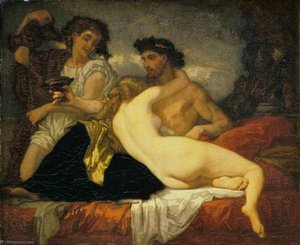
Thomas Couture’s “Etude de têtes,” a captivating study in portraiture, transcends mere likeness to become a profound meditation on identity and the complexities of human interaction. Painted circa 1850-1855 during the twilight years of the French Empire, this work embodies the burgeoning Realism that was challenging the dominance of Romanticism within the Parisian art world. It’s not simply a depiction of two men; it's an exploration of gaze, gesture, and the subtle dance between subject and observer – a visual poem brimming with quiet intensity.
The painting immediately draws the eye to the pair seated before us. Dressed in meticulously rendered 17th-century costumes—a rich velvet doublet for one man, a more subdued brocade robe for the other—they are presented as figures emerging from a bygone era. Their attire isn’t merely decorative; it's a deliberate choice that anchors them within a specific historical context, hinting at courtly intrigue and perhaps even a shared secret. The details of their clothing – the lace collars, the elaborate hats, the carefully positioned swords – speak volumes about status, profession, and the conventions of their time.
The Brushstroke and the Atelier: Couture’s Innovative Technique
Couture was a revolutionary figure in 19th-century painting. He deliberately rejected the rigid rules of the École des Beaux-Arts, establishing his own independent atelier—a space dedicated to fostering artistic freedom and experimentation. This commitment is vividly reflected in “Etude de têtes.” Couture’s brushwork is remarkably fluid and expressive, eschewing the smooth, polished surfaces favored by academic painters. Notice the loose, gestural strokes that define the contours of their faces, particularly the subtle shifts in light and shadow that capture the nuances of their expressions. He employed a technique he called “pointillé,” using small, distinct brushstrokes to build up color and texture—a method borrowed from Japanese prints, reflecting his fascination with Eastern art.
The composition itself is carefully constructed. The figures are positioned in a triangular arrangement, creating a sense of balance and stability while simultaneously suggesting a dynamic tension. Their eyes meet across the canvas, establishing a direct connection between the viewer and the subjects—a deliberate invitation to contemplate their shared moment. Couture’s use of color is equally restrained yet effective. He favors muted earth tones – browns, ochres, and grays – which lend the painting an air of solemnity and timelessness.
Symbolism and the Weight of Conversation
Beyond its technical merits, “Etude de têtes” resonates with layers of symbolic meaning. The act of conversation itself is laden with significance. What are these men discussing? Are they sharing a secret, debating an important matter, or simply enjoying each other’s company? Couture deliberately leaves the narrative ambiguous, allowing the viewer to project their own interpretations onto the scene. The slight furrow in one man's brow and the subtle turn of his head suggest a moment of contemplation—a pause within the flow of dialogue.
The painting can also be interpreted as an exploration of masculinity and social roles. The two men represent different facets of male identity – perhaps representing intellect and action, or formality and intimacy. Their attire and posture subtly reinforce these distinctions, inviting us to consider the complexities of gender dynamics within 19th-century society.
A Legacy of Innovation: Couture’s Enduring Influence
Thomas Couture's “Etude de têtes” stands as a testament to his artistic vision and his willingness to challenge convention. His work paved the way for later Realist painters, such as Manet, and helped to usher in a new era of artistic expression. Today, this captivating portrait continues to fascinate viewers with its quiet intensity, masterful technique, and profound exploration of human nature. It’s a piece that rewards careful observation and invites us to lose ourselves in the subtle nuances of a timeless conversation.
Questions et réponses
Puis-je voir une vue aux rayons X de «Etude de têtes (Titre d'usage)» de Thomas Couture ?
La vue X de «Etude de têtes (Titre d'usage)» de Thomas Couture est disponible sur la page Radiographie de l'œuvre : une exploration interactive de l'image à travers onze couches optiques.
Quelle palette de couleurs utilise "Etude de têtes (Titre d'usage)" ?
La palette de «Etude de têtes (Titre d'usage)» de Thomas Couture est décrite comme étant Earthy. Il s'agit d'une description concise des couleurs de l'œuvre.
Quelle place occupe « Etude de têtes (Titre d'usage) » parmi les thèmes récurrents de Thomas Couture ?
Parmi les thèmes récurrents de Thomas Couture — romanticism, rebellion, atelier, tradition, innovation, decadence, empires, new artistry — « Etude de têtes (Titre d'usage) » met l'accent sur portraits, men, conversation, costumes, 17th century, gold frame, heads.
Quick facts and art quiz
About Thomas Couture

Thomas Couture
1815 - 1879, France
Biographie de l'artiste
première vie et formation
thomas couture, figure marquante du monde de l'art, est né le 21 décembre 1815 à senlis, oise, france. à l'âge de 11 ans, sa famille a déménagé à paris, où il allait étudier à l'école des arts et métiers, puis à l'école des beaux-arts.carrière artistique
malgré un rejet initial, couture a persévéré et a finalement remporté le prestigieux prix de rome en 1837. il a commencé à exposer ses tableaux historiques et d'genre au salon de paris dès 1840, remportant plusieurs médailles pour ses œuvres, dont son chef-d'œuvre, romains pendant la décadence (1847).enseignement et influence
la technique innovante de couture a suscité une attention considérable, et il a reçu des commandes gouvernementales et ecclésiastiques pour des fresques murales à la fin des années 1840 et dans les années 1850. il a également enseigné de nombreux artistes notables, dont édouard manet, henri fantin-latour, john la farge, pierre puvis de chavannes et karel javůrek.vie ultérieure et héritage
en 1860, couture a quitté paris pour sa ville natale de senlis, où il a continué à enseigner de jeunes artistes. il a publié un livre sur ses idées et ses méthodes de travail, *méthode et entretiens d'atelier*, en 1867. celui-ci a également été traduit sous le titre *conversations on art methods* en 1879, l’année de son décès.- voir les œuvres de thomas couture sur TopImpressionists.com
- en savoir plus sur thomas couture sur wikipedia
- découvrez le musée des beaux-arts de carcassonne, un musée présentant des œuvres d'artistes français et européens, dont ceux influencés par le style de couture : découvrir le musée des beaux-arts de carcassonne (france)
Quick facts about Thomas Couture
- Artistes Influents:
- Antoine-Jean Gros
- Paul Delaroche
- Date De Décès: 30 mars 1879
- Date De Naissance: 21 décembre 1815
- Influence Sur Les Artistes:
- Édouard Manet
- Henri Fantin-Latour
- Pierre Puvis de Chavannes
- Lieu De Naissance: Senlis, France
- Mouvement Artistique: Romantisme, Réalisme
- Nationalité: Française
- Nom Complet: Thomas Couture
- Oeuvres Notables:
- Romains pendant la décadence
- Le Duel après le bal masqué
- Un Avocat allant en cour
Explorez des œuvres d'art classées par thèmes, styles et caractéristiques.



Thomas Couture
Etude de têtes (Titre d'usage)
() ·
With its frame: · Hand-painted in oil on linen
Total