Aperçu en situation
 Envoyer
 Partager
 Détails de l'œuvre
 Guide
Guide

 Télécharger l'image
 Articles similaires
 Radiographie
 Diaporama
 Questions et réponses
 Statistiques
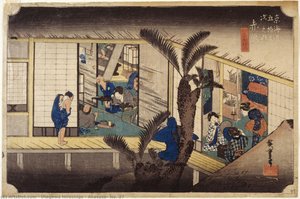
Station 23, Fujieda


Admirez la magnifique Station 23 de Fujieda peint par Hiroshige ! Cette œuvre emblématique du Tokaido illustre une scène animée sur la côte japonaise, capturant l'esprit artistique de l'époque Edo.
 Lire la suite
Découvrez Utagawa Hiroshige (1797-1858), maître incontesté de l'ukiyo-e japonais. Ses paysages poétiques, comme "Les 53 stations du Tôkaidô", ont inspiré l'Impressionnisme.
Giclées et impressions d'art
Impressions giclées ou sur toile de qualité musée, avec une production rapide et des finitions au choix. ( Commander la reproduction peinte à la main Passer au format numérique)




P118B €10

P118H €10

P118W €10

P438Z €10

P508JH €12

P508YH €12

P805H €10

P805Z €10

P919BZ €10

P919G €10

P919XJ €10

P959ZH €10

P968JZ €12

W106C €8

W218G €10

W218JH €8

W218Y €10

W307PJ €10

W316G €10

W316PJ €8

W316Y €10

W398PJ €8

W4111J €10

W500HY €15

W500JH €15

W692G €12

W849H €8

W940BG €15

W953PJ €8




Format standard
sur mesure
CM
INCH
Choisissez parmi nos formats prédéfinis qui respectent les proportions originales de l’œuvre.
Loading sizes...

largeur
hauteur
Saisissez la largeur et la hauteur souhaitées pour qu'elles s'adaptent à votre cadre ou à votre mur. Une impression peut être recadrée, mais jamais agrandie au-delà de l'image originale ; ainsi, un format de forme différente entraînera la perte d'une partie de l'image. Nous vous envoyons une maquette numérique pour approbation avant toute impression. L'image présentée sur cette page ne montre pas le recadrage réel — seule la maquette le permet.
Livraison dans le monde entier () en 2 semaines au lieu des 4/5 semaines habituelles. (4 novembre)

Livraison express gratuite dans le monde entier

Toile de lin de qualité supérieure

Assurance transport complète

Garantie de remboursement des droits de douane

Garantie de fidélité des couleurs

Politique de retour de 100 jours (uniquement en cas de défaut)

Garantie de remboursement à 100%

Offre de tarifs dégressifs
 L'option verre n'est disponible que pour les dimensions inférieures à 110 cm.

Station 23, Fujieda
Giclées et impressions d'art
Format de la reproduction
-


Prix total
€ 62
Station 23, Fujieda : A Snapshot of Edo Tranquility
Utagawa Hiroshige’s “Station 23, Fujieda” transcends mere depiction; it's an invitation into the heart of Edo Japan—a meticulously crafted woodblock print that captures a fleeting moment of rural life along the Tokaido Road. Published around 1847/52 during the reign of Emperor Hiroaku II, this artwork exemplifies Hiroshige’s signature style: *tokaido*, or “journey to Edo,” series, which aimed to document the pilgrimage route connecting Kyoto and Tokyo with breathtaking landscapes interspersed with scenes of everyday life. More than just a scenic panorama, Station 23 speaks volumes about the artistic sensibilities of its time.- Composition & Technique: Hiroshige masterfully employs *bokashi*, shading techniques that create subtle gradations of color and texture—a hallmark of Japanese woodblock printing—to render Fujieda Beach with remarkable realism. The print utilizes Prussian blue, a pigment imported from Europe during this period, demonstrating the influence of Western artistic innovations on Edo art.
- Subject Matter: The scene unfolds around a horse-drawn carriage laden with passengers, symbolizing prosperity and travel. A solitary dog adds an element of spontaneity to the composition, representing companionship and perhaps hinting at the hardships faced by travelers during this arduous journey. Notably, Hiroshige includes an umbrella held aloft—a gesture of protection against the elements and a visual motif frequently appearing in his prints.
- Historical Context: Station 23 reflects the broader socio-cultural landscape of Edo Japan – a time of relative stability under Tokugawa rule but also undergoing significant modernization pressures. Hiroshige’s depiction captures not only the beauty of the natural world but also the human element—the interactions and experiences of ordinary people traversing this important route.
- Symbolism & Emotion: The muted palette and serene atmosphere evoke a feeling of contemplative stillness, inviting viewers to contemplate the passage of time and the grandeur of nature. Hiroshige’s meticulous attention to detail underscores his belief in capturing not just what is seen but also what is felt—a core principle of Japanese aesthetics.
A Legacy Influenced by Impressionism
Hiroshige's influence extended far beyond Japan, profoundly impacting artists like Claude Monet and Vincent van Gogh who embraced *hokuyo*, or “atmospheric perspective,” a technique pioneered by Hiroshige to convey depth and luminosity—a revolutionary departure from European artistic conventions of the era. Station 23 stands as a testament to Hiroshige’s visionary approach to landscape painting, securing his place as one of the most celebrated artists of Edo Japan and an enduring inspiration for generations of painters worldwide. Its tranquil beauty continues to resonate with audiences today, reminding us of the power of art to transport us back in time and capture the essence of a bygone era.Reproductions & Interior Design Considerations
A high-quality reproduction of Station 23 can bring a touch of Edo Japan’s elegance into any interior space. Consider framing it with simple, neutral tones—perhaps linen or matte white—to allow the artwork's subtle hues and textures to shine through. Its calming composition complements minimalist décor styles beautifully, creating an atmosphere of serenity and contemplation. Explore TopImpressionists.com for exceptional reproductions that faithfully preserve Hiroshige’s artistic vision.Questions et réponses
Où puis-je acheter une reproduction peinte à la main de «Station 23, Fujieda» de Utagawa Hiroshige ?
Les reproductions peintes à la main de «Station 23, Fujieda» de Utagawa Hiroshige sont disponibles sur ce site : une reproduction à l'huile peinte à la main sur toile de lin, via sa page Reproduction peinte à la main.
Que représente "Station 23, Fujieda" et quelle atmosphère s'en dégage ?
«Station 23, Fujieda» de Utagawa Hiroshige allie japanese landscape, tokai road, horse carriage, beach scene, wooden print, hiroshige style, edo period à une atmosphère Sérénité.
Comment puis-je découvrir des œuvres d'art similaires à «Station 23, Fujieda» de Utagawa Hiroshige ?
La page Œuvres similaires de «Station 23, Fujieda» de Utagawa Hiroshige présente des œuvres similaires.
Biographie de l'artiste
Biographie d'une icône de l'art japonais
Utagawa Hiroshige, un artiste renommé du genre ukiyo-e japonais, a vécu de 1797 à 1858. Il est largement considéré comme le dernier grand maître de ce genre traditionnel. Le travail d'Hiroshige se caractérise par son approche poétique et ambiante, qui le distingue des estampes plus audacieuses et plus formelles de ses contemporains.Style artistique et techniques
L’utilisation de la couleur par Hiroshige était subtile mais essentielle à ses estampes. Il employait souvent plusieurs impressions dans la même zone, utilisant la technique du bokashi (gradation de couleurs), ce qui était laborieux mais résultait en un effet visuel unique. Ses œuvres les plus célèbres incluent les cinquante-trois stations du Tōkaidō et les cent vues célèbres d'Edo, toutes deux témoignant de sa maîtrise des séries paysagères.Développement et influences
Hiroshige est né à Tokyo en 1797, dans le quartier de Yayosu Quay. Son père était responsable de la brigade anti-incendie d’Edo. Il a commencé à s'intéresser à l'art dès son plus jeune âge et a étudié sous la direction du maître ukiyo-e Utagawa Toyohiro. Hiroshige a été influencé par le style Kanō, qui mettait l'accent sur les techniques de peinture traditionnelles japonaises, ainsi que par le style Shijō, connu pour son approche impressionniste. Ces influences se reflètent dans ses œuvres, qui combinent des éléments de ces différents styles.Impact sur l'art occidental
Le travail d’Hiroshige a eu un impact profond sur l’art occidental, en particulier pendant la tendance japonisme à la fin du XIXe siècle. Des artistes tels que Manet et Monet ont été influencés par les estampes japonaises, tandis que des post-impressionnistes comme Van Gogh collectionnaient et étudiaient les compositions d'Hiroshige. Son influence est visible dans l’utilisation de couleurs vives et de perspectives inhabituelles par ces artistes.Héritage
Après la mort d'Hiroshige en 1858, le genre ukiyo-e a connu un déclin rapide en raison de la modernisation après la restauration Meiji de 1868. Cependant, son influence sur l’art occidental reste significative, et de nombreux artistes continuent à s’inspirer de ses œuvres.- Œuvres notables : * Les cinquante-trois stations du Tōkaidō * Les cent vues célèbres d'Edo * L'influence sur la série japonaiserie de Van Gogh, incluant l'arbre de prunier en fleurs après Hiroshige
- Dates clés : * 1797 : Naissance au Japon * 1858 : Décès, marquant le début d’un déclin rapide du genre ukiyo-e

Utagawa Hiroshige
1797 - 1858 , Japon
L'essentiel de l'artiste
- Artistic Movement Or Style: Ukiyo-e
- Artists Or Movements Influenced By This Artist:
- Manet
- Monet
- Van Gogh
- Impressionnisme
- Post-impressionnisme
- Art Nouveau
- Artists Who Influenced This Artist:
- Utagawa Toyohiro
- Hokusai Katsushika
- Date Of Birth: 1797
- Date Of Death: 1858
- Full Name: Utagawa Hiroshige
- Nationality: Japonaise
- Notable Artworks:
- Cinquante-trois stations du Tōkaidō
- Cent vues célèbres d'Edo
- Place Of Birth: Tokyo, Japon
Articles connexes

Évocations de lieux : Un voyage historique à travers l'art du paysage
Explorez l'histoire fascinante de la peinture de paysage à travers les chefs-d'œuvre du Romantisme. Découvrez Friedrich, Turner et Aivazovski et laissez-vous inspirer par la beauté sauvage et le sublime. Reproduction d'art de qualité chez TopImpressionists.

Ukiyo-e's Poetic Visionary: Hiroshige Ando & the Transformation of Landscape in 19th-Century Japan
Explore the life & art of Ando Hiroshige, Japan's last great ukiyo-e master. Discover his iconic landscapes, poetic style, and profound influence on Western Impressionism. Learn about The Fifty-Three Stations & more!

Les 25 chefs-d'œuvre iconiques de Katsushika Hokusai : l'art éternel du Japon
Explorez les 25 chefs-d'œuvre de Hokusai et l'âme de l'ukiyo-e. Découvrez ces trésors sur TopImpressionists.com.

Ephemeral Landscapes: Hiroshige's Poetics of Transient Beauty in Edo Japan
Explore the captivating world of Utagawa Hiroshige's ukiyo-e landscapes. Discover his artistic innovations, influence on Western art, and the poetics of transient beauty in Edo period Japan. A guide for collectors & enthusiasts.

Les 10 Chefs-d'œuvre du Paysage Romantique : Artistes et Décor d'Intérieur
Plongez dans l'émotion du Romantisme avec les 10 plus beaux paysages de Friedrich, Turner & Delacroix. Découvrez leur histoire et trouvez l'inspiration déco idéale sur TopImpressionists.com !
Explorez des œuvres d'art classées par thèmes, styles et caractéristiques.