

Présenté : · Avec son cadre :
 Aperçu en situation
 Envoyer
 Partager
 Détails de l'œuvre
 Guide
Guide

 Télécharger l'image
 Articles similaires
 Radiographie
 Diaporama
 Questions et réponses
 Statistiques


€ 240
Reproduction à l'huile faite à la main
Huile sur toile peinte à la main, avec cadre et dimensions personnalisés, réalisée sur commande par nos artistes. ( Passer au format impression Passer au format numérique)
Format
·Format standard
sur mesure
CM
INCH
Choisissez parmi nos formats prédéfinis qui respectent les proportions originales de l’œuvre.
Chargement des formats...

largeur
hauteur
Saisissez la largeur et la hauteur souhaitées, pour s'adapter à votre cadre ou à votre mur. Cette œuvre est peinte à la main ; ainsi, pour un format de forme différente, l'artiste peut peindre un peu plus autour du tableau ou réduire légèrement les bords — c'est vous qui choisissez. Nous vous envoyons une maquette numérique pour approbation avant que la peinture ne commence. L'image présentée sur cette page ne reflète pas le résultat réel — seule la maquette le fait.
 En savoir plus
Finition
·
Bords blancs €1

Bords estompés €1

Bords imprimés €1

P118B €10

P118H €10

P118W €10

P438Z €10

P508JH €12

P508YH €12

P805H €10

P805Z €10

P919BZ €10

P919G €10

P919XJ €10

P959ZH €10

P968JZ €12

W106C €8

W218G €10

W218JH €8

W218Y €10

W307PJ €10

W316G €10

W316PJ €8

W316Y €10

W398PJ €8

W4111J €10

W500HY €15

W500JH €15

W692G €12

W849H €8

W940BG €15

W953PJ €8

H24-GOLD €30

H24-SILVER €30

H36-GOLD €45

H36-SILVER €45
Expédié dans un tube de protection, prêt à être encadré par votre professionnel habituel.
Options supplémentaires
optionnelQue comprennent les extras ?
Exemples de personnalisation possibles : Remplacer le visage par la photo du client ; Ajouter un animal (ex: remplacer le chat par un chien) ; Inclure un message caché en arrière-plan ; Modifier le paysage ou les éléments de l'arrière-plan.
Après la commande, l'équipe de TopImpressionists.com contactera le client par e-mail pour obtenir ses instructions et lui fournir un aperçu de la maquette
Après la commande, l'équipe de TopImpressionists.com contactera le client par e-mail pour obtenir ses instructions et lui fournir un aperçu de la maquette
Livraison dans le monde entier () en 3 à 4 semaines au lieu des 5 semaines habituelles. (6 novembre). Aucun compromis sur la qualité.
Vernis de protection
Cartel
Détails de la plaque en bronze gravée
This elegant plaque features the artist's name and the title of the artwork, finely engraved for a timeless presentation.
It is made from bronze with a refined, elegant finish. The text is precisely laser-engraved for a sharp and permanent result. Measuring 9x2 cm, the plaque is compact yet easy to read. It's built to be durable and scratch-resistant, offering a professional, museum-quality look. Mounting is simple thanks to the included adhesive backing.
Détails de la plaque en acrylique transparent
The plaque includes essential engraved details such as the artist's name, the title of the artwork, the date it was created, the type of media used-like oil on canvas or watercolor-a brief description of the piece, and a QR code that links to the complete artwork information.
It is crafted from clear acrylic, offering a sleek, modern appearance. The text is UV-engraved in black to ensure strong visual contrast. With a size of 10x15 cm, it ensures optimal readability. It comes equipped with two metal hooks for secure wall mounting. The plaque is designed to be weather-resistant, making it suitable for various environments, and it includes interactive features that work seamlessly with smartphone scanning.
Détails de la plaque en acrylique noir
This elegant plaque includes engraved information such as the artist's name, the title of the artwork, the date it was created, the type of media used (like oil on canvas or watercolor), a short description of the artwork, and a QR code for quick access to more information.
The plaque itself is made from refined black acrylic with a premium finish. The text is laser-engraved in white for high contrast and readability. Its size is 10x15 cm, designed to be easy to read. It comes with two metal hooks for professional mounting. The design is sleek and fits any interior style. It is also weather-resistant and durable, with built-in digital integration for mobile compatibility.
L'option verre n'est disponible que pour les dimensions inférieures à 110 cm.
 L'option verre n'est disponible que pour les dimensions inférieures à 110 cm.
- Livraison express gratuite dans le monde entier
- Toile de lin de qualité supérieure
- Assurance transport complète
- Garantie de remboursement des droits de douane
- Garantie de fidélité des couleurs
- Politique de retour de 100 jours (uniquement en cas de défaut)
- Garantie de remboursement à 100%
- Offre de tarifs dégressifs


Description de la pièce
Le voyage de Kandinsky commence avec Monet, éveillant sa fascination pour le symbolisme des couleurs et la musique. Son expérience au Bauhaus a ancré son engagement envers l'abstraction géométrique et l'art expérimental.
Biographie de l'artiste
Découvrez Kandinsky (1866-1944), pionnier de l'art abstrait ! Explorez son expressionnisme vibrant, ses thèmes spirituels et son héritage Bauhaus à travers des reproductions exceptionnelles.
À propos de l'œuvre
Division -Unit: A Symphony of Color and Spirit
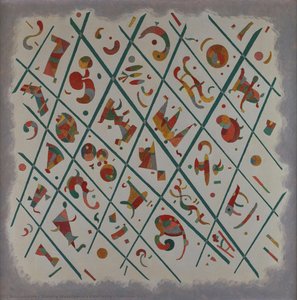
Wassily Kandinsky’s “Division - Unite,” created in 1934 during his formative Parisian period, stands as an emblem of abstract expressionism and a testament to the artist's relentless pursuit of spiritual resonance within visual art. Born in Moscow in 1866, Kandinsky embarked on a transformative artistic odyssey fueled by encounters with Impressionist painting—particularly Claude Monet’s “Haystacks”—and profoundly moved by Wagner’s opera "Lohengrin." These experiences instilled within him an unwavering conviction that art could transcend mere representation and communicate directly with the soul. This conviction would become the cornerstone of his groundbreaking approach to abstraction, forever altering the landscape of modern artistic endeavor. Early influences extended beyond purely visual stimuli; Kandinsky absorbed the vibrant hues and symbolic narratives of Russian folk art, gleaned from expeditions into the Vologda region. He meticulously documented these observations, recognizing their capacity to evoke emotional responses akin to musical harmonies—a concept he would champion throughout his career. This intellectual framework underpinned his artistic explorations, guiding him toward a deliberate rejection of conventional pictorial conventions in favor of forms that prioritized color and composition as primary expressive vehicles. The painting itself presents a striking visual experience: a square grid serves as the foundational structure for an astonishing array of organic shapes—circles, squares, triangles—interwoven with scattered letters. These elements are not uniformly distributed; rather, they cluster and overlap, generating a palpable sense of controlled chaos that belies Kandinsky’s meticulous planning. Diagonal lines intersect the grid, injecting dynamism into the composition and reinforcing the feeling of movement. The color palette is extraordinarily rich and diverse, encompassing reds, greens, blues, yellows, oranges, and purples—applied in both solid blocks and blended areas to create subtle gradations that heighten visual interest. Dominating the background is a pale grey or off-white hue, allowing the vibrant colors of the shapes to command attention and radiate luminosity. Kandinsky’s technique reflects his unwavering commitment to capturing inner experience. Executed primarily with oil paints on canvas—likely stretched taut—the application appears remarkably smooth, minimizing visible brushstrokes and prioritizing tonal harmony. This deliberate restraint underscores Kandinsky's belief that color alone could convey profound emotional significance. The resulting surface possesses a subtle textural quality, suggestive of the paper-like texture of his preparatory sketches, hinting at the artist’s ongoing engagement with traditional drawing methods alongside his pioneering explorations of abstraction. “Division - Unite” embodies Kandinsky’s mature abstract style—characterized by its rejection of representational imagery and its masterful manipulation of color relationships to evoke spiritual contemplation. It aligns seamlessly with the tenets of Abstract Expressionism, a movement that championed spontaneous gesture and emotional intensity as paramount considerations in artistic creation. More than just a visual spectacle, this artwork invites viewers into a realm where form and color coalesce to communicate unspoken truths—a legacy that continues to inspire artists and collectors alike.Composition & Structure
The square grid serves as the central organizing principle of “Division - Unite,” providing a framework for the arrangement of disparate elements while simultaneously fostering a sense of controlled dynamism. Unlike traditional perspectival representations, Kandinsky eschews depth illusion, opting instead for a flattened surface that emphasizes color and form as independent expressive forces. Diagonal lines intersect the grid, injecting movement into the composition and disrupting any potential static equilibrium. This deliberate disruption mirrors Kandinsky’s philosophical conviction that art should transcend rational thought and tap into primal instincts—a core tenet of his spiritual worldview.Color Palette & Harmony
Kandinsky's masterful use of color is arguably the painting's most striking feature. The palette encompasses a spectrum of hues—reds, greens, blues, yellows, oranges, and purples—each carefully positioned to create visual harmony and convey specific emotional resonances. Solid blocks of color coexist with blended areas, generating subtle gradations that enrich the overall tonal range. The dominant off-white background serves as a counterpoint to the vibrant shapes, maximizing their luminosity and enhancing their impact on the viewer’s eye. Kandinsky's meticulous attention to color theory—informed by Goethean aesthetics—demonstrates his profound understanding of how color can stimulate sensory perception and evoke psychological responses.Technique & Materials
The painting was crafted using oil paints on canvas, a medium favored by Kandinsky for its ability to achieve exceptional tonal fidelity and textural nuance. The application technique prioritizes smoothness and tonal consistency, minimizing visible brushstrokes and emphasizing the artist’s commitment to capturing inner experience through visual form. This deliberate restraint underscores Kandinsky's belief that color alone could convey profound emotional significance—a conviction that underpinned his entire artistic practice.Symbolic Significance & Emotional Impact
“Division - Unite” transcends mere aesthetic beauty; it embodies Kandinsky’s aspiration to communicate spiritual truths through abstraction. The scattered letters within the composition serve as visual anchors, grounding the organic shapes in a realm of intellectual contemplation—a reflection of Kandinsky's engagement with philosophical ideas and his belief that art could illuminate hidden dimensions of human consciousness. Ultimately, this painting invites viewers into a meditative state—a testament to Kandinsky’s enduring legacy as one of the foremost pioneers of abstract expressionism and a visionary artist who dared to explore the uncharted territories of visual perception.Historical Context
Created in 1934, “Division - Unite” emerged during Kandinsky's Parisian period—a time marked by profound intellectual ferment and artistic experimentation. The painting reflects the influence of Bauhaus, where Kandinsky taught from 1922 to 1933, and embodies the broader ethos of Abstract Expressionism—a movement that championed spontaneity and emotional intensity as paramount considerations in artistic creation. It stands as a pivotal work within Kandinsky’s oeuvre, solidifying his reputation as one of the most innovative and influential artists of the 20th century.Size & Dimensions
Unknown Date: 1934Questions et réponses
Quelle émotion Division - Unité dégage-t-il ?
«Division - Unité» est empreint d'un sentiment Spirituel. La tonalité émotionnelle décrit l'impression qui se dégage de l'œuvre.
Quelle est l'orientation de «Division - Unité» de Wassily Wassilyevich Kandinsky ?
L'œuvre « Division - Unité » est au format Format carré. Cette information est utile pour prévoir l'emplacement de sa reproduction.
Où puis-je acheter une reproduction peinte à la main de «Division - Unité» de Wassily Wassilyevich Kandinsky ?
«Division - Unité» est disponible en tant que une reproduction à l'huile peinte à la main sur toile de lin. Vous pouvez passer commande sur sa page Reproduction peinte à la main, avec un choix de formats disponibles.
Informations clés et quiz sur l'œuvre
À propos de Wassily Wassilyevich Kandinsky

Wassily Wassilyevich Kandinsky
1866 - 1944, Russie
Biographie de l'artiste
Wassily Wassilyevich Kandinsky : Pionnier de l'Abstraction
- Né : 16 décembre 1866, Moscou, Russie
- Décédé : 13 décembre 1944
- Nationalité : Russe
Jeunesse et Développement Artistique
- La jeunesse de Kandinsky a été marquée par une éducation diversifiée, étudiant initialement le droit et l'économie à l'Université de Moscou.
- À l’âge de 30 ans, il s’est tourné vers l’art, s’inscrivant à l’Académie de Munich sous la direction de Franz von Stuck. Ce changement a marqué un engagement profond envers l’expression artistique.
- Ses premières œuvres ont été influencées par l'art populaire russe, notamment lors d'un voyage ethnographique dans la région de Vologda en 1889.
- Il a développé un intérêt pour le symbolisme des couleurs et la psychologie, qui sont devenus des éléments fondamentaux de ses compositions abstraites ultérieures.
Périodes Artistiques Clés et Styles
- Expressionnisme Précoce : Caractérisé par des couleurs vibrantes et une intensité émotionnelle, comme on le voit dans "Papeln (Poplars)" (1902).
- Transition vers l'Abstraction : Kandinsky s’est progressivement éloigné de l’art représentatif, explorant la relation entre la couleur, la forme et l’émotion.
- Abstraction Géométrique : Cette période a vu un intérêt accru pour les formes géométriques et les compositions, illustré par "Several Circles" (140 x 140 cm).
- Abstraction Spirituelle : Kandinsky croyait que l'art pouvait exprimer des vérités spirituelles à travers des formes non représentatives. Ses œuvres visaient à évoquer des émotions et des expériences intérieures plutôt qu’à dépeindre la réalité externe.
Influence et Héritage
- Influence du Bauhaus : En tant que membre de faculté de l'école Bauhaus en Allemagne, Kandinsky a profondément influencé des générations d'artistes grâce à ses théories sur la couleur, la forme et l’abstraction.
- Écrits Théoriques : Ses écrits, notamment "De lo Spirituel dans l'Art", ont articulé sa philosophie artistique et ont contribué de manière significative au développement de la théorie de l'art abstrait.
- Impact sur l'Art Moderne : Kandinsky est largement reconnu comme un pionnier de l'art abstrait, ouvrant la voie à de nombreux mouvements et artistes ultérieurs.
- Collections Muséales : Ses œuvres sont conservées dans les principaux musées du monde entier, notamment la Galerie Tretyakov à Moscou, qui abrite sa "Composition VII" monumentale.
Œuvres Notables
- Composition VII : Une œuvre abstraite de grande envergure considérée comme l'aboutissement du développement artistique de Kandinsky.
- Carré Noir (en collaboration avec Kazimir Malevitch) : Une œuvre fondamentale dans l’histoire de l’abstraction, représentant un départ radical des formes artistiques traditionnelles.
- Several Circles : Démontre son utilisation innovante de formes géométriques et de couleurs vibrantes pour créer des compositions dynamiques.
- Murnau avec une Église : Équilibre les éléments abstraits avec l'imagerie représentative, mettant en valeur son style en évolution.
- Un Bal Intime : Une œuvre ultérieure présentant une abstraction géométrique et un empâtement superposé, reflétant son exploration continue des thèmes spirituels.
Informations clés sur Wassily Wassilyevich Kandinsky
- Artistic Movement Or Style: Expressionnisme abstrait
- Date De Décès: 13 décembre 1944
- Date De Naissance: 16 décembre 1866
- Full Name: Wassily Wassilyevich Kandinsky
- Lieu De Naissance: Moscou, Russie
- Nationalité: Russe
- Notable Artworks:
- Composition VII
- Carré noir
- Plusieurs cercles
- Murnau avec une église
- Un après-midi intime
Explorez des œuvres d'art classées par thèmes, styles et caractéristiques.




Wassily Wassilyevich Kandinsky
Division - Unité
() ·
Avec son cadre : · Peint à la main à l'huile sur lin
Total