The Master of Drama and Light: The Life of Solomon Joseph Solomon
In the grand tapestry of late Victorian and Edwardian art, few figures command as much presence through both their brushwork and their historical contributions as Solomon Joseph Solomon. A man of profound versatility, Solomon was not merely a painter of exquisite skill but a pivotal figure in the British art establishment. Born into a Jewish family in London, his journey through the prestigious halls of the Heatherley School of Fine Art, the Royal Academy Schools, and eventually the esteemed Munich Academy and the École des Beaux-Arts under Alexandre Cabanel, shaped a style that was both classically grounded and vibrantly modern. His education allowed him to weave together the academic rigor of the French tradition with a uniquely British sensibility, creating works that felt both timeless and immediate.
Solomon’s artistic evolution was deeply influenced by the masters of his era, most notably Alexandre Cabanel, whose influence provided a foundation of anatomical precision and elegance. This, combined with the classical grandeur of Frederic Leighton and the meticulous, opulent detail of Lawrence Alma-Tadema, allowed Solomon to master the art of the large-scale narrative. While he maintained a steady practice of portraiture to sustain his livelihood, it was in the sweeping, theatrical realms of mythology and biblical epic that his soul truly found expression. His canvases became stages where ancient legends were brought to life with a palpable sense of movement and human emotion.
A Legacy of Narrative and Grandeur
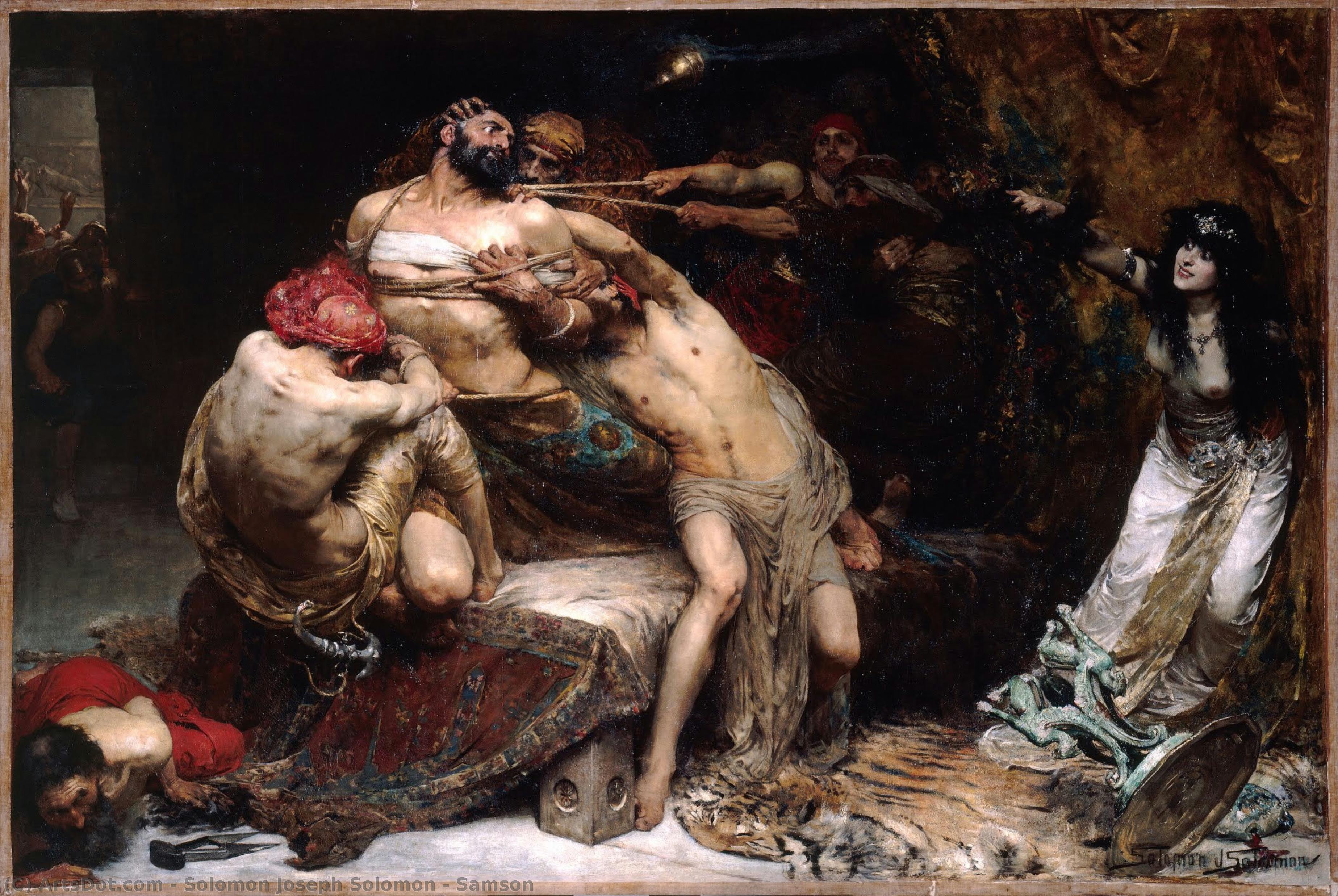
The true brilliance of Solomon’s work lies in his ability to capture the tension of a single, decisive moment. He possessed a rare talent for composing complex scenes that utilized the human form as a vehicle for drama. One of his most celebrated triumphs, Samson (1887), remains a landmark of his career. In this piece, he masterfully depicted the biblical struggle between Samson and Delilah, earning widespread acclaim for his daring use of multiple male nudes in dynamic, active poses. This work demonstrated not only his technical command over musculature and light but also his ability to push the boundaries of what was acceptable in the academic circles of his time.
Beyond the intimate drama of his biblical scenes, Solomon contributed to the very architecture of London’s history. His mural for the Royal Exchange, Charles I Demanding the Five Members at the Guildhall, stands as a testament to his ability to handle historical gravity and monumental scale. His career was marked by significant institutional achievements, including:
- Founding Member: He played a crucial role in the establishment of the New English Art Club, fostering a space for fresh, contemporary perspectives.
- Royal Academy Recognition: His ascent through the ranks of the Royal Academy, from Associate to full member, signaled his acceptance into the highest echelon of British art.
- Leadership: Serving as the President of the Royal Society of British Artists, he helped shape the direction of the British art scene during a period of immense transition.
Innovation Beyond the Canvas
Perhaps the most unexpected chapter of Solomon’s life occurred far from the quiet sanctity of his studio. During the First World War, the artist applied his keen eye for observation and texture to a much more practical, albeit grim, necessity: the development of camouflage. Recognizing the lethal importance of concealment in modern warfare, he worked tirelessly on the design of tree observation posts and advocated passionately for the implementation of camouflage netting. This period of his life reveals a man whose intellect and observational skills were not confined to the aesthetic, but were deeply engaged with the pressing realities of his age.
Solomon Joseph Solomon’s significance extends far beyond the borders of the frame. He was an artist who bridged the gap between the classical traditions of the 19th century and the burgeoning complexities of the 20th. Through his portraits, his epic mythological canvases, and his unexpected contributions to military science, he left an indelible mark on the history of British art, proving that a true master is one who can find beauty in the divine and utility in the shadows.


 पूर्वावलोकन देखें
 प्रिंट खरीदें
 साझा करें
 साझा करें
 विस्तृत विवरण

 डाउनलोड करें
 समान कलाकृतियाँ
 एक्स-रे
 स्लाइड शो देखें


 पूरा देखें






































 ग्लास का विकल्प केवल 110 सेमी से कम आकार में ही उपलब्ध है।



