

Shown: · With its frame:
 Pregledaj u realnoj veličini
 Pošalji
 Podijeli
 Detalji o umjetničkom djelu
 Vodič
Vodič

 Preuzmi umjetničko djelo
 Slični predmeti
 Rentgenska snimka
 Slide show
 Q&A
Q&A Statistika
- 316.0 x 215.0 cm


€ 239
Ručno rađena uljana reprodukcija
Ručno oslikano uljanim bojama na platnu u dimenzijama i okviru po vašem izboru, izrađeno po narudžbi od strane naših umjetnika. ( Prebacite na printove Prebacite na digitalnu sliku)
Size
·Standardne dimenzije
po mjeri
CM
INCH
Odaberite jednu od naših unaprijed definiranih veličina koje odgovaraju izvornim proporcijama umjetničkog djela.
Loading sizes...

širina
visina
Unesite potrebnu širinu i visinu kako bi dimenzije odgovarale vašem okviru ili zidu. Budući da je riječ o ručno oslikanom djelu, umjetnik može malo proširiti rubove slike ili ih skratiti kako bi postigao drugačiji oblik — izbor je vaš. Prije početka slikanja poslat ćemo vam digitalni prikaz (mockup) radi potvrde. Slika prikazana na ovoj stranici ne predstavlja stvarni rezultat — samo digitalni prikaz to čini.
 Pročitajte više
Finish
·
White €1

Blurside €1

Extended €1

P118B €10

P118H €10

P118W €10

P438Z €10

P508JH €12

P508YH €12

P805H €10

P805Z €10

P919BZ €10

P919G €10

P919XJ €10

P959ZH €10

P968JZ €12

W106C €8

W218G €10

W218JH €8

W218Y €10

W307PJ €10

W316G €10

W316PJ €8

W316Y €10

W398PJ €8

W4111J €10

W500HY €15

W500JH €15

W692G €12

W849H €8

W940BG €15

W953PJ €8

H24-GOLD €30

H24-SILVER €30

H36-GOLD €45

H36-SILVER €45
Shipped in a protective tube, ready for your own framer.
Above 105 cm the frame is shipped as a kit for a professional framer — read the details.
Extras
optionalWhat do the extras include?
Examples of what can be changed: Replace face with customer photo; Add pet (e.g., replace cat with dog); Include hidden message in background; Change background landscape or elements.
After order, TopImpressionists.com team will email client for instructions and provide a mockup preview
After order, TopImpressionists.com team will email client for instructions and provide a mockup preview
Isporuka širom svijeta () u roku od 3-4 tjedna umjesto standardnih 5 tjedana. (1 Studeni). Bez kompromisa u kvaliteti.
Zaštitni lak
Natpisna pločica
Detalji gravirane brončane pločice
This elegant plaque features the artist's name and the title of the artwork, finely engraved for a timeless presentation.
It is made from bronze with a refined, elegant finish. The text is precisely laser-engraved for a sharp and permanent result. Measuring 9x2 cm, the plaque is compact yet easy to read. It's built to be durable and scratch-resistant, offering a professional, museum-quality look. Mounting is simple thanks to the included adhesive backing.
Detalji prozirne akrilne pločice
The plaque includes essential engraved details such as the artist's name, the title of the artwork, the date it was created, the type of media used-like oil on canvas or watercolor-a brief description of the piece, and a QR code that links to the complete artwork information.
It is crafted from clear acrylic, offering a sleek, modern appearance. The text is UV-engraved in black to ensure strong visual contrast. With a size of 10x15 cm, it ensures optimal readability. It comes equipped with two metal hooks for secure wall mounting. The plaque is designed to be weather-resistant, making it suitable for various environments, and it includes interactive features that work seamlessly with smartphone scanning.
Detalji crne akrilne pločice
This elegant plaque includes engraved information such as the artist's name, the title of the artwork, the date it was created, the type of media used (like oil on canvas or watercolor), a short description of the artwork, and a QR code for quick access to more information.
The plaque itself is made from refined black acrylic with a premium finish. The text is laser-engraved in white for high contrast and readability. Its size is 10x15 cm, designed to be easy to read. It comes with two metal hooks for professional mounting. The design is sleek and fits any interior style. It is also weather-resistant and durable, with built-in digital integration for mobile compatibility.
Opcija stakla dostupna je samo za dimenzije manje od 110 cm
 Opcija stakla dostupna je samo za dimenzije manje od 110 cm
- Besplatna ekspresna dostava širom svijeta
- Visokokvalitetno laneno platno
- Potpuno osiguranje dostave
- Jamstvo povrata carine i uvoznih poreza
- Jamstvo vjernosti boja
- Politika povrata u roku od 100 dana (samo u slučaju nedostataka)
- Jamstvo povrata 100% novca
- Popust na više proizvoda


Opis kolekcionarskog predmeta
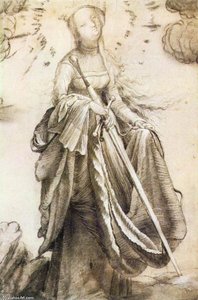
Admire Matthias Grünewald's 'St Catherine,' a captivating chalk drawing from 1520. Explore the Northern Renaissance master’s unique style, featuring a serene saint and symbolic details – available as a hand-painted replica.
Biografija umjetnika
Istražite dramatičnu umjetnost Matthiasa Grünewalda renesanse! Poznat po Isenheimskom oltaru i emocionalnim religijskim slikama. Otkrijte njegov jedinstveni stil i povijesni značaj.
About the painting
The Enigmatic Saint: Matthias Grünewald’s St Catherine
Matthias Grünewald's 1520 chalk drawing, “St Catherine,” is more than just a portrait; it’s a profound meditation on faith, scholarship, and the enduring power of medieval symbolism. This remarkable work, currently residing in the Staatliche Museen zu Berlin, offers a captivating glimpse into the artist’s unique vision – a synthesis of late Gothic sensibilities with nascent Renaissance influences. Grünewald, a pivotal figure in German art, deliberately eschewed the prevailing Italian humanist trends, instead drawing deeply from the rich traditions of Central European religious painting, resulting in an intensely personal and emotionally resonant style.
The image depicts St Catherine from the waist up, her head tilted slightly downwards as if lost in contemplation. Her posture exudes a quiet dignity, while the subtle turn of her neck invites us into her inner world. She’s dressed in a gown with voluminous sleeves – a detail that speaks to both the formality of her status and the luxurious fabrics favored by wealthy patrons during the period. Crucially, she holds two objects: an open book or manuscript, symbolizing her role as a learned scholar, and a sword raised upright, representing her martyrdom and unwavering faith. These symbols aren’t merely decorative; they are potent visual statements about Catherine's life and devotion.
A Study in Northern Renaissance Technique
Grünewald’s masterful technique is immediately apparent. The drawing is executed with exquisite detail using chalk on paper, a medium that allowed for the delicate shading and fine lines characteristic of his work. Notice the subtle gradations of tone – the way light catches on her dress, the modeling of her face, and the atmospheric haze in the background. This meticulous attention to texture and form creates a remarkable sense of depth and realism, despite the relatively small scale of the piece. The artist’s use of chalk also lends a slightly ethereal quality to the image, contributing to its contemplative mood.
Furthermore, Grünewald's style deviates significantly from the prevailing Renaissance aesthetic. Unlike the idealized figures favored by artists like Albrecht Dürer, Catherine is rendered with a certain distortion – her proportions aren’t perfectly symmetrical, and her features possess an expressive intensity. This deliberate departure from classical ideals reflects Grünewald’s commitment to conveying emotional truth rather than purely visual accuracy. The background, deliberately minimalistic, consists of only a few suggestive lines—perhaps hinting at a cloudy sky or an abstract representation of the heavens – further emphasizing the saint's presence and drawing our focus entirely onto her.
Historical Context and Symbolic Resonance
Created in 1520, “St Catherine” exists within a fascinating transitional period in art history. Grünewald was working at a time when the influence of Italian Renaissance humanism was beginning to spread across Europe, yet he remained firmly rooted in the traditions of late medieval Central European painting. The saint herself holds significant religious importance – she is venerated as a martyr and patron saint of scholars, librarians, and translators. Her story, recounted in early Christian hagiographies, details her conversion after being saved from execution by St Peter, who recognized her divine calling.
Interestingly, the figure of Catherine has been associated with intellectual pursuits for centuries. Her association with learning stems from her devotion to scripture and her role as a translator of the Bible. The book she holds in the drawing symbolizes this scholarly dedication, while the sword represents her willingness to defend her faith against persecution. The combination of these symbols creates a powerful image of a woman who embodies both spiritual strength and intellectual prowess.
A Legacy of Emotion and Innovation
“St Catherine” is a testament to Matthias Grünewald’s artistic genius – a work that seamlessly blends technical skill with profound emotional depth. It's a poignant reminder of the artist’s ability to capture not just the likeness of his subject, but also her inner world. The drawing’s enduring appeal lies in its ability to evoke a sense of quiet contemplation and spiritual yearning. As a significant example of Northern Renaissance art, it continues to inspire artists and scholars alike, offering a valuable window into the artistic and intellectual landscape of 16th-century Germany.
Pitanja i odgovori
U kojem je položenu (okrenu) umjetničko djelo "St Catherine" autora Matthias Grünewald?
Format djela "St Catherine" je Portrait, što vam može pomoći pri planiranju prostora za postavljanje reprodukcije.
U kojem se muzeju čuva izvornik djela "St Catherine"?
Originalno djelo "St Catherine" možete vidjeti u muzeju Staatliche Museen, Berlin, Germany.
Koja je tehnika korištena za "St Catherine"?
Matthias Grünewald koristio je tehniku Chalk za "St Catherine". Ova tehnika definira materijalnu prirodu izvornog djela.
Quick facts and art quiz
About Matthias Grünewald

Matthias Grünewald
1480 - 1528, Njemačka
Biografija umjetnika
Matthias Grünewald: Život i nasljeđe
Matthias Grünewald, rođen kao Mathis Gothart Neithardt oko 1470.-1475. u Würzburgu, Njemačka, bio je iznimno važna figura njemačke renesanse. Iako je živio u razdoblju sve većeg utjecaja talijanskih renesansnih ideala, Grünewald je ostao duboko ukorijenjen u umjetničkim tradicijama kasnog srednjovjekovnog Središnje Europe. Detalji o njegovom ranom životu su oskudni, ali se zna da je primio umjetničku obuku, vjerojatno unutar lokalnih radionica.
Umjetnički razvoj i utjecaji
Grünewaldov umjetnički razvoj oblikovale su prevladavajuće sjevernoeuropske tradicije realizma, emocionalne intenzivnosti i detaljne promatljivosti. Njegovo djelo pokazuje utjecaje umjetnika poput Albrechta Dürera i Martina Schongauera, ali je izkovao jedinstveni put obilježen dramatičnim izrazom i živopisnom bojom. Nije bio izravno uključen u humanističke krugove koji su prevladavali u Italiji; umjesto toga, njegova umjetnost služila je prvenstveno religioznim svrhomama, odražavajući duhovne nemire svog vremena.
Ključna djela i stil
Grünewaldov stil karakterizira snažan osjećaj dramatičnosti, intenzivno korištenje boje i duboka psihološka introspekcija. Njegova su djela često prikazivala patnju i žrtvu s iznimnom realističnošću, što je odražavalo teološke koncepte tog vremena. Jedno od njegovih najpoznatijih djela, Isenheimski oltar (1512.-1516.), smješten u Musée d'Unterlinden u Colmaru, smatra se njegovim remek-djelom. Oltar prikazuje scene iz Kristovog života s potresnom realističnošću, posebno usredotočujući se na patnju i otkupljenje. Njegova Križanje (oko 1502.-1503.), ranije djelo, demonstrira njegov rastući stil, pokazujući intenzivne emocije i anatomski detalj. Ostala važna djela uključuju Djevicu s navještenjem (1512.-14.), studiju za Isenheimski oltar koja otkriva njegov pedantan proces planiranja, te crtež Mojsija (1511.) koji ističe njegovu vještinu u hvatanju ekspresivnih figura i dramatičnih poza.
Povijesni značaj i nasljeđe
Grünewaldov rad stoji kao svjedočanstvo trajne snage srednjovjekovnih umjetničkih tradicija u Njemačkoj tijekom renesanse. On je poslužio kao most između kasnog gotičkog stila i novonastale renesanse, stvarajući jedinstveni vizualni jezik koji je odjeknuo kod njegovih suvremenika. Njegov utjecaj se može vidjeti u kasnijim njemačkim umjetnicima koji su nastavili istraživati teme religioznog žara i emocionalne intenzivnosti. Iako je bio zaboravljen stoljećima nakon njegove smrti 1528. godine, Grünewald je doživio preporod u 19. stoljeću, a danas je priznat kao jedan od najvažnijih slikara njemačke renesanse. Njegova umjetnost nastavlja očaravati gledatelje svojim sirovim emocijama, tehničkom briljantnošću i dubokom duhovnom dubinom.
Daljnja istraživanja
Saznajte više o životu i djelima Matthiasa Grünewalda na: TopImpressionists
Quick facts about Matthias Grünewald
- Datum Rođenja: oko 1470-1475
- Datum Smrti: 1528.
- Državljanstvo: Njemački
- Mjesto Rođenja: Würzburg, Njemačka
- Puno Ime: Matthias Grünewald
- Umjetnički Pokret: Kasni srednjovjekovni
- Utjecaj Na Umjetnike: Kasniji njemački slikari
- Utjecaji Umjetnika:
- Albrecht Dürer
- Martin Schongauer
- Značajna Djela:
- Isenheimski oltar
- Križenje
Istražite umjetnička djela organizirana prema temama, stilovima i karakteristikama.


Matthias Grünewald
St Catherine
() ·
With its frame: · Hand-painted in oil on linen
Total