Deconstructing Reality: A Deep Dive into Picasso’s *The Guitar* (1913)
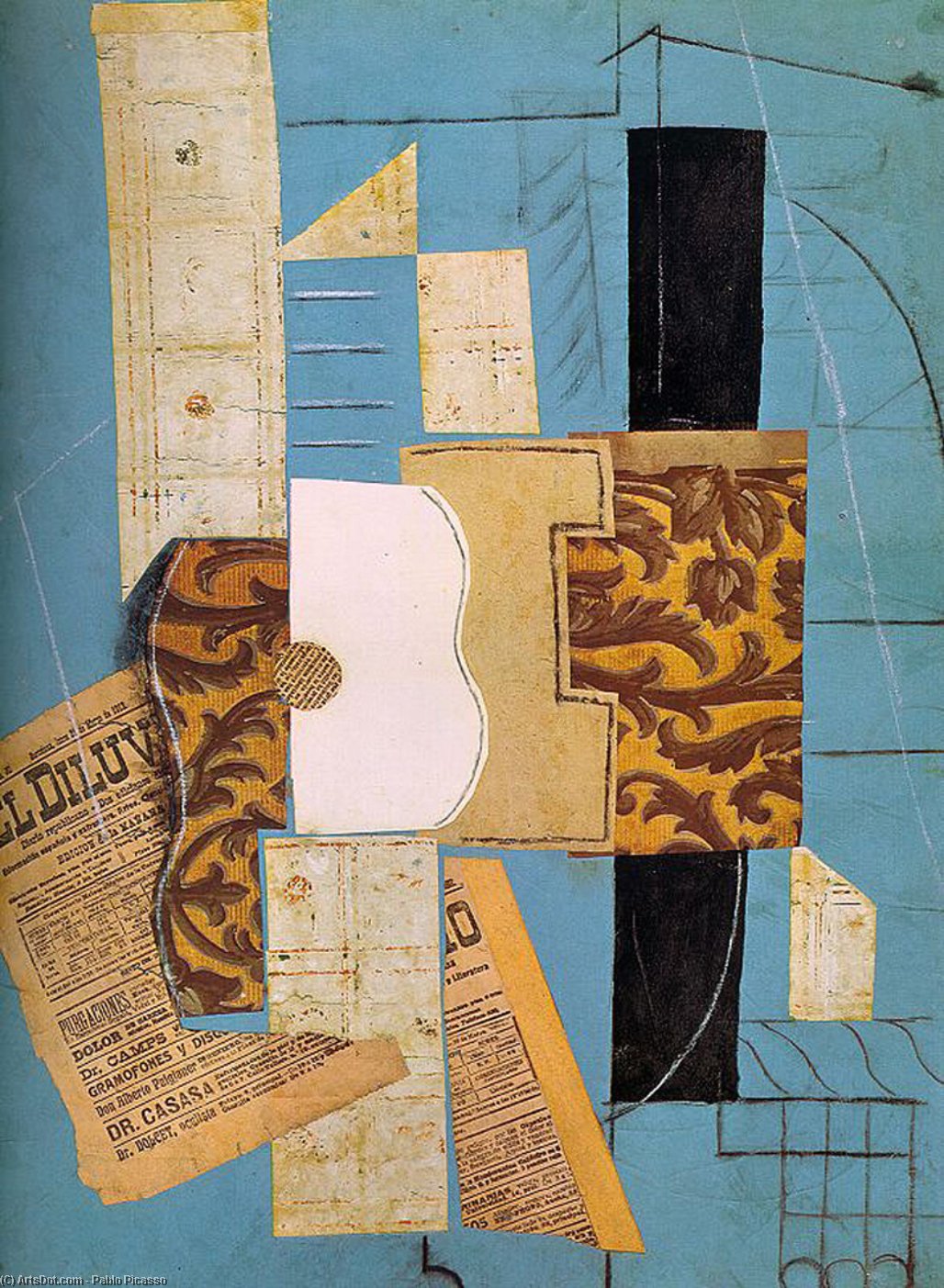
Pablo Picasso's *The Guitar*, created in 1913, is far more than a simple depiction of a musical instrument; it’s a pivotal moment in the birth of modern art, a bold statement born from Synthetic Cubism. Measuring just 66 x 49 cm, this painting doesn't aim to capture a guitar as we conventionally perceive it – its precise form, its familiar curves – but rather to represent how we *know* it exists: distilled into fragmented planes, suggestive shapes, and an almost dreamlike quality. Currently residing within the esteemed Museo Thyssen-Bornemisza in Madrid, this work stands as a testament to Picasso’s revolutionary vision and its enduring influence on generations of artists.
A Symphony of Shapes: Composition & Technique
From the moment you encounter *The Guitar*, it's clear that traditional representation has been abandoned. Picasso doesn’t present us with a realistically rendered guitar; instead, he offers fragments – glimpses of sound holes, hints of the neck and strings – scattered across a predominantly cool blue background. These elements aren’t merely broken apart; they are meticulously reassembled in a flattened space, overlapping and interacting with other forms that evoke a sense of familiarity: perhaps a chair, a sheet of music, or even a bottle of wine. This technique is at the heart of Synthetic Cubism – building an image not from analyzing its constituent parts (as was characteristic of Analytic Cubism), but rather from constructing it anew from abstracted components. Notice how the blue isn’t just a backdrop; it actively shapes the forms, creating depth and allowing them to ‘float’ dynamically, almost suspended in space. The artist's masterful control over line and form creates a powerful tension between order and chaos, inviting the viewer to participate in the act of reconstruction.
The Birth of Synthetic Cubism: Historical Context
*The Guitar* emerged during a period of intense experimentation within Picasso’s career. Following his earlier Blue and Rose Periods – periods marked by emotional intensity and distinct color palettes – he, alongside Georges Braque, spearheaded the development of Cubism itself. This work exemplifies Synthetic Cubism (1912-1919), a phase that represented a significant shift in artistic thinking. Instead of dissecting objects into geometric fragments as done in Analytic Cubism, Picasso and Braque began to build up images from these fragments, creating new visual realities. This period was also profoundly influenced by the rivalry with Henri Matisse – Picasso’s exploration of form and space pushed beyond pure color expression, focusing instead on formal innovation and intellectual deconstruction. The “Crystal Period,” as this era is sometimes referred to, reflects this fascination with fractured forms and crystalline structures.
Symbolism & Interpretation: Beyond the Instrument
While seemingly abstract, *The Guitar* resonates with deeper meanings. The guitar itself held significant symbolic weight for Picasso – representing his Spanish heritage, a source of comfort and nostalgia, and perhaps even serving as a metaphor for the artist himself, constantly shaping and manipulating form to create something entirely new. Consider the deliberate fragmentation; it mirrors the complexities and uncertainties inherent in modern life. The blue background isn’t merely decorative; it evokes feelings of melancholy and introspection, adding another layer of emotional depth to the composition. Some scholars suggest that the painting also alludes to the burgeoning industrial age and the mechanization of society – a world where objects are increasingly reduced to their functional components. The subtle inclusion of newspaper fragments hints at the overwhelming influx of information characteristic of the early 20th century, a theme that would become increasingly relevant in Picasso’s later work.
Emotional Resonance & Lasting Legacy
Despite its intellectual rigor and formal experimentation, *The Guitar* possesses a surprising emotional resonance. The interplay of cool blues and muted tones creates a sense of quiet contemplation, inviting the viewer to lose themselves within its fragmented forms. The seemingly chaotic arrangement is, in fact, remarkably harmonious, suggesting an underlying order beneath the surface. Picasso’s contribution to modern art is immeasurable; his innovations in Cubism fundamentally altered the course of artistic expression, paving the way for movements like Surrealism and Abstract Expressionism. Artists such as Kazimir Malevich were profoundly influenced by his formal explorations. *The Guitar* remains a powerful testament to Picasso's genius – a captivating exploration of form, space, and the very nature of representation, continuing to inspire artists and viewers alike.


 Preview
 Switch to Print
 Pošalji
 Podijeli
 Detalji o umjetničkom djelu

 Preuzmi
 Slični predmeti
 Rentgenska snimka
 Automatska prezentacija


 Prikaži više






































 Opcija stakla dostupna je samo za dimenzije manje od 110 cm