

Shown: · With its frame:
 Pregledaj u realnoj veličini
 Pošalji
 Podijeli
 Detalji o umjetničkom djelu
 Vodič
Vodič

 Preuzmi umjetničko djelo
 Slični predmeti
 Rentgenska snimka
 Slide show
 Q&A
Q&A Statistika

€ 239
Ručno rađena uljana reprodukcija
Ručno oslikano uljanim bojama na platnu u dimenzijama i okviru po vašem izboru, izrađeno po narudžbi od strane naših umjetnika. ( Prebacite na printove Prebacite na digitalnu sliku)
Ovo djelo je zaštićeno autorskim pravima
Djelo prikazano na ovoj stranici zaštićeno je autorskim pravima, što znači da zakonski ne možemo izraditi niti prodati identičnu reprodukciju. Ova se zaštita provodi u skladu s međunarodnim sporazumima kao što su Bernska konvencija i nacionalnim zakonima, uključujući i one koji su utvrđeni u Američki zakon o autorskom pravu – Title 17.
Kao poštovana i legalna alternativa, nudimo prilagođena, ručno oslikana umjetnička djela inspirirana originalom. Naši vješti i profesionalni umjetnici pažljivo proučavaju stil, raspoloženje i umjetničku bit originala kako bi stvorili novo, jedinstveno djelo koje izaziva isti osjećaj – ostajući pritom vlastito, originalno stvaralaštvo.
Ova metoda u potpunosti je usklađena s autorskim pravima jer ne uključuje kopiranje ili dupliciranje zaštićenih umjetničkih djela. Umjesto toga, riječ je o kreativnoj reinterpretaciji – novoj slici koja je dobila utjecaj na izvornik, ali nije identična njemu.
 Pročitajte više
Size
·Standardne dimenzije
po mjeri
CM
INCH
Odaberite jednu od naših unaprijed definiranih veličina koje odgovaraju izvornim proporcijama umjetničkog djela.
Loading sizes...

širina
visina
Unesite potrebnu širinu i visinu kako bi dimenzije odgovarale vašem okviru ili zidu. Budući da je riječ o ručno oslikanom djelu, umjetnik može malo proširiti rubove slike ili ih skratiti kako bi postigao drugačiji oblik — izbor je vaš. Prije početka slikanja poslat ćemo vam digitalni prikaz (mockup) radi potvrde. Slika prikazana na ovoj stranici ne predstavlja stvarni rezultat — samo digitalni prikaz to čini.
Finish
·
White €1

Blurside €1

Extended €1

P118B €10

P118H €10

P118W €10

P438Z €10

P508JH €12

P508YH €12

P805H €10

P805Z €10

P919BZ €10

P919G €10

P919XJ €10

P959ZH €10

P968JZ €12

W106C €8

W218G €10

W218JH €8

W218Y €10

W307PJ €10

W316G €10

W316PJ €8

W316Y €10

W398PJ €8

W4111J €10

W500HY €15

W500JH €15

W692G €12

W849H €8

W940BG €15

W953PJ €8

H24-GOLD €30

H24-SILVER €30

H36-GOLD €45

H36-SILVER €45
Shipped in a protective tube, ready for your own framer.
Above 105 cm the frame is shipped as a kit for a professional framer — read the details.
Extras
optionalWhat do the extras include?
Examples of what can be changed: Replace face with customer photo; Add pet (e.g., replace cat with dog); Include hidden message in background; Change background landscape or elements.
After order, TopImpressionists.com team will email client for instructions and provide a mockup preview
After order, TopImpressionists.com team will email client for instructions and provide a mockup preview
Isporuka širom svijeta () u roku od 3-4 tjedna umjesto standardnih 5 tjedana. (1 Studeni). Bez kompromisa u kvaliteti.
Zaštitni lak
Natpisna pločica
Detalji gravirane brončane pločice
This elegant plaque features the artist's name and the title of the artwork, finely engraved for a timeless presentation.
It is made from bronze with a refined, elegant finish. The text is precisely laser-engraved for a sharp and permanent result. Measuring 9x2 cm, the plaque is compact yet easy to read. It's built to be durable and scratch-resistant, offering a professional, museum-quality look. Mounting is simple thanks to the included adhesive backing.
Detalji prozirne akrilne pločice
The plaque includes essential engraved details such as the artist's name, the title of the artwork, the date it was created, the type of media used-like oil on canvas or watercolor-a brief description of the piece, and a QR code that links to the complete artwork information.
It is crafted from clear acrylic, offering a sleek, modern appearance. The text is UV-engraved in black to ensure strong visual contrast. With a size of 10x15 cm, it ensures optimal readability. It comes equipped with two metal hooks for secure wall mounting. The plaque is designed to be weather-resistant, making it suitable for various environments, and it includes interactive features that work seamlessly with smartphone scanning.
Detalji crne akrilne pločice
This elegant plaque includes engraved information such as the artist's name, the title of the artwork, the date it was created, the type of media used (like oil on canvas or watercolor), a short description of the artwork, and a QR code for quick access to more information.
The plaque itself is made from refined black acrylic with a premium finish. The text is laser-engraved in white for high contrast and readability. Its size is 10x15 cm, designed to be easy to read. It comes with two metal hooks for professional mounting. The design is sleek and fits any interior style. It is also weather-resistant and durable, with built-in digital integration for mobile compatibility.
Opcija stakla dostupna je samo za dimenzije manje od 110 cm
 Opcija stakla dostupna je samo za dimenzije manje od 110 cm
- Besplatna ekspresna dostava širom svijeta
- Visokokvalitetno laneno platno
- Potpuno osiguranje dostave
- Jamstvo povrata carine i uvoznih poreza
- Jamstvo vjernosti boja
- Politika povrata u roku od 100 dana (samo u slučaju nedostataka)
- Jamstvo povrata 100% novca
- Popust na više proizvoda


Opis kolekcionarskog predmeta
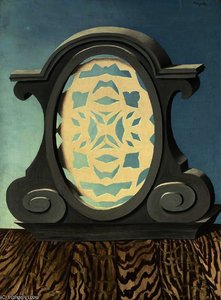
Explore René Magritte's 'The End of Time': A surreal masterpiece blending familiar objects with unsettling juxtapositions, inviting contemplation on reality and perception.
Biografija umjetnika
René Magritte (1898-1967): Belgijski nadrealista poznat po ikoničnim djelima poput "Ljudi ljubavi", izazivanju stvarnosti i percepcije.
About the painting
A Window into the Subconscious: Exploring Magritte’s Enigma
This captivating artwork embodies the quintessential style of René Magritte, inviting viewers into a realm where reality bends and perception is challenged. More than just a still life, it's a meticulously crafted visual puzzle that sparks contemplation and invites personal interpretation. The composition presents an unusual juxtaposition – an ornate frame containing a patterned oval set against a backdrop of zebra stripes, all bathed in a graduated blue wash.Surrealist Precision & Technique
Executed with the precision characteristic of Surrealism, likely using oil paints on canvas, this piece showcases Magritte’s mastery of technique. The smooth application of paint and meticulous detail belie the illogical nature of the scene. While seemingly realistic in its rendering of individual elements – the scrolling frame, the textured zebra hide – the overall effect is decidedly dreamlike and unsettling. This deliberate contrast between realism and absurdity is a hallmark of Magritte's artistic approach.Decoding the Symbolism
Magritte frequently employed everyday objects in unexpected contexts to provoke thought and question our understanding of reality. Here, the frame acts as a portal or window, drawing attention to the abstract oval within – perhaps representing an alternate dimension, hidden truth, or simply the power of imagination. The zebra stripes introduce an element of wildness and duality, contrasting sharply with the formality of the frame. These symbols aren't meant to be definitively decoded; rather, they serve as catalysts for individual reflection.Historical Context & Artistic Lineage
Created during a period of significant artistic innovation, this work aligns with the broader Surrealist movement that flourished in the aftermath of World War I. Artists like Magritte sought to liberate art from rational thought and explore the depths of the subconscious mind. Influenced by earlier Symbolists and pioneers like Giorgio de Chirico, Magritte developed a unique visual language characterized by its enigmatic imagery and intellectual rigor. His work continues to resonate with contemporary audiences fascinated by the mysteries of perception and the human psyche.Emotional Resonance & Interior Appeal
The muted color palette – dominated by dark browns, blues, and tans – contributes to a somber yet intriguing mood. This artwork evokes feelings of quiet contemplation, mystery, and perhaps even a touch of melancholy. Its formal composition and restrained aesthetic make it a sophisticated addition to any interior space. It would complement modern or contemporary décor schemes, adding a layer of intellectual depth and artistic intrigue. Whether displayed in a living room, study, or office, this piece is sure to spark conversation and inspire the imagination. A high-quality reproduction allows art enthusiasts to experience Magritte’s vision firsthand, bringing a touch of surreal elegance into their homes.Pitanja i odgovori
Tko prodaje ručno oslikane kopije djela "The end of time" autora René Magritte?
Ručno oslikane kopije djela "The end of time" autora René Magritte dostupne su na stranici ovaj web-mjesto: ručno oslikana uljana reprodukcija na lanenom platnu, a mogu se naručiti putem njihove stranice Ručno oslikana reprodukcija.
Koliko ljudi gleda "The end of time"?
Statistike o djelu "The end of time" autora René Magritte možete pronaći na stranici Statistika pregleda tog umjetničkog djela: mjesečni broj posjeta umjetničkom djelu, broj posjeta umjetnikovim radovima te pregled nedavnih posjetitelja prema državi i jeziku.
Koliko je poznato djelo "The end of time" autora René Magritte?
"The end of time" ima razinu popularnosti Ikonični.
Quick facts and art quiz
About René Magritte

René Magritte
1898 - 1967, Belgija
Biografija umjetnika
Early Life and the Seeds of Surrealism
René Magritte, born René François Ghislain Magritte on November 21, 1898, in Lessines, Belgium, emerged into a world that would profoundly shape his enigmatic artistic vision. His early years were marked by an unsettling event – the suicide of his mother when he was just thirteen. The image of her body being recovered from the River Sambre, with her dress obscuring her face, became a haunting motif that would subtly permeate his later work, manifesting in veiled figures and a persistent exploration of hidden realities. This early trauma instilled within him a fascination with mystery, loss, and the unsettling power of what remains unseen. While details of his childhood remain somewhat elusive, it’s clear this formative experience laid the groundwork for his lifelong questioning of perception and representation. He began drawing lessons at age ten, revealing an innate inclination towards visual expression, but initially explored Impressionism before embarking on a path that would lead him to become one of the most significant figures in Surrealist art.
Artistic Development and Influences
Magritte’s artistic journey was not immediate or straightforward. He studied at the Académie Royale des Beaux-Arts in Brussels, yet found its traditional methods stifling. His early work experimented with Futurism and Cubism, absorbing elements of these avant-garde movements but ultimately rejecting their purely formal concerns. It wasn't until encountering Giorgio de Chirico’s painting *The Song of Love* in 1922 that Magritte discovered a resonance that would irrevocably alter his artistic course. De Chirico’s dreamlike landscapes and unsettling juxtapositions unlocked within Magritte a new way of seeing – a world where the familiar could be rendered strange, and the ordinary imbued with profound mystery. This encounter sparked his commitment to Surrealism, though he often maintained a unique distance from its more overtly psychological or automatic approaches. He preferred a meticulous, almost clinical precision in his painting, using realistic techniques to depict illogical scenarios.
The Heart of Surrealism: Challenging Reality
By 1926, Magritte had fully embraced the tenets of Surrealism, producing *Le Jockey Perdu (The Lost Jockey)*, widely considered his first truly surrealist work. However, his brand of Surrealism was distinct. He wasn’t interested in exploring the subconscious through free association or dream imagery in the manner of some of his contemporaries. Instead, Magritte sought to challenge viewers' perceptions of reality by presenting ordinary objects in unexpected contexts, forcing them to question their assumptions about the world around them. Iconic works like *The Treachery of Images (This is not a pipe)* (1929) brilliantly deconstructs the relationship between image and object, reminding us that a representation is never the thing itself. *Les Amants (The Lovers)* (1927-1928), with its shrouded figures, echoes the trauma of his mother’s death while simultaneously exploring themes of concealment and intimacy. *Time Transfixed* (1938) presents a locomotive bursting through a brick wall, disrupting our sense of space and time. And *The Human Condition* (1933), a canvas within a canvas, blurs the boundaries between representation and reality, prompting us to consider how we perceive and interpret the world.
Later Life, Recognition, and Enduring Legacy
Despite initial struggles for recognition, Magritte’s work gradually gained prominence, particularly in the United States with exhibitions in 1936 and later retrospective shows at the Museum of Modern Art (1965) and the Metropolitan Museum of Art (1992). He continued to refine his signature style, exploring themes of repetition, illusion, and the power of language in paintings that are both intellectually stimulating and visually arresting. Magritte died on August 15, 1967, leaving behind a body of work that continues to captivate and challenge audiences worldwide. His influence extends far beyond the realm of painting, impacting pop art, minimalist art, conceptual art, and even advertising and film. Today, his paintings are held in major museum collections around the globe, including the Musées royaux des beaux-arts de Belgique in Brussels, which houses the Magritte Museum – dedicated entirely to his work and boasting the world’s largest collection of his creations.
Quick facts about René Magritte
- Artistic Movement Or Style: Surealizam
- Artists Who Influenced This Artist: ['Giorgio de Chirico']
- Date Of Birth: 21. studenog 1898.
- Date Of Death: 15. kolovoza 1967.
- Full Name: René François Ghislain Magritte
- Nationality: Belgijanin
- Notable Artworks:
- Les Amants
- The Treachery of Images
- Time Transfixed
- The Human Condition
- Place Of Birth: Lessines, Belgiji
Istražite umjetnička djela organizirana prema temama, stilovima i karakteristikama.


René Magritte
The end of time
() ·
With its frame: · Hand-painted in oil on linen
Total