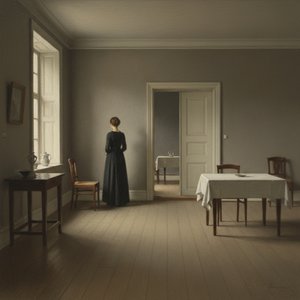
A Life Shaped by the Hanseatic Spirit
Born in Hamburg in 1875, Wilhelm Eberhardt was a product of the German maritime atmosphere. His early years were defined by the rigorous training of the Kunstgewerbeschule in his home city, a foundation that would later support his professional endeavors. He sought further refinement in Berlin, studying at the Unterrichtsanstalt des Kunstgewerbemuseums under the guidance of M. Seliger. This period of education provided him with the technical precision required for both draftsmanship and painting.
His professional life was deeply intertwined with the civic identity of Hamburg. He achieved a significant milestone when he served as an assistant to Hugo Vogels, contributing to the murals within the festival hall of the Hamburg City Hall. This involvement in public art suggests a man deeply embedded in the visual fabric of his community, working on a scale that moved beyond the private canvas to the very walls of the city's administrative heart.
Technical Foundations and Subject Matter
Eberhardt’s work often returned to the atmospheric qualities of his surroundings. His paintings frequently captured the specific light and mood of the northern German landscape, particularly the maritime environments that defined his upbringing. His technical approach was characterized by a disciplined hand, a trait likely honed during his years as a draftsperson.
The following elements characterize his documented output:
- The use of oil on cardboard as a preferred medium for certain studies.
- A focus on urban and maritime scenes, such as the Hamburg harbor.
- Detailed depictions of city architecture, including the Katharinenstrasse and its church.
His ability to translate the heavy, shifting air of the harbor into a visual medium allowed him to document the changing face of Hamburg. Whether working on large-scale murals or smaller, intimate studies of the Altstadt, his focus remained on the intersection of architecture and atmosphere.
The Final Years
The later years of Eberhardt's life remain a subject of some historical ambiguity. While some records suggest he passed away in 1940, other accounts place his death between 1943 and 1946. This uncertainty reflects the turbulent era in which he lived, a time that often obscured the personal histories of many artists. Regardless of the exact year, his presence in the German art scene was marked by a commitment to the visual language of his home city.
Pitanja i odgovori
Gdje je i kada je rođen/a Wilhelm Eberhardt?
Wilhelm Eberhardt rođen/a je u gradu Hamburg 1875. godine.
Po kojim drugim imenima je Wilhelm Eberhardt poznat/a?
Wilhelm Eberhardt poznat/a je i pod drugim imenima: Wilhelm Julius Eberhardt.
Kako mogu vidjeti sva umjetnička djela autora/ice Wilhelm Eberhardt?
Sva djela umjetnika Wilhelm Eberhardt na stranici ovaj web-mjesto možete pregledati na njegovoj/njezinoj Sva umjetnička djela stranici.
U kojem su gradu i državi rođen/a Wilhelm Eberhardt?
Wilhelm Eberhardt rođen/a je u gradu Hamburg, u Germany.