

Shown: · With its frame:
 Megtekintés
 Küldés
 Megosztás
 Részletek
 Útmutató

 Letöltés
 Hasonló darabok
 X-ray felvétel
 Diavetítés
 Q&A
Q&A Statisztika
- 25.0 x 34.0 cm

Ft 88090
Kézzel készített olajfestmény reprodukció
Kézzel festett olajvastú vászon, az Ön által választott méretben és keretben, művészeink készítik meglévőre. ( Váltás nyomtatványra Áttérés digitális képre)
Ez a műalkotás szerzői jogi védelem alatt áll
Az ezen az oldalon megjelenített műalkotások szerzői jogi védelem alatt állnak, ami azt jelenti, hogy törvényileg nem készíthetünk és nem adhatunk el belőlük pontos másolatokat. Ez a védelem olyan nemzetközi megállapodások alapján érvényesül, mint például a Berni Egyezmény és a nemzeti jogszabályok által, beleértve azokat is, amelyeket meghatározott Az USA szerzői jogi törvénye – 17. cím.
Mint tiszteletes és törvényes alternatívát, olyan egyedi, kézzel festett alkotásokat kínálunk, amelyek az eredetiből merítnek inspirációt. Tapasztalt és professzionális művészeink alaposan tanulmányozzák az eredeti stílusát, hangulatát és művészeti esszenciáját, hogy egy olyan új, egyedi alkotást hozzunk létre, amely ugyanazt az érzést kelti – miközben önálló, eredeti alkotásként létezik.
Ez a módszer teljes mértékben megfelel a szerzői jogi szabályozásnak, mivel nem tartalmazza a védett műalkotás másolását vagy duplikálását. Ehelyett ez egy kreatív újinterpretáció – egy új festmény, amely az eredetivel való összefüggései miatt hatással van rá, de nem az az.
 További információk
Size
·Standard méret
egyedi méretű
CM
INCH
Válasszon előre meghatározott méreteink közül, amelyek megfelelnek a műalkotás eredeti arányainak.
Loading sizes...

szélesség
magasság
Írja be a kívánt szélességet és magasságot, hogy illeszkedjen a keretéhez vagy a falához. Mivel ez kézzel festett alkotás, egy eltérő formájú méret esetén a művész akár festhet is valamivel többet a kép körül, vagy korolathat is belőle — az Ön döntésének megfelelően. A festés megkezdése előtt küldünk egy digitális tervezetet jóváhagyásra. Az oldalon látható kép nem tartalmazza a végeredményt — csak a tervezet mutatja meg a valódi eredményt.
Finish
·
White Ft1

Blurside Ft1

Extended Ft1

P118B Ft10

P118H Ft10

P118W Ft10

P438Z Ft10

P508JH Ft12

P508YH Ft12

P805H Ft10

P805Z Ft10

P919BZ Ft10

P919G Ft10

P919XJ Ft10

P959ZH Ft10

P968JZ Ft12

W106C Ft8

W218G Ft10

W218JH Ft8

W218Y Ft10

W307PJ Ft10

W316G Ft10

W316PJ Ft8

W316Y Ft10

W398PJ Ft8

W4111J Ft10

W500HY Ft15

W500JH Ft15

W692G Ft12

W849H Ft8

W940BG Ft15

W953PJ Ft8

H24-GOLD Ft30

H24-SILVER Ft30

H36-GOLD Ft45

H36-SILVER Ft45
Shipped in a protective tube, ready for your own framer.
Above 105 cm the frame is shipped as a kit for a professional framer — read the details.
Extras
optionalWhat do the extras include?
Examples of what can be changed: Replace face with customer photo; Add pet (e.g., replace cat with dog); Include hidden message in background; Change background landscape or elements.
After order, TopImpressionists.com team will email client for instructions and provide a mockup preview
After order, TopImpressionists.com team will email client for instructions and provide a mockup preview
Világszerte elérhető szállítás () 3-4 hét alatt a szokásos 5 hét helyett. (31 október). A minőség nem kérdőjelezhető.
Védőréteg (Lakk)
Névtábla
A gravírozott bronztábla részletei
This elegant plaque features the artist's name and the title of the artwork, finely engraved for a timeless presentation.
It is made from bronze with a refined, elegant finish. The text is precisely laser-engraved for a sharp and permanent result. Measuring 9x2 cm, the plaque is compact yet easy to read. It's built to be durable and scratch-resistant, offering a professional, museum-quality look. Mounting is simple thanks to the included adhesive backing.
Átlátszó akril tábla részletei
The plaque includes essential engraved details such as the artist's name, the title of the artwork, the date it was created, the type of media used-like oil on canvas or watercolor-a brief description of the piece, and a QR code that links to the complete artwork information.
It is crafted from clear acrylic, offering a sleek, modern appearance. The text is UV-engraved in black to ensure strong visual contrast. With a size of 10x15 cm, it ensures optimal readability. It comes equipped with two metal hooks for secure wall mounting. The plaque is designed to be weather-resistant, making it suitable for various environments, and it includes interactive features that work seamlessly with smartphone scanning.
Fekete akril tábla részletei
This elegant plaque includes engraved information such as the artist's name, the title of the artwork, the date it was created, the type of media used (like oil on canvas or watercolor), a short description of the artwork, and a QR code for quick access to more information.
The plaque itself is made from refined black acrylic with a premium finish. The text is laser-engraved in white for high contrast and readability. Its size is 10x15 cm, designed to be easy to read. It comes with two metal hooks for professional mounting. The design is sleek and fits any interior style. It is also weather-resistant and durable, with built-in digital integration for mobile compatibility.
Az üvegkeretes opció csak 110 cm alatti méretben érhető el
 Az üvegkeretes opció csak 110 cm alatti méretben érhető el
- Ingyenes globális expressz szállítás
- Prémium minőségű len vászon
- Teljes körű szállítási biztosítás
- Vámvisszatérítési Garancia
- Hiteles színarányosság garancia
- 100 napos visszaküldési lehetőség (csak hibás termékek esetén)
- 100% pénzvisszatérítési garancia
- Több darab vásárlásakor kedvezmény


A gyűjtemény leírása
A művész életrajza
Explore the evocative paintings of Alfred William Strutt, a British artist known for landscapes, portraits & historical scenes, particularly from New Zealand. Discover his unique style!
About the painting
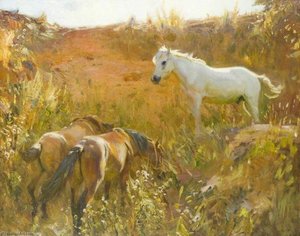
The painting "Up to His Knees" by Alfred William Strutt is a masterpiece that embodies the essence of natural beauty and tranquility. This stunning oil on canvas piece, measuring 25 x 34 cm, is currently housed at the Nuneaton Museum And Art Gallery in the United Kingdom.
The painting's serene atmosphere and intricate details make it a standout piece in the world of art, and its availability as a handmade oil painting reproduction on https://TopImpressionists.com makes it accessible to art lovers everywhere.
A Glimpse into the Painting's Details
The painting depicts a majestic brown horse standing in a lush green field, surrounded by vibrant flowers. The horse is positioned near the center of the scene, with several other horses visible in the background, creating a sense of depth and perspective. The overall atmosphere of the painting exudes a sense of peace and freedom, inviting the viewer to step into the serene world of Alfred William Strutt.Exploring the Artist's Style
Alfred William Strutt was a renowned artist known for his exceptional skill in capturing the beauty of nature. His paintings often featured animals, landscapes, and rural scenes, showcasing his ability to convey emotion and atmosphere through his brushstrokes. "Up to His Knees" is a testament to his talent, with the intricate details and textures of the horse's coat and the surrounding environment demonstrating his mastery of oil painting.- View more artworks by Alfred William Strutt on https://TopImpressionists.com/@/Alfred-William-Strutt
- Discover other beautiful paintings, such as Vasily Dmitrievich Polenov's "Sea of Galilee" on /art/list/?Filter=8XZ4E5-Vasily-Dmitrievich-Polenov-Sea-of-Galilee
- Learn more about the Nuneaton Museum And Art Gallery and its collection on https://TopImpressionists.com
The painting's serene atmosphere and intricate details make it a standout piece in the world of art, and its availability as a handmade oil painting reproduction on https://TopImpressionists.com makes it accessible to art lovers everywhere.
Kérdések és válaszok
„Up to His Knees”, Alfred William Strutt alkotása erős kontrasztokat vagy lágy harmóniákat használ?
A „Up to His Knees”, Alfred William Strutt alkotása színelemzése Gentle kontrasztot és Strong Color Unity harmóniát mutat be.
Hogyan tekinthetem meg előre a(z) „Up to His Knees”, Alfred William Strutt alkotása reprodukcióját?
A „Up to His Knees” Előnézet oldalán megtekintheti a művészeti alkotást megrendelés előtt.
Megtekinthetem a "Up to His Knees" alkotást részletesebben?
A „Up to His Knees”, Alfred William Strutt alkotása X-ray felvétel oldala egy interaktív nézegető, amely lehetővé teszi a mű alkotásának eleven optikai rétegei közötti görgetést, beleértve az röntgenszerű felvételt is.
Quick facts and art quiz
About Alfred William Strutt

A művész életrajza
The Intersection of Precision and Poetic Vision
Alfred William Strutt (1856–1924) remains a captivating figure in the tapestry of British art, representing a unique moment where the meticulous rigor of scientific observation met the sweeping emotionality of the Victorian era. Born in New Zealand to the visionary William Thomas Strutt—a man whose innovations in iron framing would forever alter the landscape of architecture—Alfred was raised in an environment where craftsmanship and structural integrity were paramount. This early exposure to the principles of engineering and fine detail instilled in him a profound respect for the physical world, a quality that would later define his artistic signature. His upbringing allowed him to bridge the gap between the burgeoning scientific inquiries of the late 19th century and the established traditions of Romanticism.
His formative years, spent navigating the intellectual corridors of Chelmsford and Cambridge, provided the academic foundation necessary for his multifaceted career. Under the guidance of his father and through his association with the rigorous atmosphere of Trinity College, Strutt developed a worldview that saw no conflict between the analytical eye and the creative spirit. His early training in engraving and drawing, influenced by the historical documentation styles of Joseph Strutt, taught him the importance of precision. This technical mastery allowed him to move seamlessly between genres, from the delicate, intimate textures of portraiture to the expansive, atmospheric grandeur of landscape painting.
A Mastery of Light, Texture, and Narrative
Strutt’s body of work is characterized by an extraordinary ability to capture both the tangible weight of the material world and the ephemeral nature of light. In his more intimate works, such as Young woman holding a book, he demonstrates a profound sensitivity to the Victorian soul. Through the careful rendering of heavy silk, ornate fabrics, and the soft luminosity of skin, he invites the viewer into a private moment of contemplation. Here, the subject is not merely a figure in a frame but a vessel for themes of literacy, interiority, and the quiet dignity of intellectual life. The book itself serves as a powerful symbol, acting as a bridge between the external social reality and the boundless reaches of the human imagination.
When his gaze turned toward the natural world or historical epic, Strutt’s technique expanded to embrace the dramatic influences of masters like Turner and Constable. His landscapes often possess a rhythmic vitality, where the interplay of light and shadow creates a sense of living breath within the canvas. Whether depicting the serene biblical narratives of Jerusalem Pilgrims or the rugged, untamed beauty found in scenes like Up to His Knees, his brushwork remains remarkably controlled yet emotionally resonant. He possessed a rare talent for utilizing warm tones and detailed compositions to evoke a sense of nostalgia and reverence, making his historical scenes feel less like distant memories and more like present, breathing realities.
Legacy of an Observational Pioneer
The significance of Alfred William Strutt lies in his refusal to separate the observer from the creator. While many of his contemporaries were moving toward purely abstract or impressionistic expressions, Strutt maintained a commitment to the "modern observation" of reality—a belief that true art must be rooted in an accurate understanding of form and structure. This commitment was perhaps most visible in his fascination with the structural revolutions of his time; just as his father utilized iron to redefine safety and aesthetics in architecture, Alfred used the structural elements of composition to reinforce the emotional impact of his subjects.
His contributions to the art world are marked by several enduring achievements:
- Technical Versatility: The seamless transition between the minute details of portraiture and the large-scale drama of historical and landscape painting.
- Symbolic Depth: The integration of contemporary Victorian values, such as the importance of literature and education, into fine art compositions.
- Historical Synthesis: A unique ability to blend the Romantic tradition with a burgeoning scientific interest in the natural world's mechanics.
Today, Strutt’s work serves as a vital historical record, capturing the aesthetic transitions of a century in flux. His paintings remain much more than mere depictions; they are windows into an era that sought to find harmony between the progress of industry and the enduring beauty of the natural and human spirit.
Quick facts about Alfred William Strutt
- Artistic Movement Or Style: Victorian Painting
- Artists Or Movements Influenced By This Artist: ['Royal Academy']
- Artists Who Influenced This Artist: ['William Wynne Ryland']
- Date Of Birth: July 3, 1825
- Date Of Death: January 3, 1915
- Full Name: Alfred William Strutt
- Nationality: British
- Notable Artworks:
- The Old Cottage
- Horses
- Place Of Birth: Teignmouth, Devonshire




Alfred William Strutt
Up to His Knees
() ·
With its frame: · Hand-painted in oil on linen
Total