

Shown: · With its frame:
 Megtekintés
 Küldés
 Megosztás
 Részletek
 Útmutató

 Letöltés
 Hasonló darabok
 X-ray felvétel
 Diavetítés
 Q&A
Q&A Statisztika
Ft 88102
Kézzel készített olajfestmény reprodukció
Kézzel festett olajvastú vászon, az Ön által választott méretben és keretben, művészeink készítik meglévőre. ( Váltás nyomtatványra Áttérés digitális képre)
Size
·Standard méret
egyedi méretű
CM
INCH
Válasszon előre meghatározott méreteink közül, amelyek megfelelnek a műalkotás eredeti arányainak.
Loading sizes...

szélesség
magasság
Írja be a kívánt szélességet és magasságot, hogy illeszkedjen a keretéhez vagy a falához. Mivel ez kézzel festett alkotás, egy eltérő formájú méret esetén a művész akár festhet is valamivel többet a kép körül, vagy korolathat is belőle — az Ön döntésének megfelelően. A festés megkezdése előtt küldünk egy digitális tervezetet jóváhagyásra. Az oldalon látható kép nem tartalmazza a végeredményt — csak a tervezet mutatja meg a valódi eredményt.
 További információk
Finish
·
White Ft1

Blurside Ft1

Extended Ft1

P118B Ft10

P118H Ft10

P118W Ft10

P438Z Ft10

P508JH Ft12

P508YH Ft12

P805H Ft10

P805Z Ft10

P919BZ Ft10

P919G Ft10

P919XJ Ft10

P959ZH Ft10

P968JZ Ft12

W106C Ft8

W218G Ft10

W218JH Ft8

W218Y Ft10

W307PJ Ft10

W316G Ft10

W316PJ Ft8

W316Y Ft10

W398PJ Ft8

W4111J Ft10

W500HY Ft15

W500JH Ft15

W692G Ft12

W849H Ft8

W940BG Ft15

W953PJ Ft8

H24-GOLD Ft30

H24-SILVER Ft30

H36-GOLD Ft45

H36-SILVER Ft45
Shipped in a protective tube, ready for your own framer.
Above 105 cm the frame is shipped as a kit for a professional framer — read the details.
Extras
optionalWhat do the extras include?
Examples of what can be changed: Replace face with customer photo; Add pet (e.g., replace cat with dog); Include hidden message in background; Change background landscape or elements.
After order, TopImpressionists.com team will email client for instructions and provide a mockup preview
After order, TopImpressionists.com team will email client for instructions and provide a mockup preview
Világszerte elérhető szállítás () 3-4 hét alatt a szokásos 5 hét helyett. (2 november). A minőség nem kérdőjelezhető.
Védőréteg (Lakk)
Névtábla
A gravírozott bronztábla részletei
This elegant plaque features the artist's name and the title of the artwork, finely engraved for a timeless presentation.
It is made from bronze with a refined, elegant finish. The text is precisely laser-engraved for a sharp and permanent result. Measuring 9x2 cm, the plaque is compact yet easy to read. It's built to be durable and scratch-resistant, offering a professional, museum-quality look. Mounting is simple thanks to the included adhesive backing.
Átlátszó akril tábla részletei
The plaque includes essential engraved details such as the artist's name, the title of the artwork, the date it was created, the type of media used-like oil on canvas or watercolor-a brief description of the piece, and a QR code that links to the complete artwork information.
It is crafted from clear acrylic, offering a sleek, modern appearance. The text is UV-engraved in black to ensure strong visual contrast. With a size of 10x15 cm, it ensures optimal readability. It comes equipped with two metal hooks for secure wall mounting. The plaque is designed to be weather-resistant, making it suitable for various environments, and it includes interactive features that work seamlessly with smartphone scanning.
Fekete akril tábla részletei
This elegant plaque includes engraved information such as the artist's name, the title of the artwork, the date it was created, the type of media used (like oil on canvas or watercolor), a short description of the artwork, and a QR code for quick access to more information.
The plaque itself is made from refined black acrylic with a premium finish. The text is laser-engraved in white for high contrast and readability. Its size is 10x15 cm, designed to be easy to read. It comes with two metal hooks for professional mounting. The design is sleek and fits any interior style. It is also weather-resistant and durable, with built-in digital integration for mobile compatibility.
Az üvegkeretes opció csak 110 cm alatti méretben érhető el
 Az üvegkeretes opció csak 110 cm alatti méretben érhető el
- Ingyenes globális expressz szállítás
- Prémium minőségű len vászon
- Teljes körű szállítási biztosítás
- Vámvisszatérítési Garancia
- Hiteles színarányosság garancia
- 100 napos visszaküldési lehetőség (csak hibás termékek esetén)
- 100% pénzvisszatérítési garancia
- Több darab vásárlásakor kedvezmény


A gyűjtemény leírása
A művész életrajza
Fedezze fel Daubigny Charles-François (1817-1878) munkáit! A barbizoni iskola egyik kiemelkedő képzőművésze, a természet atmoszférájának mesterségesítése és az impresszionizmus előfutára. Nézze meg itt a lenyűgöző tájképeket!
About the painting
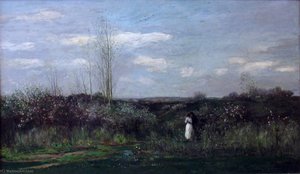
The Spring Landscape painting by Charles-François Daubigny is a beautiful representation of a woman walking through a field with trees in the background. Created in 1862, this artwork showcases the artist's unique style and technique. As a leading online platform specializing in handmade oil paintings reproductions and print on canvas of famous artwork, https://TopImpressionists.com offers a wide range of oil painting reproductions, including the works of Charles-François Daubigny.
The Alte Nationalgalerie, where the painting is housed, is a prominent art museum located in Berlin, Germany. It is part of the Staatliche Museen zu Berlin (National Museums in Berlin) and houses an extensive collection of European art from the 13th to the 20th centuries.
For more information on Charles-François Daubigny and his works, visit https://TopImpressionists.com. You can also explore the Nationalgalerie collection and learn more about the Barbizon School and Impressionism.
The Artist and His Style
Charles-François Daubigny was a French painter, representative of the Barbizon School, and an important precursor of Impressionism. His early traditional style changed when he met Camille Corot in 1852. He came under the influence of Gustave Courbet from 1852 onward. Daubigny for his part influenced Claude Monet, who he got to know in 1866 when he visited England.The Painting
The Spring Landscape painting is a stunning example of the artist's ability to capture the essence of nature. The woman walking through the field, surrounded by trees and a beautiful sky, creates a sense of serenity and peace. The painting measures 133 x 240 cm and is made with oil on canvas, giving it a vibrant and eye-catching appearance.The Alte Nationalgalerie, where the painting is housed, is a prominent art museum located in Berlin, Germany. It is part of the Staatliche Museen zu Berlin (National Museums in Berlin) and houses an extensive collection of European art from the 13th to the 20th centuries.
For more information on Charles-François Daubigny and his works, visit https://TopImpressionists.com. You can also explore the Nationalgalerie collection and learn more about the Barbizon School and Impressionism.
- View Charles-François Daubigny paintings on /art/list/?Filter=charles+fran%C3%A7ois+daubigny,charles,daubigny&
- Learn more about the Nationalgalerie on /art/list/?Filter=A@D3AMAR-The-Nationalgalerie-of-Berlin-Germany:-A-Comprehensive-Guide
Kérdések és válaszok
Ki készítette a(t) "Spring Landscape"-t, és melyik évben?
A "Spring Landscape" alkotója Daubigny Charles-François, a mű pedig 1862 származik.
Hol találhatok egy útmutatót a(z) "Spring Landscape" alkotáshoz?
A "Spring Landscape" útmutatója a mű Útmutató oldala – egy kinyomtatható adatlap, amely bemutatja a művet a leírással, a szerzői megjegyzéssel és az azonosító táblázattal (művész, dátumok, technika, eredeti méret, gyűjtemény) együtt.
Megtekinthető „Spring Landscape”, Daubigny Charles-François alkotása a saját falamon vásárlás előtt?
A „Spring Landscape”, Daubigny Charles-François alkotása Kiterjesztett valóság előnézet oldala kiterjesztett valóságot használ, hogy az alkotást egy kompatibilis eszközön, az Ön saját környezetében is megmutassa.
Quick facts and art quiz
About Daubigny Charles-François

Daubigny Charles-François
1817 - 1878, Franciaország
A művész életrajza
A Pioneer of Atmospheric Impressionism: The Life and Art of Charles-François Daubigny
Charles-François Daubigny, born in Paris in 1817, emerged from a family deeply rooted in artistic tradition—his father, Edmé François Daubigny, and uncle, Pierre Daubigny, both painters – laying the groundwork for his early training. However, young Charles quickly sought to forge his own distinct path, moving beyond the constraints of academic painting towards a more direct engagement with the natural world. His initial studies under Paul Delaroche provided him with valuable technical skills, yet it was a journey through Italy in 1836, undertaken independently with fellow artist Henri Mignan, that truly ignited his artistic vision. This transformative experience instilled within him an unparalleled appreciation for landscape and a profound desire to capture its essence not as idealized scenery, but as a vibrant, living entity – constantly shifting and imbued with atmosphere. Returning to Paris, Daubigny skillfully balanced commercial commissions—illustrating books and adorning decorative panels—with his burgeoning passion for *plein air* painting, a practice that would ultimately define his entire career and establish him as a pivotal figure in the transition between Realism and Impressionism. He became an integral part of a thriving artistic community centered at the Rue des Amandiers-Popincourt, fostering collaboration and shared exploration of innovative approaches to art – a space where experimentation and the pursuit of new visual languages flourished.The Barbizon Circle and the Embrace of Nature
Daubigny’s artistic trajectory took a decisive turn in 1843 when he settled in Barbizon, a small, idyllic hamlet nestled within the heart of the Forest of Fontainebleau. This marked his formal association with the Barbizon School, a collective of artists who deliberately rejected the polished artifice and meticulous detail characteristic of academic painting, instead embracing direct observation and an honest representation of rural life and the surrounding landscape. Unlike earlier landscape painters who often sketched outdoors before completing their works in the studio, the Barbizon artists – including the esteemed Théodore Rousseau, Jean-François Millet, and Camille Corot – championed *en plein air* painting as a fundamental principle, believing that capturing the immediacy of nature was paramount to artistic truth. Daubigny’s friendship with Corot proved particularly influential; together they embarked on countless expeditions into the depths of the Fontainebleau forest, meticulously documenting the subtle nuances of light, shadow, and atmosphere – creating paintings that felt remarkably alive. This shared exploration fostered a unique approach to landscape painting, characterized by loose brushstrokes, muted colors, and an emphasis on capturing the fleeting effects of weather and time. Daubigny’s innovative spirit extended beyond mere observation; he conceived of a mobile studio—a small boat affectionately known as “Le botin”—which he used to navigate the rivers of France – primarily the Seine and the Oise – allowing him unparalleled access to diverse landscapes and fostering an intimate, almost visceral connection with nature. This unconventional working method became inextricably linked to his artistic identity, symbolizing his commitment to painting directly from life and experiencing the world in its purest form.A Bridge Between Realism and Impressionism
Daubigny’s work occupies a uniquely significant position within 19th-century art history – serving as a crucial bridge between the realism of the Barbizon School and the nascent movement that would come to be known as Impressionism. While firmly rooted in the Barbizon tradition's dedication to depicting nature with meticulous accuracy and sincerity, his paintings increasingly incorporated elements that foreshadowed the radical innovations of Monet, Renoir, and their contemporaries – a shift towards capturing fleeting moments of light, subjective perception, and atmospheric effects. He experimented boldly with techniques such as *cliché verre*—a process combining photography and printmaking—demonstrating an openness to embracing new technologies and artistic possibilities. This willingness to push boundaries is evident in his paintings, which are characterized by broad, loose brushstrokes, a restrained palette, and a deliberate focus on evoking mood and atmosphere – transporting the viewer into the very heart of the French countryside. Paintings such as “Harvest” (1857) and “The Ponds of Gylieu” (1864) exemplify his remarkable ability to capture not just what he saw, but *how* it felt to be present in that moment – a testament to his artistic sensitivity and profound understanding of light and color.Notable Achievements and Legacy
Charles-François Daubigny’s career spanned several decades, during which he produced a substantial body of work that garnered both critical acclaim and considerable commercial success. He gained particular recognition as a painter of the natural world in 1858, the year he exhibited at the Universal Exposition in Paris – an event that brought him widespread attention and solidified his reputation within the art community. Later, in 1862, he published two albums of etchings, establishing his mastery of printmaking alongside his painting skills. He was honored with a knighthood in the Legion of Honor in 1874, recognizing his contributions to French culture. Daubigny’s influence extended far beyond his immediate circle of students – including his son Karl, Achille Oudinot, and Hippolyte Camille Delpy – inspiring generations of landscape painters to embrace *plein air* painting and explore the expressive potential of light and atmosphere. He is remembered not only for his individual artistic achievements but also for his role in fostering connections between the Barbizon School and the burgeoning Impressionist movement, introducing artists like Monet and Cézanne to new ways of seeing and painting. His paintings are now held in prestigious museums worldwide – including the Musée d'Orsay in Paris and the Cincinnati Art Museum – serving as enduring testaments to his lasting contribution to the history of art. Daubigny remains a pivotal figure—a master of atmospheric realism who anticipated the arrival of Impressionism and helped shape the course of modern painting, leaving behind a legacy that continues to inspire artists today.Notable Works
- Harvest (1857): A quintessential example of Daubigny’s ability to capture rural life and atmosphere, now housed in the Musée d'Orsay.
- The Ponds of Gylieu (1864): Demonstrates his mastery of landscape painting and atmospheric perspective, currently at the Cincinnati Art Museum.
- Moonlight (1865): Showcases Daubigny’s skill in rendering nocturnal scenes with subtle light effects.
- Auvers-sur-Oise (1868): A captivating depiction of the French countryside, reflecting his deep connection to the region.
- Seascape (1876): An impressionistic depiction of waves and coastal beauty.
Quick facts about Daubigny Charles-François
- Artistic Movement Or Style: Barbizoni iskola, impresszionizmus
- Artists Or Movements Influenced By This Artist:
- Impressionizmus
- Monet
- Artists Who Influenced This Artist:
- Corot
- Courbet
- Date Of Birth: 1817. Feb 15.
- Date Of Death: 1878. Feb 19.
- Full Name: Charles-François Daubigny
- Nationality: Francia
- Notable Artworks:
- Színes szálók (1857)
- Gylieu tója (1864)
- Holdfény (1865)
- Place Of Birth: Párizs, Francia
Fedezze fel a műalkotásokat témák, stílusok és jellemzők szerint csoportosítva.


Daubigny Charles-François
Spring Landscape
() ·
With its frame: · Hand-painted in oil on linen
Total