

Shown: · With its frame:
 Megtekintés
 Küldés
 Megosztás
 Részletek
 Útmutató

 Letöltés
 Hasonló darabok
 X-ray felvétel
 Diavetítés
 Q&A
Q&A Statisztika
 Acrylic On Canvas
- WallArt
- Early Renaissance
 1268
1268- Renaissance
 45.0 x 28.0 cm
 San Domenico
Ft 96129
Kézzel készített olajfestmény reprodukció
Kézzel festett olajvastú vászon, az Ön által választott méretben és keretben, művészeink készítik meglévőre. ( Váltás nyomtatványra Áttérés digitális képre)
Size
·Standard méret
egyedi méretű
CM
INCH
Válasszon előre meghatározott méreteink közül, amelyek megfelelnek a műalkotás eredeti arányainak.
Loading sizes...

szélesség
magasság
Írja be a kívánt szélességet és magasságot, hogy illeszkedjen a keretéhez vagy a falához. Mivel ez kézzel festett alkotás, egy eltérő formájú méret esetén a művész akár festhet is valamivel többet a kép körül, vagy korolathat is belőle — az Ön döntésének megfelelően. A festés megkezdése előtt küldünk egy digitális tervezetet jóváhagyásra. Az oldalon látható kép nem tartalmazza a végeredményt — csak a tervezet mutatja meg a valódi eredményt.
 További információk
Finish
·
White Ft1

Blurside Ft1

Extended Ft1

P118B Ft10

P118H Ft10

P118W Ft10

P438Z Ft10

P508JH Ft12

P508YH Ft12

P805H Ft10

P805Z Ft10

P919BZ Ft10

P919G Ft10

P919XJ Ft10

P959ZH Ft10

P968JZ Ft12

W106C Ft8

W218G Ft10

W218JH Ft8

W218Y Ft10

W307PJ Ft10

W316G Ft10

W316PJ Ft8

W316Y Ft10

W398PJ Ft8

W4111J Ft10

W500HY Ft15

W500JH Ft15

W692G Ft12

W849H Ft8

W940BG Ft15

W953PJ Ft8

H24-GOLD Ft30

H24-SILVER Ft30

H36-GOLD Ft45

H36-SILVER Ft45
Shipped in a protective tube, ready for your own framer.
Above 105 cm the frame is shipped as a kit for a professional framer — read the details.
Extras
optionalWhat do the extras include?
Examples of what can be changed: Replace face with customer photo; Add pet (e.g., replace cat with dog); Include hidden message in background; Change background landscape or elements.
After order, TopImpressionists.com team will email client for instructions and provide a mockup preview
After order, TopImpressionists.com team will email client for instructions and provide a mockup preview
Világszerte elérhető szállítás () 3-4 hét alatt a szokásos 5 hét helyett. (31 október). A minőség nem kérdőjelezhető.
Védőréteg (Lakk)
Névtábla
A gravírozott bronztábla részletei
This elegant plaque features the artist's name and the title of the artwork, finely engraved for a timeless presentation.
It is made from bronze with a refined, elegant finish. The text is precisely laser-engraved for a sharp and permanent result. Measuring 9x2 cm, the plaque is compact yet easy to read. It's built to be durable and scratch-resistant, offering a professional, museum-quality look. Mounting is simple thanks to the included adhesive backing.
Átlátszó akril tábla részletei
The plaque includes essential engraved details such as the artist's name, the title of the artwork, the date it was created, the type of media used-like oil on canvas or watercolor-a brief description of the piece, and a QR code that links to the complete artwork information.
It is crafted from clear acrylic, offering a sleek, modern appearance. The text is UV-engraved in black to ensure strong visual contrast. With a size of 10x15 cm, it ensures optimal readability. It comes equipped with two metal hooks for secure wall mounting. The plaque is designed to be weather-resistant, making it suitable for various environments, and it includes interactive features that work seamlessly with smartphone scanning.
Fekete akril tábla részletei
This elegant plaque includes engraved information such as the artist's name, the title of the artwork, the date it was created, the type of media used (like oil on canvas or watercolor), a short description of the artwork, and a QR code for quick access to more information.
The plaque itself is made from refined black acrylic with a premium finish. The text is laser-engraved in white for high contrast and readability. Its size is 10x15 cm, designed to be easy to read. It comes with two metal hooks for professional mounting. The design is sleek and fits any interior style. It is also weather-resistant and durable, with built-in digital integration for mobile compatibility.
Az üvegkeretes opció csak 110 cm alatti méretben érhető el
 Az üvegkeretes opció csak 110 cm alatti méretben érhető el
- Ingyenes globális expressz szállítás
- Prémium minőségű len vászon
- Teljes körű szállítási biztosítás
- Vámvisszatérítési Garancia
- Hiteles színarányosság garancia
- 100 napos visszaküldési lehetőség (csak hibás termékek esetén)
- 100% pénzvisszatérítési garancia
- Több darab vásárlásakor kedvezmény


A gyűjtemény leírása
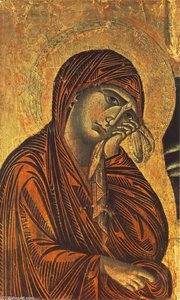
Explore Cimabue’s ‘Crucifix (detail)’ – a poignant 1268 panel painting showcasing early Renaissance emotion & technique. Discover its layered impasto, halo effect, and profound sorrow.
A művész életrajza
Cimabue (1240-1302): A korai reneszánsz úttörője! Bizánci és olasz stílusa, realista figurái, és hatása Giotto-ra. Fedezze fel a mesteri alkotásait!
About the painting
A Glimpse into Divine Sorrow: Cimabue’s *Crucifix (detail)*
This exquisite detail from Cimabue's larger *Crucifix* (circa 1268) offers a profoundly moving encounter with the Virgin Mary and infant Jesus. Painted during a pivotal moment in art history, this work transcends mere religious iconography to become a powerful expression of maternal grief and spiritual contemplation. It’s a piece that resonates across centuries, offering both artistic beauty and emotional depth.Historical Context & Artistic Transition
Cimabue – or *Cenni di Pepo* as he was known – stands at the cusp of the Italian Renaissance. He was one of the first artists to actively move away from the rigid conventions of the Italo-Byzantine style, which had dominated Italian painting for generations. While still exhibiting elements of Byzantine formality—note the gold halo and stylized drapery—Cimabue infused his work with a nascent naturalism. This is visible in the attempt to render more lifelike proportions and introduce subtle shading, paving the way for artists like Giotto, who would fully embrace Renaissance ideals. The artwork originates from Florence, Italy, a city rapidly becoming a center of artistic innovation. Originally created for the church of San Francesco in Pisa, it now resides at the Barts Hospital in London.Subject & Symbolism
The detail focuses intensely on the Madonna and Child. Mary cradles the infant Jesus, her expression one of profound sorrow and premonition. This isn’t a joyful depiction of motherhood; rather, it foreshadows the suffering to come – Christ's Passion and crucifixion. Key symbolic elements amplify this emotional weight:- The veil draped over Mary’s head signifies her purity and modesty, traditional attributes associated with the Virgin.
- Her downcast gaze is a powerful visual cue of grief, sorrow, and acceptance of her son's destiny.
- The gold halo surrounding both figures denotes their holiness and divine status.
Technique & Materials
Cimabue masterfully employed tempera paint on a gesso-prepared wood panel. This technique, common in the period, involved layering pigments mixed with egg yolk to create luminous colors. The artist’s skillful use of impasto – applying thick layers of paint – is particularly evident in the folds of Mary's cloak and her skin tones, adding a tactile quality and enhancing the sense of volume. Despite its age, the artwork retains a remarkable vibrancy thanks to the enduring qualities of tempera and the inclusion of gold leaf for highlights. The shallow perspective and limited atmospheric depth are characteristic of panel painting from this era.Emotional Impact & Aesthetic Qualities
The overall effect is one of solemnity, piety, and profound emotional resonance. Cimabue doesn’t simply depict a religious scene; he invites the viewer to share in Mary's sorrow and contemplate the weight of faith and sacrifice. The warm earthy tones – ochre, terracotta, and gold – create a rich, aged aesthetic that evokes a sense of timelessness. While not striving for photorealistic detail, Cimabue’s stylized approach imbues the figures with a dignified grace and emotional power. This *Crucifix (detail)* is more than just an artwork; it's a window into the spiritual world of medieval Italy and a testament to the enduring power of human emotion. It would be a stunning focal point in any collection, adding depth and historical significance to both classic and contemporary interiors.Kérdések és válaszok
Milyen fényerő ébreszt fel „Crucifix (detail)”, Cimabue alkotása alkotást?
Összességében a "Crucifix (detail)" alkotás balanced fényerőséget mutat. A tapasztalt fényerő azt írja le, hogy a mű mennyire tűnik világosnak vagy sötétnek.
Hol találhatók statisztikák a(z) „Crucifix (detail)”, Cimabue alkotása kapcsán?
A „Crucifix (detail)”, Cimabue alkotása Statisztikák oldala a nyilvános látogatási statisztikákat mutatja be: az alkotás havi látogatottságát, összehasonlításban a művész legnézettebb alkotásaival, valamint a látogatók származási helyét.
Melyik szín tűnik ki leginkább a(z) "Crucifix (detail)" alkotásból?
A(z) Clay (#a8713a) a(z) „Crucifix (detail)”, Cimabue alkotása domináns színe.
Quick facts and art quiz
About Cimabue

Cimabue
1240 - 1302, Olaszország
A művész életrajza
The Florentine Dawn: Cimabue and the Transition from Byzantium
Giovanni Cimabue, született Cenni di Pepo körülbelül 1240-ben Firenze városban, egy monumentális alak – egy olyan híd, amely a bizantine világ megállapított művészi hagyománya és az olasz reneszánsza felbontó innovációi között. Élete, bár részletesen nem dokumentált, és romantizált leírások alapján íródott – elsősorban Giorgio Vasari szájából származóak évszázadokkal később –, egy vitatható fordulatot jelent a nyugati művészettörténetben. Cimabue nem csupán festő volt; ő egy merészes innovátor, aki bátran kihívta a művészi konvenciókat, megalapozva a hamarosan olaszországot átható forradalmi változásokat. Sőt, álneve is – melynek jelentése “oroszlánfejű” – utal egy erős akaratra és talán rebbelességi szellemiségre – tulajdonságokra, amelyek nyilvánvalóan jelen voltak a formák és kifejezések kísérletezésére való hajlandóságában. Ő egy kulcsfontosságú pillanatot jelöl meg, ahol az művészet nem csupán vallási képi ábrázolás volt, hanem valami emberközeli és érzelmileg gazdagabb lett.Korai befolyások és művészi fejlődés
A bizantine stílusba, amely Firenze-ben uralkodott, Cimabue korai munkái szorosan követették a megállapított esztétikai elveket: lapos alakok csillogó aranyozással, szimbolikus helyett realisztikus ábrázolások térrel kapcsolatban és mély vallási ikonográfia fókuszában. Azonban ezek a korlátok között is egy gyöngyvesszű vágy mutatkozott meg a naturalizmus felé. Nem volt hajlandó csupán megragamizni létező formákat; inkább arra törekedett, hogy a festményeihez nagyobb életet és érzelmi mélységet adjon. Bár a pontos korai képzése még mindig vitatott, valószínűleg a florentini műhelyekben fejtette ki készségeit, elnyelve az időszak technikáit és befolyásait, miközben egyedi művészi hangját is fejlesztette. A bizantine stílus, amely formális volt és spirituális fókuszú, biztosította számára egy szilárd alapot, de Cimabue elkezdte finoman bevezetni olyan elemeket, amelyek a reneszánsza előfutamait vetítik előre – nagyobb figyelmet fordított a térségre, kifejezőbb arckifejezésekre és a térrel kapcsolatos kapcsolatok elsődleges megértésére. Ez nem egy hirtelen szakítás a hagyománnyal volt, hanem fokozatos fejlődés, egy finom egyensúly az elmúlt hagyományok tiszteletadásával és új lehetőségek felé való hajlandóssággal.Fontos művek és művészi innovációk
Cimabue öröksége a mesteri alkotások sorában gyökerezik, amelyek bemutatják fejlődő stílusát. A *Maestà* (Louvre), amely eredetileg Pisa városban található S. Francesco templom apszisához készült, egyike legkiemelkedőbb művei közül. Ez a monumentális altárpapír példája a mester képességének és a szín használatának, miközben finoman kihívja a bizantine konvenciókat. Az alakok még rendelkeznek bizonyos formális megjelenéssel, de újfajta testtömeggel és jelenlétükkel rendelkeznek – egyértelműen eltérve az korábbi vallási képi ábrázolásoktól. A *Crucifixion* (San Domenico, Arezzo), körülbelül 1270-ben készülő alkotás különösen jelentős, mert a bizantine normákhoz való elállását mutatja be. Itt a proporciók realistábbak, és a jelenet érzelmi súlya érezhető – egyértelműen ellentétes az korábbi vallási művekkel. Cimabue innovációinak bizonyítékát láthatjuk a *Flagellation of Christ* (Frick Collection) című alkotásában is, amely workshop-jának munkája. Ez a bonyolult kompozíció elsődleges megértést mutat be a térrel és a térrel kapcsolatos kapcsolatokról.Egy kulcsfontosságú tanár: Giotto és tovább
Talán Cimabue legmaradandóbb öröksége pedig a Giotto di Bondone tanításaiban rejlik. Bár történelmi leírások eltérőek, általánosan elfogadott, hogy Giotto kapta fontos képzéseit Cimabue irányításával. Azonban Giotto végül felülmúlt mestert, forradalmi módon ábrázolva az olasz művészetet a naturalizmus és az érzelmi realizmus nagyobb hangsúlyozásával. A két személy közötti dinamika egyértelműen mutatja a mester és a tanítvány közötti kölcsönhatást – egy játékos vetélkedést, amely mindkét művészt magasabb szintekre vitte. Cimabue hatása nem korlátozódott Giottora; befolyásolta más művészeket is az időszakban. Ő kihívta a művészeti hagyományok normáit, bizonyítva, hogy a művészet nem csupán vallási szimbólum lehet; hanem tükrözhet emberi érzelmeket és tapasztalatokat is. A formák, a proporciók és a kifejezések kísérletezése lehetővé tette számára, hogy új utakat nyithasson a nyugati művészet történetében.Történelmi jelentőség
Cimabue 1302-ben halt meg Pisában, laissant behind a body of work that continues to captivate and inspire. Despite his significant contributions, details surrounding his later life remain scarce. However, his artistic legacy resonates powerfully through the works of his students and the evolution of Italian art. He represents a crucial step in the development of Western painting, moving away from the stylized conventions of the Byzantine era towards a more humanistic and naturalistic approach. His paintings are not merely historical artifacts; they are windows into a pivotal moment in artistic history—a time when artists began to question established norms and explore new possibilities. He was a pioneer, a visionary who dared to challenge the status quo and lay the foundations for the artistic brilliance that would define the Renaissance.Quick facts about Cimabue
- Artistic Movement Or Style: Bizánci és reneszánszi
- Artists Or Movements Influenced By This Artist: ['Giotto di Bondone']
- Artists Who Influenced This Artist:
- Coppo di Marcovaldo
- Giunta Pisano
- Date Of Birth: c. 1240
- Date Of Death: 1302
- Full Name: Giovanni Cimabue
- Nationality: Olasz
- Notable Artworks:
- Maestà
- Keresztmetsés
- Krisztus megvesztegetése
- Place Of Birth: Firenze, Olaszország
Fedezze fel a műalkotásokat témák, stílusok és jellemzők szerint csoportosítva.


Cimabue
Crucifix (detail)
() ·
With its frame: · Hand-painted in oil on linen
Total