


 Előnézet
 Megosztás
 Megosztás
 Részletek
 Útmutató

 Letöltés
 Hasonló darabok
 X-ray felvétel
 Diavetítés
 Statisztika
Autumn
 Oil On Canvas
- WallArt
- Hudson River School
 1875
1875- 19th Century
 39.0 x 61.0 cm
 Thyssen-Bornemisza Múzeum
Experience Frederic Edwin Church’s "Autumn," a breathtaking Luminist masterpiece capturing the sublime beauty of Seneca Lake in 1875. This panoramic river landscape, rich with ochre and azure hues, embodies Victorian contemplation and offers a stunning opportunity to own a piece of Hudson River School history.
 Tovább olvasom
"Hungarian Meta Description": "Frederic Edwin Church (1826-1900) a híres Hudson River School festő, aki lenyűgöző tájakat alkotott, melyek a 19. század amerikai művészetének ikonikus elemei. Kiemelkedett a részletességben és a romantikus hangulatban, a természet szépségét és erejét ábrázolva."
Giclée / Műnyomat
Múzeumi minőségű giclée vagy vászonnyomat, gyors gyártással és rugalmas finomítási lehetőségekkel. ( Kézzel festett másolat vásárlása Áttérés digitális képre)




P118B $10

P118H $10

P118W $10

P438Z $10

P508JH $12

P508YH $12

P805H $10

P805Z $10

P919BZ $10

P919G $10

P919XJ $10

P959ZH $10

P968JZ $12

W106C $8

W218G $10

W218JH $8

W218Y $10

W307PJ $10

W316G $10

W316PJ $8

W316Y $10

W398PJ $8

W4111J $10

W500HY $15

W500JH $15

W692G $12

W849H $8

W940BG $15

W953PJ $8




Standard méret
egyedi
CM
INCH
Válasszon előre meghatározott méreteink közül, amelyek megfelelnek a műalkotás eredeti arányainak.
Loading sizes...

szélesség
magasság
Megadhat saját méreteket is egy konkrét kerethez vagy helyszínhez igazítva. Amennyiben a kiválasztott méret nem egyezik az eredeti kép arányokkal, a műalkotást le fogjuk vágni, vagy kiegészítjük a képet tükrözött vagy egyszínű szélekkel. A gyártás megkezdése előtt egy digitális tervezetet küldünk jóváhagyásra.
Kérjük, vegye figyelembe, hogy a képernyőn látható előnézet nem tükrözi a tényleges levágást vagy kiegészítést. Csak a tervezet mutatja pontosan a végső kompozíciót.
Bár az egyedi méretek is elérhetőek, az eredeti arányok megőrzése érdekében azt javasoljuk, hogy válasszon a előre meghatározott listából származó méretet.
Világszerte történő kiszállítás területére mindössze 2 hét alatt, a szokásos 4-5 hét helyett. (27 szeptember)

Ingyenes globális expressz szállítás

Prémium minőségű len vászon

Teljes körű szállítási biztosítás

Vámvisszatérítési Garancia

Tökéletes színarányosság garancia

100 napos visszaküldési garancia (csak gyártási hibás termékek esetén)

100% pénzvisszatérítési garancia

Több darab vásárlásakor kedvezmény
 Az üvegkeretes opció csak 110 cm alatti méretben érhető el

Autumn
Giclée / Műnyomat
Reprodukció méretei
-


Összesített ár
$ 69
A Symphony in Ochre and Azure: Exploring Frederic Edwin Church’s Autumn
The painting “Autumn,” executed by Frederic Edwin Church in 1875, stands as a testament to the Hudson River School's unwavering devotion to capturing the sublime beauty of the American wilderness. More than just a depiction of a picturesque landscape, it embodies a profound philosophical contemplation on mortality and regeneration—themes deeply rooted in Victorian sensibilities and subtly interwoven into Church’s masterful artistic vision.Subject Matter and Composition
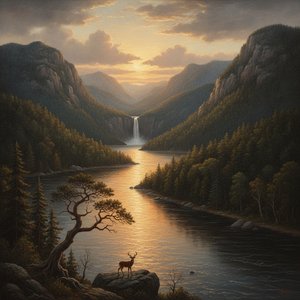
Church meticulously rendered a panoramic vista overlooking Seneca Lake in New York State. Dominating the scene is a majestic river winding its way through a densely populated forest, reflecting the fiery hues of a setting sun. Scattered amongst the trees are prominent rocks and boulders, anchoring the composition and providing textural contrast against the flowing water. Notably, perched atop one of these rocks is a solitary bird—a deliberate inclusion that serves as a poignant symbol of resilience and hope amidst the encroaching darkness of autumn. The artist’s careful attention to detail ensures every element contributes to the overall impression of serene grandeur.Style and Technique: Luminism Elevated
Church's approach aligns perfectly with Luminism, an artistic movement characterized by its emphasis on diffused light and atmospheric perspective—techniques pioneered by Thomas Cole and championed by Church himself. Unlike Impressionists who sought to capture fleeting moments of sensory experience, Church aimed for a more contemplative portrayal of nature’s enduring power. He achieved this through painstaking layering of thin glazes applied over a textured underpainting, meticulously blending colors to create an illusion of depth and luminosity. The resulting surface possesses remarkable brilliance, capturing the ethereal glow of twilight and conveying the palpable warmth of the fading sun.Historical Context: Victorian Romanticism’s Embrace of Nature
“Autumn” emerged during the height of Victorian Romanticism—a period marked by a fervent belief in emotion and imagination as pathways to spiritual understanding. Artists like Church wrestled with existential questions concerning humanity's place within the cosmos, seeking solace and inspiration in the grandeur of God’s creation. The painting reflects this intellectual climate through its symbolic representation of decay followed by rebirth—mirroring the cyclical rhythms of nature and offering a comforting reassurance that beauty persists even amidst inevitable decline. Furthermore, Church’s work coincided with burgeoning scientific interest in geology and botany, influencing his artistic choices and reinforcing his conviction in portraying landscapes accurately while simultaneously conveying their emotional resonance.Symbolism: Light, Darkness, and Renewal
The dominant color palette—ochre yellows and azure blues—is deliberately symbolic. The golden light of the sunset represents divine illumination and signifies the promise of eternal life, countering the encroaching darkness that symbolizes mortality. However, Church doesn’t present darkness as solely negative; rather, it serves as a backdrop against which the bird's presence illuminates the enduring spirit of nature. This juxtaposition underscores the Victorian preoccupation with themes of death and resurrection—a cornerstone of spiritual belief during the era.Emotional Impact: A Balm for the Soul
“Autumn” transcends mere visual representation; it aspires to evoke profound emotional responses in the viewer. The painting’s tranquil atmosphere invites contemplation, prompting reflection on the beauty of impermanence and reaffirming faith in a benevolent Creator. Its luminous quality imbues the scene with warmth and serenity—a comforting reminder that even as seasons change and life diminishes, nature continues its ceaseless cycle of renewal. Collectors and interior designers alike recognize “Autumn”’s enduring appeal precisely because it captures not just a landscape but also an intangible essence of human experience – a timeless meditation on beauty, faith, and the cyclical rhythms of existence.A művész életrajza
A Pioneer of American Landscape: The Life and Art of Frederic Edwin Church
Frederic Edwin Church, born in Hartford, Connecticut, on May 4th, 1826, emerged as a pivotal figure in the blossoming landscape tradition of 19th-century America. His lineage was steeped in New England history—a direct descendant of Puritan pioneers—and his family’s prosperity afforded him opportunities rare for aspiring artists of the time. This financial stability allowed Church to dedicate himself wholeheartedly to his artistic pursuits, a path that would ultimately lead him to become one of the most celebrated and influential painters of the Hudson River School. His early training began at the age of eighteen under the tutelage of Thomas Cole, the very founder of this distinctly American art movement. These formative years spent in Catskill, New York, were crucial, instilling in Church a deep reverence for nature and a commitment to capturing its grandeur on canvas. The apprenticeship wasn’t merely technical; it was an immersion into a philosophy that saw landscape not just as scenery, but as a reflection of the divine and a symbol of national identity.The Rise of a Master: Style and Influences
Church quickly distinguished himself from his contemporaries through a remarkable ability to blend meticulous realism with a romantic sensibility. His paintings are characterized by an astonishing level of detail, capturing the textures of foliage, the play of light on water, and the imposing scale of mountains with breathtaking accuracy. However, this wasn’t simply photographic representation; Church infused his work with a dramatic flair, employing sweeping panoramic views, vibrant color palettes, and a masterful command of atmospheric perspective. He was deeply influenced by the scientific explorations of Alexander von Humboldt, whose writings on the interconnectedness of nature resonated profoundly with the artist. Humboldt's emphasis on experiencing nature firsthand, documenting its intricacies, and conveying its grandeur to others directly inspired Church’s own approach to painting. This influence is evident in Church’s later expeditions to South America and his attempts to convey not just the visual beauty of these landscapes but also their underlying geological and botanical complexities. The Oxbow, completed in 1836, stands as an early testament to this synthesis of observation and imagination—a romantic vision of the American wilderness that would become a hallmark of his style. His technique involved “hidden” brushstrokes, creating smooth surfaces that enhanced the realism and luminosity of his paintings.Ventures into the Wild: Travels and Major Works
Church’s ambition extended beyond the familiar landscapes of New England and New York. Driven by a thirst for firsthand experience and inspired by Humboldt's writings, he embarked on daring expeditions to remote corners of the world. These journeys—to South America in 1853 and 1857, and later to the Arctic regions—provided him with an unparalleled wealth of visual material. The Heart of the Andes, completed in 1859, is perhaps his most ambitious undertaking, a monumental canvas that sought to encapsulate the entire ecosystem of the Andean mountains. The painting was exhibited in a specially constructed gallery, illuminated by skylights, creating an immersive experience for viewers and solidifying Church’s reputation as a master showman as well as an artist. He meticulously documented the flora, fauna, and geological formations he encountered, incorporating these observations into his paintings with remarkable accuracy. His later works, such as *Niagara* (1853), showcased his ability to capture the dramatic interplay of light and water, creating scenes that seemed almost alive. Church’s expeditions weren't merely about documenting landscapes; they were about experiencing them fully—a philosophy reflected in his art.A Unique Exhibition Style: The Single-Painting Show
Church revolutionized the way paintings were presented to the public by pioneering the single-painting exhibition. Rather than displaying works within larger group shows, he meticulously constructed elaborate settings – often incorporating special lighting, exotic plants, and even simulated weather conditions – to create an immersive experience for viewers. This approach, exemplified by his 1859 exhibition of *The Heart of the Andes*, transformed a simple art viewing into a theatrical event. The darkened gallery, filled with lush vegetation and strategically placed skylights, transported spectators to the heart of the Andes Mountains, allowing them to feel as though they were truly present in the scene. This innovative approach not only drew massive crowds but also elevated the status of the individual painting, emphasizing its artistic merit and emotional impact. Church’s success demonstrated a keen understanding of audience psychology and established a new standard for art exhibitions that continues to influence artists today.Legacy and Impact on American Art
Frederic Edwin Church’s influence on American landscape painting is undeniable. He elevated the genre to new heights of artistic achievement and popular acclaim, inspiring generations of artists to explore the beauty and majesty of the natural world. His innovative exhibition practices—presenting single paintings in dramatic settings—set a precedent for future art displays and helped to cultivate a broader public appreciation for art. Beyond his painting, Church was also a dedicated conservationist, advocating for the preservation of Niagara Falls and playing a role in the establishment of national parks. He understood that art could be a powerful tool for raising awareness about environmental issues and inspiring action. His home, Olana, designed and built with his own hands overlooking the Hudson River, stands as a testament to his artistic vision and his deep connection to the landscape.- Church’s work bridged the gap between Romanticism and Realism.
- He pioneered immersive exhibition techniques that captivated audiences.
- His advocacy for conservation foreshadowed the modern environmental movement.

Frederic Edwin Church
1826 - 1900 , Egyesült Államok
Gyors információk
- Artistic Movement Or Style: Hudson River School
- Artists Or Movements Influenced By This Artist: ['Amerikai tájképfestők']
- Artists Who Influenced This Artist:
- Thomas Cole
- Alexander von Humboldt
- Date Of Birth: 1826. május 4.
- Date Of Death: 1900. április 7.
- Full Name: Frederic Edwin Church
- Nationality: Amerikai
- Notable Artworks:
- Niagara
- A Hegyek Szíve
- Place Of Birth: Hartford, USA
Kapcsolódó cikkek

A Hudson River Iskola 10 Mesterműve: Tájképfestészet és Amerika Lelke – TopImpressionists
Fedezze fel a Hudson River Iskola 10 legikonikusabb műalkotását! Frederic Church, Thomas Cole és más amerikai festők romantikus tájképei. Vászonkép másolatok, faliképek otthonába – TopImpressionists.com kínálatából. Explore the full collection online!

Capturing the American Spirit: A Journey Through Iconic Landscapes and the Legacy of the Hudson River School
Explore the profound beauty of American art history. From the Hudson River School to iconic landscapes, discover a curated journey through the masterpieces that defined a nation's spirit and the enduring legacy of American Romanticism.

Robert Spencer: Luminism, Narrative & the American Landscape Tradition
Explore the captivating world of Luminism & the Hudson River School with our expert analysis. Discover the history, artists, and enduring beauty of 19th-century American landscape painting. Find museum-quality reproductions at TopImpressionists.

The Sublime Landscape: Exploring the Hudson River School Movement
Explore the captivating world of the Hudson River School! Discover the history, artists, and defining characteristics of this iconic American art movement. Learn about Romanticism's influence & find inspiration for your collection.
Epic Landscapes & Wild Nature: The Power of the Hudson River School's Sublime Artistry
Explore the breathtaking power of the Hudson River School. Journey through epic American landscapes, from Thomas Cole's sublime vistas to Luminist light, and discover how these timeless masterpieces continue to inspire modern collectors and art lovers worldwide.
Fedezze fel a műalkotásokat témák, stílusok és jellemzők szerint csoportosítva.


