

A képen: · A kerettel együtt:
 Megtekintés
 Küldés
 Megosztás
 Részletek
 Útmutató

 Letöltés
 Hasonló darabok
 X-ray felvétel
 Diavetítés
 Kérdések és válaszok
 Statisztika

Ft 103955
Kézzel készített olajfestmény reprodukció
Kézzel festett olajvastú vászon, az Ön által választott méretben és keretben, művészeink készítik meglévőre. ( Váltás nyomtatványra Áttérés digitális képre)
Ez a műalkotás szerzői jogi védelem alatt áll
Az ezen az oldalon megjelenített műalkotások szerzői jogi védelem alatt állnak, ami azt jelenti, hogy törvényileg nem készíthetünk és nem adhatunk el belőlük pontos másolatokat. Ez a védelem olyan nemzetközi megállapodások alapján érvényesül, mint például a Berni Egyezmény és a nemzeti jogszabályok által, beleértve azokat is, amelyeket meghatározott Az USA szerzői jogi törvénye – 17. cím.
Mint tiszteletes és törvényes alternatívát, olyan egyedi, kézzel festett alkotásokat kínálunk, amelyek az eredetiből merítnek inspirációt. Tapasztalt és professzionális művészeink alaposan tanulmányozzák az eredeti stílusát, hangulatát és művészeti esszenciáját, hogy egy olyan új, egyedi alkotást hozzunk létre, amely ugyanazt az érzést kelti – miközben önálló, eredeti alkotásként létezik.
Ez a módszer teljes mértékben megfelel a szerzői jogi szabályozásnak, mivel nem tartalmazza a védett műalkotás másolását vagy duplikálását. Ehelyett ez egy kreatív újinterpretáció – egy új festmény, amely az eredetivel való összefüggései miatt hatással van rá, de nem az az.
 További információk
Méret
·Standard méret
egyedi méretű
CM
INCH
Válasszon előre meghatározott méreteink közül, amelyek megfelelnek a műalkotás eredeti arányainak.
Méretek betöltése...

szélesség
magasság
Írja be a kívánt szélességet és magasságot, hogy illeszkedjen a keretéhez vagy a falához. Mivel ez kézzel festett alkotás, egy eltérő formájú méret esetén a művész akár festhet is valamivel többet a kép körül, vagy korolathat is belőle — az Ön döntésének megfelelően. A festés megkezdése előtt küldünk egy digitális tervezetet jóváhagyásra. Az oldalon látható kép nem tartalmazza a végeredményt — csak a tervezet mutatja meg a valódi eredményt.
Befejezés
·
Fehér Ft1

Elmosódott szélek Ft1

Kiterjesztett Ft1

P118B Ft10

P118H Ft10

P118W Ft10

P438Z Ft10

P508JH Ft12

P508YH Ft12

P805H Ft10

P805Z Ft10

P919BZ Ft10

P919G Ft10

P919XJ Ft10

P959ZH Ft10

P968JZ Ft12

W106C Ft8

W218G Ft10

W218JH Ft8

W218Y Ft10

W307PJ Ft10

W316G Ft10

W316PJ Ft8

W316Y Ft10

W398PJ Ft8

W4111J Ft10

W500HY Ft15

W500JH Ft15

W692G Ft12

W849H Ft8

W940BG Ft15

W953PJ Ft8

H24-GOLD Ft30

H24-SILVER Ft30

H36-GOLD Ft45

H36-SILVER Ft45
Védődobozban, feltekercselve szállítva, készen a saját keretbe helyezésre.
Extrák
opcionálisMit tartalmaznak a plusz szolgáltatások?
Példák a módosíthatóságra: Az arc kicserélése a vásárló fotójára; háziállat hozzáadása (pl. macska kicserélése kutyára); rejtett üzenet elhelyezése a háttérben; a háttér tájéképének vagy elemeinek megváltoztatása.
A megrendelést követően a TopImpressionists.com csapat e-mailt küld a vásárlónak az instrukciókkal, és biztosítja a tervezeti előnézetet
A megrendelést követően a TopImpressionists.com csapat e-mailt küld a vásárlónak az instrukciókkal, és biztosítja a tervezeti előnézetet
Világszerte elérhető szállítás () 3-4 hét alatt a szokásos 5 hét helyett. (7 november). A minőség nem kérdőjelezhető.
Védőréteg (Lakk)
Névtábla
A gravírozott bronztábla részletei
This elegant plaque features the artist's name and the title of the artwork, finely engraved for a timeless presentation.
It is made from bronze with a refined, elegant finish. The text is precisely laser-engraved for a sharp and permanent result. Measuring 9x2 cm, the plaque is compact yet easy to read. It's built to be durable and scratch-resistant, offering a professional, museum-quality look. Mounting is simple thanks to the included adhesive backing.
Átlátszó akril tábla részletei
The plaque includes essential engraved details such as the artist's name, the title of the artwork, the date it was created, the type of media used-like oil on canvas or watercolor-a brief description of the piece, and a QR code that links to the complete artwork information.
It is crafted from clear acrylic, offering a sleek, modern appearance. The text is UV-engraved in black to ensure strong visual contrast. With a size of 10x15 cm, it ensures optimal readability. It comes equipped with two metal hooks for secure wall mounting. The plaque is designed to be weather-resistant, making it suitable for various environments, and it includes interactive features that work seamlessly with smartphone scanning.
Fekete akril tábla részletei
This elegant plaque includes engraved information such as the artist's name, the title of the artwork, the date it was created, the type of media used (like oil on canvas or watercolor), a short description of the artwork, and a QR code for quick access to more information.
The plaque itself is made from refined black acrylic with a premium finish. The text is laser-engraved in white for high contrast and readability. Its size is 10x15 cm, designed to be easy to read. It comes with two metal hooks for professional mounting. The design is sleek and fits any interior style. It is also weather-resistant and durable, with built-in digital integration for mobile compatibility.
Az üvegkeretes opció csak 110 cm alatti méretben érhető el
 Az üvegkeretes opció csak 110 cm alatti méretben érhető el
- Ingyenes globális expressz szállítás
- Prémium minőségű len vászon
- Teljes körű szállítási biztosítás
- Vámvisszatérítési Garancia
- Hiteles színarányosság garancia
- 100 napos visszaküldési lehetőség (csak hibás termékek esetén)
- 100% pénzvisszatérítési garancia
- Több darab vásárlásakor kedvezmény


A gyűjtemény leírása
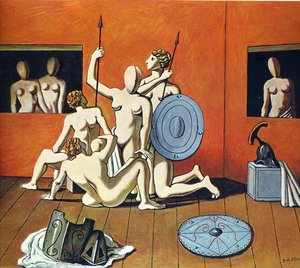
Explore Giorgio de Chirico’s "untitled (3427)", a surrealist masterpiece featuring nude figures & fragmented forms. Discover Cubism, unsettling compositions & dramatic lighting in this iconic oil painting.
A művész életrajza
Fedezd fel a Giorgio de Chirico szürreális világát! Kísérletezz álomtérképekkel, filozófiai témákkal és ikonikus manekinek-szobrokkal. Hatalmas hatással volt a szurrealizmusra.
A festményről
A Vision of Disquiet: De Chirico’s Untitled Tableau
This compelling work by Giorgio de Chirico plunges the viewer into a realm of unsettling beauty and psychological tension. Executed in an undefined period, *untitled (3427)* exemplifies the artist's pivotal role in establishing Metaphysical painting – a movement that profoundly influenced Surrealism. The canvas presents three nude male figures amidst fragmented armor and weaponry, creating a scene both classical in allusion and radically modern in its execution.Deconstructing Form: Style & Technique
- Cubist & Surrealist Fusion: De Chirico masterfully blends the fractured perspectives of Cubism with the dreamlike logic of Surrealism. Forms are deconstructed and reassembled, creating a sense of spatial ambiguity and emotional unease.
- Oil on Canvas: The work is rendered in oil paint, applied with loose, visible brushstrokes that imbue the surface with texture and tactility despite its inherently unreal subject matter. This technique emphasizes color over meticulous detail, contributing to the painting’s atmospheric quality.
- Dramatic Lighting & Composition: Strong directional lighting casts stark shadows, accentuating the volume of the figures and objects while heightening the dramatic tension. The composition is dominated by a central triangular arrangement, further amplifying the sense of instability and movement.
Symbolism & Narrative Threads
- The Fallen Hero: The nude figures, vulnerable and exposed amidst remnants of battle – scattered armor and weapons – suggest a critique of traditional heroic ideals. They are not triumphant warriors but rather figures stripped bare by conflict.
- Metaphysical Space: De Chirico’s signature use of unsettling spatial arrangements creates a ‘metaphysical’ space, divorced from the logic of reality. The windows framing additional, partially visible figures add to this sense of mystery and psychological depth.
- Color as Emotion: The warm, earthy palette dominated by orange and red evokes feelings of passion, anxiety, and perhaps even violence. These colors contribute significantly to the painting’s overall emotional impact.
Historical Context & Artistic Legacy
Giorgio de Chirico (1888-1978) was a Greek-Italian artist who pioneered the *Scuola Metafisica* art movement in 1910. His work, characterized by haunting imagery and dreamlike scenarios, profoundly influenced Surrealist artists like Salvador Dalí and René Magritte. De Chirico sought to depict not merely what he saw, but what lay beneath the surface of reality – the hidden anxieties and psychological complexities of modern life. *untitled (3427)* stands as a powerful example of this artistic vision.Emotional Resonance & Interior Design
This painting is more than just an aesthetic object; it’s an invitation to contemplation. The work evokes feelings of tension, vulnerability, and disillusionment – emotions that resonate deeply with the human experience. Its complex composition and striking color palette would make a powerful statement in a modern interior, particularly one seeking a sophisticated and thought-provoking atmosphere. The painting's unsettling beauty lends itself well to spaces designed for contemplation or creative inspiration. A high-quality reproduction of this piece will undoubtedly become a focal point, sparking conversation and adding depth to any collection.Kérdések és válaszok
Miért van az, hogy a "untitled (3427)" szerzői jogi állapota ilyen?
A „untitled (3427)”, De Chirico alkotása még szerzői jog védi állapotban van. A szerzői jogi védelem időtartama a művész halálától számítódik, amely 1978 évben történt.
Melyik szobához ajánlott a „untitled (3427)”, De Chirico alkotása?
A „untitled (3427)”, De Chirico alkotása számára a javasolt helyszín egy Living Room. Természetesen ez az ajánlás az Ön belső terehez is igazítható.
Hogyan egyensúlyozza a fényt és a sötétséget a "untitled (3427)"?
A „untitled (3427)”, De Chirico alkotása rögzített értékei: bright fényerő és Gentle Luminance luminancia.
Gyors tények és művészeti kvíz
De Chirico életrajza

De Chirico
1888 - 1978, Görögország
A művész életrajza
A Dreamscape of the Mind: The Life and Art of Giorgio de Chirico
Giorgio de Chirico’s artistic journey began in Volos, Greece, in 1888, a birthplace that would profoundly shape his unique vision. Born to Italian parents – a Genoese mother and a Sicilian father – he was immersed in a world of dual heritage, a blend of classical tradition and burgeoning modern alienation. His early education at the Athens Polytechnic provided him with a solid grounding in traditional techniques, but it was his subsequent studies in Munich that truly ignited his creative spirit. This period exposed him to the evocative landscapes and symbolic imagery of artists like Arnold Böcklin and Max Klinger, whose work resonated deeply with his own developing aesthetic sensibilities. Equally influential were the philosophical currents swirling through Europe at the time – the challenging ideas of Friedrich Nietzsche, Arthur Schopenhauer, and Otto Weininger, which explored themes of existentialism, the irrationality of human desire, and the subjective nature of reality. These intellectual currents became the bedrock upon which de Chirico built his groundbreaking artistic vision.The Birth of Metaphysical Painting
Around 1909, a truly singular style began to emerge from de Chirico’s explorations – a style he himself termed “Metaphysical” art. This wasn't merely a stylistic innovation; it was a profound attempt to penetrate the surface of everyday life, to reveal the unsettling poetry hidden within familiar spaces. A pivotal moment occurred during a visit to Florence and an experience in Piazza Santa Croce, which served as the catalyst for his iconic ‘Metaphysical Town Square’ series. These paintings are characterized by their arresting stillness, long dramatic shadows, illogical perspectives, and the disconcerting presence of classical architecture juxtaposed with unsettling elements – faceless mannequins, looming statues, and a pervasive sense of isolation. The effect is deeply disquieting, evoking a potent blend of nostalgia, loneliness, and an almost unbearable longing for something lost or unattainable. It’s as if he was peering into a dreamscape, capturing the hidden anxieties and unspoken desires of the human psyche. De Chirico founded the Scuola Metafisica, profoundly impacting Surrealism, though his relationship with the movement remained complex and often fraught with disagreement over interpretations of his work. His paintings weren't intended as literal representations of dreams; rather, they were attempts to depict a reality beyond the visible world – a realm where time and space are fluid, and the boundaries between consciousness and unconsciousness blur. Works like *The Vexations of the Thinker*, *The Enigma of an Autumn Afternoon*, and *The Song of Love* exemplify this haunting aesthetic, inviting viewers to contemplate the mysteries of existence and the fragility of human perception.Influences and Philosophical Roots
De Chirico’s artistic development was inextricably linked to his intellectual pursuits. He devoured the works of philosophers like Friedrich Nietzsche and Arthur Schopenhauer, whose ideas about existentialism, irrationality, and the subjective nature of reality deeply influenced his art. Nietzsche's concept of the "eternal recurrence" – the idea that life repeats itself infinitely – resonated with de Chirico’s fascination with cycles, repetition, and the sense of déjà vu that permeates many of his paintings. Schopenhauer’s pessimistic worldview, emphasizing the suffering inherent in human existence, informed the melancholic atmosphere of his works. The influence of Otto Weininger, a controversial Austrian philosopher who explored themes of sexuality and race, is also evident in de Chirico's exploration of psychological states and the unsettling juxtaposition of familiar objects. These philosophical currents provided him with a framework for exploring the darker aspects of human experience – alienation, loneliness, anxiety, and the search for meaning in a seemingly meaningless world.A Shift in Style and Lasting Legacy
Following World War I, around 1919, de Chirico’s artistic trajectory took an unexpected turn. He consciously distanced himself from his earlier metaphysical approach, embracing instead a more traditional neoclassical or neo-baroque style. This shift was met with considerable criticism; many critics lamented the perceived abandonment of the innovative spirit that had defined his early work. However, de Chirico remained steadfast in his artistic choices, revisiting themes from his past but rendering them with a different aesthetic sensibility. He continued to paint and exhibit prolifically throughout his life, exploring various styles and subjects while maintaining a consistent commitment to craftsmanship and technical skill. Despite the criticism, his influence on subsequent generations of artists remains undeniable. His innovative use of space, perspective, and symbolism challenged conventional artistic norms and paved the way for new forms of expression. He left behind not just a body of artwork but a new way of seeing – a way of perceiving the world as a place of hidden meanings, unsettling beauty, and enduring mystery.Key Influences & Artistic Lineage
- Influenced By: Arnold Böcklin, Max Klinger, Friedrich Nietzsche, Arthur Schopenhauer.
- Influenced: Surrealism, particularly artists like René Magritte and Salvador Dalí. His work also impacted later movements such as Magic Realism.
Gyors információk De Chirico művészről
- Artistic Movement Or Style: Metafisziikai művészet
- Artists Or Movements Influenced By This Artist: ['Surrealizmus']
- Artists Who Influenced This Artist:
- Böcklin
- Klinger
- Date Of Birth: 1888. 7. 10.
- Date Of Death: 1978. 11. 20.
- Full Name: Giorgio de Chirico
- Nationality: Olasz
- Notable Artworks:
- A Veszélyes gondolatok
- Őszi estének rejtélye
- Place Of Birth: Volos, Görögország
Fedezze fel a műalkotásokat témák, stílusok és jellemzők szerint csoportosítva.


De Chirico
untitled (3427)
() ·
A kerettel együtt: · Kézzel festve, olajfesték, vászonon
Összesen