

Shown: · With its frame:
 Megtekintés
 Küldés
 Megosztás
 Részletek
 Útmutató

 Letöltés
 Hasonló darabok
 X-ray felvétel
 Diavetítés
 Q&A
Q&A Statisztika
 Oil On Canvas
- WallArt
- Realist Impressionism
 1873
1873- 19th Century
 72.0 x 88.0 cm
Ft 87954
Kézzel készített olajfestmény reprodukció
Kézzel festett olajvastú vászon, az Ön által választott méretben és keretben, művészeink készítik meglévőre. ( Váltás nyomtatványra Áttérés digitális képre)
Size
·Standard méret
egyedi méretű
CM
INCH
Válasszon előre meghatározott méreteink közül, amelyek megfelelnek a műalkotás eredeti arányainak.
Loading sizes...

szélesség
magasság
Írja be a kívánt szélességet és magasságot, hogy illeszkedjen a keretéhez vagy a falához. Mivel ez kézzel festett alkotás, egy eltérő formájú méret esetén a művész akár festhet is valamivel többet a kép körül, vagy korolathat is belőle — az Ön döntésének megfelelően. A festés megkezdése előtt küldünk egy digitális tervezetet jóváhagyásra. Az oldalon látható kép nem tartalmazza a végeredményt — csak a tervezet mutatja meg a valódi eredményt.
 További információk
Finish
·
White Ft1

Blurside Ft1

Extended Ft1

P118B Ft10

P118H Ft10

P118W Ft10

P438Z Ft10

P508JH Ft12

P508YH Ft12

P805H Ft10

P805Z Ft10

P919BZ Ft10

P919G Ft10

P919XJ Ft10

P959ZH Ft10

P968JZ Ft12

W106C Ft8

W218G Ft10

W218JH Ft8

W218Y Ft10

W307PJ Ft10

W316G Ft10

W316PJ Ft8

W316Y Ft10

W398PJ Ft8

W4111J Ft10

W500HY Ft15

W500JH Ft15

W692G Ft12

W849H Ft8

W940BG Ft15

W953PJ Ft8

H24-GOLD Ft30

H24-SILVER Ft30

H36-GOLD Ft45

H36-SILVER Ft45
Shipped in a protective tube, ready for your own framer.
Above 105 cm the frame is shipped as a kit for a professional framer — read the details.
Extras
optionalWhat do the extras include?
Examples of what can be changed: Replace face with customer photo; Add pet (e.g., replace cat with dog); Include hidden message in background; Change background landscape or elements.
After order, TopImpressionists.com team will email client for instructions and provide a mockup preview
After order, TopImpressionists.com team will email client for instructions and provide a mockup preview
Világszerte elérhető szállítás () 3-4 hét alatt a szokásos 5 hét helyett. (31 október). A minőség nem kérdőjelezhető.
Védőréteg (Lakk)
Névtábla
A gravírozott bronztábla részletei
This elegant plaque features the artist's name and the title of the artwork, finely engraved for a timeless presentation.
It is made from bronze with a refined, elegant finish. The text is precisely laser-engraved for a sharp and permanent result. Measuring 9x2 cm, the plaque is compact yet easy to read. It's built to be durable and scratch-resistant, offering a professional, museum-quality look. Mounting is simple thanks to the included adhesive backing.
Átlátszó akril tábla részletei
The plaque includes essential engraved details such as the artist's name, the title of the artwork, the date it was created, the type of media used-like oil on canvas or watercolor-a brief description of the piece, and a QR code that links to the complete artwork information.
It is crafted from clear acrylic, offering a sleek, modern appearance. The text is UV-engraved in black to ensure strong visual contrast. With a size of 10x15 cm, it ensures optimal readability. It comes equipped with two metal hooks for secure wall mounting. The plaque is designed to be weather-resistant, making it suitable for various environments, and it includes interactive features that work seamlessly with smartphone scanning.
Fekete akril tábla részletei
This elegant plaque includes engraved information such as the artist's name, the title of the artwork, the date it was created, the type of media used (like oil on canvas or watercolor), a short description of the artwork, and a QR code for quick access to more information.
The plaque itself is made from refined black acrylic with a premium finish. The text is laser-engraved in white for high contrast and readability. Its size is 10x15 cm, designed to be easy to read. It comes with two metal hooks for professional mounting. The design is sleek and fits any interior style. It is also weather-resistant and durable, with built-in digital integration for mobile compatibility.
Az üvegkeretes opció csak 110 cm alatti méretben érhető el
 Az üvegkeretes opció csak 110 cm alatti méretben érhető el
- Ingyenes globális expressz szállítás
- Prémium minőségű len vászon
- Teljes körű szállítási biztosítás
- Vámvisszatérítési Garancia
- Hiteles színarányosság garancia
- 100 napos visszaküldési lehetőség (csak hibás termékek esetén)
- 100% pénzvisszatérítési garancia
- Több darab vásárlásakor kedvezmény


A gyűjtemény leírása
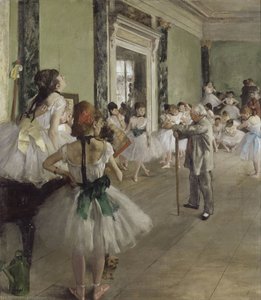
Captured in exquisite monochrome by Degas during the Impressionist era, ‘The Dance Class’ portrays a ballet studio brimming with youthful energy and focused movement—a testament to artistic observation and unwavering realism.
A művész életrajza
Degas: Francia egyik legjelentősebb festője, a balett táncosai, párizsi élete és innovatív technikái világsühmeki művész. Egyedi látásmódja, dinamikus kompozíciói és precíz ábrázolása teszik igazán különlegessé.
About the painting
A Glimpse into the Soul of the Studio
In the quiet, focused atmosphere of a Parisian rehearsal hall, Edgar Degas captures something far more profound than a mere ballet lesson. The Dance Class is not just a depiction of movement; it is an intimate study of the discipline, exhaustion, and quiet anticipation that define the life of a dancer. As we gaze upon this masterpiece, we are transported to 1873, stepping into a world where the soft rustle of tulle and the rhythmic breathing of young women fill the air. Degas, a master of observing the unvarnished truth, avoids the grand, theatrical spectacle often associated with the opera, choosing instead to present a candid snapshot of preparation. The composition draws the eye through a labyrinth of bodies—some stretching limbs, others adjusting ribbons or resting momentarily—creating a sense of lived-in reality that feels as though we have just walked through the studio door.
The emotional resonance of the piece lies in its ability to balance the grace of the ballet with the grueling physical labor behind it. There is a palpable tension between the elegance of the tutus and the weary, slumped shoulders of dancers caught in moments of repose. For the collector or the lover of fine art, this painting offers a window into the Belle Époque, capturing a period of intense cultural transformation. Degas’s ability to find beauty in the mundane—in the tilt of a head or the way light catches a stray strand of hair—makes this work an enduring symbol of human aspiration and the relentless pursuit of perfection.
Mastery of Light and Realist Precision
While often whispered about in the same breath as the Impressionists, Degas’s technique in The Dance Class reveals a soul deeply rooted in Realism. He does not rely on the fleeting, broken light of Monet; rather, he employs a purposeful, structured brushstroke that lends weight and volume to the dancers' forms. The palette is a sophisticated arrangement of muted tones, punctuated by the delicate pinks and soft whites of the costumes, which allows the viewer to focus on the subtle interplay of shadow and depth within the studio space. This careful use of tonal variation creates an atmospheric dimension, making the confined room feel expansive yet intimate.
The composition itself is a marvel of classical arrangement disguised as spontaneity. By utilizing architectural elements—such as the staircase and the arched doorway—Degas directs our gaze in a sweeping motion across the canvas. This prevents the eye from resting too long on any single figure, instead encouraging a continuous journey through the scene. For interior designers seeking to anchor a room with a sense of movement and history, this painting provides a dynamic focal point. It possesses a unique ability to breathe life into a space, offering a sophisticated narrative that complements both classical and contemporary decor with its timeless elegance and profound psychological depth.
Kérdések és válaszok
Mennyire tel愈t a "The Dance Class" színpalettája?
A „The Dance Class”, Hilaire-Germain-Edgar Degas alkotása színei Muted telítettségűek. A telítettség azt mutatja meg, hogy a színek mennyire élénkek vagy fakók.
Milyen színek jellemzik a "The Dance Class" alkotást?
A „The Dance Class”, Hilaire-Germain-Edgar Degas alkotása színek palettáját úgy jellemzik, mint Earthy. Ez a mű színeinek tömör leírása.
Milyen módon kapcsolódik a "The Dance Class" stílusa alkotójának korához?
A „The Dance Class”, Hilaire-Germain-Edgar Degas alkotása a Realist Impressionism irányzat alkotása, mely alkotójának 19. század korszakából származik.
Quick facts and art quiz
About Hilaire-Germain-Edgar Degas

Hilaire-Germain-Edgar Degas
1834 - 1917, Franciaország
A művész életrajza
A Life Immersed in Movement
Edgar Degas, born Hilaire-Germain-De Gas in Paris on July 19, 1834, remains one of the most intriguing and complex figures in French art history. Often associated with Impressionism, a label he actively resisted, Degas was fundamentally a realist—a meticulous observer of the world around him, dedicated to portraying it with startling honesty and a unique visual language. His early life, comfortably bourgeois thanks to his banker father’s wealth and his mother's Creole background, provided him with access to education and artistic training, though he often felt constrained by academic expectations. Initially enrolled at the Lycée Louis-le-Grand, Degas’s true education began in the Louvre, where he spent countless hours copying works by masters like Raphael and Rembrandt, honing his skills and developing a deep appreciation for classical form. However, this wasn't simply imitation; it was a process of intense study and critical engagement with artistic tradition—a foundation upon which he would later build his own distinctive style. His father’s encouragement, recognizing his son’s innate talent, allowed him to establish a studio within their grand home, providing a space for experimentation and self-discovery.Beyond Impressionism: A Unique Artistic Vision
While many of his contemporaries, including Monet and Renoir, sought to capture the fleeting effects of light outdoors, Degas largely worked within the confines of his Parisian studio. His subject matter was decidedly modern—a departure from the historical or mythological scenes favored by traditional academic painters. He found inspiration in the vibrant, often overlooked details of everyday Parisian life: the bustling activity of laundresses at the Seine, the alluring figures of cabaret singers and dancers, the quiet elegance of milliners crafting their creations. It is this fascination with ballet that defines much of his oeuvre—a world of grueling rehearsals, physical strain, and fleeting moments of grace amidst a demanding profession. Degas didn’t simply paint beautiful ballerinas; he captured the *reality* of their lives, revealing both their beauty and their hardship. His compositions are often unconventional, cropping figures in unexpected ways, utilizing asymmetrical arrangements, and employing a dynamic sense of movement that draws the viewer into the scene. He was particularly adept at capturing the subtle nuances of gesture and expression, conveying not just what he saw but also *how* it felt to be present in those moments. His work is characterized by an intimate, almost voyeuristic perspective, as if he were a silent observer privy to private dramas unfolding before him.Influences and Artistic Development
Degas’s artistic journey was shaped by a remarkably diverse range of influences. His early training emphasized classical principles, particularly the meticulous draftsmanship championed by Jean-Auguste-Dominique Ingres, whose emphasis on precise form and idealized beauty left an indelible mark on his work. However, he also admired the Realist movement, spearheaded by artists like Gustave Courbet, who challenged academic conventions and sought to depict contemporary life with unflinching honesty. A pivotal moment in his development came through his association with Camille Pissarro, a leading Impressionist who encouraged him to experiment with new techniques and broadened his artistic horizons. Degas was deeply captivated by Japanese prints—Ukiyo-e—which exerted a profound influence on his compositions, color palettes, and use of asymmetrical arrangements. He studied the bold lines, flattened perspectives, and decorative patterns of these woodblock prints, incorporating them into his own work to create a sense of dynamism and visual interest. Furthermore, Degas embraced photography as a tool for studying movement and capturing fleeting moments in time—a technique he skillfully integrated into his paintings, particularly his depictions of dancers. He wasn’t simply copying what he saw; he was actively synthesizing diverse influences into something entirely new and uniquely his own.Major Works and Techniques
Degas's artistic output spanned a remarkable range of subjects and media. His paintings of ballet dancers—such as *The Dance Class*, *Little Dancer on the Bar* (bronze sculpture), and *L’Étoile*—are arguably his most famous works, capturing the intensity of rehearsals and the fleeting beauty of performance with unparalleled skill. He also produced a significant body of pastel drawings, often depicting scenes from Parisian life—laundresses at work, milliners displaying their wares, and street vendors hawking their goods. His use of pastels was particularly innovative, employing a loose, expressive technique that captured the immediacy of observation. Beyond painting and sculpture, Degas also experimented with monotypes (unique prints) and drypoint etchings, further expanding his artistic repertoire. His ability to capture movement—not through blurred lines or hazy effects, but through precise observation and careful rendering of form—is a hallmark of his work.Legacy and Lasting Impact
Edgar Degas died in Paris on September 27, 1917, leaving behind a vast and influential body of work that continues to captivate audiences today. He paved the way for future generations of artists who sought to break free from traditional conventions and explore new ways of representing the world around them. His innovative approach to composition, his masterful draftsmanship, and his unflinching portrayal of modern life have had a profound impact on the course of art history. He wasn’t merely a painter of dancers or racehorses; he was a keen observer of human nature, a master of form and movement, and a true innovator who redefined the possibilities of art. His influence can be seen in the work of Pablo Picasso and Henri Matisse, among others, solidifying his place as one of the most important figures in modern art.- Innovative Composition: Degas frequently employed unconventional cropping and asymmetrical arrangements.
- Capturing Movement: He masterfully depicted movement through precise observation and rendering.
- Diverse Subject Matter: His work encompassed ballet, Parisian life, and horse racing.
Quick facts about Hilaire-Germain-Edgar Degas
- Artistic Movement Or Style: Impressionizmus, Realizmus
- Artists Or Movements Influenced By This Artist:
- Picasso
- Matisse
- Artists Who Influenced This Artist:
- Ingres
- Courbet
- Pissarro
- Date Of Birth: 1834. július 19.
- Date Of Death: 1917. szeptember 27.
- Full Name: Hilaire-Germain-Edgar De Gas
- Nationality: Francia
- Notable Artworks:
- Táncosok csoportja
- A táncmester
- Kávéházi jelenet
- Place Of Birth: Párizs, Franciaország
Hasonló műalkotások




Fedezze fel a műalkotásokat témák, stílusok és jellemzők szerint csoportosítva.


Hilaire-Germain-Edgar Degas
The Dance Class
() ·
With its frame: · Hand-painted in oil on linen
Total