


 Megtekintés
 Küldés
 Megosztás
 Részletek
 Útmutató

 Letöltés
 Hasonló darabok
 X-ray felvétel
 Diavetítés
 Statisztika
After Bathing, Valencia


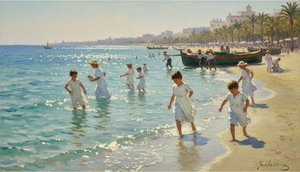
Joaquin Sorolla’s "After Bathing, Valencia" captures a sun-drenched scene of women changing after a swim – a vibrant glimpse into 19th-century Valencian life.
 Összes részlet megjelenítése
Sorolla: A spanyol festőművész, aki a fény és szín mesterese! Élénk portrék és tengerparti tájképek a mediterrán élet esszenciájából. Fedezd fel örökségét!
Giclée / Műnyomat
Múzeumi minőségű giclée vagy vászonnyomat, gyors gyártással és rugalmas finomítási lehetőségekkel. ( Kézzel festett másolat rendelése Áttérés digitális képre)




































Standard méret
egyedi méretű
CM
INCH
Válasszon előre meghatározott méreteink közül, amelyek megfelelnek a műalkotás eredeti arányainak.
Loading sizes...

szélesség
magasság
Írja be a keretének vagy a falának megfelelő szélességet és magasságot. A nyomatot csak le lehet vágni, soha nem tehető nagyobbá, mint az eredeti kép, így egy eltérő alakú méretnél a kép egy része elveszik. Mielőtt bármit kinyatintanánk, küldünk egy digitális próbamodellt jóváhagyásra. Az oldalon látható kép nem tartalmazza a valós levágást — ezt csak a próbamodell mutatja meg.
Világszerte történő kiszállítás területére mindössze 2 hét alatt, a szokásos 4-5 hét helyett. (28 október)

Ingyenes globális expressz szállítás

Prémium minőségű len vászon

Teljes körű szállítási biztosítás

Vámvisszatérítési Garancia

Hiteles színarányosság garancia

100 napos visszaküldési lehetőség (csak hibás termékek esetén)

100% pénzvisszatérítési garancia

Több darab vásárlásakor kedvezmény
 Az üvegkeretes opció csak 110 cm alatti méretben érhető el

After Bathing, Valencia
Giclée / Műnyomat
Reprodukció mérete
-


Összesített ár
Ft 22276
A Moment of Mediterranean Grace: Exploring Sorolla’s “After Bathing, Valencia”
Joaquín Sorolla’s “After Bathing, Valencia,” painted in 1909, isn't merely a depiction of women emerging from the sea; it’s a vibrant distillation of Spanish light, culture, and the fleeting beauty of summer. This captivating work, housed within the Museo Sorolla in Madrid, offers a glimpse into a specific moment in Valencian life – a tradition deeply rooted in the region’s history and social fabric. The painting immediately draws the eye with its luminous palette; a symphony of blues, pinks, and whites that mimic the shimmering surface of the Mediterranean Sea and the delicate hues of the women's bathing attire. Sorolla masterfully captures the heat haze rising from the water, creating an atmosphere thick with warmth and vitality.
The scene unfolds on a simple wooden boat deck, suggesting a private moment of leisure amongst friends. Two young women – one clad in a blush-toned dressing gown, the other in a crisp white garment – stand close together, their postures relaxed and imbued with a quiet joy. A third woman, partially visible behind them, is preparing to shed her pink robe, completing the tableau of transformation and transition. The inclusion of two chairs and a handbag hints at the domesticity that underlies this idyllic scene, grounding it in everyday life. Sorolla’s brushwork is remarkably loose and expressive, particularly evident in the depiction of the water – a swirling dance of light and color that seems to ripple with movement. He employs broken brushstrokes and vibrant glazes, creating an effect of shimmering transparency that perfectly captures the essence of sunlight reflecting off the sea.
The Valencian Custom: Bathing and Social Ritual
To fully appreciate “After Bathing, Valencia,” it’s crucial to understand the historical context surrounding this seemingly simple subject. In late 19th and early 20th-century Valencia, a unique social custom prevailed: young boys would bathe naked in the sea until adolescence, while girls began using bathing gowns around the age of four or five. This practice, deeply ingrained in Valencian culture, was often undertaken at dawn or dusk to avoid the heat of the midday sun. The painting therefore isn’t just a portrait; it's a visual record of this cherished tradition, offering a window into the daily lives and social norms of the time. Sorolla’s choice to depict these scenes – bathing in the nude for boys and in gowns for girls – reflects the evolving roles and expectations within Valencian society.
Sorolla's Impressionistic Vision: Light as Subject
Joaquín Sorolla was a pivotal figure in the Spanish art world, renowned for his masterful use of light. He considered it not merely a technical element but an active participant in his paintings – a force that shaped color, form, and emotion. In “After Bathing, Valencia,” this philosophy is brilliantly demonstrated. Sorolla’s technique is firmly rooted in Impressionism, yet he developed a distinctly Spanish style characterized by bold colors, loose brushwork, and a focus on capturing the fleeting effects of light. He often painted *en plein air* (outdoors), directly observing and translating the natural world onto canvas. The painting's luminosity isn’t achieved through meticulous detail but rather through Sorolla’s intuitive understanding of how light interacts with surfaces – the wetness of the skin, the shimmer of the water, and the warmth of the sun.
Symbolism and Emotional Resonance
Beyond its depiction of a specific social custom, “After Bathing, Valencia” resonates with broader themes of youth, beauty, and connection. The women’s relaxed postures and shared gaze suggest a sense of camaraderie and intimacy. The painting evokes a feeling of nostalgia for a simpler time – a moment of carefree joy captured in a single, radiant instant. Sorolla's masterful use of color and light imbues the scene with an almost dreamlike quality, inviting the viewer to step into this idyllic world and experience its warmth and serenity. It’s a testament to his ability to transform everyday life into enduring works of art, imbued with both historical significance and timeless beauty.
Kérdések és válaszok
Hol tudok nyomtatványt vásárolni a(z) „After Bathing, Valencia”, Joaquín Sorolla alkotása alkotásból?
A „After Bathing, Valencia”, Joaquín Sorolla alkotása nyomtatott példányát egyszerűen megrendelheti a következő oldalon: minőségi giclée nyomat pamutvászonon vagy archiváló vászonpapíron, a Művészeti nyomtatvány kautta.
Honnan érkeznek a „After Bathing, Valencia”, Joaquín Sorolla alkotása látogatói?
A „After Bathing, Valencia”, Joaquín Sorolla alkotása statisztikái a mű Statisztikák oldalán érhetőek el: a mű havi látogatottsága, a művész alkotásainak megtekintése, valamint a legutóbbi látogatók országos és nyelvi lebontása.
Megrendelhető-e a "After Bathing, Valencia" olajfestmény kézzel festett másolata?
A "After Bathing, Valencia" kézzel festett olajfesték reprodukció lino vászonon formátumban is elérhető. A rendelés a Kézzel festett másolat oldalon adható le, különböző méretválasztékban.
Hasonló műalkotások


A művész életrajza
A Life Bathed in Light: The World of Joaquín Sorolla
Joaquín Sorolla y Bastida, a name synonymous with the radiant light and vibrant energy of Spain, was more than just a painter; he was a chronicler of his nation’s soul. Born in Valencia in 1863, Sorolla's early life was marked by tragedy. Orphaned at the tender age of two following a cholera epidemic that claimed both parents, young Joaquín and his sister were raised by their maternal aunt and uncle. This early experience with loss perhaps instilled within him a profound appreciation for the fleeting beauty of life – a sentiment that would permeate his art. Though hardship shadowed his beginnings, it did not dim the spark of artistic talent that quickly became apparent. He received initial instruction in Valencia, demonstrating an aptitude that led to studies under established artists like Cayetano Capuz and José Benlliure, eventually culminating in a four-year grant to study in Rome. It was there, amidst the classical grandeur of Italy, that Sorolla began to forge his unique artistic path, absorbing influences while simultaneously developing a style distinctly his own.From Historical Narratives to Sun-Drenched Realism
Sorolla’s early work reflected the prevailing academic trends of the time – large-scale historical and mythological scenes. He was initially commissioned to paint grand narratives for royal patrons, depicting heroic battles and allegorical figures with meticulous detail. However, a pivotal shift occurred as he returned to Spain and began to truly observe the world around him. He found himself captivated by the everyday lives of his countrymen, particularly those along the Valencian coast. The intense Mediterranean sunlight, the shimmering sea, and the vibrant energy of the people became his primary subjects. This transition wasn’t immediate; Sorolla continued to explore social realism with works like Sad Inheritance (1899), a powerful depiction of children afflicted by polio bathing in the sea – a painting that garnered significant acclaim but also revealed a darker, more compassionate side to his artistic vision. This work, exhibited at the Universal Exhibition in Paris, brought him widespread recognition and cemented his position as a leading figure in Spanish art. Yet, it was his increasingly focused exploration of light and color, inspired by Impressionism though never fully embracing its tenets, that would define his legacy. He wasn’t merely *depicting* light; he was attempting to *capture* its very essence, the way it danced on water, illuminated skin, and transformed ordinary moments into scenes of extraordinary beauty.Master of Luminism: A Unique Artistic Voice
Sorolla's technique became instantly recognizable – a bravura display of brushwork, characterized by loose, energetic strokes that conveyed movement and atmosphere. He worked *en plein air* whenever possible, directly confronting the challenges of capturing fleeting light conditions. This dedication to painting outdoors resulted in canvases brimming with life and immediacy. His beach scenes, perhaps his most iconic works, are not simply picturesque representations of leisure; they are studies in luminosity, reflections, and the joyful interaction between people and their environment. Paintings like Children on the Seashore and Sewing the Sail exemplify this mastery – figures bathed in golden light, rendered with a remarkable sense of spontaneity and vitality. He wasn’t interested in meticulous detail; rather, he sought to convey the *impression* of reality, prioritizing atmosphere and emotion over precise representation. This approach earned him comparisons to Impressionists like Monet and Renoir, but Sorolla's work possessed a unique Spanish character – a warmth, intensity, and emotional depth that set it apart.Key Achievements & Recognition
- 1892: Gold medal at the National Exhibition in Madrid for Another Marguerite.
- 1894: Acclaimed for The Return from Fishing: Hauling the Boat, acquired by the Musée du Luxembourg.
- 1899: Grand Prix and medal of honor at the Universal Exhibition in Paris for Sad Inheritance.
- 1900-1923: Extensive exhibitions throughout Europe and the United States, establishing international recognition.
- 1912-1928: Commissioned to create Vision of Spain for the Hispanic Society of America (completed posthumously).
- Present Day: Works held in major museums worldwide, including the Museo Sorolla in Madrid.
Legacy and Enduring Influence
By the early 20th century, Joaquín Sorolla was internationally renowned. He exhibited widely throughout Europe and the United States, receiving numerous accolades and commissions. His most ambitious undertaking, Vision of Spain, a series of fourteen monumental murals commissioned by the Hispanic Society of America, remains a testament to his artistic vision and technical skill. Though he suffered a stroke in 1920 that curtailed his painting activity, Sorolla’s influence continued to grow after his death in 1923. His work inspired generations of artists, not only in Spain but around the world. Today, his paintings are held in major museums globally, including the Museo Sorolla in Madrid – a former home transformed into a dedicated space for showcasing his art. Sorolla’s legacy extends beyond his technical brilliance; he captured a specific moment in Spanish history and culture, immortalizing the beauty of its landscapes and the spirit of its people. He remains a master of light, color, and emotion—a painter whose work continues to resonate with audiences today, reminding us of the power of art to illuminate our world.
Joaquín Sorolla
1863 - 1923 , Spanyolország
Rövid információk
- Artistic Movement Or Style: Luminizmus, Impresszionizmus
- Artists Or Movements Influenced By This Artist: ['Impressionizmus']
- Artists Who Influenced This Artist:
- Pradilla
- Bastien-Lepage
- Menzel
- Date Of Birth: 27 Feb 1863
- Date Of Death: 10 Aug 1923
- Full Name: Joaquín Sorolla y Bastida
- Nationality: Spanyol
- Notable Artworks:
- A1930
- Bathing Time
- White Slave Trade
- Typical Sorianos
- Children on the Seashore
- Sewing the Sail
- Place Of Birth: Valencia, Spanyolország
Kapcsolódó cikkek

Paul Cézanne 25 Mesterműve: A Modern Művészet Úttörői | TopImpressionists
Fedezze fel Paul Cézanne 25 legikonikusabb művét! Ismerje meg a posztimpresszionizmus úttörőjének festményeit, technikáját és inspirációit. Vászonképek, portrék, tájképfestmények – minden otthonba. Böngéssze gyűjteményünket a TopImpressionists-on!

A fényrózsaszín varázsa: 10 ikonikus festmény a művészettörténetből
Fedezze fel a 10 legikonikusabb festményt, melyeket a fényrózsaszín varázsa jellemez! Monet-tól Renoir-ig, ismerje meg a művészettörténet e gyönyörű árnyalatainak szerepét. Vászonképek és reprodukciók prémium minőségben – TopImpressionists.com

Manuel Benedito Vives: A Study of Light, Color & Emotional Resonance in Contemporary Spanish Painting
Explore the captivating world of Manuel Benedito Vives, a celebrated Spanish painter influenced by Sorolla. Discover his masterful portraits, luminous landscapes & enduring legacy – a favorite of the Spanish Royal Family. Art collectors will appreciate this in-depth study.

A benyomásosok mesterművei: 10 ikonikus festmény a művészetben és otthonában
Fedezze fel a 10 legikonikusabb impresszionista festményt! Monet, Renoir és más mesterek művészete életre kel TopImpressionists.com-on. Vászonképek, faliképek – inspirálja otthonát a benyomásosok színeivel és hangulatával! Explore the full collection online.
Joaquín Sorolla: Capturing Spanish Light & Life – A Legacy of Impressionism
Explore the luminous world of Joaquín Sorolla, Spanish master of Impressionism. Discover his life, techniques & legacy – a guide for art collectors and enthusiasts. Invest in timeless beauty.
Fedezze fel a műalkotásokat témák, stílusok és jellemzők szerint csoportosítva.


