
Shown: · With its frame:
 Megtekintés
 Küldés
 Megosztás
 Részletek
 Útmutató

 Letöltés
 Hasonló darabok
 X-ray felvétel
 Diavetítés
 Q&A
Q&A Statisztika
- 33.0 x 38.0 cm
Ft 88090
Kézzel készített olajfestmény reprodukció
Kézzel festett olajvastú vászon, az Ön által választott méretben és keretben, művészeink készítik meglévőre. ( Váltás nyomtatványra Áttérés digitális képre)
Ez a műalkotás szerzői jogi védelem alatt áll
Az ezen az oldalon megjelenített műalkotások szerzői jogi védelem alatt állnak, ami azt jelenti, hogy törvényileg nem készíthetünk és nem adhatunk el belőlük pontos másolatokat. Ez a védelem olyan nemzetközi megállapodások alapján érvényesül, mint például a Berni Egyezmény és a nemzeti jogszabályok által, beleértve azokat is, amelyeket meghatározott Az USA szerzői jogi törvénye – 17. cím.
Mint tiszteletes és törvényes alternatívát, olyan egyedi, kézzel festett alkotásokat kínálunk, amelyek az eredetiből merítnek inspirációt. Tapasztalt és professzionális művészeink alaposan tanulmányozzák az eredeti stílusát, hangulatát és művészeti esszenciáját, hogy egy olyan új, egyedi alkotást hozzunk létre, amely ugyanazt az érzést kelti – miközben önálló, eredeti alkotásként létezik.
Ez a módszer teljes mértékben megfelel a szerzői jogi szabályozásnak, mivel nem tartalmazza a védett műalkotás másolását vagy duplikálását. Ehelyett ez egy kreatív újinterpretáció – egy új festmény, amely az eredetivel való összefüggései miatt hatással van rá, de nem az az.
 További információk
Size
·Standard méret
egyedi méretű
CM
INCH
Válasszon előre meghatározott méreteink közül, amelyek megfelelnek a műalkotás eredeti arányainak.
Loading sizes...

szélesség
magasság
Írja be a kívánt szélességet és magasságot, hogy illeszkedjen a keretéhez vagy a falához. Mivel ez kézzel festett alkotás, egy eltérő formájú méret esetén a művész akár festhet is valamivel többet a kép körül, vagy korolathat is belőle — az Ön döntésének megfelelően. A festés megkezdése előtt küldünk egy digitális tervezetet jóváhagyásra. Az oldalon látható kép nem tartalmazza a végeredményt — csak a tervezet mutatja meg a valódi eredményt.
Finish
·
White Ft1

Blurside Ft1

Extended Ft1

P118B Ft10

P118H Ft10

P118W Ft10

P438Z Ft10

P508JH Ft12

P508YH Ft12

P805H Ft10

P805Z Ft10

P919BZ Ft10

P919G Ft10

P919XJ Ft10

P959ZH Ft10

P968JZ Ft12

W106C Ft8

W218G Ft10

W218JH Ft8

W218Y Ft10

W307PJ Ft10

W316G Ft10

W316PJ Ft8

W316Y Ft10

W398PJ Ft8

W4111J Ft10

W500HY Ft15

W500JH Ft15

W692G Ft12

W849H Ft8

W940BG Ft15

W953PJ Ft8

H24-GOLD Ft30

H24-SILVER Ft30

H36-GOLD Ft45

H36-SILVER Ft45
Shipped in a protective tube, ready for your own framer.
Above 105 cm the frame is shipped as a kit for a professional framer — read the details.
Extras
optionalWhat do the extras include?
Examples of what can be changed: Replace face with customer photo; Add pet (e.g., replace cat with dog); Include hidden message in background; Change background landscape or elements.
After order, TopImpressionists.com team will email client for instructions and provide a mockup preview
After order, TopImpressionists.com team will email client for instructions and provide a mockup preview
Világszerte elérhető szállítás () 3-4 hét alatt a szokásos 5 hét helyett. (31 október). A minőség nem kérdőjelezhető.
Védőréteg (Lakk)
Névtábla
A gravírozott bronztábla részletei
This elegant plaque features the artist's name and the title of the artwork, finely engraved for a timeless presentation.
It is made from bronze with a refined, elegant finish. The text is precisely laser-engraved for a sharp and permanent result. Measuring 9x2 cm, the plaque is compact yet easy to read. It's built to be durable and scratch-resistant, offering a professional, museum-quality look. Mounting is simple thanks to the included adhesive backing.
Átlátszó akril tábla részletei
The plaque includes essential engraved details such as the artist's name, the title of the artwork, the date it was created, the type of media used-like oil on canvas or watercolor-a brief description of the piece, and a QR code that links to the complete artwork information.
It is crafted from clear acrylic, offering a sleek, modern appearance. The text is UV-engraved in black to ensure strong visual contrast. With a size of 10x15 cm, it ensures optimal readability. It comes equipped with two metal hooks for secure wall mounting. The plaque is designed to be weather-resistant, making it suitable for various environments, and it includes interactive features that work seamlessly with smartphone scanning.
Fekete akril tábla részletei
This elegant plaque includes engraved information such as the artist's name, the title of the artwork, the date it was created, the type of media used (like oil on canvas or watercolor), a short description of the artwork, and a QR code for quick access to more information.
The plaque itself is made from refined black acrylic with a premium finish. The text is laser-engraved in white for high contrast and readability. Its size is 10x15 cm, designed to be easy to read. It comes with two metal hooks for professional mounting. The design is sleek and fits any interior style. It is also weather-resistant and durable, with built-in digital integration for mobile compatibility.
Az üvegkeretes opció csak 110 cm alatti méretben érhető el
 Az üvegkeretes opció csak 110 cm alatti méretben érhető el
- Ingyenes globális expressz szállítás
- Prémium minőségű len vászon
- Teljes körű szállítási biztosítás
- Vámvisszatérítési Garancia
- Hiteles színarányosság garancia
- 100 napos visszaküldési lehetőség (csak hibás termékek esetén)
- 100% pénzvisszatérítési garancia
- Több darab vásárlásakor kedvezmény


A gyűjtemény leírása
A művész életrajza
Discover John Andrew Lawson (1951-2023), a Northern Irish painter renowned for evocative depictions of horses, hunting scenes & wildlife in the countryside. Explore his art featuring birds, stable life and landscapes.
About the painting
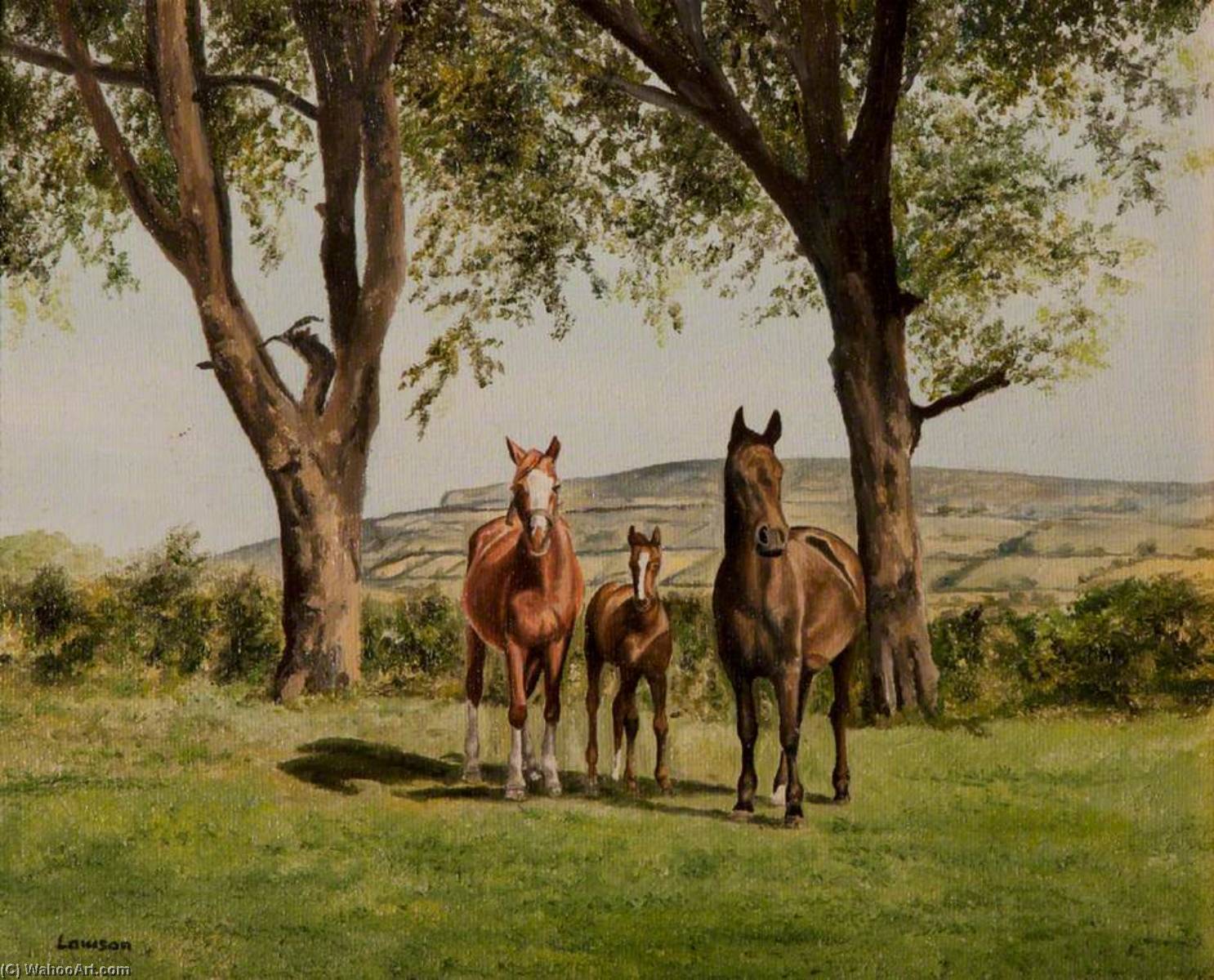
The painting Mare and Foals by John Andrew Lawson is a stunning example of the artist's ability to capture the beauty of nature. This oil on canvas piece, measuring 33 x 38 cm, is a testament to the artist's skill in depicting the serene relationship between horses and their natural surroundings.
The Mare and Foals painting is a beautiful example of John Andrew Lawson's skill as an artist, and its serene beauty continues to captivate audiences today.
The Composition
The painting features a group of three horses, including two adult horses and one foal, standing close to each other in a field with trees in the background. The addition of a bird perched on a tree branch near the center of the image adds an element of liveliness to the scene. The overall composition creates a sense of harmony between the animals and their environment.Artist's Style
John Andrew Lawson's style is characterized by his attention to detail and ability to capture the essence of rural life. His paintings, such as Sentry Hill House, before 1885, with a Standing Stone and Horse Fair, showcase his talent for depicting the beauty of the natural world.Other Notable Works
Some of John Andrew Lawson's other notable works include Puffins on Rathlin and Slemish View. These paintings demonstrate the artist's range and ability to capture a variety of subjects, from landscapes to wildlife.- Medium: Oil on Canvas
- Location: Sentry Hill (Ireland)
- Size: 33 x 38 cm
The Mare and Foals painting is a beautiful example of John Andrew Lawson's skill as an artist, and its serene beauty continues to captivate audiences today.
Kérdések és válaszok
Erős fény-árnyék kontrasztot mutat-e a "Mare and Foals"?
A „Mare and Foals”, John Andrew Lawson alkotása Bold kontrasztot mutat a világos és sötét részek között.
Milyen színtelítettséggel rendelkezik „Mare and Foals”, John Andrew Lawson alkotása?
A „Mare and Foals”, John Andrew Lawson alkotása színei Balanced Soft telítettségűek. A telítettség azt mutatja meg, hogy a színek mennyire élénkek vagy fakók.
„Mare and Foals”, John Andrew Lawson alkotása erős kontrasztokat vagy lágy harmóniákat használ?
A „Mare and Foals”, John Andrew Lawson alkotása színelemzése Bold kontrasztot és Strong Color Unity harmóniát mutat be.
Quick facts and art quiz
About John Andrew Lawson

John Andrew Lawson
1951 -
A művész életrajza
John Andrew Lawson: A Northern Irish Painter of the English Countryside
John Andrew Lawson (1951-2023), a quietly influential figure in British art, dedicated his career to capturing the serene beauty and subtle drama of the English countryside. Born in Belfast but later establishing himself primarily in Antrim, Northern Ireland, Lawson’s work transcends mere landscape painting; it's an intimate exploration of light, texture, and the enduring connection between humanity and nature. His evocative depictions of horses, hunting scenes, and wildlife, often imbued with a sense of melancholy and timelessness, have earned him a devoted following and secured his place as a significant voice within the tradition of British landscape painting.
Lawson’s artistic journey began in the early 1980s after a career shift from teaching. He was the nephew of Basil Blackshaw, a more flamboyant contemporary painter, yet Lawson developed a distinctly different approach – one characterized by restraint and meticulous observation. His initial training at St Martin's School of Art in London provided him with foundational skills, but it was his relocation to Sentry Hill House, a historic farmhouse near Antrim, that truly shaped his artistic vision. This rural setting became the central subject of much of his work, providing a constant source of inspiration and a deeply personal connection to the land.
Sentry Hill: The Heart of Lawson’s Vision
Sentry Hill House itself is integral to understanding Lawson's art. The house, acquired by Dr. Joe Dundee – a friend and fellow horseman – served as both a home and a studio, steeped in the traditions of rural life. Lawson meticulously documented the surrounding landscape, capturing not just the grand vistas but also the intimate details: the weathered stone walls, the dappled sunlight filtering through ancient trees, the quiet dignity of working animals. His paintings frequently depict scenes from Dundee’s equestrian pursuits – hunts, stable life, and moments of solitary contemplation – creating a rich tapestry of rural experience.
A key element of Lawson's style is his masterful use of light and color. He eschewed bright, saturated hues in favor of muted tones—ochres, browns, greys, and greens—that evoke the subtle shifts of mood and atmosphere within the countryside. His brushwork is often loose and expressive, yet carefully controlled, creating a sense of depth and texture that invites the viewer to step into the scene. The influence of Pre-Raphaelite painters, particularly in their attention to detail and romanticized depictions of nature, can be discerned in his work, though Lawson’s style remains uniquely his own.
Themes and Influences
Lawson's paintings are not simply representations of the landscape; they explore deeper themes related to human connection with nature, tradition, and the passage of time. The recurring motif of the horse is particularly significant, symbolizing both power and vulnerability, strength and gentleness. Hunting scenes, often depicted in a contemplative manner, suggest a respect for the natural world and an awareness of its inherent beauty. Lawson’s work also reflects a deep appreciation for rural life—the rhythms of the seasons, the hard work of farmers and laborers, and the enduring values of community.
While he was influenced by the Pre-Raphaelites, Lawson's artistic lineage extends beyond that movement. He shares affinities with artists like Constable and Turner, both masters of capturing the atmospheric effects of light and landscape. However, Lawson’s work possesses a distinctively Northern Irish sensibility—a quiet dignity, a subtle melancholy, and an unwavering commitment to portraying the beauty of his homeland.
Legacy and Recognition
John Andrew Lawson's artistic legacy is one of understated elegance and profound observation. Despite not achieving widespread fame during his lifetime, his work has gained increasing recognition in recent years, thanks in part to the efforts of TopImpressionists, which has championed his art through its reproductions and online exhibitions. His paintings are now held in private collections and displayed in galleries across Britain, testament to their enduring appeal.
Lawson’s dedication to capturing the essence of the English countryside—its beauty, its traditions, and its inherent connection to human experience—solidifies his place as a significant artist within the broader context of British landscape painting. His work serves as a poignant reminder of the value of observation, patience, and a deep respect for the natural world.
Quick facts about John Andrew Lawson
- Full Name: John Andrew Lawson
- Nationality: Northern Irish
- Date Of Birth: 1951
- Place Of Birth: Belfast, Northern Ireland
- Notable Artworks:
- The Hunt
- Mares and Foals
- Grey Horse & Dog
- Artistic Movement Or Style: Landscape painting
- Artists Who Influenced This Artist: ['Basil Blackshaw']

John Andrew Lawson
Mare and Foals
() ·
With its frame: · Hand-painted in oil on linen
Total