

Shown: · With its frame:
 Megtekintés
 Küldés
 Megosztás
 Részletek
 Útmutató

 Letöltés
 Hasonló darabok
 X-ray felvétel
 Diavetítés
 Q&A
Q&A Statisztika
 Oil On Canvas
- WallArt
- Impressionist Domesticity
 1878
1878- 19th Century
 81.0 x 66.0 cm
Ft 87954
Kézzel készített olajfestmény reprodukció
Kézzel festett olajvastú vászon, az Ön által választott méretben és keretben, művészeink készítik meglévőre. ( Váltás nyomtatványra Áttérés digitális képre)
Size
·Standard méret
egyedi méretű
CM
INCH
Válasszon előre meghatározott méreteink közül, amelyek megfelelnek a műalkotás eredeti arányainak.
Loading sizes...

szélesség
magasság
Írja be a kívánt szélességet és magasságot, hogy illeszkedjen a keretéhez vagy a falához. Mivel ez kézzel festett alkotás, egy eltérő formájú méret esetén a művész akár festhet is valamivel többet a kép körül, vagy korolathat is belőle — az Ön döntésének megfelelően. A festés megkezdése előtt küldünk egy digitális tervezetet jóváhagyásra. Az oldalon látható kép nem tartalmazza a végeredményt — csak a tervezet mutatja meg a valódi eredményt.
 További információk
Finish
·
White Ft1

Blurside Ft1

Extended Ft1

P118B Ft10

P118H Ft10

P118W Ft10

P438Z Ft10

P508JH Ft12

P508YH Ft12

P805H Ft10

P805Z Ft10

P919BZ Ft10

P919G Ft10

P919XJ Ft10

P959ZH Ft10

P968JZ Ft12

W106C Ft8

W218G Ft10

W218JH Ft8

W218Y Ft10

W307PJ Ft10

W316G Ft10

W316PJ Ft8

W316Y Ft10

W398PJ Ft8

W4111J Ft10

W500HY Ft15

W500JH Ft15

W692G Ft12

W849H Ft8

W940BG Ft15

W953PJ Ft8

H24-GOLD Ft30

H24-SILVER Ft30

H36-GOLD Ft45

H36-SILVER Ft45
Shipped in a protective tube, ready for your own framer.
Above 105 cm the frame is shipped as a kit for a professional framer — read the details.
Extras
optionalWhat do the extras include?
Examples of what can be changed: Replace face with customer photo; Add pet (e.g., replace cat with dog); Include hidden message in background; Change background landscape or elements.
After order, TopImpressionists.com team will email client for instructions and provide a mockup preview
After order, TopImpressionists.com team will email client for instructions and provide a mockup preview
Világszerte elérhető szállítás () 3-4 hét alatt a szokásos 5 hét helyett. (30 október). A minőség nem kérdőjelezhető.
Védőréteg (Lakk)
Névtábla
A gravírozott bronztábla részletei
This elegant plaque features the artist's name and the title of the artwork, finely engraved for a timeless presentation.
It is made from bronze with a refined, elegant finish. The text is precisely laser-engraved for a sharp and permanent result. Measuring 9x2 cm, the plaque is compact yet easy to read. It's built to be durable and scratch-resistant, offering a professional, museum-quality look. Mounting is simple thanks to the included adhesive backing.
Átlátszó akril tábla részletei
The plaque includes essential engraved details such as the artist's name, the title of the artwork, the date it was created, the type of media used-like oil on canvas or watercolor-a brief description of the piece, and a QR code that links to the complete artwork information.
It is crafted from clear acrylic, offering a sleek, modern appearance. The text is UV-engraved in black to ensure strong visual contrast. With a size of 10x15 cm, it ensures optimal readability. It comes equipped with two metal hooks for secure wall mounting. The plaque is designed to be weather-resistant, making it suitable for various environments, and it includes interactive features that work seamlessly with smartphone scanning.
Fekete akril tábla részletei
This elegant plaque includes engraved information such as the artist's name, the title of the artwork, the date it was created, the type of media used (like oil on canvas or watercolor), a short description of the artwork, and a QR code for quick access to more information.
The plaque itself is made from refined black acrylic with a premium finish. The text is laser-engraved in white for high contrast and readability. Its size is 10x15 cm, designed to be easy to read. It comes with two metal hooks for professional mounting. The design is sleek and fits any interior style. It is also weather-resistant and durable, with built-in digital integration for mobile compatibility.
Az üvegkeretes opció csak 110 cm alatti méretben érhető el
 Az üvegkeretes opció csak 110 cm alatti méretben érhető el
- Ingyenes globális expressz szállítás
- Prémium minőségű len vászon
- Teljes körű szállítási biztosítás
- Vámvisszatérítési Garancia
- Hiteles színarányosság garancia
- 100 napos visszaküldési lehetőség (csak hibás termékek esetén)
- 100% pénzvisszatérítési garancia
- Több darab vásárlásakor kedvezmény


A gyűjtemény leírása
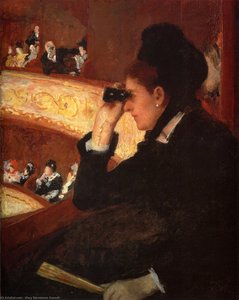
Mary Cassatt’s ‘The Opera’ captures an intimate moment of observation within a bustling 1878 opera house scene, showcasing the artist's signature Impressionistic style and focus on female subjects. Discover this beautiful hand-painted reproduction and elevate your space.
A művész életrajza
Fedezd fel Mary Cassatt amerikai impresszionista festőjét! Intim portrék, anyaság, és a modern nő életének ábrázolása – egy igazi művésznő története.
About the painting
A Moment of Private Observation: Mary Cassatt's "The Opera"
Mary Stevenson Cassatt’s “The Opera,” painted in 1878, offers a captivating glimpse into the refined leisure of late 19th-century Parisian society. This intimate scene, rendered with meticulous detail and imbued with a quiet sense of observation, perfectly encapsulates Cassatt's signature style – her ability to capture fleeting moments of female experience with remarkable sensitivity and psychological depth. The painting depicts a woman seated in an opera house audience, a poised figure absorbed in the spectacle unfolding before her. She is adorned in a fashionable hat, a symbol of status and elegance during this era, and utilizes binoculars, suggesting a deliberate act of focused attention, perhaps scrutinizing a particular performer or detail on stage.
Impressionistic Technique and Delicate Brushwork
- Color Palette: Cassatt employs a muted yet luminous color palette characteristic of Impressionism. Soft blues, pinks, and creams dominate the scene, creating an atmosphere of refined elegance and subdued light – reflective of the opera house’s interior.
- Brushwork: The artist's brushstrokes are remarkably delicate and controlled, contributing to the painting’s overall sense of stillness and tranquility. She utilizes short, broken strokes to build up form and texture, particularly in the woman’s clothing and the surrounding drapery.
- Light and Shadow: Cassatt masterfully manipulates light and shadow to create a three-dimensional effect, enhancing the realism of the scene while maintaining an impressionistic quality. The subtle gradations of tone contribute to the painting's atmospheric depth.
Symbolism and Social Commentary
“The Opera” is more than just a depiction of a social gathering; it subtly engages with themes of female agency and observation within a patriarchal society. The woman’s act of focused viewing, aided by the binoculars, can be interpreted as a quiet assertion of her intellect and discerning eye – a subtle rebellion against the passive roles often assigned to women at the time. The inclusion of other spectators adds to this dynamic, suggesting a shared experience of appreciation and engagement with art and culture. The handbag placed near the spectator is a detail that speaks to the practicality and independence of women in this era.
Historical Context and Cassatt’s Legacy
Painted in 1878, “The Opera” reflects the burgeoning interest in Impressionism and its focus on capturing everyday life. Cassatt was a pioneer for American women artists, navigating the challenges of the art world while establishing herself as one of the leading figures of the movement. Her work, often depicting scenes of domesticity and female relationships, challenged conventional artistic subject matter and paved the way for future generations of female artists. This piece exemplifies her dedication to portraying the nuances of human emotion and experience with a profound understanding of light, color, and form – qualities that continue to resonate with viewers today.
Kérdések és válaszok
Szabadon reprodukálható-e a/az „The Opera”, Mary Stevenson Cassatt alkotása képe?
A „The Opera”, Mary Stevenson Cassatt alkotása szerzői jogi státusza: a mű közösségi tulajdon – a szerzői jog lejártt. Ez határozza meg, hogy a kép másolatai szabadon készíthetők-e.
Ismertebb műalkotás a „The Opera”, Mary Stevenson Cassatt alkotása?
A „The Opera”, Mary Stevenson Cassatt alkotása népszerűségi szintje: Recognized.
Milyen fényerő ébreszt fel „The Opera”, Mary Stevenson Cassatt alkotása alkotást?
Összességében a "The Opera" alkotás deep_shadow fényerőséget mutat. A tapasztalt fényerő azt írja le, hogy a mű mennyire tűnik világosnak vagy sötétnek.
Quick facts and art quiz
About Mary Stevenson Cassatt

Mary Stevenson Cassatt
1843 - 1926, Egyesült Államok
A művész életrajza
A Life Dedicated to Impressionism and Domesticity
Mary Stevenson Cassatt, a name forever linked with intimate portrayals of women and children within the radiant world of late 19th-century Impressionism, forged an exceptional path as an American artist who discovered her artistic sanctuary in France. Born on May 22, 1844, in Allegheny City, Pennsylvania – now part of Pittsburgh – Cassatt’s upbringing was steeped in privilege and a cultivated awareness of culture. Her family, with roots tracing back to French Huguenots, placed high value on education and travel, instilling within young Mary a cosmopolitan perspective that would profoundly shape her artistic vision. While societal norms often confined women to domestic spheres, Cassatt's mother, Katherine Kelso Johnston, actively encouraged her daughter’s burgeoning interest in art, recognizing and nurturing a talent that defied convention. This early support proved invaluable as Cassatt navigated the challenges of pursuing a professional career within a male-dominated field.
From Philadelphia to Parisian Immersion
Cassatt's formal artistic training commenced at the Pennsylvania Academy of the Fine Arts in Philadelphia at the age of fifteen, a bold step for a young woman during the Civil War era. Despite encountering skepticism and subtle discouragement from some instructors and fellow students, she persevered through years of diligent study. However, feeling constrained by the academy’s deliberate pace and traditional methods, Cassatt sought broader horizons. A pivotal moment arrived in 1866 when she relocated to Paris, accompanied by her mother and family friends as chaperones. This move marked a turning point in her artistic development. She studied privately with established artists affiliated with the École des Beaux-Arts, including Jean-Léon Gérôme, absorbing technical skills while simultaneously immersing herself in the burgeoning Parisian art scene. It was during this period that Cassatt began to gravitate toward the innovative ideas of the Impressionists, a group challenging academic conventions and striving to capture the fleeting moments of modern life. A particularly significant relationship blossomed with Edgar Degas, who recognized her exceptional talent and invited her to exhibit alongside the Impressionist circle. Their connection extended beyond exhibition; Degas became a mentor, encouraging Cassatt’s exploration of printmaking techniques, especially color aquatint, which would become an integral part of her artistic repertoire. He profoundly influenced her compositional choices, particularly in his emphasis on asymmetrical arrangements and cropped figures – elements that would come to define her unique style.
Capturing Modern Womanhood: Style and Themes
Cassatt’s artistic style evolved to embrace the hallmarks of Impressionism – visible brushstrokes, a focus on light and color, and a commitment to depicting contemporary life. Yet, she infused her work with a distinct clarity and precision that set it apart from some of her contemporaries. Unlike many male Impressionists who favored landscapes or Parisian nightlife, Cassatt centered her art around the social and private worlds of women, particularly mothers and children. She portrayed scenes of domesticity – bathing rituals, tea parties, quiet moments of connection – with remarkable intimacy and psychological depth. Her paintings are not merely depictions of everyday life; they are sensitive explorations of maternal bonds, female relationships, and the complexities of modern womanhood. Key works like The Boating Party (1894), The Child’s Bath (in various versions), and Little Girl in a Blue Armchair exemplify her ability to capture fleeting moments with both technical skill and emotional resonance. Furthermore, Cassatt was deeply influenced by Japanese *ukiyo-e* woodblock prints, evident in her compositions’ flattened perspective, bold color choices, and elegant simplicity. This Japonisme influence added another layer of sophistication to her already distinctive style, influencing her use of pattern and the arrangement of forms within a space. She admired the way these prints captured everyday life with such directness and grace, qualities she sought to emulate in her own work.
Historical Significance and Legacy
Mary Cassatt’s contributions to the art world extend far beyond her captivating paintings and masterful prints. Often recognized as one of the “three great ladies” of Impressionism, alongside Berthe Morisot and Marie Bracquemond, she shattered barriers for women artists and paved the way for future generations. She played a vital role in bridging American and European art, introducing Impressionist ideas to an American audience and significantly contributing to the development of American Impressionism. Her work offered a nuanced and sympathetic portrayal of women’s lives during a period when they were often marginalized or stereotyped in art. Her depictions of motherhood are particularly celebrated for their honesty and emotional depth, challenging conventional representations and celebrating the strength and tenderness of maternal love. She was also an early adopter of printmaking as a serious artistic medium, pushing the boundaries of color aquatint and drypoint. Cassatt’s legacy endures not only through her iconic artworks but also through her pioneering spirit and unwavering commitment to her artistic vision. Her story serves as an inspiration for artists and individuals alike, demonstrating the power of pursuing one's passions in a world often resistant to change.
Further Exploration
- Online Resources: Explore Mary Cassatt’s life and work further through resources like Wikipedia (https://en.wikipedia.org/wiki/Mary_Cassatt) and TopImpressionists.
- Museum Collections: Discover her masterpieces in renowned museums worldwide, including the Art Institute of Chicago and the National Portrait Gallery in London.
- Related Artists: Delve into the works of Edgar Degas, Berthe Morisot, and Marie Bracquemond to understand the broader context of Impressionism and the contributions of women artists during this period.
Quick facts about Mary Stevenson Cassatt
- Artistic Movement Or Style: Impressionista
- Artists Or Movements Influenced By This Artist: ['Amerikai Impressionista']
- Artists Who Influenced This Artist:
- Degas
- Géróme
- Date Of Birth: 1844. május 22.
- Date Of Death: 1926. június 14.
- Full Name: Mary Stevenson Cassatt
- Nationality: Amerikai
- Notable Artworks:
- A Boating Party
- Gyermek fürdő
- Kislány kék székben
- Place Of Birth: Pittsburgh, USA
Hasonló műalkotások


Fedezze fel a műalkotásokat témák, stílusok és jellemzők szerint csoportosítva.


Mary Stevenson Cassatt
The Opera
() ·
With its frame: · Hand-painted in oil on linen
Total