A művész életrajza
A Legacy of Ink: Nakabayashi Chikkei and the Nanga Tradition
Nakabayashi Chikkei, born in Nagoya in 1801 and passing away in 1867, occupies a significant yet often understated position within the landscape of Japanese art. He was a painter deeply rooted in the *nanga* style – a tradition that prized literati painting from China, emphasizing not merely technical skill but also intellectual depth, poetic sensibility, and a profound connection to nature. Chikkei’s life unfolded during the late Edo period, a time of relative peace and flourishing arts, yet also one marked by increasing social change and eventual Western influence. His artistic journey was profoundly shaped by his lineage; he was the son of Nakabayashi Chikutō, himself a respected nanga painter, creating a direct line of transmission for this refined aesthetic.
Early Life and Artistic Foundations
Chikkei’s upbringing within an artistically inclined family provided him with a strong foundation in painting from a young age. His father, Chikutō, was not only a skilled practitioner but also a scholar deeply immersed in Chinese art theory and history. This environment instilled in Chikkei a reverence for the masters of the Yuan Dynasty – artists like Wu Zhen whose influence would become central to his own work. The early years were dedicated to meticulous copying, a common practice in nanga training designed to internalize the brushwork, composition, and spirit of earlier styles. However, this was not mere imitation; it was a process of absorption, allowing Chikkei to develop a nuanced understanding of ink techniques and the philosophical underpinnings of Chinese landscape painting. The influence of Kamiya Ten’yū, a wealthy merchant and art collector who supported both Chikutō and Baiitsu, also played a crucial role in their early development, providing access to valuable resources and fostering an environment conducive to artistic exploration.
Developing a Distinctive Style
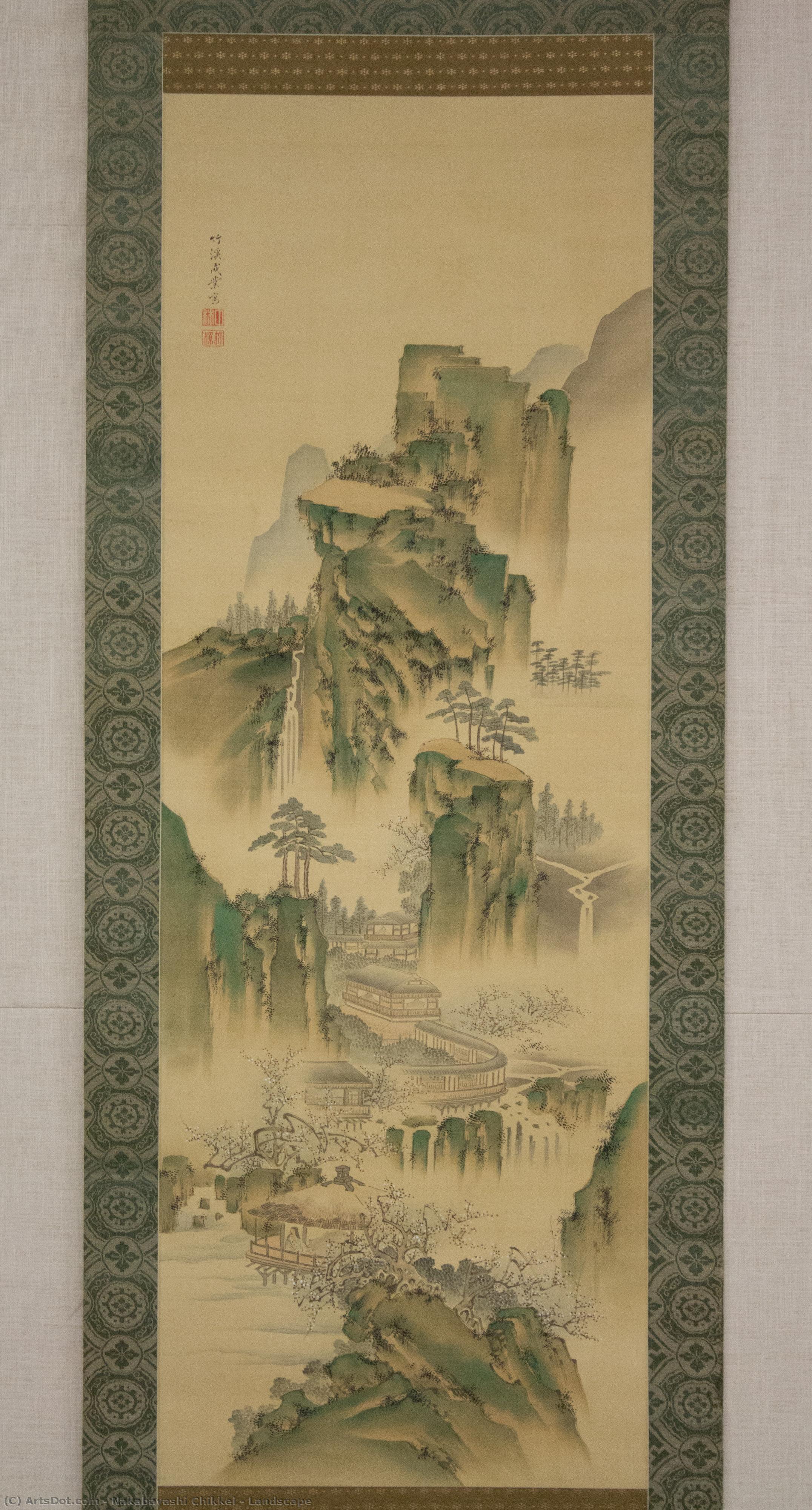
While deeply indebted to the Chinese tradition, Chikkei did not simply replicate it. He developed a distinctive style characterized by serene landscapes rendered with delicate brushwork and subtle color washes. His paintings often depict mountains, waterfalls, and forests shrouded in mist, evoking a sense of tranquility and contemplation. Unlike some nanga painters who favored bold, expressive strokes, Chikkei’s approach was more restrained, emphasizing precision and refinement. He excelled at capturing the atmospheric effects of light and shadow, creating scenes that feel both realistic and ethereal. A key aspect of his work is the integration of calligraphy – often poems or inscriptions – into the paintings themselves, further enhancing their intellectual depth and poetic resonance. This practice reflects the literati ideal of uniting painting, poetry, and scholarship in a single harmonious expression.
The Kyoto Nanga Group and Artistic Circles
Chikkei became an active member of the Kyoto nanga group, a community of artists who shared a passion for Chinese-style painting and classical literature. This association provided him with opportunities to exchange ideas, collaborate with fellow painters, and refine his artistic skills. The group’s emphasis on intellectual discourse and philosophical inquiry further deepened Chikkei’s understanding of the nanga tradition. He was particularly influenced by Gion Nankai and Yamamoto Baiitsu, both prominent figures in the Kyoto art scene. While his father focused on Northern School Chinese painting, Chikkei gravitated towards the Southern School style, demonstrating a personal artistic preference within the broader nanga framework. This divergence highlights the individual creativity that flourished even within established traditions.
Legacy and Historical Significance
Nakabayashi Chikkei’s works are now held in prestigious collections such as the Los Angeles County Museum of Art and the Harvard Art Museums, attesting to their enduring artistic merit. While perhaps not as widely recognized as some of his contemporaries, he played a vital role in preserving and transmitting the nanga tradition during a period of significant change. His paintings offer a glimpse into the aesthetic values of the late Edo period – a time when scholars and artists sought solace and inspiration in the beauty of nature and the wisdom of classical literature. Chikkei’s legacy lies not only in his skillful execution but also in his ability to create works that evoke a sense of tranquility, contemplation, and intellectual depth. His dedication to the nanga style ensured its continued vitality, influencing generations of Japanese painters who followed in his footsteps. He represents a bridge between tradition and individual expression, demonstrating how artistic heritage can be both honored and creatively reinterpreted.


 Megtekintés
 Kézzel festett másolat rendelése
 Küldés
 Megosztás
 Részletek

 Letöltés
 Hasonló darabok
 X-ray felvétel
 Diavetítés


 Összes részlet megjelenítése






































 Az üvegkeretes opció csak 110 cm alatti méretben érhető el



