

Shown: · With its frame:
 Megtekintés
 Küldés
 Megosztás
 Részletek
 Útmutató

 Letöltés
 Hasonló darabok
 X-ray felvétel
 Diavetítés
 Q&A
Q&A Statisztika


Ft 87954
Kézzel készített olajfestmény reprodukció
Kézzel festett olajvastú vászon, az Ön által választott méretben és keretben, művészeink készítik meglévőre. ( Váltás nyomtatványra Áttérés digitális képre)
Size
·Standard méret
egyedi méretű
CM
INCH
Válasszon előre meghatározott méreteink közül, amelyek megfelelnek a műalkotás eredeti arányainak.
Loading sizes...

szélesség
magasság
Írja be a kívánt szélességet és magasságot, hogy illeszkedjen a keretéhez vagy a falához. Mivel ez kézzel festett alkotás, egy eltérő formájú méret esetén a művész akár festhet is valamivel többet a kép körül, vagy korolathat is belőle — az Ön döntésének megfelelően. A festés megkezdése előtt küldünk egy digitális tervezetet jóváhagyásra. Az oldalon látható kép nem tartalmazza a végeredményt — csak a tervezet mutatja meg a valódi eredményt.
 További információk
Finish
·
White Ft1

Blurside Ft1

Extended Ft1

P118B Ft10

P118H Ft10

P118W Ft10

P438Z Ft10

P508JH Ft12

P508YH Ft12

P805H Ft10

P805Z Ft10

P919BZ Ft10

P919G Ft10

P919XJ Ft10

P959ZH Ft10

P968JZ Ft12

W106C Ft8

W218G Ft10

W218JH Ft8

W218Y Ft10

W307PJ Ft10

W316G Ft10

W316PJ Ft8

W316Y Ft10

W398PJ Ft8

W4111J Ft10

W500HY Ft15

W500JH Ft15

W692G Ft12

W849H Ft8

W940BG Ft15

W953PJ Ft8

H24-GOLD Ft30

H24-SILVER Ft30

H36-GOLD Ft45

H36-SILVER Ft45
Shipped in a protective tube, ready for your own framer.
Above 105 cm the frame is shipped as a kit for a professional framer — read the details.
Extras
optionalWhat do the extras include?
Examples of what can be changed: Replace face with customer photo; Add pet (e.g., replace cat with dog); Include hidden message in background; Change background landscape or elements.
After order, TopImpressionists.com team will email client for instructions and provide a mockup preview
After order, TopImpressionists.com team will email client for instructions and provide a mockup preview
Világszerte elérhető szállítás () 3-4 hét alatt a szokásos 5 hét helyett. (30 október). A minőség nem kérdőjelezhető.
Védőréteg (Lakk)
Névtábla
A gravírozott bronztábla részletei
This elegant plaque features the artist's name and the title of the artwork, finely engraved for a timeless presentation.
It is made from bronze with a refined, elegant finish. The text is precisely laser-engraved for a sharp and permanent result. Measuring 9x2 cm, the plaque is compact yet easy to read. It's built to be durable and scratch-resistant, offering a professional, museum-quality look. Mounting is simple thanks to the included adhesive backing.
Átlátszó akril tábla részletei
The plaque includes essential engraved details such as the artist's name, the title of the artwork, the date it was created, the type of media used-like oil on canvas or watercolor-a brief description of the piece, and a QR code that links to the complete artwork information.
It is crafted from clear acrylic, offering a sleek, modern appearance. The text is UV-engraved in black to ensure strong visual contrast. With a size of 10x15 cm, it ensures optimal readability. It comes equipped with two metal hooks for secure wall mounting. The plaque is designed to be weather-resistant, making it suitable for various environments, and it includes interactive features that work seamlessly with smartphone scanning.
Fekete akril tábla részletei
This elegant plaque includes engraved information such as the artist's name, the title of the artwork, the date it was created, the type of media used (like oil on canvas or watercolor), a short description of the artwork, and a QR code for quick access to more information.
The plaque itself is made from refined black acrylic with a premium finish. The text is laser-engraved in white for high contrast and readability. Its size is 10x15 cm, designed to be easy to read. It comes with two metal hooks for professional mounting. The design is sleek and fits any interior style. It is also weather-resistant and durable, with built-in digital integration for mobile compatibility.
Az üvegkeretes opció csak 110 cm alatti méretben érhető el
 Az üvegkeretes opció csak 110 cm alatti méretben érhető el
- Ingyenes globális expressz szállítás
- Prémium minőségű len vászon
- Teljes körű szállítási biztosítás
- Vámvisszatérítési Garancia
- Hiteles színarányosság garancia
- 100 napos visszaküldési lehetőség (csak hibás termékek esetén)
- 100% pénzvisszatérítési garancia
- Több darab vásárlásakor kedvezmény


A gyűjtemény leírása
Paul Sérusier's 'The Grammar' (1892) is an iconic Cloisonnism painting, pioneering abstract art & inspiring the Nabis movement. Explore its symbolism and artistic innovation.
A művész életrajza
Paul Sérusier (1864-1927) francia festő, a Nabis csoport egyik alapítója és a modern művészet úgymeg kezdeteinek meghatározó alakja. Cloisonnism stílusával, a tájak és figurák expresszív ábrázolásával jelent meg, inspirálva ezzel a tömegét.
About the painting
The Grammar: A Pioneering Exploration of Abstraction
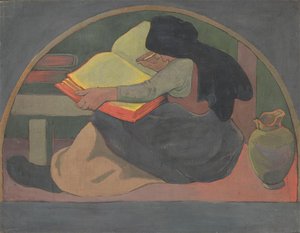
Paul Sérusier’s “Grammar,” painted in 1892, stands as a pivotal work not just within the artist's oeuvre but also as a foundational piece in the development of modern art. More than simply a portrait, it’s an intensely personal and experimental exploration of color, form, and the very nature of representation – a bold step towards abstraction that profoundly influenced generations of artists to come. The painting depicts a woman seated on the ground, absorbed in reading a book, a scene rendered with remarkable intimacy and a deliberate departure from traditional academic styles.
Sérusier’s artistic journey was deeply intertwined with the burgeoning Nabis movement, a group of Symbolist painters who sought to move beyond mere imitation of nature towards expressing inner emotions and spiritual truths. He initially studied at the Académie Julian, but it was his summer sojourn in Pont-Aven, Brittany, that proved transformative. There, under the tutelage of Paul Gauguin – a figure whose influence extended far beyond technique – Sérusier encountered the revolutionary approach of Cloisonnism, championed by Gauguin himself. This style, characterized by sharply defined outlines and areas of flat color applied in small, separate strokes, aimed to mimic the appearance of stained glass, creating a sense of luminous clarity and symbolic resonance.
Cloisonnism and the Language of Color
“Grammar” exemplifies this Cloisonnism technique with striking precision. The woman’s figure is not rendered through subtle gradations of tone but rather defined by bold, distinct outlines – a deliberate simplification that prioritizes color and form over meticulous detail. Sérusier employs a vibrant palette, dominated by deep blues, greens, and ochres, creating an atmosphere both serene and slightly melancholic. The colors aren’t blended; instead, they are applied in small, separate strokes, building up layers of hue and texture. This technique, combined with the flattened perspective, creates a sense of immediacy and directness, as if the painting is capturing a fleeting moment of contemplation.
Crucially, Sérusier’s use of color isn't merely descriptive; it carries symbolic weight. The blues evoke a sense of introspection and mystery, while the greens suggest connection to nature – a key theme in Symbolist art. The muted ochres contribute to the painting’s overall feeling of quietude and contemplation. The deliberate choice of colors, rather than realistic representation, is central to the work's expressive power.
A Study in Form and Abstraction
Beyond its technical mastery, “Grammar” represents a significant shift towards abstraction. While not entirely devoid of recognizable forms – the woman’s figure, the book, the surrounding objects – the painting prioritizes the exploration of color and form over strict representation. The simplified shapes, flattened perspective, and emphasis on pure color anticipate later developments in abstract art, foreshadowing the work of artists like Kandinsky and Mondrian. It's a deliberate move away from photographic realism towards a more subjective and expressive approach to visual language.
The painting’s title, “Grammar,” is particularly intriguing. It suggests that Sérusier was not simply depicting a scene but rather exploring the fundamental building blocks of artistic expression – the elements of color, line, and form – in a way that transcends traditional representation. The book itself becomes a symbol of knowledge and contemplation, inviting the viewer to engage with the painting on a deeper level.
Legacy and Inspiration
“Grammar” remains a vital work in the history of modern art, demonstrating Sérusier’s pioneering spirit and his profound influence on subsequent generations. It's a testament to the power of abstraction to convey emotion, ideas, and spiritual truths. Reproductions of this evocative painting continue to inspire artists and collectors alike, offering a glimpse into the heart of artistic innovation and the enduring quest for new forms of visual expression.
Kérdések és válaszok
Használhatom az augmented reality technológiát, hogy megtekintsem a „The Grammar”, Paul Sérusier alkotása művet a saját szobámban?
A „The Grammar”, Paul Sérusier alkotása mű kiterjesztett valóság technológiával, egy kompatibilis eszközön keresztül, a mű Kiterjesztett valóság előnézet oldalán megtekinthető a saját falán is.
Milyen módon kapcsolódik a "The Grammar" stílusa alkotójának korához?
A „The Grammar”, Paul Sérusier alkotása a Cloisonnism / Nabis irányzat alkotása, mely alkotójának 19. század korszakából származik.
Milyen telítettséget és intenzitást mutat „The Grammar”, Paul Sérusier alkotása?
A "The Grammar" színe Muted telítettségű és Monochromatic intenzitású.
Quick facts and art quiz
About Paul Sérusier

Paul Sérusier
1864 - 1927, Franciaország
A művész életrajza
Early Life and Artistic Beginnings
Paul Sérusier, a pivotal figure in the development of modern art, was born on November 9th, 1864, in the heart of Paris. His upbringing within a prosperous middle-class family provided him with an exceptional education, beginning at the Lycée Fontane – later known as Lycée Condorcet – where he immersed himself in classical philosophy, Greek and Latin studies, and the sciences. This rigorous foundation laid the groundwork for his future artistic explorations. Notably, Sérusier’s classmates included fellow artists who would profoundly influence his trajectory, including Maurice Denis, Édouard Vuillard, and Ker-Xavier Roussel. His father, a successful businessman involved in the perfume industry, ensured that Paul received an upbringing conducive to pursuing his passions, recognizing his innate talent and desire for artistic expression. This familial support allowed Sérusier to dedicate himself fully to his burgeoning career as a painter, free from the constraints of immediate financial concerns.The Pont-Aven Years: Gauguin’s Influence and Cloisonnism
Sérusier's artistic journey truly took shape during the summer of 1888 when he traveled to Pont-Aven in Brittany. This picturesque coastal village became a vibrant hub for artists seeking inspiration and camaraderie, drawing figures like Paul Gauguin, Emile Bernard, and many others. It was within this environment that Sérusier encountered Gauguin, whose artistic philosophy and techniques exerted a powerful influence on the young painter. Gauguin encouraged Sérusier to break free from traditional academic painting practices, urging him to embrace pure colors, simplified forms, and a more intuitive approach to representation. This guidance culminated in the creation of *Bois d’Amour* (1888), a seminal work that exemplifies Sérusier's pioneering use of cloisonnism – a technique characterized by bold, flat shapes delineated by dark outlines, creating an almost mosaic-like effect. This innovative approach marked a significant departure from conventional painting methods and foreshadowed the development of abstract art.The Nabis Movement: Synthesis and Symbolism
Building upon his experiences at Pont-Aven, Sérusier became a key figure in the formation of the *Nabis* (meaning “prophet”) group – a collective of artists united by their desire to synthesize diverse artistic influences. Alongside Paul Gauguin, Maurice Denis, Pierre Bonnard, and Édouard Vuillard, the Nabis sought to create a new visual language that blended elements of Post-Impressionism, Symbolism, and even hints of Japanese aesthetics. The group met regularly at Ranson’s studio in Paris, engaging in spirited discussions about art, philosophy, and spirituality. Sérusier's work during this period reflected the Nabis’ emphasis on subjective experience, emotional expression, and a rejection of purely representational painting. He explored themes of melancholy, solitude, and the beauty of the natural world, often employing muted colors and evocative compositions to convey his inner state.Notable Works and Lasting Legacy
Throughout his career, Sérusier produced a remarkable body of work that continues to captivate viewers today. Key pieces include *L’Averse* (1893), a poignant depiction of a rainy day in Paris, which showcases his mastery of color and composition; the portrait of Paul Ranson (1890), offering a glimpse into the artist's personality; and *The Snake Eaters* (1894), a striking image that reflects the group’s interest in symbolism and mythology. Later in life, Sérusier taught at the École Ranson, further disseminating his artistic ideas and mentoring a new generation of artists. He also published “ABC de la peinture” in 1921, a seminal work exploring the fundamentals of painting. Paul Sérusier passed away on October 7th, 1927, in Morlaix, leaving behind a legacy as one of the most influential figures in the transition from Impressionism to modern art. His pioneering use of abstraction and his contributions to the Nabis movement continue to inspire artists today.Quick facts about Paul Sérusier
- Artistic Movement Or Style: Post-Impressionista
- Artists Or Movements Influenced By This Artist:
- Les Nabis
- Synthetizmus
- Artists Who Influenced This Artist:
- Paul Gauguin
- Maurice Denis
- Date Of Birth: November 9, 1864
- Date Of Death: October 7, 1927
- Full Name: Louis-Paul-Henri Sérusier
- Nationality: Francia
- Notable Artworks:
- A Talisman
- L'averse
- Melancholy
- Place Of Birth: Párizs, Franciaország
Hasonló műalkotások




Fedezze fel a műalkotásokat témák, stílusok és jellemzők szerint csoportosítva.


Paul Sérusier
The Grammar
() ·
With its frame: · Hand-painted in oil on linen
Total