

Shown: · With its frame:
 Megtekintés
 Küldés
 Megosztás
 Részletek
 Útmutató

 Letöltés
 Hasonló darabok
 X-ray felvétel
 Diavetítés
 Q&A
Q&A Statisztika

Ft 88091
Kézzel készített olajfestmény reprodukció
Kézzel festett olajvastú vászon, az Ön által választott méretben és keretben, művészeink készítik meglévőre. ( Váltás nyomtatványra Áttérés digitális képre)
Size
·Standard méret
egyedi méretű
CM
INCH
Válasszon előre meghatározott méreteink közül, amelyek megfelelnek a műalkotás eredeti arányainak.
Loading sizes...

szélesség
magasság
Írja be a kívánt szélességet és magasságot, hogy illeszkedjen a keretéhez vagy a falához. Mivel ez kézzel festett alkotás, egy eltérő formájú méret esetén a művész akár festhet is valamivel többet a kép körül, vagy korolathat is belőle — az Ön döntésének megfelelően. A festés megkezdése előtt küldünk egy digitális tervezetet jóváhagyásra. Az oldalon látható kép nem tartalmazza a végeredményt — csak a tervezet mutatja meg a valódi eredményt.
 További információk
Finish
·
White Ft1

Blurside Ft1

Extended Ft1

P118B Ft10

P118H Ft10

P118W Ft10

P438Z Ft10

P508JH Ft12

P508YH Ft12

P805H Ft10

P805Z Ft10

P919BZ Ft10

P919G Ft10

P919XJ Ft10

P959ZH Ft10

P968JZ Ft12

W106C Ft8

W218G Ft10

W218JH Ft8

W218Y Ft10

W307PJ Ft10

W316G Ft10

W316PJ Ft8

W316Y Ft10

W398PJ Ft8

W4111J Ft10

W500HY Ft15

W500JH Ft15

W692G Ft12

W849H Ft8

W940BG Ft15

W953PJ Ft8

H24-GOLD Ft30

H24-SILVER Ft30

H36-GOLD Ft45

H36-SILVER Ft45
Shipped in a protective tube, ready for your own framer.
Above 105 cm the frame is shipped as a kit for a professional framer — read the details.
Extras
optionalWhat do the extras include?
Examples of what can be changed: Replace face with customer photo; Add pet (e.g., replace cat with dog); Include hidden message in background; Change background landscape or elements.
After order, TopImpressionists.com team will email client for instructions and provide a mockup preview
After order, TopImpressionists.com team will email client for instructions and provide a mockup preview
Világszerte elérhető szállítás () 3-4 hét alatt a szokásos 5 hét helyett. (1 november). A minőség nem kérdőjelezhető.
Védőréteg (Lakk)
Névtábla
A gravírozott bronztábla részletei
This elegant plaque features the artist's name and the title of the artwork, finely engraved for a timeless presentation.
It is made from bronze with a refined, elegant finish. The text is precisely laser-engraved for a sharp and permanent result. Measuring 9x2 cm, the plaque is compact yet easy to read. It's built to be durable and scratch-resistant, offering a professional, museum-quality look. Mounting is simple thanks to the included adhesive backing.
Átlátszó akril tábla részletei
The plaque includes essential engraved details such as the artist's name, the title of the artwork, the date it was created, the type of media used-like oil on canvas or watercolor-a brief description of the piece, and a QR code that links to the complete artwork information.
It is crafted from clear acrylic, offering a sleek, modern appearance. The text is UV-engraved in black to ensure strong visual contrast. With a size of 10x15 cm, it ensures optimal readability. It comes equipped with two metal hooks for secure wall mounting. The plaque is designed to be weather-resistant, making it suitable for various environments, and it includes interactive features that work seamlessly with smartphone scanning.
Fekete akril tábla részletei
This elegant plaque includes engraved information such as the artist's name, the title of the artwork, the date it was created, the type of media used (like oil on canvas or watercolor), a short description of the artwork, and a QR code for quick access to more information.
The plaque itself is made from refined black acrylic with a premium finish. The text is laser-engraved in white for high contrast and readability. Its size is 10x15 cm, designed to be easy to read. It comes with two metal hooks for professional mounting. The design is sleek and fits any interior style. It is also weather-resistant and durable, with built-in digital integration for mobile compatibility.
Az üvegkeretes opció csak 110 cm alatti méretben érhető el
 Az üvegkeretes opció csak 110 cm alatti méretben érhető el
- Ingyenes globális expressz szállítás
- Prémium minőségű len vászon
- Teljes körű szállítási biztosítás
- Vámvisszatérítési Garancia
- Hiteles színarányosság garancia
- 100 napos visszaküldési lehetőség (csak hibás termékek esetén)
- 100% pénzvisszatérítési garancia
- Több darab vásárlásakor kedvezmény


A gyűjtemény leírása
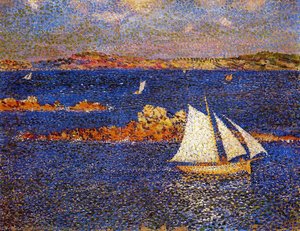
Experience the vibrant tranquility of Paul Signac's 1906 Pointillist masterpiece The Bay featuring colorful sailboats on a serene seascape and inviting you to bring this Neo-Impressionist gem into your collection.
A művész életrajza
Paul Signac (1863-1935): A neo-impressionista festő, a pointillizmus megalkotója! Élénk tengerparti tájak, kikötők és a modern művészet meghatározó alakja. Fedezd fel a vibráló világát!
About the painting
A Symphony of Light and Color
In the tranquil embrace of Paul Signac’s 1906 masterpiece, "The Bay," the viewer is invited into a world where light does not merely illuminate a scene but becomes the very fabric of its existence. This breathtaking work captures a serene coastal moment, where two sailboats with vibrant red and white sails drift lazily upon a shimmering expanse of water. The composition is anchored by a rugged, rocky shoreline in the foreground, where textured trees reach toward a sky filled with soft, drifting clouds. Beyond the gentle movement of the boats, a distant cliff rises with a sense of quiet grandeur, providing a structural weight that balances the ethereal lightness of the sea and sky. It is a scene that transcends mere landscape painting, offering instead a meditative window into the harmony of the natural world.
The true soul of this painting lies in its meticulous execution through the Pointillist technique, a method perfected by Signac to achieve a scientific yet deeply emotional resonance. Rather than blending pigments on a palette, Signac applied tiny, distinct dots of pure, unadulterated color directly onto the canvas. From a distance, these rhythmic pulsations of pigment dance and merge within the viewer's eye, creating an optical fusion that mimics the flickering quality of sunlight on water. This technique lends "The Bay" a unique, vibrating texture; the colors do not sit static upon the surface but seem to breathe and shimmer, capturing the fleeting essence of a summer afternoon with unparalleled vitality.
The Legacy of Neo-Impressionism
To understand the profound impact of "The Bay," one must look to the historical currents that shaped Paul Signac’s vision. As a pioneer of Neo-Impressionism, Signac sought to move beyond the spontaneous, often fleeting impressions of his predecessors toward a more structured and systematic approach to art. Influenced heavily by the scientific theories of color and light prevalent in late 19th-century France, he transformed the canvas into a laboratory of perception. In this work, we see the culmination of years of experimentation—a transition from the soft edges of Impressionism to a disciplined, mosaic-like precision that celebrates the mathematical beauty of light.
For the discerning collector or interior designer, "The Bay" offers much more than aesthetic beauty; it provides a focal point of sophisticated tranquility. The striking contrast between the deep, saturated tones of the rocky coast and the brilliant pops of crimson in the sails creates a dynamic visual energy that can anchor a room with elegance. Whether placed in a contemporary gallery setting or a classic study, this reproduction serves as a testament to the enduring power of Pointillism. It is an invitation to slow down, to observe the minute details, and to rediscover the profound peace found in the rhythmic dance of color and light.
Kérdések és válaszok
Használhatom az augmented reality technológiát, hogy megtekintsem a „The bay”, Paul Signac alkotása művet a saját szobámban?
A(z) "The bay" kiterjesztett valóság (AR) előnézettel rendelkezik: a mű Kiterjesztett valóság előnézet oldalán kompatibilis eszközön megtekinthető saját környezetében.
A „The bay”, Paul Signac alkotása portré, tájékép vagy négyzet alakú kompozíció?
A „The bay”, Paul Signac alkotása egy Landscape kompozíció. A nyomtatási méret kiválasztása előtt érdemes ellenőrizni az arányokat.
Melyik szakaszába tartozik Paul Signac pályájának a "The bay" (1906)?
A 1906 évszám a "The bay" alkotást Paul Signac fejlődésének Mature Period szakaszába helyezi.
Quick facts and art quiz
About Paul Signac

Paul Signac
1863 - 1935, Franciaország
A művész életrajza
The Harmonious Vision of Paul Signac
Paul Victor Jules Signac, born in Paris in 1863, emerged as a pivotal figure in the evolution of modern art, inextricably linked to the birth and development of Neo-Impressionism. His early life, marked by a privileged upbringing within a successful merchant family, provided him with both financial security and exposure to the cultural elite of the time. However, it was a youthful encounter with Claude Monet’s exhibition in 1880 that truly ignited his artistic passion, setting him on a path far removed from the expected trajectory of a young man from a wealthy background. This initial fascination with Impressionism sparked a lifelong exploration of light, color, and the very science underpinning visual perception – a pursuit that would ultimately define his unique contribution to the art world. Signac wasn’t merely a painter; he was a dedicated explorer, driven by an insatiable curiosity about how we perceive the world around us.A Dialogue with Seurat and the Birth of Neo-Impressionism
The meeting between Signac and Georges Seurat in 1884 proved transformative for both artists. They shared a deep admiration for Eugène Delacroix’s writings on color theory, particularly his exploration of complementary contrasts and the emotional impact of hue. This intellectual kinship fueled a rigorous investigation into these principles, leading them to develop a revolutionary painting technique – Pointillism. Signac wholeheartedly embraced Seurat's vision, abandoning the fleeting brushstrokes of Impressionism for the precise, calculated application of tiny, distinct dots of pure color intended to blend optically in the viewer’s eye. This wasn’t simply about aesthetics; it was an attempt to systematize painting, grounding it in scientific principles and challenging conventional artistic norms. The core idea was that by applying small strokes of complementary colors side-by-side, the human eye would naturally mix them, creating a richer, more vibrant image than could be achieved with traditional brushwork. Boulevard de Clichy (1886) stands as an early and remarkably successful testament to this new approach, showcasing Signac’s meticulous style and his commitment to capturing the vibrancy of urban life through a scientific lens – a deliberate departure from the subjective impressions favored by many Impressionists. Their collaboration wasn't merely technical; it was intellectual, fueled by a shared desire to elevate painting to the level of a rigorous science.Coastal Reveries and Artistic Independence
Following Seurat’s tragic early death in 1891, Signac continued to develop his artistic vision, deeply influenced by his profound love for sailing and the allure of the Mediterranean coast. He discovered Saint-Tropez in 1892, establishing a home there that became a haven for artists and a source of endless inspiration. The shimmering waters, sun-drenched harbors, and picturesque coastal towns provided an ideal setting to explore the interplay of light and color. *The Red Buoy, Saint-Tropez* (1895) exemplifies this period, showcasing his mastery of Pointillism in capturing the vibrant hues and dynamic energy of the sea. He experimented with larger brushstrokes and a broader palette, moving beyond strict adherence to Seurat’s precise dotting method, incorporating elements of Impressionistic spontaneity into his technique. His travels extended beyond France, encompassing Italy, Holland, and even Constantinople, each journey enriching his artistic vocabulary and broadening his perspective – he meticulously documented these experiences in watercolor notebooks, capturing the essence of each location through rapid sketches and washes of color.A Patron of the Avant-Garde and Lasting Legacy
Beyond his own prolific output, Signac played a crucial role in fostering the development of modern art through his leadership within the Société des Artistes Indépendants. As president from 1908 until his death in 1935, he championed artistic freedom and provided a platform for emerging talents, including Henri Matisse, André Derain, and other pioneers of Fauvism and Cubism. He was among the first to recognize and support their groundbreaking work, exhibiting controversial pieces that challenged conventional aesthetic norms – often defying established tastes and pushing the boundaries of artistic expression. Signac’s commitment to inclusivity and his willingness to embrace innovation helped shape the trajectory of 20th-century art. His theoretical writings, notably *From Eugène Delacroix to Neo-Impressionism* (1899), further solidified his position as a leading intellectual figure in the art world, offering a systematic exploration of color theory and its application to painting. Paul Signac’s legacy extends far beyond his captivating paintings; he was a visionary artist, a dedicated theorist, and a generous patron who profoundly influenced the course of modern art, leaving an indelible mark on generations of artists to come.Key Dates & Achievements
- 1863: Born in Paris, France.
- 1884: Co-founded the Société des Artistes Indépendants with Georges Seurat.
- 1886: Painted *Boulevard de Clichy*, a key example of early Pointillism.
- 1895: Created *The Red Buoy, Saint-Tropez*, showcasing his mastery of coastal scenes.
- 1899: Published *From Eugène Delacroix to Neo-Impressionism*, a seminal work on color theory.
- 1908 – 1935: Served as President of the Société des Artistes Indépendants, championing avant-garde artists.
- 1935: Passed away in Paris at the age of 72, leaving behind a rich artistic legacy.
Quick facts about Paul Signac
- Artistic Movement Or Style: Neo-Impressionizmus, Divizionizmus
- Artists Or Movements Influenced By This Artist:
- Henri Matisse
- Fauvizmus
- Artists Who Influenced This Artist:
- Claude Monet
- Georges Seurat
- Date Of Birth: November 11, 1863
- Date Of Death: August 15, 1935
- Full Name: Paul Victor Jules Signac
- Nationality: Francia
- Notable Artworks:
- Boulevard de Clichy
- A Vörös Bottyú
- A Szellő Concarneau-ban
- A Velodrom
- A tengerpart Collioure-ban
- Place Of Birth: Párizs, Franciaország
Hasonló műalkotások





Fedezze fel a műalkotásokat témák, stílusok és jellemzők szerint csoportosítva.


Paul Signac
The bay
() ·
With its frame: · Hand-painted in oil on linen
Total