

 Előnézet
 Megosztás
 Megosztás
 Részletek
 Útmutató

 Letöltés
 Hasonló darabok
 X-ray felvétel
 Diavetítés
 Statisztika
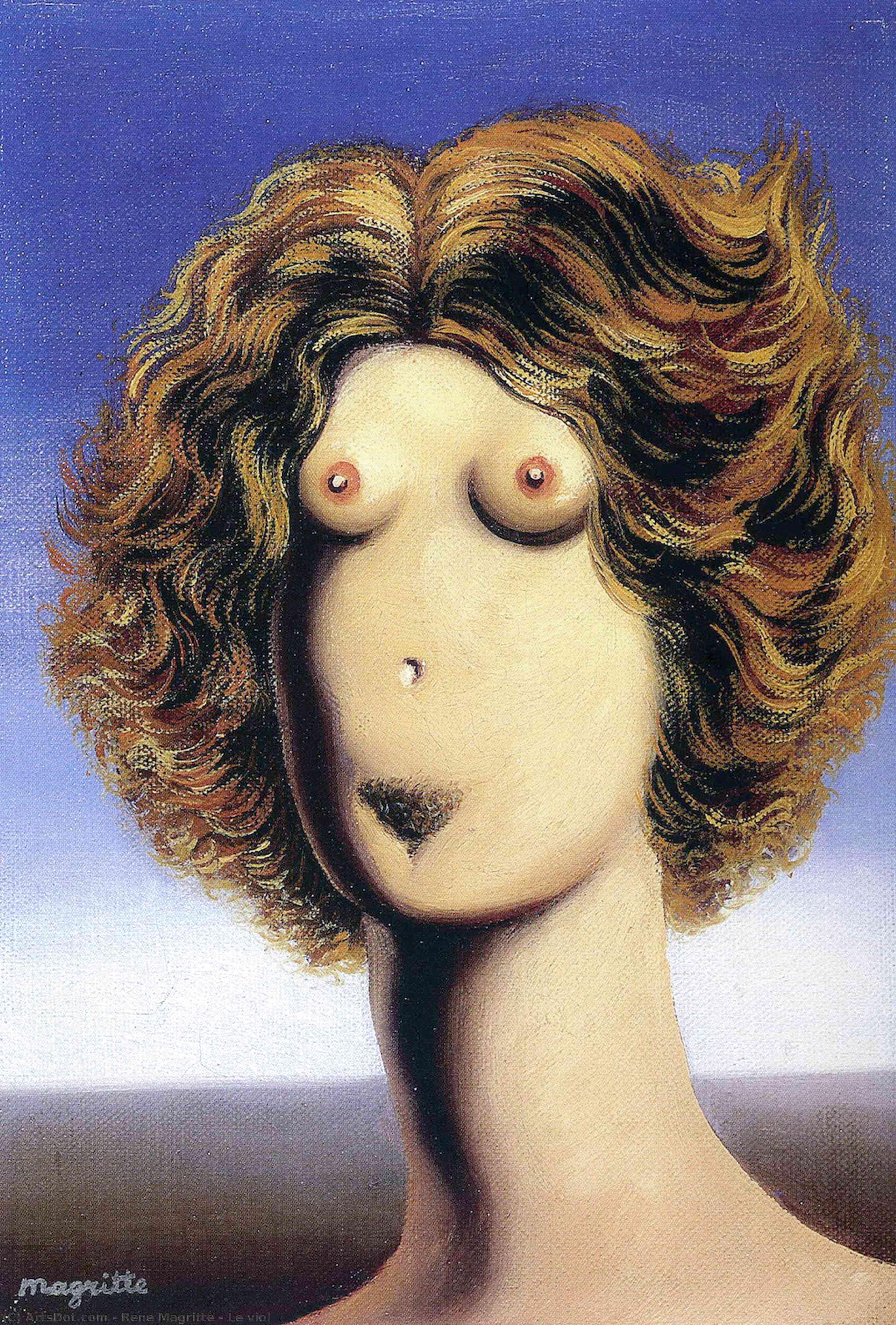
Le viol


A surrealist visual paradox featuring a nude female figure with two breasts by René Magritte from 1935 invites you to explore the unsettling depths of perception and find your place within this enigmatic masterpiece.
 Tovább olvasom
Magritte: A szürrealista festő, aki a valóságot megkérdőjelezte! Képei a 'Szívszorító csók', 'A lovagló' és más ikonikus művekkel kihívják az elképzeléseinket. Nézze meg a szokatlan világát!
Az ezen az oldalon megjelenített műalkotások szerzői jogi védelem alatt állnak, ami azt jelenti, hogy törvényileg nem készíthetünk és nem adhatunk el belőlük pontos másolatokat. Ez a védelem olyan nemzetközi megállapodások alapján érvényesül, mint például a Berni Egyezmény és a nemzeti törvények által, beleértve azokat is, amelyeket meghatározott Az USA szerzői jogi törvénye – 17. cím.
Mint tiszteletes és törvényes alternatívát, olyan egyedi, kézzel festett alkotásokat kínálunk, amelyek az eredetiből merítnek inspirációt. Tapasztalt és professzionális művészeink alaposan tanulmányozzák az eredeti stílusát, hangulatát és művészeti esszenciáját, hogy egy olyan új, egyedi alkotást hozzunk létre, amely ugyanazt az érzést kelti – miközben önálló, eredeti alkotásként létezik.
Ez a módszer teljes mértékben megfelel a szerzői jogi szabályozásnak, mivel nem tartalmazza a védett műalkotás másolását vagy duplikálását. Ehelyett ez egy kreatív újinterpretáció – egy új festmény, amely az eredetivel való összefüggései miatt hatással van rá, de nem az az.
Kézzel készített olajfestmény reprodukció
Kézzel festett olajvastú vászon, az Ön által választott méretben és keretben, művészeink készítik meglévőre. ( Váltás nyomtatványra Áttérés digitális képre)




P118B Ft10

P118H Ft10

P118W Ft10

P438Z Ft10

P508JH Ft12

P508YH Ft12

P805H Ft10

P805Z Ft10

P919BZ Ft10

P919G Ft10

P919XJ Ft10

P959ZH Ft10

P968JZ Ft12

W106C Ft8

W218G Ft10

W218JH Ft8

W218Y Ft10

W307PJ Ft10

W316G Ft10

W316PJ Ft8

W316Y Ft10

W398PJ Ft8

W4111J Ft10

W500HY Ft15

W500JH Ft15

W692G Ft12

W849H Ft8

W940BG Ft15

W953PJ Ft8




Standard méret
egyedi
CM
INCH
Válasszon előre meghatározott méreteink közül, amelyek megfelelnek a műalkotás eredeti arányainak.
Loading sizes...

szélesség
magasság
Írja be a kívánt szélességet és magasságot, hogy illeszkedjen a keretéhez vagy a falához. Mivel ez kézzel festett alkotás, egy eltérő formájú méret esetén a művész akár festhet is valamivel többet a kép körül, vagy korolathat is belőle — az Ön döntésének megfelelően. A festés megkezdése előtt küldünk egy digitális tervezetet jóváhagyásra. Az oldalon látható kép nem tartalmazza a végeredményt — csak a tervezet mutatja meg a valódi eredményt.
Példák arra, mit lehet módosítani: az arc kicserélése az ügyfél fotójára; háziállat hozzáadása (pl. macska helyett kutya); rejtett üzenet elhelyezése a háttérben; a háttér tájának vagy elemeinek megváltoztatása.
A rendelést követően a TopImpressionists.com csapata e-mailt küld az ügyfélnek az instrukciókért, és biztosít egy előnézeti képet (mockup).
A rendelést követően a TopImpressionists.com csapata e-mailt küld az ügyfélnek az instrukciókért, és biztosít egy előnézeti képet (mockup).
Világszerte elérhető szállítás () 3-4 hét alatt a szokásos 5 hét helyett. (15 október). A minőség nem kérdőjelezhető.

Ingyenes globális expressz szállítás

Prémium minőségű len vászon

Teljes körű szállítási biztosítás

Vámvisszatérítési Garancia

Tökéletes színarányosság garancia

100 napos visszaküldési garancia (csak gyártási hibás termékek esetén)

100% pénzvisszatérítési garancia

Több darab vásárlásakor kedvezmény
 Az üvegkeretes opció csak 110 cm alatti méretben érhető el

Le viol
Reprodukciós technika
Reprodukció méretei
-


Összesített ár
Ft 85321
A Surrealist Riddle: Exploring René Magritte’s “Le Viol”
René Magritte's "Le Viol," painted in 1935, isn’t merely a depiction of a woman; it’s an invitation to confront the unsettling core of perception itself. This deceptively simple image—a nude female figure with two breasts—immediately arrests the viewer’s gaze and compels contemplation beyond its surface appearance. Magritte, deeply influenced by the burgeoning Surrealist movement, skillfully employs visual paradox to unsettle conventional notions of beauty and reality.The Style and Technique of Illusion
Magritte's approach aligns perfectly with Surrealism’s manifesto championed by André Breton—a deliberate rejection of rational thought in favor of accessing the subconscious mind. He achieves this effect through meticulous realism rendered in oil paint on canvas, a technique that contrasts sharply with the dreamlike distortions characteristic of other Surrealist artists. The artist employs precise shading and tonal gradations to create an illusionistic depth, grounding the fantastical element—the doubled breast—within a believable space. This careful craftsmanship underscores Magritte’s commitment to portraying the world as it *feels*, rather than simply how it looks.Historical Context: Surrealism's Challenge to Convention
The 1930s witnessed a fervent debate regarding artistic expression and societal values. Surrealism arose from disillusionment with the horrors of World War I and a desire to liberate thought from the constraints of logic. Breton argued that art should bypass conscious control, tapping into primal instincts and repressed desires—a radical departure from academic painting’s focus on idealized representations. “Le Viol” embodies this spirit, mirroring the movement's preoccupation with exploring hidden anxieties and questioning accepted standards of femininity. It reflects a broader cultural fascination with psychoanalysis and its exploration of unconscious motivations.Symbolism: Beyond Anatomy – A Meditation on Desire
The doubled breast is arguably the painting’s most potent symbol—a deliberate provocation designed to disrupt our ingrained understanding of female anatomy. While seemingly straightforward, Magritte avoids explicit eroticism; instead, he presents a visual enigma that invites interpretation. Some scholars suggest it represents fertility and motherhood, while others interpret it as a commentary on societal pressures surrounding female sexuality. The woman’s gaze is averted, furthering the sense of mystery and emphasizing the difficulty of accessing inner thoughts and emotions. Magritte's masterful use of symbolism elevates “Le Viol” beyond mere visual representation, transforming it into a profound meditation on desire and vulnerability.Emotional Resonance: Unease and Intellectual Engagement
“Le Viol” lingers in the viewer’s mind long after initial observation—a testament to its ability to evoke feelings of unease and stimulate intellectual curiosity. Magritte doesn't offer answers; he poses questions, forcing us to confront our assumptions about beauty, sexuality, and the nature of reality. Like many Surrealist artworks, it operates on multiple levels, stimulating contemplation and prompting viewers to consider alternative perspectives. Its enduring appeal lies in its refusal to succumb to easy interpretations—a characteristic that secures its place as a cornerstone of 20th-century art history.Gyakran Ismételt Kérdések
Milyen hangulatot árasztana egy „Le viol”, Magritte alkotása reprodukció egy szobában?
A „Le viol”, Magritte alkotása Elegant hangulata tökéletesen illeszkedik a javasolt helyszínhez: egy Living Room.
Elérhető-e letöltés a(z) "Le viol" című alkotáshoz?
A „Le viol”, Magritte alkotása képe letölthető a mű alkotásának Letöltés oldaláról: magas felbontású digitális kép letöltés.
Elérhető-e a "Le viol" nagy felbontású letöltése?
A „Le viol”, Magritte alkotása digitális képe megvásárolható a következő oldalon: Digitális kép: magas felbontású digitális kép letöltés.
A művész életrajza
Early Life and the Seeds of Surrealism
René Magritte, born René François Ghislain Magritte on November 21, 1898, in Lessines, Belgium, emerged into a world that would profoundly shape his enigmatic artistic vision. His early years were marked by an unsettling event – the suicide of his mother when he was just thirteen. The image of her body being recovered from the River Sambre, with her dress obscuring her face, became a haunting motif that would subtly permeate his later work, manifesting in veiled figures and a persistent exploration of hidden realities. This early trauma instilled within him a fascination with mystery, loss, and the unsettling power of what remains unseen. While details of his childhood remain somewhat elusive, it’s clear this formative experience laid the groundwork for his lifelong questioning of perception and representation. He began drawing lessons at age ten, revealing an innate inclination towards visual expression, but initially explored Impressionism before embarking on a path that would lead him to become one of the most significant figures in Surrealist art.Artistic Development and Influences
Magritte’s artistic journey was not immediate or straightforward. He studied at the Académie Royale des Beaux-Arts in Brussels, yet found its traditional methods stifling. His early work experimented with Futurism and Cubism, absorbing elements of these avant-garde movements but ultimately rejecting their purely formal concerns. It wasn't until encountering Giorgio de Chirico’s painting *The Song of Love* in 1922 that Magritte discovered a resonance that would irrevocably alter his artistic course. De Chirico’s dreamlike landscapes and unsettling juxtapositions unlocked within Magritte a new way of seeing – a world where the familiar could be rendered strange, and the ordinary imbued with profound mystery. This encounter sparked his commitment to Surrealism, though he often maintained a unique distance from its more overtly psychological or automatic approaches. He preferred a meticulous, almost clinical precision in his painting, using realistic techniques to depict illogical scenarios.The Heart of Surrealism: Challenging Reality
By 1926, Magritte had fully embraced the tenets of Surrealism, producing *Le Jockey Perdu (The Lost Jockey)*, widely considered his first truly surrealist work. However, his brand of Surrealism was distinct. He wasn’t interested in exploring the subconscious through free association or dream imagery in the manner of some of his contemporaries. Instead, Magritte sought to challenge viewers' perceptions of reality by presenting ordinary objects in unexpected contexts, forcing them to question their assumptions about the world around them. Iconic works like *The Treachery of Images (This is not a pipe)* (1929) brilliantly deconstructs the relationship between image and object, reminding us that a representation is never the thing itself. *Les Amants (The Lovers)* (1927-1928), with its shrouded figures, echoes the trauma of his mother’s death while simultaneously exploring themes of concealment and intimacy. *Time Transfixed* (1938) presents a locomotive bursting through a brick wall, disrupting our sense of space and time. And *The Human Condition* (1933), a canvas within a canvas, blurs the boundaries between representation and reality, prompting us to consider how we perceive and interpret the world.Later Life, Recognition, and Enduring Legacy
Despite initial struggles for recognition, Magritte’s work gradually gained prominence, particularly in the United States with exhibitions in 1936 and later retrospective shows at the Museum of Modern Art (1965) and the Metropolitan Museum of Art (1992). He remained politically engaged throughout his life, advocating for artistic autonomy. He continued to refine his signature style, exploring themes of repetition, illusion, and the power of language in paintings that are both intellectually stimulating and visually arresting. Magritte died on August 15, 1967, leaving behind a body of work that continues to captivate and challenge audiences worldwide. His influence extends far beyond the realm of painting, impacting pop art, minimalist art, conceptual art, and even advertising and film. Today, his paintings are held in major museum collections around the globe, including the Musées royaux des beaux-arts de Belgique in Brussels, which houses the Magritte Museum – dedicated entirely to his work and boasting the world’s largest collection of his creations.- Museum Collections: Musées royaux des beaux-arts de Belgique, Brussels; Magritte Museum.

Magritte
1898 - 1967 , Belgium
Gyors információk
- Artistic Movement Or Style: Szürrealizmus
- Artists Or Movements Influenced By This Artist:
- Pop art
- Minimalista művészet
- Artists Who Influenced This Artist: ['Giorgio de Chirico']
- Date Of Birth: November 21, 1898
- Date Of Death: August 15, 1967
- Full Name: René François Ghislain Magritte
- Nationality: Belga
- Notable Artworks:
- Les Amants
- A kép árulása
- Idő vetve
- Place Of Birth: Lessines, Belgium
Kapcsolódó cikkek

Beyond Reality: A Journey Into the Dreamlike World of Surrealism
Embark on a cultural journey through the dreamlike realm of Surrealism. Explore the profound psychological depths of masters like Dalí and Magritte through our expert art history insights and museum-quality hand-painted reproductions.

Beyond Reality: A Sophisticated Exploration of the Dreamlike Architecture in Surrealist Landscapes
Embark on a sophisticated journey through the dreamlike architecture of Surrealist landscapes. Uncover the profound psychological depths and visual paradoxes of masters like Salvador Dalí in this expert exploration of art’s most captivating, impossible vistas.

Surrealist Dreamscapes: A Curated Journey Through the Subconscious Majesty of Surrealism
Embark on a sophisticated journey through Surrealist dreamscapes. Explore the profound symbolism of masters like Dalí and discover how to curate breathtaking, museum-quality surrealist art for your private collection with expert guidance.

Beyond Reality: The Dreamlike Power of Surrealist Expressionism and the Subconscious Mind
Explore the profound depths of Surrealist Expressionism. Discover how masters like Dalí used dream logic and subconscious imagery to redefine reality through emotionally resonant, museum-quality art.

Beyond Reality: The Dreamlike Magic of Surrealist Expression and the Subconscious Mind
Explore the profound beauty of Surrealism. From Dalí’s dreamscapes to the subconscious depths of expressionism, discover how masters captured the irrational mind through breathtaking, hand-painted fine art and historical insight.
Fedezze fel a műalkotásokat témák, stílusok és jellemzők szerint csoportosítva.


