

Shown: · With its frame:
 Megtekintés
 Küldés
 Megosztás
 Részletek
 Útmutató

 Letöltés
 Hasonló darabok
 X-ray felvétel
 Diavetítés
 Q&A
Q&A Statisztika
 Oil On Canvas
- WallArt
- Cubist Futurism
 1912
1912- Modern
 150.0 x 225.0 cm
Ft 86911
Kézzel készített olajfestmény reprodukció
Kézzel festett olajvastú vászon, az Ön által választott méretben és keretben, művészeink készítik meglévőre. ( Váltás nyomtatványra Áttérés digitális képre)
Size
·Standard méret
egyedi méretű
CM
INCH
Válasszon előre meghatározott méreteink közül, amelyek megfelelnek a műalkotás eredeti arányainak.
Loading sizes...

szélesség
magasság
Írja be a kívánt szélességet és magasságot, hogy illeszkedjen a keretéhez vagy a falához. Mivel ez kézzel festett alkotás, egy eltérő formájú méret esetén a művész akár festhet is valamivel többet a kép körül, vagy korolathat is belőle — az Ön döntésének megfelelően. A festés megkezdése előtt küldünk egy digitális tervezetet jóváhagyásra. Az oldalon látható kép nem tartalmazza a végeredményt — csak a tervezet mutatja meg a valódi eredményt.
 További információk
Finish
·
White Ft1

Blurside Ft1

Extended Ft1

P118B Ft10

P118H Ft10

P118W Ft10

P438Z Ft10

P508JH Ft12

P508YH Ft12

P805H Ft10

P805Z Ft10

P919BZ Ft10

P919G Ft10

P919XJ Ft10

P959ZH Ft10

P968JZ Ft12

W106C Ft8

W218G Ft10

W218JH Ft8

W218Y Ft10

W307PJ Ft10

W316G Ft10

W316PJ Ft8

W316Y Ft10

W398PJ Ft8

W4111J Ft10

W500HY Ft15

W500JH Ft15

W692G Ft12

W849H Ft8

W940BG Ft15

W953PJ Ft8

H24-GOLD Ft30

H24-SILVER Ft30

H36-GOLD Ft45

H36-SILVER Ft45
Shipped in a protective tube, ready for your own framer.
Above 105 cm the frame is shipped as a kit for a professional framer — read the details.
Extras
optionalWhat do the extras include?
Examples of what can be changed: Replace face with customer photo; Add pet (e.g., replace cat with dog); Include hidden message in background; Change background landscape or elements.
After order, TopImpressionists.com team will email client for instructions and provide a mockup preview
After order, TopImpressionists.com team will email client for instructions and provide a mockup preview
Világszerte elérhető szállítás () 3-4 hét alatt a szokásos 5 hét helyett. (29 október). A minőség nem kérdőjelezhető.
Védőréteg (Lakk)
Névtábla
A gravírozott bronztábla részletei
This elegant plaque features the artist's name and the title of the artwork, finely engraved for a timeless presentation.
It is made from bronze with a refined, elegant finish. The text is precisely laser-engraved for a sharp and permanent result. Measuring 9x2 cm, the plaque is compact yet easy to read. It's built to be durable and scratch-resistant, offering a professional, museum-quality look. Mounting is simple thanks to the included adhesive backing.
Átlátszó akril tábla részletei
The plaque includes essential engraved details such as the artist's name, the title of the artwork, the date it was created, the type of media used-like oil on canvas or watercolor-a brief description of the piece, and a QR code that links to the complete artwork information.
It is crafted from clear acrylic, offering a sleek, modern appearance. The text is UV-engraved in black to ensure strong visual contrast. With a size of 10x15 cm, it ensures optimal readability. It comes equipped with two metal hooks for secure wall mounting. The plaque is designed to be weather-resistant, making it suitable for various environments, and it includes interactive features that work seamlessly with smartphone scanning.
Fekete akril tábla részletei
This elegant plaque includes engraved information such as the artist's name, the title of the artwork, the date it was created, the type of media used (like oil on canvas or watercolor), a short description of the artwork, and a QR code for quick access to more information.
The plaque itself is made from refined black acrylic with a premium finish. The text is laser-engraved in white for high contrast and readability. Its size is 10x15 cm, designed to be easy to read. It comes with two metal hooks for professional mounting. The design is sleek and fits any interior style. It is also weather-resistant and durable, with built-in digital integration for mobile compatibility.
Az üvegkeretes opció csak 110 cm alatti méretben érhető el
 Az üvegkeretes opció csak 110 cm alatti méretben érhető el
- Ingyenes globális expressz szállítás
- Prémium minőségű len vászon
- Teljes körű szállítási biztosítás
- Vámvisszatérítési Garancia
- Hiteles színarányosság garancia
- 100 napos visszaküldési lehetőség (csak hibás termékek esetén)
- 100% pénzvisszatérítési garancia
- Több darab vásárlásakor kedvezmény


A gyűjtemény leírása
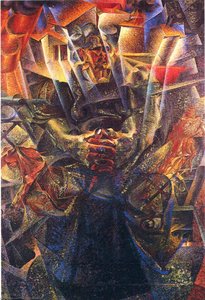
Experience Umberto Boccioni’s Futurist masterpiece ‘Materia,’ a vibrant depiction of movement and reaching for the future. This dynamic painting captures a woman's outstretched arms against a kaleidoscopic backdrop, embodying the revolutionary spirit of 1912.
A művész életrajza
Boccioni: A futurista festő, aki a mozgás és a modernitást ábrázolta a képei és szobrai segítségével. Fedezd fel a dinamikus művészetének csodáit! #Boccioni #Futurisztika
About the painting
A Symphony of Motion and Color
Umberto Boccioni’s Materia, completed in 1912, is far more than a mere painting; it is a visceral embodiment of the Futurist ethos—a defiant rejection of traditional artistic conventions in favor of capturing the frenetic, electric pulse of modern life. This monumental canvas immediately seizes the viewer by the senses, transporting them into a realm where stillness is an impossibility and energy reigns supreme. At its heart, the artwork centers around a woman rendered in muted tones, her arms outstretched in a gesture that symbolizes profound aspiration and yearning. She appears to be reaching toward an unseen horizon, embodying the Futurist preoccupation with progress and the relentless drive of the human spirit.
The composition is a masterclass in Simultaneity, a cornerstone technique of the Futurist movement where multiple viewpoints are depicted at once to convey the sensation of continuous motion. Boccioni utilizes Cubist principles to fracture reality, using geometric shapes that coalesce into recognizable forms while simultaneously disrupting linear perspective. This creates a rhythmic, vibrating surface where the boundaries between the subject and her environment begin to dissolve. The background is an explosive palette of vibrant reds and yellows, deliberately jarring and intended to stimulate the viewer’s senses, evoking feelings of both excitement and an urgent, modern anxiety.
The Pulse of an Era
To understand Materia, one must look to the tumultuous period of early 20th-century Italy. Emerging from the shadows of industrialization and rapid urbanization, the Futurist movement—led by figures like Marinetti—proclaimed a love for "Speed! Light! Noise!" Boccioni’s work captures this transition perfectly, reflecting the anxieties and exhilarations of a society undergoing radical transformation. Within the swirling chaos of shapes, a clock can be observed in the upper-middle portion of the painting, serving as a poignant reminder of time's relentless march forward—a concept central to the Futurist obsession with the ephemeral nature of the present moment.
For the discerning collector or interior designer, Materia offers an unparalleled opportunity to introduce a piece of historical revolution into a contemporary space. The painting’s dynamic energy and complex layering make it a commanding focal point, capable of breathing life and intellectual depth into any room. Whether viewed as a study in color theory or a profound symbolic exploration of humanity's struggle toward a brighter future, this work remains a timeless testament to the power of movement. Owning a high-quality reproduction of such a pivotal masterpiece allows one to possess not just a beautiful object, but a fragment of the very energy that defined the birth of the modern age.
Kérdések és válaszok
Melyik helyiségben javasolt a(z) "Materia" kihelyezését a színei alapján?
A „Materia”, Boccioni alkotása Earthy színei tökéletesen illeszkednek a javasolt helyiséghez: egy Coworking.
Ki a "Materia" szerzője, és mely művészeti irányból származik?
A "Materia" mögött Boccioni és a Cubist Futurism irányzat áll.
Mely művészeti irány része a „Materia”, Boccioni alkotása?
A „Materia”, Boccioni alkotása a Cubist Futurism irányzat része. Ez az irányzat adja a mű stilisztikai kontextusát.
Quick facts and art quiz
About Boccioni

Boccioni
1882 - 1916, Olaszország
A művész életrajza
A Life Forged in Motion: The Revolutionary Vision of Umberto Boccioni
Umberto Boccioni, born in Reggio Calabria in 1882, was a figurehead of the Italian Futurist movement—a force that sought to shatter artistic conventions and embrace the dynamism of the modern world. His life, though tragically cut short at just thirty-three, became a testament to this fervent belief in progress, speed, and the intoxicating energy of the machine age. Boccioni’s early years were marked by constant relocation due to his father's civil service position, an upbringing that exposed him to diverse landscapes and instilled within him a restless spirit. This nomadic existence eventually led him to Rome, where he initially pursued studies in decorative arts before gravitating towards painting, absorbing influences from the Liberty style poster artists of the time. However, it was his encounter with Futurism, ignited by the writings of Filippo Tommaso Marinetti, that truly set his artistic trajectory ablaze.Embracing the Whirlwind: The Rise of a Futurist
The year 1910 proved pivotal for Boccioni. He signed the *Manifesto dei Pittori Futuristi*, solidifying his commitment to a movement that celebrated technology, velocity, and even violence as emblems of modernity. This wasn’t merely an aesthetic choice; it was a philosophical rebellion against the weight of tradition, a desire to capture the very essence of a world hurtling towards an uncertain future. Boccioni quickly became one of Futurism's most articulate theorists, expanding upon Marinetti’s initial pronouncements and applying them to the visual arts. He argued for a complete break from representational accuracy, advocating instead for paintings that conveyed not just *what* things looked like, but *how* they felt in motion—the sensation of speed, the fragmentation of form, the overwhelming energy of urban life. His early works, while still hinting at Impressionist and Divisionist influences, began to demonstrate this burgeoning obsession with dynamism. Paintings such as *The City Rises* (1910-1911) are monumental in scale and ambition, depicting the chaotic construction of a modern metropolis—a swirling vortex of human figures, buildings, and machinery that embodies the Futurist ideal. The painting is not simply a depiction of a city; it’s an embodiment of its relentless energy and transformation.Deconstructing Reality: Technique and Themes
Boccioni’s artistic development was characterized by an increasingly radical approach to form. He moved away from traditional notions of perspective and composition, embracing fragmentation as a means of conveying movement and energy. Objects were broken down into their constituent parts, lines of force radiated outwards, and colors blended in swirling patterns—all designed to create a sense of visual vibration. This deconstruction wasn’t merely stylistic; it was rooted in Boccioni's belief that reality itself was fluid and constantly changing. He sought to represent not the static appearance of things, but their dynamic essence. Key themes emerged throughout his oeuvre: dynamism, the celebration of modernity, and a fascination with the human body as a vehicle for expressing energy and motion. This is powerfully illustrated in works like *Dynamism of a Human Body* (1913), where a figure is depicted not as a solid form but as a series of fragmented shapes suggesting movement through space. The painting captures the fleeting moment of action, conveying a sense of speed and power through its distorted forms and vibrant colors. He experimented with new materials and techniques, pushing the boundaries of traditional art practices. His sculptures, such as *Unique Forms of Continuity in Space* (1913), further explored these ideas, creating three-dimensional representations that captured the sensation of movement and dynamism.Influences and Artistic Journey
Boccioni’s artistic journey was shaped by a diverse range of influences. Initially, he studied drawing and portraiture, absorbing the techniques of Giacomo Balla, a key figure in the Divisionist movement. This early training instilled in him an appreciation for meticulous detail and careful observation—skills that would later inform his Futurist work. He also spent time in Paris, where he encountered the works of Impressionists and Post-Impressionists, including Seurat and Signac, whose use of pointillism influenced his own approach to color and composition. His travels through Russia exposed him to new artistic ideas and perspectives. Importantly, Boccioni’s early life, marked by frequent relocations due to his father's work, fostered a sense of restlessness and curiosity—qualities that undoubtedly contributed to his revolutionary vision. He was deeply influenced by the writings of Nietzsche, whose philosophy of dynamism and rejection of traditional values resonated with the Futurist ethos.Legacy and Lasting Impact
Boccioni’s untimely death in 1916, during World War I, tragically cut short a brilliant career. However, his ideas and artworks continued to resonate long after his passing. He profoundly influenced not only subsequent Futurist artists but also movements like Constructivism and Abstract Expressionism. His exploration of motion, dynamism, and the representation of modern life paved the way for new forms of artistic expression, challenging traditional notions of beauty and representation. Boccioni’s work remains a powerful testament to the transformative potential of art—a celebration of speed, technology, and the ever-changing nature of reality. His paintings are not just images; they are experiences – glimpses into a world in constant motion.- Influences: Giacomo Balla’s Divisionist techniques, Cubism's fragmentation of form, Nietzsche’s philosophy.
- Notable Works: *Dynamism of a Human Body*, *Unique Forms of Continuity in Space*, *The City Rises*, *Dynamism of a Cyclist*.
- Historical Significance: A pivotal figure in 20th-century art, Boccioni challenged artistic conventions and helped shape the course of modern art. His theories on dynamism and the representation of motion continue to inspire artists today.
Quick facts about Boccioni
- Artistic Movement Or Style: Futurizmus
- Artists Or Movements Influenced By This Artist:
- Konstruktivizmus
- Képzeletművészet
- Artists Who Influenced This Artist:
- Giacomo Balla
- Divizionizmus
- Kubizmus
- Date Of Birth: 1882-10-19
- Date Of Death: 1916-08-17
- Full Name: Umberto Boccioni
- Nationality: Olasz
- Notable Artworks:
- A Humán Test Dinamizmusa
- Egyedi Formák Folytathatóságában
- A Város Emelkedik
- Place Of Birth: Reggio Calabria, Olaszország
Fedezze fel a műalkotásokat témák, stílusok és jellemzők szerint csoportosítva.


Boccioni
Materia
() ·
With its frame: · Hand-painted in oil on linen
Total