

A képen: · A kerettel együtt:
 Megtekintés
 Küldés
 Megosztás
 Részletek
 Útmutató

 Letöltés
 Hasonló darabok
 X-ray felvétel
 Diavetítés
 Kérdések és válaszok
 Statisztika

Ft 87661
Kézzel készített olajfestmény reprodukció
Kézzel festett olajvastú vászon, az Ön által választott méretben és keretben, művészeink készítik meglévőre. ( Váltás nyomtatványra Áttérés digitális képre)
Méret
·Standard méret
egyedi méretű
CM
INCH
Válasszon előre meghatározott méreteink közül, amelyek megfelelnek a műalkotás eredeti arányainak.
Méretek betöltése...

szélesség
magasság
Írja be a kívánt szélességet és magasságot, hogy illeszkedjen a keretéhez vagy a falához. Mivel ez kézzel festett alkotás, egy eltérő formájú méret esetén a művész akár festhet is valamivel többet a kép körül, vagy korolathat is belőle — az Ön döntésének megfelelően. A festés megkezdése előtt küldünk egy digitális tervezetet jóváhagyásra. Az oldalon látható kép nem tartalmazza a végeredményt — csak a tervezet mutatja meg a valódi eredményt.
 További információk
Befejezés
·
Fehér Ft1

Elmosódott szélek Ft1

Kiterjesztett Ft1

P118B Ft10

P118H Ft10

P118W Ft10

P438Z Ft10

P508JH Ft12

P508YH Ft12

P805H Ft10

P805Z Ft10

P919BZ Ft10

P919G Ft10

P919XJ Ft10

P959ZH Ft10

P968JZ Ft12

W106C Ft8

W218G Ft10

W218JH Ft8

W218Y Ft10

W307PJ Ft10

W316G Ft10

W316PJ Ft8

W316Y Ft10

W398PJ Ft8

W4111J Ft10

W500HY Ft15

W500JH Ft15

W692G Ft12

W849H Ft8

W940BG Ft15

W953PJ Ft8

H24-GOLD Ft30

H24-SILVER Ft30

H36-GOLD Ft45

H36-SILVER Ft45
Védődobozban, feltekercselve szállítva, készen a saját keretbe helyezésre.
Extrák
opcionálisMit tartalmaznak a plusz szolgáltatások?
Példák a módosíthatóságra: Az arc kicserélése a vásárló fotójára; háziállat hozzáadása (pl. macska kicserélése kutyára); rejtett üzenet elhelyezése a háttérben; a háttér tájéképének vagy elemeinek megváltoztatása.
A megrendelést követően a TopImpressionists.com csapat e-mailt küld a vásárlónak az instrukciókkal, és biztosítja a tervezeti előnézetet
A megrendelést követően a TopImpressionists.com csapat e-mailt küld a vásárlónak az instrukciókkal, és biztosítja a tervezeti előnézetet
Világszerte elérhető szállítás () 3-4 hét alatt a szokásos 5 hét helyett. (7 november). A minőség nem kérdőjelezhető.
Védőréteg (Lakk)
Névtábla
A gravírozott bronztábla részletei
This elegant plaque features the artist's name and the title of the artwork, finely engraved for a timeless presentation.
It is made from bronze with a refined, elegant finish. The text is precisely laser-engraved for a sharp and permanent result. Measuring 9x2 cm, the plaque is compact yet easy to read. It's built to be durable and scratch-resistant, offering a professional, museum-quality look. Mounting is simple thanks to the included adhesive backing.
Átlátszó akril tábla részletei
The plaque includes essential engraved details such as the artist's name, the title of the artwork, the date it was created, the type of media used-like oil on canvas or watercolor-a brief description of the piece, and a QR code that links to the complete artwork information.
It is crafted from clear acrylic, offering a sleek, modern appearance. The text is UV-engraved in black to ensure strong visual contrast. With a size of 10x15 cm, it ensures optimal readability. It comes equipped with two metal hooks for secure wall mounting. The plaque is designed to be weather-resistant, making it suitable for various environments, and it includes interactive features that work seamlessly with smartphone scanning.
Fekete akril tábla részletei
This elegant plaque includes engraved information such as the artist's name, the title of the artwork, the date it was created, the type of media used (like oil on canvas or watercolor), a short description of the artwork, and a QR code for quick access to more information.
The plaque itself is made from refined black acrylic with a premium finish. The text is laser-engraved in white for high contrast and readability. Its size is 10x15 cm, designed to be easy to read. It comes with two metal hooks for professional mounting. The design is sleek and fits any interior style. It is also weather-resistant and durable, with built-in digital integration for mobile compatibility.
Az üvegkeretes opció csak 110 cm alatti méretben érhető el
 Az üvegkeretes opció csak 110 cm alatti méretben érhető el
- Ingyenes globális expressz szállítás
- Prémium minőségű len vászon
- Teljes körű szállítási biztosítás
- Vámvisszatérítési Garancia
- Hiteles színarányosság garancia
- 100 napos visszaküldési lehetőség (csak hibás termékek esetén)
- 100% pénzvisszatérítési garancia
- Több darab vásárlásakor kedvezmény


A gyűjtemény leírása
A művész életrajza
Kandinsky: A szellem festője! Fedezd fel a vibráló, spirituális absztrakt művészetét, mely a színek és formák egyedülálló világát tárja fel. TopImpressionists reprodukciókkal élményt válts!
A festményről
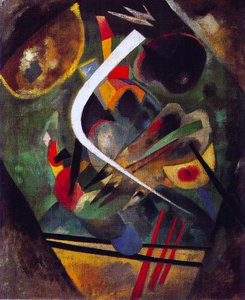
White Stroke
Kandinsky’s White Stroke stands as a cornerstone of abstract expressionism, born from the crucible of post-war Europe and fueled by a profound yearning for spiritual transcendence. More than just pigment on canvas, it’s a visual manifesto—a declaration that art could liberate itself from representational constraints and tap into realms beyond perception.The Painting's Composition
The artwork immediately captivates with its dynamic equilibrium. At the heart of White Stroke lies a single white line—a decisive gesture that traverses the canvas horizontally, acting as a conduit between disparate sections of color and form. This isn’t merely a decorative element; it embodies Kandinsky's belief in the primacy of feeling over intellect, suggesting an unbroken flow of energy and intention. Complementing this central stroke are interwoven lines and shapes—primarily blues and reds—that vary in size and placement, creating layers of visual complexity and hinting at underlying tensions. These elements don’t depict recognizable objects but rather strive to evoke emotional states—the serenity of blue countering the vibrancy of red—a deliberate mirroring of musical harmonies and dissonances.Expressionism and Its Influence
Kandinsky's artistic vision was deeply rooted in German Expressionism, a movement that prioritized subjective experience and psychological intensity. Artists like Ernst Ludwig Kirchner and Emil Nolde sought to convey inner turmoil through distorted forms and jarring colors, reflecting the anxieties of their time. However, Kandinsky pushed Expressionism further by rejecting any illusion of reality—he aimed for pure abstraction, believing it could communicate spiritual truths inaccessible to language. His influence extended beyond Expressionism, resonating with movements like Futurism, Bauhaus, and Synthetic Cubism, all of which experimented with new visual languages and challenged traditional artistic conventions.Historical Context
The early 20th century witnessed a seismic shift in Western art and thought. The Impressionists had revolutionized painting by capturing fleeting moments of light and color, while Cézanne’s geometric explorations paved the way for Cubism's fragmentation of perspective. Simultaneously, Sigmund Freud’s psychoanalytic theories were reshaping understandings of the human psyche—Kandinsky saw parallels between Freud’s work on dreams and his own artistic endeavors, arguing that art could unlock unconscious desires and reveal hidden dimensions of consciousness. The rise of industrialization and urbanization further fueled anxieties about societal change, prompting artists to grapple with questions of identity and purpose.Relevance and Legacy
Painting by 'Wassily Kandinsky' | Wassily Kandinsky: White stroke (Expressionism, Oil) continues to inspire artists and scholars alike. Its bold simplicity—a single white line against a tapestry of color—remains remarkably powerful, embodying Kandinsky’s conviction that art could transcend the limitations of representational imagery and communicate universal emotions. The painting serves as a testament to the transformative potential of abstraction and its enduring relevance in contemporary artistic discourse. For those seeking to delve deeper into Kandinsky's oeuvre, history of Western painting and abstract expressionism offer invaluable insights into the intellectual and aesthetic currents that shaped his groundbreaking work.Kérdések és válaszok
Ismertebb műalkotás a „White stroke”, Wassily Wassilyevich Kandinsky alkotása?
A „White stroke”, Wassily Wassilyevich Kandinsky alkotása népszerűségi szintje: Iconic.
Mely helyet foglal el a művészettörténetben a „White stroke”, Wassily Wassilyevich Kandinsky alkotása?
Történelmileg a "White stroke" a szélesebb körű Renaissance korszak Expressionism alkotása.
Használhatom az augmented reality technológiát, hogy megtekintsem a „White stroke”, Wassily Wassilyevich Kandinsky alkotása művet a saját szobámban?
A „White stroke”, Wassily Wassilyevich Kandinsky alkotása mű kiterjesztett valóság technológiával, egy kompatibilis eszközön keresztül, a mű Kiterjesztett valóság előnézet oldalán megtekinthető a saját falán is.
Gyors tények és művészeti kvíz
Wassily Wassilyevich Kandinsky életrajza

Wassily Wassilyevich Kandinsky
1866 - 1944, Oroszország
A művész életrajza
A Life Immersed in Color and Spirit
Wassily Wassilyevich Kandinsky, born in Moscow in 1866, was a revolutionary figure who irrevocably altered the course of modern art. His journey wasn’t one of immediate artistic calling; initially destined for a career in law and economics at the University of Moscow, it was a profound encounter with Impressionist painting – specifically Claude Monet's “Haystacks” – and a deeply moving experience witnessing Wagner’s opera "Lohengrin" that ignited within him an irrepressible desire to pursue art. This pivotal moment, occurring around age thirty, marked not merely a career change but a complete transformation of perspective, setting him on a path toward pioneering abstraction. He soon relocated to Munich, enrolling at the prestigious Academy of Fine Arts and studying under Franz von Stuck, though even within formal training, Kandinsky’s spirit yearned for exploration beyond conventional boundaries. Early influences included Russian folk art, gleaned from an ethnographic expedition to the Vologda region in 1889, which instilled a fascination with vibrant color palettes and symbolic imagery. This foundation would prove crucial as he began to develop his unique artistic language. These early explorations weren’t simply about aesthetic preference; they were rooted in a deep cultural connection and a burgeoning understanding of how art could communicate beyond the literal. He was particularly drawn to the rich, earthy tones and intricate patterns found in traditional Russian textiles and icons, which would later inform his use of color and composition.The Dawn of Abstraction: From Expressionism to Inner Necessity
Kandinsky’s early works reveal a strong expressionistic bent, characterized by bold colors and emotional intensity – pieces like “Papeln (Poplars)” from 1902 exemplify this period. These paintings were imbued with a sense of dynamism and movement, reflecting the artist's own inner turmoil and striving for self-expression. However, he wasn’t content with merely representing the external world; he sought to express inner realities, spiritual truths that transcended mere visual depiction. This quest led him gradually away from representational art and toward a revolutionary exploration of color, form, and their emotional resonance. He believed that art should not simply mirror reality but rather serve as a conduit for conveying profound emotions and ideas. He began to believe that colors possessed inherent psychological effects, capable of evoking specific feelings and sensations in the viewer. This conviction was deeply intertwined with his burgeoning interest in Theosophy, a spiritual movement emphasizing esoteric knowledge and universal brotherhood. As he delved deeper into these ideas, Kandinsky’s paintings became increasingly non-objective, shedding recognizable forms in favor of abstract compositions driven by an “inner necessity.” This wasn't simply about abandoning representation; it was about discovering a new visual language capable of expressing the intangible realms of emotion and spirituality. He sought to create a visual equivalent of music, where color and form harmonized to evoke profound emotional responses.Geometric Harmony and Spiritual Resonance
The period following his involvement with the influential artist group Der Blaue Reiter (The Blue Rider), which he co-founded in Munich in 1911, saw a further evolution in Kandinsky’s style. While earlier works often featured fluid, organic shapes, he began to explore geometric abstraction, focusing on the interplay of circles, triangles, and squares. “Several Circles” (140 x 140 cm) stands as a prime example of this phase – a dynamic composition where color and form interact in a harmonious yet energetic dance. He believed that these simple geometric forms held profound symbolic meaning, representing fundamental aspects of the universe and human consciousness. The use of primary colors—red, blue, and yellow—was deliberate, reflecting his belief in their inherent power to evoke specific emotions. This wasn’t cold or sterile geometry; rather, it was imbued with spiritual significance. Kandinsky believed that geometric shapes possessed inherent symbolic meaning, and their arrangement within the canvas could evoke specific emotional responses. His theoretical writings, most notably “Concerning the Spiritual in Art” (1911), articulated these beliefs, laying the groundwork for a new understanding of abstract art as a vehicle for expressing profound spiritual truths. He argued that art should not aim to imitate nature but rather to reveal the artist’s inner world and connect with the viewer on a deeper, more intuitive level.Bauhaus Influence and Lasting Legacy
The outbreak of World War I forced Kandinsky's return to Russia in 1914, but following the Russian Revolution, he found himself increasingly at odds with the prevailing artistic climate. In 1920, he accepted a teaching position at the Bauhaus school in Germany, where he profoundly influenced generations of artists with his theories on color, form, and abstraction. The Bauhaus provided an ideal environment for Kandinsky to further develop his ideas and explore new creative avenues. He emphasized the importance of intuitive feeling and non-objective expression, encouraging students to move beyond representational art and embrace the expressive potential of pure color and form. He continued to experiment with geometric forms and vibrant colors, often incorporating layered impasto techniques to create textured surfaces that added depth and complexity to his compositions – as seen in later works like “An Intimate Party” (1942). After the closure of the Bauhaus by the Nazi regime in 1933, Kandinsky moved to France, where he remained for the rest of his life. His impact on modern art is immeasurable; he is widely recognized as a pioneer of abstract expressionism and a key figure in the development of non-representational painting. His works are held in major museums worldwide, including the Tretyakov Gallery in Moscow, which houses his monumental “Composition VII,” a testament to his artistic vision and enduring legacy. Kandinsky’s exploration of color, form, and spirituality continues to inspire artists today, solidifying his place as one of the most important figures in 20th-century art history. He didn't just paint pictures; he painted emotions, ideas, and the very essence of the human spirit.Gyors információk Wassily Wassilyevich Kandinsky művészről
- Artistic Movement Or Style: Ábrázatlan művészet, Kifejezőművészet
- Artists Or Movements Influenced By This Artist:
- Ábrázatlan művészet
- Der Blaue Reiter
- Artists Who Influenced This Artist:
- Claude Monet
- Richard Wagner
- Date Of Birth: 1866
- Date Of Death: 1944
- Full Name: Wassily Wassilyevich Kandinsky
- Nationality: Orosz, Francia
- Notable Artworks:
- Múzeum Színes Újra
- Tömbös Elán
- Belső Vendégvárás
- Számos Kör
- Place Of Birth: Moszkva, Oroszország
Fedezze fel a műalkotásokat témák, stílusok és jellemzők szerint csoportosítva.


Wassily Wassilyevich Kandinsky
White stroke
() ·
A kerettel együtt: · Kézzel festve, olajfesték, vászonon
Összesen