

A képen: · A kerettel együtt:
 Megtekintés
 Küldés
 Megosztás
 Részletek
 Útmutató

 Letöltés
 Hasonló darabok
 X-ray felvétel
 Diavetítés
 Kérdések és válaszok
 Statisztika

Ft 87344
Kézzel készített olajfestmény reprodukció
Kézzel festett olajvastú vászon, az Ön által választott méretben és keretben, művészeink készítik meglévőre. ( Váltás nyomtatványra Áttérés digitális képre)
Méret
·Standard méret
egyedi méretű
CM
INCH
Válasszon előre meghatározott méreteink közül, amelyek megfelelnek a műalkotás eredeti arányainak.
Méretek betöltése...

szélesség
magasság
Írja be a kívánt szélességet és magasságot, hogy illeszkedjen a keretéhez vagy a falához. Mivel ez kézzel festett alkotás, egy eltérő formájú méret esetén a művész akár festhet is valamivel többet a kép körül, vagy korolathat is belőle — az Ön döntésének megfelelően. A festés megkezdése előtt küldünk egy digitális tervezetet jóváhagyásra. Az oldalon látható kép nem tartalmazza a végeredményt — csak a tervezet mutatja meg a valódi eredményt.
 További információk
Befejezés
·
Fehér Ft1

Elmosódott szélek Ft1

Kiterjesztett Ft1

P118B Ft10

P118H Ft10

P118W Ft10

P438Z Ft10

P508JH Ft12

P508YH Ft12

P805H Ft10

P805Z Ft10

P919BZ Ft10

P919G Ft10

P919XJ Ft10

P959ZH Ft10

P968JZ Ft12

W106C Ft8

W218G Ft10

W218JH Ft8

W218Y Ft10

W307PJ Ft10

W316G Ft10

W316PJ Ft8

W316Y Ft10

W398PJ Ft8

W4111J Ft10

W500HY Ft15

W500JH Ft15

W692G Ft12

W849H Ft8

W940BG Ft15

W953PJ Ft8

H24-GOLD Ft30

H24-SILVER Ft30

H36-GOLD Ft45

H36-SILVER Ft45
Védődobozban, feltekercselve szállítva, készen a saját keretbe helyezésre.
Extrák
opcionálisMit tartalmaznak a plusz szolgáltatások?
Példák a módosíthatóságra: Az arc kicserélése a vásárló fotójára; háziállat hozzáadása (pl. macska kicserélése kutyára); rejtett üzenet elhelyezése a háttérben; a háttér tájéképének vagy elemeinek megváltoztatása.
A megrendelést követően a TopImpressionists.com csapat e-mailt küld a vásárlónak az instrukciókkal, és biztosítja a tervezeti előnézetet
A megrendelést követően a TopImpressionists.com csapat e-mailt küld a vásárlónak az instrukciókkal, és biztosítja a tervezeti előnézetet
Világszerte elérhető szállítás () 3-4 hét alatt a szokásos 5 hét helyett. (4 november). A minőség nem kérdőjelezhető.
Védőréteg (Lakk)
Névtábla
A gravírozott bronztábla részletei
This elegant plaque features the artist's name and the title of the artwork, finely engraved for a timeless presentation.
It is made from bronze with a refined, elegant finish. The text is precisely laser-engraved for a sharp and permanent result. Measuring 9x2 cm, the plaque is compact yet easy to read. It's built to be durable and scratch-resistant, offering a professional, museum-quality look. Mounting is simple thanks to the included adhesive backing.
Átlátszó akril tábla részletei
The plaque includes essential engraved details such as the artist's name, the title of the artwork, the date it was created, the type of media used-like oil on canvas or watercolor-a brief description of the piece, and a QR code that links to the complete artwork information.
It is crafted from clear acrylic, offering a sleek, modern appearance. The text is UV-engraved in black to ensure strong visual contrast. With a size of 10x15 cm, it ensures optimal readability. It comes equipped with two metal hooks for secure wall mounting. The plaque is designed to be weather-resistant, making it suitable for various environments, and it includes interactive features that work seamlessly with smartphone scanning.
Fekete akril tábla részletei
This elegant plaque includes engraved information such as the artist's name, the title of the artwork, the date it was created, the type of media used (like oil on canvas or watercolor), a short description of the artwork, and a QR code for quick access to more information.
The plaque itself is made from refined black acrylic with a premium finish. The text is laser-engraved in white for high contrast and readability. Its size is 10x15 cm, designed to be easy to read. It comes with two metal hooks for professional mounting. The design is sleek and fits any interior style. It is also weather-resistant and durable, with built-in digital integration for mobile compatibility.
Az üvegkeretes opció csak 110 cm alatti méretben érhető el
 Az üvegkeretes opció csak 110 cm alatti méretben érhető el
- Ingyenes globális expressz szállítás
- Prémium minőségű len vászon
- Teljes körű szállítási biztosítás
- Vámvisszatérítési Garancia
- Hiteles színarányosság garancia
- 100 napos visszaküldési lehetőség (csak hibás termékek esetén)
- 100% pénzvisszatérítési garancia
- Több darab vásárlásakor kedvezmény


A gyűjtemény leírása
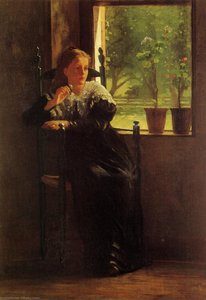
'At the Window' by Winslow Homer captures serene beauty with meticulous detail—a lone woman gazing out at a garden through a window, bathed in soft light. Explore this masterpiece and discover more Realism art on WikiArt.
A művész életrajza
Winslow Homer (1836-1910): Amerikai realista festőművész, aki tengeri tájakat, amerikai életképeket és a természeti erő ábrázolásával vált híressé. Fedezze fel műveit!
A festményről
A Moment Frozen in Time: Exploring Winslow Homer’s “At the Window”
Winslow Homer's "At the Window," painted in 1872, isn’t merely a depiction of a woman gazing out at a garden; it’s a masterful distillation of American Realism—a movement that championed honest observation and eschewed romantic embellishment. More than just capturing a picturesque scene, Homer achieves something deeper: he freezes a fleeting moment of contemplation within the quiet grandeur of rural New England. This piece resides in the Princeton University Art Museum, offering visitors a chance to experience firsthand the profound impact of this iconic artwork.The Essence of Realism: Technique and Detail
Homer’s approach is strikingly direct. He employs oil paints on canvas with meticulous attention to texture—notice the rough grain of the wooden window frame juxtaposed against the smooth sheen of the woman's garment. The artist skillfully renders light, bathing her face in a soft glow that emphasizes her stillness and introspection. Homer’s technique prioritizes accuracy; every element contributes to an overall impression of understated beauty and palpable atmosphere. This dedication to realism distinguishes “At the Window” from its predecessors, rejecting idealized representations for a grounded portrayal of everyday life.Symbolism Within Simplicity: The Garden Motif
Beyond mere visual representation lies a subtle layer of symbolism. The garden itself—represented with carefully positioned flowering plants—serves as a powerful emblem of growth, renewal, and the passage of time. It’s a deliberate choice that invites viewers to consider themes of serenity, solitude, and perhaps even longing. Homer doesn't spell out these ideas; instead, he presents them organically within the frame, allowing the viewer to interpret their significance personally. The woman’s posture—head resting gently against her hand—further reinforces this mood of quiet contemplation.Historical Context: The Rise of American Realism
“At the Window” emerged during a pivotal moment in American art history – the burgeoning influence of Realism. Artists like Homer rejected the conventions of Romanticism, favoring instead an unflinching gaze upon the realities of American life. This movement sought to depict subjects truthfully, without idealization or sentimentality, reflecting the spirit of the era’s social and intellectual currents. The painting's placement within Princeton University Art Museum underscores its importance as a cornerstone of this influential artistic movement.A Legacy of Quiet Beauty: Why “At the Window” Endures
The enduring appeal of Homer’s masterpiece lies in its ability to convey emotion through understated visual language. It’s a portrait not of grand gesture or dramatic narrative, but of quiet dignity and profound introspection—qualities that resonate powerfully across generations. "At the Window" continues to inspire artists and collectors alike, reminding us that beauty can be found in simplicity and that true art captures the essence of human experience with remarkable precision. If you’re seeking a stunning oil painting reproduction of this masterpiece, visit /art/list/?Filter=8BX2FW-Winslow-Homer-At-the-Window/.Kérdések és válaszok
Milyen technikával és milyen stílusban készült a "At the Window"?
A „At the Window”, Winslow Homer alkotása egyesíti a Acrylic On Canvas technikát a Contemporary Realism stílussal. A technika és a művészeti irány a mű elkészítésének módját és stílusát jellemzi.
Hogyan épül fel a „At the Window”, Winslow Homer alkotása színes kompozíciója?
A „At the Window”, Winslow Homer alkotása színes kompozíció egy Gentle kontrasztot és egy Balanced Harmony harmóniát ötvöz.
Hogyan találkoznak a korszak és a mű stílusa „At the Window”, Winslow Homer alkotása alkotásban?
A „At the Window”, Winslow Homer alkotása a Contemporary Realism irányzat alkotása, mely alkotójának 19. század korszakából származik.
Gyors tények és művészeti kvíz
Winslow Homer életrajza

Winslow Homer
1836 - 1910, Egyesült Államok
A művész életrajza
A Brush with the American Spirit: The Life and Art of Winslow Homer
Winslow Homer, born in Boston in 1836, wasn’t sculpted by the traditional European art academies that shaped so many of his contemporaries. Instead, he emerged from a distinctly American experience, one rooted in practicality and observation. His journey began not with grand historical canvases, but as a commercial illustrator at the tender age of twelve for Harper's Weekly. This early apprenticeship was formative, honing an exceptional ability to capture scenes with clarity and detail – skills that would become hallmarks of his mature work. He wasn’t learning perspective in Paris; he was learning to *see* America, its people, and its unfolding story. The bustling streets of Boston, the quiet dignity of rural New England life, these were his first subjects, rendered with a precision born of necessity for the demands of print media. This foundation allowed him to transition into painting, initially in watercolor, before fully embracing the expressive potential of oil paints.Early Life and Artistic Beginnings
Homer’s childhood was marked by a close relationship between his parents—Charles Savage Homer, a merchant with restless ambitions, and Henrietta Maria Benson Homer, a gifted amateur watercolorist who instilled in him a lifelong appreciation for artistic observation. His father's entrepreneurial spirit propelled him to seek fortune abroad, leaving young Winslow largely under his mother’s tutelage. From Cambridge, Massachusetts, where he attended school, Homer developed an early fascination with drawing and sketching—skills that would prove invaluable throughout his career. He began honing his craft by copying the works of established artists, gaining experience in mastering technique and capturing visual impressions. This formative period instilled in him a disciplined approach to artmaking that would characterize his later work. His mother’s encouragement fostered his artistic talent and nurtured his innate sensitivity to beauty—traits that would become integral to Homer's distinctive style.The Civil War Years: Witnessing History Through Art
The American Civil War profoundly impacted Homer’s artistic vision, transforming him from a painter of idyllic landscapes into a chronicler of the brutal realities of conflict. As a war correspondent for Harper’s Weekly, he documented the daily lives of soldiers and civilians—not grand battles or strategic maneuvers—but rather the quiet moments of grief, resilience, and human suffering amidst chaos. This experience instilled in him an unwavering commitment to portraying truthfulness and empathy—values that would permeate his paintings throughout his life. Homer eschewed romanticized depictions of heroism, focusing instead on capturing the psychological impact of war on ordinary people. His sketches for Harper’s Weekly are considered singular examples of wartime reporting, demonstrating his remarkable ability to convey emotion through visual imagery. The Civil War served as a catalyst for Homer's artistic evolution, prompting him to explore themes of trauma and vulnerability—themes that would become central to his oeuvre.A Master of Watercolor and Oil: Exploring Diverse Techniques
Homer’s artistic versatility extended beyond watercolor; he excelled in oil painting, achieving remarkable textural depth and luminosity through a technique rooted in direct observation from nature. He embraced the expressive potential of oil paints while retaining the fluidity and spontaneity characteristic of watercolor—a duality that defined his distinctive style. Homer's studio was located primarily in New York City, yet he frequently traveled to Pennsylvania, the Catskills, and Gloucester, Maine, drawing inspiration from these varied landscapes. These excursions fueled his creativity and informed his artistic vision, resulting in paintings that captured both grandeur and intimacy. He meticulously built up layers of paint—often applying them with a palette knife—creating surfaces rich in texture and color—a technique that distinguishes Homer’s work from many of his contemporaries. His masterful handling of light—particularly the dramatic effects achieved during Maine summers—became a hallmark of his artistic style.Legacy: An Icon of American Realism
Winslow Homer stands as one of America's most celebrated painters, recognized for his unflinching portrayal of the human condition and his profound engagement with the natural world. His paintings—particularly *The Gulf Stream*, *Breezing Up (A Fair Wind)*, and *Innocence*—remain enduring symbols of American artistic achievement. Homer’s influence extended beyond his own time, inspiring subsequent generations of artists who sought to capture the spirit of their nation with similar honesty and conviction. He rejected academic conventions in favor of a direct painting approach—a stylistic choice that cemented his place as a pioneer of American Realism. His legacy is defined by his ability to convey emotion through visual imagery—to communicate profound truths about human experience without resorting to sentimentality or embellishment. Homer’s enduring appeal lies in his unwavering commitment to portraying the beauty and complexity of America—a commitment that continues to resonate with audiences today. He remains a pivotal figure in the history of American art, ensuring his place as one of its most influential voices.Gyors információk Winslow Homer művészről
- Artistic Movement Or Style: Amerikai Realizmus
- Artists Or Movements Influenced By This Artist: ['Amerikai festők']
- Artists Who Influenced This Artist:
- Barbizon Schule
- Courbet
- Millet
- Date Of Birth: Feb 24, 1836
- Date Of Death: Sept 29, 1910
- Full Name: Winslow Homer
- Nationality: Amerikai
- Notable Artworks:
- Breezing Up
- A Szántóföldi Gyűjtő
- A Gulf Stream
- Place Of Birth: Boston, USA


Fedezze fel a műalkotásokat témák, stílusok és jellemzők szerint csoportosítva.




Winslow Homer
At the Window
() ·
A kerettel együtt: · Kézzel festve, olajfesték, vászonon
Összesen