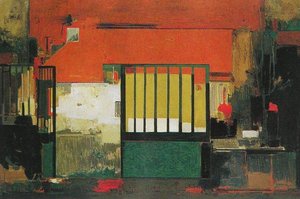
Műterem — Ingyenes világszerte történő szállítás — Szállítás: 2–6 hét

      1904 - 1975

      Röviden összefoglalva

      • Also known as: Alekos Kontopoulos
      • Works on this site: 16
      • Born: 1904
      • Art period: Modern
      • Typical colors:
        • earthy
        • dark
      • Top 3 works:
        • Nude
        • Loads with a crane barge on the Seine
        • Armchair

      Alecos Kontopoulos: A Pioneer of Greek Abstract Expressionism

      Alecos Kontopoulos (1904-1975) stands as a monumental figure in the evolution of Greek art, a bridge between traditional aesthetics and the radical experimentation of modern abstraction. Born in Lamia, Greece, his artistic journey was marked by a profound engagement with social realities, philosophical inquiry, and an unwavering pursuit of visual language that transcended representational forms. Kontopoulos’s career wasn't simply about stylistic shifts; it represented a fundamental reimagining of how art could engage with the complexities of the 20th century, solidifying his place as one of Greece’s most influential artists.

      Early Influences and Artistic Training

      Kontopoulos’s early artistic development was shaped by a confluence of influences. Initially apprenticed to the icon painter George Sarafianos, he gained a foundational understanding of Byzantine techniques and religious iconography – a discipline that instilled in him a meticulous attention to detail and a deep appreciation for color and texture. This traditional training provided a crucial counterpoint to the later explorations of abstraction. He then enrolled at the School of Fine Arts in Athens, where he studied under prominent figures like Georgios Iakovidis, Dimitrios Geraniotis, Pavlos Mathiopoulos, and Nikolaos Ransom. Crucially, his time in Paris from 1930 to 1932 proved transformative. Studying under P. Le Doux and H. Morisset exposed him to the burgeoning avant-garde movements of Europe – Cubism, Futurism, and early Abstraction – broadening his artistic horizons significantly. This period wasn't merely about absorbing new styles; it was a process of critical engagement, leading him to question established conventions and seek alternative modes of expression.

      The Transition to Abstract Art: A Response to Social and Political Turmoil

      Kontopoulos’s shift towards abstraction around 1947 wasn't a stylistic choice made in isolation; it was deeply intertwined with the turbulent political landscape of post-war Greece. Witnessing the hardships, social injustices, and the oppressive atmosphere of the occupation, he felt compelled to move beyond representational art as a means of conveying deeper truths. His abstract works became vehicles for expressing internal emotions, philosophical concepts, and critiques of societal norms. He began utilizing simplified geometric forms, bold colors, and often, a deliberate lack of tonal gradation – rejecting traditional notions of perspective and realism in favor of pure visual impact. This period saw the emergence of his most iconic pieces, characterized by their raw emotional intensity and symbolic weight. The influence of figures like Kandinsky and Malevich is evident, but Kontopoulos forged a distinctly Greek voice within this broader abstract vocabulary.

      Key Themes and Artistic Techniques

      Kontopoulos’s oeuvre is rich in symbolism and intellectual depth. Recurring themes include the human condition, social responsibility, spirituality, and the relationship between art and life. His works frequently explore concepts of faith, doubt, and the search for meaning in a world grappling with uncertainty. Technically, Kontopoulos was a master of color theory, employing vibrant hues to evoke specific emotions and create dynamic visual relationships. He often utilized layering techniques, building up complex compositions through multiple applications of paint, creating surfaces that shimmered with texture and depth. His later works are particularly notable for their use of “force,” a term he himself coined, referring to the inherent energy and dynamism within his paintings – an attempt to capture not just visual form but also the underlying currents of existence.

      Legacy and Recognition

      Alecos Kontopoulos’s impact on Greek art is undeniable. He played a pivotal role in introducing abstract expressionism to Greece, challenging established artistic conventions and paving the way for subsequent generations of artists. His work was exhibited internationally at prestigious venues such as the Biennales of São Paulo (1953, 1955, 1957), Alexandria (1959), and Venice (1960). He received numerous accolades, including the Guggenheim Prize in 1950 (which he famously declined as a protest against the Greek dictatorship) and the First State Prize in 1973. After his death in 1975, Kontopoulos’s legacy was preserved through the establishment of the Alekos Kontopoulos Library in Agia Paraskevi – a testament to his intellectual curiosity and commitment to artistic education – and the Alekos Kontopoulos Gallery in Lamia, which continues to showcase his work. Today, his paintings are held in prominent collections throughout Greece and internationally, ensuring that this visionary artist’s profound contribution to modern art endures.

      Egy rövid kvíz

      Minden kérdésre csak egy helyes válasz létezik.

      Kérdés 1:
      Alecos Kontopoulos was primarily known for his contributions to which art movement?
      Kérdés 2:
      In what year did Alecos Kontopoulos pass away?
      Kérdés 3:
      Before his focus on abstract art, Kontopoulos initially trained under which type of artist?
      Kérdés 4:
      During World War II, Alecos Kontopoulos actively participated in:
      Kérdés 5:
      Which of the following best describes a key theme explored in Kontopoulos's later abstract works?

      Kérdések és válaszok

      Mely történelmi korszakban alkotott Alecos Kontopoulos?

      Alecos Kontopoulos a Modern korszakban alkotott. Ez az időszak a művész tevékenységét a történelembe helyezi.

      Szűrhetem Alecos Kontopoulos műveit szín alapján?

      Alecos Kontopoulos művei színek szerinti csoportosítással is felfedezhetők a művész Színindex oldalán.

      Hol tekinthetném meg Alecos Kontopoulos összes művét?

      Alecos Kontopoulos minden alkotása megtekinthető a ez a weboldal oldalán, az alkotó Összes műalkotás oldalán keresztül.

      Megvizsgálhatom Alecos Kontopoulos színhasználatát az összes művében?

      Alecos Kontopoulos műveleteinek színprofilja a művész Paletta Genom oldalán tekinthető meg.

      Milyen más nevét vagy álneveit használ még Alecos Kontopoulos?

      Alecos Kontopoulos a következő más néven is ismert: Alekos Kontopoulos.

      Mely Alecos Kontopoulos művei a legnézettebbek?

      Alecos Kontopoulos Statisztikák oldala a ez a weboldal felületén található műalkotásokból számított statisztikákat mutatja be.

      Hány Alecos Kontopoulos alkotása tekinthető meg a katalógusban?

      A Összes műalkotás oldalon Alecos Kontopoulos 16 műalkotás alkotását tekintheti meg.

      Hol tekinthetném meg Alecos Kontopoulos műveit időrendi sorrendben?

      A művész Műalkotások időrendje oldala Alecos Kontopoulos műveit év évre, időrendi sorrendben mutatja be.

      Mi a(z) legnépszerűbb Alecos Kontopoulos festmény a ArtsDot.com oldalon?

      Nude