Early Life and Artistic Beginnings
Sanford Robinson Gifford, a name synonymous with the serene beauty of American landscape painting, was born on July 10th, 1823, in Greenfield, New York – a small town nestled amidst the rolling hills of Saratoga County. His childhood unfolded in Hudson, a picturesque riverside community steeped in history and artistic tradition. Gifford’s upbringing wasn't one of formal academic training initially; instead, his early fascination with art blossomed through observation and imitation, fueled by the legacy of Thomas Cole, a pivotal figure in the burgeoning Hudson River School movement. Gifford’s father, a successful foundry owner, provided a supportive environment for his son’s artistic pursuits, recognizing and encouraging this nascent talent. Following in the footsteps of his elder brother Charles, who had shown an early aptitude for art, Gifford embarked on his artistic journey, initially studying under Henry Ary, a local landscape painter whose work served as a foundational influence. This early exposure to the techniques of capturing light and atmosphere laid the groundwork for Gifford’s distinctive style.Formal Training and European Influences
In 1845, seeking more structured guidance, Gifford relocated to New York City and enrolled in the tutelage of John Rubens Smith, a highly respected drawing master and author of “A Key to the Art of Drawing the Human Figure.” Smith’s instruction provided Gifford with essential skills in perspective, anatomy, and draughtsmanship – crucial elements for any aspiring artist. However, Gifford's artistic aspirations extended beyond mere portraiture; he was deeply inspired by Cole’s romanticized depictions of the Hudson Valley and sought to emulate his ability to infuse landscapes with emotion and narrative. Driven by this ambition, Gifford made a pivotal decision in 1855: he embarked on a transformative journey to Europe, spanning nearly three years. This extended sojourn proved instrumental in shaping his artistic vision. During his travels, Gifford immersed himself in the art of European masters, particularly J.M.W. Turner, whose dynamic use of light and color profoundly influenced Gifford’s approach to landscape painting. He also studied the works of the French Barbizon School, absorbing their emphasis on capturing the immediacy of nature. Italy held a special allure for Gifford; he spent considerable time in Rome, meticulously sketching scenes from antiquity and drawing inspiration from the Italian countryside.The Luminist Style and American Landscapes
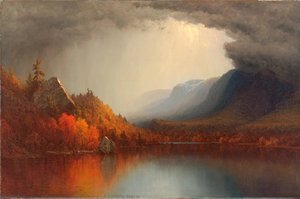
Upon his return to America in 1858, Gifford established a studio in New York City, joining a vibrant community of artists who had also been exposed to European artistic trends. He quickly developed a distinctive style that became known as Luminism – a subgenre characterized by its subtle light effects, soft atmospheric perspectives, and an almost dreamlike quality. Unlike the more dramatic and heroic landscapes favored by some of his contemporaries, Gifford’s paintings often depicted serene and idyllic scenes, capturing the quiet beauty of nature with remarkable delicacy. His compositions were meticulously crafted, balancing minute detail with a graceful sense of overall atmosphere. Gifford's approach to color was particularly noteworthy; he skillfully blended hues to create luminous effects that seemed to emanate from within the painted surface. He frequently employed a slow and deliberate painting process, allowing him ample time to capture the nuances of light and shadow. Gifford’s most celebrated works include *Tivoli* (1868), now housed in the Metropolitan Museum of Art, and *Mount Mansfield* (1858), which was exhibited at the National Academy of Design.Travels, Expeditions, and Legacy
Throughout his career, Gifford continued to travel extensively, seeking inspiration in diverse landscapes across America and Europe. In 1870, he joined F.V. Hayden’s geological survey expedition to Wyoming, documenting the rugged beauty of the Rocky Mountains – a period that profoundly influenced his artistic sensibilities. His travels also took him to the Pacific Northwest in 1874, where he captured the dramatic vistas of Oregon, Washington, and British Columbia. Despite these journeys, Gifford remained deeply rooted in the Hudson River School tradition, consistently prioritizing the evocative power of light and atmosphere over detailed topographical representation. Sanford Robinson Gifford died on August 29th, 1880, in New York City, leaving behind a rich legacy of luminous landscapes that continue to captivate viewers today. His work is celebrated for its quiet beauty, masterful technique, and enduring contribution to the American art landscape. His paintings are displayed in numerous museums across the country, including the Metropolitan Museum of Art, ensuring his place as one of America’s most important landscape painters.- view gifford's tivoli at the metropolitan museum of art
- learn more about sanford robinson gifford on wikipedia
- explore the hudson river school art movement on TopImpressionists
Kérdések és válaszok
Sanford Robinson Gifford műveit hangulat alapján is böngészhetem?
Sanford Robinson Gifford Hangulatok szobája oldala, amely a művész alkotásait hangulat alapján csoportosítja.
Melyik városban és melyik országban született Sanford Robinson Gifford?
Sanford Robinson Gifford Greenfield, Egyesült Államok városában született.
Hány Sanford Robinson Gifford alkotása tekinthető meg a katalógusban?
A Összes műalkotás oldalon Sanford Robinson Gifford 221 műalkotás alkotását tekintheti meg.