

 Invia
Invia Condividi
 Dettagli opera
 Guida
Guida

 Scarica
 Simili
 Slideshow
 Domande e risposte
 Statistiche
Erwartung, op. 17

- 36.0 x 28.0 cm


Experience Arnold Schoenberg's groundbreaking 1909 monodrama Erwartung, op. 17, a pivotal work of expressionism captured in this rare music score. Discover the intensity and innovation of this iconic piece and bring its timeless beauty into your space.
 Espandi i dettagli
Scopri Arnold Schoenberg, il rivoluzionario compositore tedesco-americano noto per l'atonalità e la dodecafonia, padre della musica moderna e figura chiave della Seconda Scuola Viennese.
Giclée / Stampe d'arte
Stampa giclée o su tela di qualità museale, con produzione rapida e diverse opzioni di finitura. ( Acquista il dipinto realizzato a mano Passa all'immagine digitale)




































Formato standard
su misura
CM
INCH
Scegli tra le nostre dimensioni predefinite, che rispettano le proporzioni originali dell'opera d'arte.
Loading sizes...

larghezza
altezza
Inserisci la larghezza e l'altezza desiderate, per adattarle alla tua cornice o alla tua parete. Una stampa può essere solo ritagliata, mai resa più grande dell'immagine originale; pertanto, un formato con una forma differente comporterà la perdita di una parte dell'opera. Ti invieremo un mockup digitale da approvare prima di procedere con la stampa. L'immagine mostrata in questa pagina non rappresenta il ritaglio reale — solo il mockup lo mostra.
Consegna in tutto il mondo () in 2 settimane invece delle normali 4/5 settimane. (3 Novembre)

Spedizione espressa gratuita in tutto il mondo

Tela in lino di alta qualità

Assicurazione completa sulla spedizione

Garanzia di rimborso dei dazi doganali

Garanzia di fedeltà cromatica assoluta

Politica di reso entro 100 giorni (solo per difetti di fabbricazione)

Garanzia di rimborso al 100%

Offerta per acquisti multipli
 L'opzione vetro è disponibile solo per dimensioni inferiori a 110 cm

Erwartung, op. 17
Giclée / Stampe d'arte
Dimensioni riproduzione
-


Prezzo finale calcolato
€ 62
A Fragment of Anxiety: Schoenberg's "Erwartung" – A Window into Musical Angst
This meticulously crafted hand-painted reproduction offers an unparalleled glimpse into the genesis of Arnold Schoenberg’s groundbreaking monodrama, “Erwartung” (Expectation), composed in 1909. More than just a musical score, it is a tangible embodiment of intense creative struggle and a profound exploration of human emotion – a testament to Schoenberg's revolutionary approach to composition. The image captures the very document upon which this pivotal work was born, revealing the raw, almost frantic energy that fueled its creation.
- The Score as Canvas: The reproduction faithfully replicates the original score, a chaotic yet meticulously organized collection of notes, symbols, and handwritten annotations. Schoenberg’s characteristic use of short scores – a technique designed to capture fleeting moments of heightened emotion – is strikingly evident.
- A Moment Frozen in Time: The inclusion of two clocks within the image adds another layer of significance. These aren't merely decorative elements; they represent the relentless passage of time, a key thematic concern within “Erwartung,” where suspense and anticipation build to unbearable tension.
- Technical Detail: Notice the varying levels of detail – fully notated pitches and rhythms alongside fragmented dynamics and phrasing, reflecting Schoenberg’s initial approach. This reveals the composer's iterative process, constantly refining his vision as he wrestled with translating psychological states into musical form.
The Birth of Atonality: Contextualizing "Erwartung"
"Erwartung," created in Steinakirchen (Lower Austria), marked a radical departure from traditional tonal music. Schoenberg, alongside Alban Berg and Anton Webern, spearheaded the development of atonality – a system where no single note held inherent harmonic significance. This wasn't simply about discarding established rules; it was an attempt to represent the subjective experience of emotion with unprecedented directness. The monodrama’s narrative, centered around a woman’s increasingly paranoid and unsettling wait for a lover, perfectly mirrored this new musical landscape.
Schoenberg himself articulated his intent brilliantly: “I have written something for the theatre: a monodrama. By that I mean a piece in which only one person appears…” This focus on singular experience, amplified by the dramatic tension of the score, is central to understanding "Erwartung’s" enduring power.
Symbolism and Emotional Resonance
The black-and-white aesthetic of the original photograph lends itself powerfully to the drama unfolding within the score. The stark contrast emphasizes the fragmented nature of the musical ideas and the unsettling atmosphere of anticipation. The handwritten annotations, often corrections or fleeting thoughts, contribute to a sense of vulnerability and intellectual struggle – mirroring the protagonist’s descent into paranoia.
The image isn't just a representation of music; it is an invitation to experience the raw emotional core of Schoenberg’s masterpiece. It speaks to themes of anxiety, isolation, and the fragility of human perception—themes that continue to resonate with audiences today.
Specifications
Title: Erwartung, op. 17 Description: As detailed in the artwork information. Size: 36 x 28 cm Date: 1909 Artist: Arnold Schoenberg Birth Year: 1874 Death Year: 1951Domande e risposte
Dove dovrebbe essere appesa una riproduzione di "Erwartung, op. 17" di Arnold Schoenberg?
Il formato (Landscape) e l'ambiente consigliato (Office) sono i due dettagli di posizionamento registrati per "Erwartung, op. 17" di Arnold Schoenberg.
I colori di "Erwartung, op. 17" di Arnold Schoenberg sono saturi o desaturati?
"Erwartung, op. 17" di Arnold Schoenberg presenta una saturazione Balanced Soft.
Chi è l'autore e in che anno è stata realizzata "Erwartung, op. 17"?
L'autore di "Erwartung, op. 17" è Arnold Schoenberg e l'opera risale al 1909.
Biografia dell'artista
Early Life and Musical Beginnings
Arnold Schoenberg, Austrian-American composer who created new methods of musical composition involving atonality, namely serialism and the twelve-tone row. He was also one of the most influential teachers of the 20th century; among his most significant pupils were Alban Berg and Anton Webern. His birth on September 13, 1874, in Vienna, Austria, began a life shaped by humble origins—his father operated a shoe shop—yet Schoenberg’s innate passion for music propelled him to largely self-educate himself in the field. Initially, his musical explorations mirrored the stylistic fusion championed by Johannes Brahms and Richard Wagner, as evidenced in his early masterpiece, “Verklärte Nacht” (1899). However, he swiftly ascended to prominence as a central figure of the Second Viennese School alongside Webern and Berg, marking the dawn of a revolutionary era in musical thought.Notable Works and Musical Innovation
Schoenberg’s compositional breakthroughs fundamentally altered the trajectory of classical music. His seminal works—including “String Quartet No. 2” (1907–1908), “Erwartung” (1909), and “Pierrot Lunaire” (1912)—became emblems of atonality, a radical departure from tonal harmony that challenged established musical conventions. This pioneering approach—later formalized as serialism—involved arranging musical elements in predetermined sequences based on mathematical ratios, fundamentally reshaping the sonic landscape of the time. Furthermore, Schoenberg’s unwavering commitment to artistic integrity led him to resign from the Prussian Academy of Arts in 1933 due to mounting pressure from Nazi ideology, labeling his music as “degenerate.” Despite this perilous period, he persevered in teaching at UCLA (1936–1944), where facilities bear his name—a testament to his enduring legacy.Influence and Legacy
Schoenberg’s influence extended far beyond his immediate contemporaries, shaping the artistic sensibilities of subsequent generations of composers. Theodor W. Adorno and Carl Dahlhaus recognized Schoenberg's profound impact on musicological thought, acknowledging his contribution to redefining musical aesthetics. His aesthetic and music-historical views profoundly impacted the understanding of modern classical music, establishing him as a pivotal figure in shaping its intellectual framework.Later Life and Recognition
As awareness grew of the horrors inflicted during the Holocaust, Schoenberg honored the memory of victims through “A Survivor from Warsaw” (1947), demonstrating his compassion for human suffering. The Israel Conservatory and Academy of Music elected him honorary president in 1951—a poignant acknowledgment of his artistic stature and humanitarian spirit. His final composition, "String Trio" (1946), reflects the somber mood of Vienna during wartime, capturing a moment of vulnerability amidst profound historical upheaval.
Arnold Schoenberg
1874 - 1951 , Austria
Dettagli rapidi
- Artistic Movement Or Style: Twelve-tone technique; Expressionism
- Artists Or Movements Influenced By This Artist:
- Anton Webern
- Alban Berg
- Artists Who Influenced This Artist:
- Johannes Brahms
- Richard Wagner
- Date Of Birth: 1874
- Date Of Death: 1951
- Full Name: Arnold Schoenberg
- Nationality: Austrian-American
- Notable Artworks:
- Suite, op. 29
- Music Typewriter
- Staffliner
- Place Of Birth: Vienna, Austria
Articoli correlati

Espressionismo Pittorico: 10 Capolavori Che Hanno Definito un Movimento Artistico
Esplora i 10 capolavori dell'Espressionismo Pittorico con TopImpressionists.com! Scopri Munch, Kirchner e altri artisti iconici, le loro tecniche e l'impatto emotivo dei colori. Trova riproduzioni di alta qualità per la tua casa. Esplora la collezione online!

José Gutiérrez Solana: A Chronicle of Spanish Society Through Expressionist Vision
Explore the captivating world of José Gutiérrez Solana, a pivotal Spanish Expressionist painter. Discover his haunting depictions of early 20th-century Spain, influenced by Goya & El Greco. Learn about his key works and lasting legacy.

August Macke: Visioni Espressioniste di Armonia e Vita Moderna
Esplora il mondo di August Macke e l'Espressionismo tedesco con TopImpressionists. Scopri la sua arte innovativa, le collaborazioni con Der Blaue Reiter e i temi della vita moderna. Consulenza gratuita e riproduzioni di alta qualità.

The Visceral Self: Exploring Emotion & Identity in Expressionist Portraiture
Explore the powerful world of Expressionist portraiture with TopImpressionists. Discover how artists captured raw emotion & identity through bold color and distortion. Expert insights for collectors.
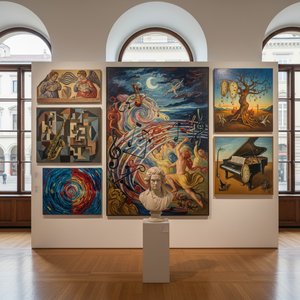
Harmonies on Canvas: Exploring the Visual Representation of Music in Art History
Explore the fascinating history of music's visual representation in art! From ancient symbolism to modern abstraction, discover how artists have captured sound and emotion on canvas. Expert insights & stunning examples.
Esplora le opere d'arte organizzate per temi, stili e caratteristiche.


