A Wild West Portrait: Charles Marion Russell's "Bucking Horse and Cowgirl"
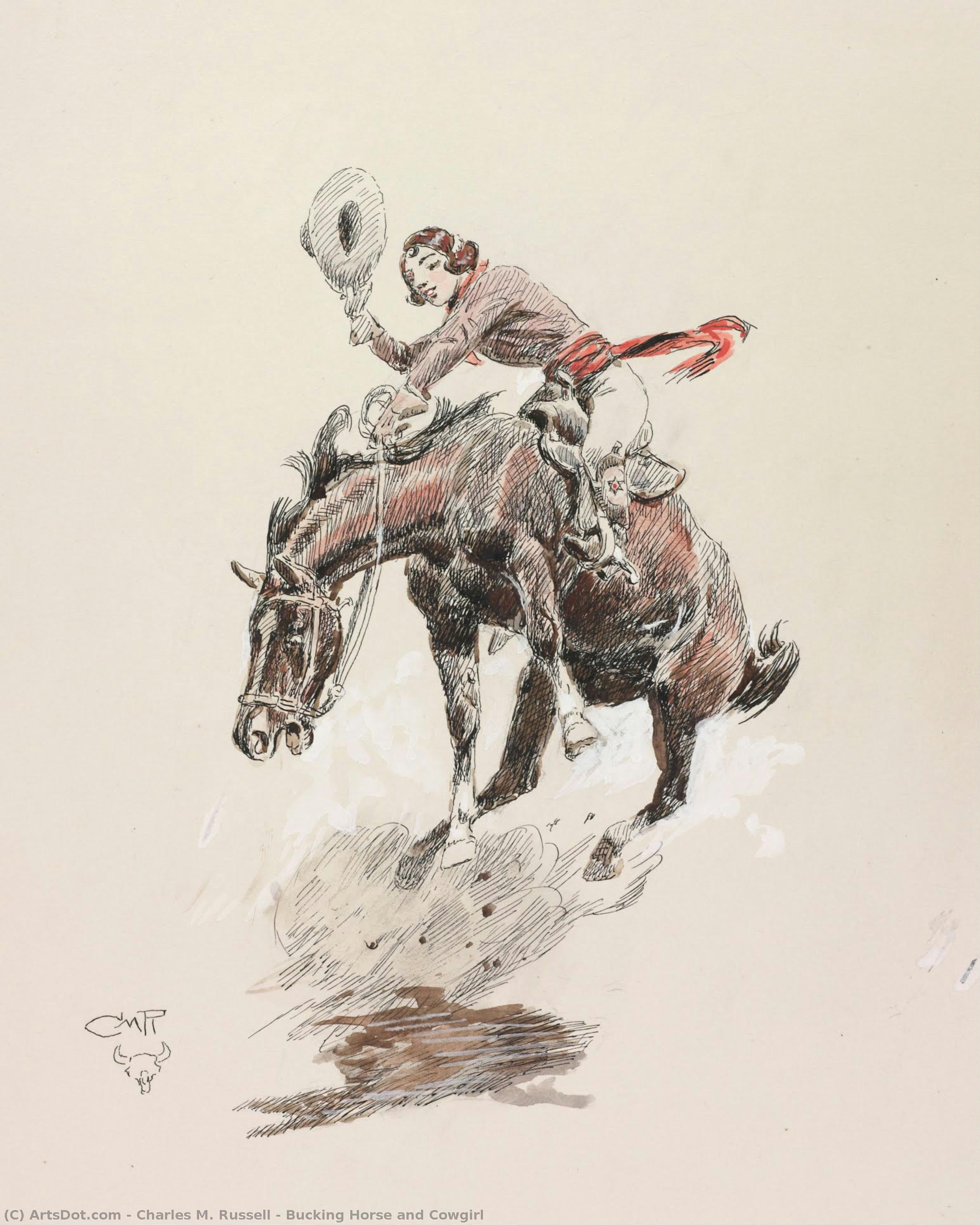
Charles Marion Russell’s “Bucking Horse and Cowgirl,” painted in 1925, isn’t merely a depiction of a cowboy and his steed; it’s a vibrant distillation of the American West—a realm of rugged individualism, untamed beauty, and the enduring partnership between man and animal. Born in St. Louis but forged by a life spent immersed in Montana's wilderness, Russell possessed an unparalleled understanding of this landscape and its inhabitants. This painting captures that essence with remarkable immediacy, transporting the viewer to a moment of thrilling action and profound connection.
The scene unfolds on a muted beige canvas—a deliberate choice that allows Russell’s masterful use of hatching and cross-hatching to take center stage. These meticulous lines aren't simply outlines; they build texture with astonishing detail, conveying the rough coat of the horse, the worn leather of the saddle, and the sturdy fabric of the cowboy’s clothing. The artist doesn’t shy away from portraying the physicality of these subjects—the powerful musculature of the animal straining against its bonds, the determined stance of the rider gripping the reins. It's a testament to Russell’s commitment to realism, tempered by an undeniable artistic sensibility.
The Cowboy and His Horse: A Symbol of Partnership
Russell’s work is deeply rooted in the mythology of the American West, and “Bucking Horse and Cowgirl” embodies this perfectly. The cowboy, a figure both stoic and intensely focused, represents the spirit of self-reliance and mastery over nature. He's not conquering the horse; he’s collaborating with it—a dynamic exchange built on mutual respect and understanding. The bucking horse itself is more than just an animal; it’s a symbol of freedom, wildness, and the untamed heart of the West. The painting speaks to a time when cowboys were essential figures in shaping the landscape and defining the American identity.
Interestingly, this particular scene draws upon a rich history within Wyoming. The image is closely tied to the state’s official symbol – the bucking bronco – which has been used on license plates since 1936, reflecting its enduring significance in the state's culture and identity. The painting’s popularity also stems from its association with the University of Wyoming athletic teams, who proudly adopt the image as their emblem.
Technique and Historical Context
Russell primarily employed a dry media technique—likely watercolor or ink—layered meticulously to achieve depth and texture. The flattened perspective, characteristic of illustrations from the late 19th century, lends the painting a slightly nostalgic quality, evoking a bygone era of frontier life. The use of light is particularly effective, casting dramatic shadows that emphasize the three-dimensionality of the figures and creating a sense of movement and energy. It’s a masterful demonstration of how Russell could capture both the grandeur and the grit of the West.
The painting's creation in 1925 also places it within a pivotal moment in American art history—a time when realism was gaining prominence alongside more impressionistic styles. Russell’s work stands as a powerful example of how artists could simultaneously embrace traditional techniques and infuse their subjects with personal vision and emotional depth. The painting is now housed at the Amon Carter Museum of American Art in Fort Worth, Texas, ensuring its legacy continues to inspire generations.
Bringing “Bucking Horse and Cowgirl” into Your Space
Reproductions of "Bucking Horse and Cowgirl" offer a beautiful way to bring the spirit of the American West into your home or office. Whether you choose a large-scale canvas print or a smaller framed piece, this iconic image will serve as a constant reminder of the courage, resilience, and enduring connection between humans and the natural world. It’s more than just a painting; it's a window into a captivating chapter in American history.


 Acquista stampa
 Invia
Invia Condividi
 Dettagli opera

 Scarica
 Simili
 Radiografia
 Slideshow


 Scopri di più






































 L'opzione vetro è disponibile solo per dimensioni inferiori a 110 cm




![[Cavallo bardato]](/media/artworks/images/thumbnails/a7/35/a735571cb0254499ac2cd16e581a87c6.jpg)



